
Monthly Musical Miscellany – August 2026

Bonjour mes amis,
What a scorching hot yet wonderful year it’s been so far. I’m not long back from a very exciting week of musical facilitation training in France, abuzz with new ideas and songs to share with you. I’ve rarely felt quite so motivated and inspired by the work I do, and genuinely can’t wait to get back to teaching.
I hope you've all managed, in equal measure, to make some sweet and pleasant sounds this summer, and to reconnect with yourselves — roll around in some grass, stare at some clouds, that sort of thing. Essential human maintenance.
I'll shortly be packing my bags again for a late-summer sojourn up to Leeds, but before I go, there's just enough time for another monthly musical postcard.
Nous voici!
New term incoming!
Sharpen your pencils, everyone.
Next term — Harvest — starts on Tuesday 1 September 2026.
For those of you on weekly or fortnightly lessons, reminders will start going out next week. There are no lessons on Monday 31 August, on account of it being a Bank Holiday.
Harvest is the longest term I run — a full eight weeks, from 1 September to 25 October. Half term follows, then a further six weeks into late autumn and early winter.
I'm still working through the schedule and the waiting list, so thank you for your patience. If you already know you can't make a lesson next term, do let me know as soon as you can, so I can offer the slot elsewhere.
Full studio term dates, as ever, live here: https://www.pianism.co.uk/studio-policy
Baianá by Barbatuques
This is something I’ve been meaning to do a Sunday Listen on, but now is as good a time as any.
Barbatuques are a Brazilian ensemble built entirely from the body: hands, chest, feet, thighs, voice. No instruments, in the conventional sense, just a room full of people treating themselves as percussion. The group was founded in São Paulo in the mid-1990s by Fernando Barba, a now incredibly beloved and influential musical figure in Brazil.
Baianá is one of their best-known pieces, built from a traditional song called "Mestra Terezinha", and it's since been sampled by several rather different corners of the music world. What I love about this and Barbatuques, in general, is how it straddles the intersection of samba, funk, and a much older lineage of body music that stretches back through Brazilian folk tradition — the idea that the body was always the first instrument, and everything since has just been an increasingly elaborate way of avoiding that fact. It's also, not coincidentally, deeply relevant to the Musica di Circle training I've been doing this summer: circle work leans hard on body percussion as a way in for people who'd otherwise freeze at the words "now sing something!"
Studio policy update on exams
I’ll write about this in greater length in another newsletter, but I’ve made the important decision that – from January 2027 – I will no longer be offering to teach any new pupils to take graded exams.
This decision is not a logistical one: I’m perfectly able and happy to guide students through a number of different exam board syllabi. However, I simply no longer align with the purpose or effectiveness of exams. In fact, I find them to be intrinsically detrimental, for both students and parents, to the enjoyment of music and the overall development of healthy and joyful musicality. They’re also increasingly unnecessary, with grades mattering less for career or higher education pathways than they used to, other forms of evidencing proficiency now taking their place.
I will, of course, continue to offer support to anyone currently on the exam path, or considering doing exams at a later stage.
Would Madam care for some more Yann Tiersen?
Part of my practice this summer has gone into building a few hour-long sets for a project next year, one of which is built around the music of Yann Tiersen — a composer I've mentioned before, and shared with quite a few of you in lessons.
While researching, I found a wonderful old clip from 1997: Tiersen, on French regional television, playing La Dispute on melodica and toy piano, in front of what looks very much like a mildly unimpressed dinner table of Parisian petite bourgeoisie. La Dispute would later appear on his 1998 album Le Phare, and eventually on the Amélie soundtrack, but here it's just him, a toy piano, and a melodica, years before any of that.
I love the sheer earnestness of this. There's no ego on display, no anxiety, no sense of a performance straining to be seen as important. It's naked and intimate in a way that only amateur-adjacent instruments seem to allow; a melodica cannot, by its nature, be pompous. It feels so incredibly naked and intimate, and hits the heart in places sheer bombast cannot reach. And before you've had the chance to be impressed, you are simply moved instead.
There’s also this lovely live performance of The Gutter, en plain air, as it so happens…
Marble Machine by Wintergatan
I'm still not entirely sure what this is — a sort of freak collision between a harpsichord and a Rube Goldberg machine — but I love it unreasonably.
The short story: Swedish musician Martin Molin visited the Speelklok Museum in the Netherlands, fell hard for mechanical instruments, and decided he'd build his own — a hand-cranked contraption using 2,000 marbles to trigger a vibraphone, bass, cymbal, and drum kit, all following a programmed wheel not unlike the mechanisms in old bell towers. He told friends he'd be done by Christmas. It took fourteen months, several complete rebuilds, and by his own account very nearly ate his life.
(Turns out, there's a whole online subculture of people who build marble machines for fun. Isn’t the internet fun when it’s not ruining your life?)
Rather charmingly, Molin's earlier band was formed after he heard Yann Tiersen's La Valse d'Amélie and decided he needed to make music like that immediately — so there's a strange, direct thread running from a French toy-piano waltz to a two-metre birch-plywood marble contraption in a Swedish garage.
Those of you who know me will already be well aware of my fondness for odd instruments, and for the basic idea that literally anything can be raw material for music, given sufficient patience and a lack of shame. The theremin, the musical saw, prepared piano, glass harmonicas, whole orchestras built from vegetables (yes, really) — there's a long, slightly mad tradition of people looking at an object that very obviously isn't an instrument and thinking: and yet.
Wonder by B O D I E S
One of my resolutions for the rest of the year is to share a wider variety of music on this channel, and it’s occurred to me that I hardly ever bring to the table some of the outstanding work being done in the choral and vocal improvisation world at the moment.
Singing is something I’ve taught a little, but I’ve always wanted to go deeper, and this summer I had the chance to work with a number of fantastic vocalists from all over Europe. The fact so much sound and so much resonance that be generated just from our hearts and lungs never fails to astonish me. For all our fancy instruments and contraptions, there’s nothing quite as utterly wild and throbbing as a human voice.
Hopeful reports on the death of Spotify
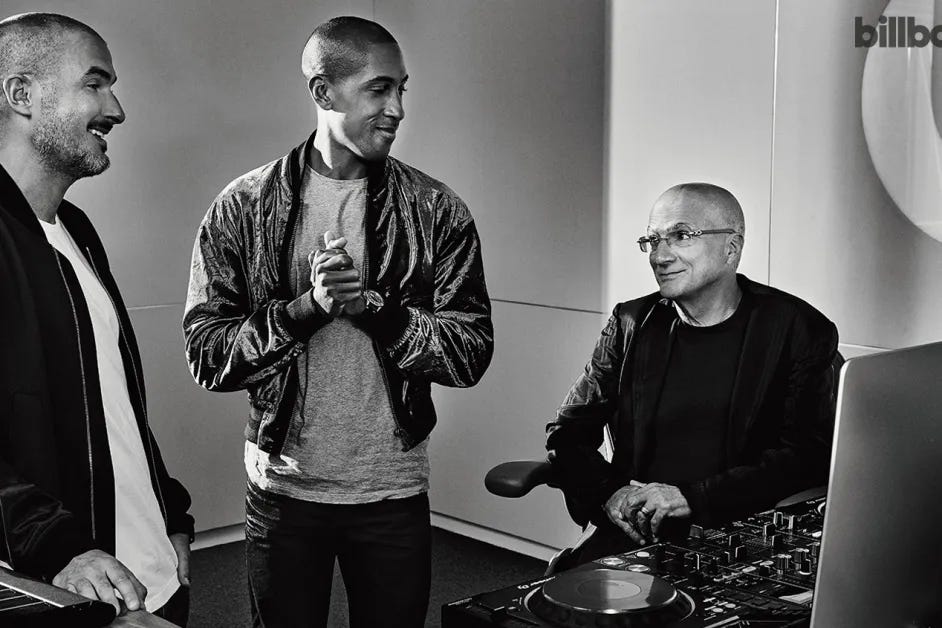
The Death of Spotify: Why Streaming is Minutes Away From Being Obsolete
Jimmy Iovine just called the Death of Spotify. He might be right.
Earlier this year, I left Spotify. So should you.
Music-industry veteran Jimmy Iovine — the man behind Interscope and Beats — has declared that streaming services are "minutes away from being obsolete." His argument, in short: labels used to own the entire chain, from artist to record player to the plastic in between, and now they own none of it. Every streaming platform offers essentially the same library, which means music has been quietly reduced to a utility indistinguishable from tap water or electricity, and like utilities they get squeezed on price and margin until something breaks. Thank you, capitalism.
Spotify's core economics basically mean it structurally cannot afford to help artists build a relationship with their own fans, because the platform's only real asset is your fans' attention, and it has no interest in you owning any of that data yourself.
If you want your money going to the music you actually love, rather than subsidising whoever's topping the charts that week, streaming was never really built to do that.
Her Name by As. 70
And to close, something I stumbled across in the same vocal-improvisation rabbit hole as the B O D I E S track above — a hushed, layered, filmic piece built almost entirely from voice and loop. Enjoy!
Happy practise and see you all soon,
Will