
Of Course You Realize, This Means (Class) War
In which I ponder the shameful quarter of Seattle voters who tried to defund the Seattle Public Library.
Hi!
Washington state had its primary earlier this month, and on the ballot was a proposition to fund roughly one-third of the Seattle Public Library’s budget for the next seven years.
The proposition would charge property owners 23 cents for every thousand dollars of assessed home value—less than $200 per year for the median household. In return, the 27 branches of the Seattle Public Library would be able to maintain their current hours of operation and staffing levels, SPL would be able to buy more materials for patrons, and the library would be able to expand its programming—including educational programs for children.
Because this is Seattle, Prop 1 easily passed, with just above 75% of the vote. The good guys won! And it wasn’t even close! Hooray! Libraries for all!
In the days since the election, though, I keep coming back to Jason Weill’s excellent visualization of which parts of the city voted overwhelmingly against the proposition.

That sea of deep green you see represents all the voting precincts that voted to fund the library. That’s what a 75% electoral victory looks like.
But it’s those small orange swatches that I keep thinking about. Those are some of the richest enclaves in the city—gated communities and coastal neighborhoods that also traditionally come out in force to combat public transit and the construction of more housing. One of those light orange neighborhoods actually prevented the local children’s hospital from helicoptering certain sick kids directly to the hospital for decades because they didn’t like the noise, until the whole city recently rose up in disgust and forced them to end the prohibition.
When I started blogging decades ago, every time I’d write something negative about rich people, people in the comments would accuse me of engaging in “class warfare.” They would accuse me of jealousy and suggest that I was attacking the wealthy with my opinion that they should pay as much in taxes as they used to in the 1950s.
I’ve been thinking about those commenters a lot, lately, because that map up there? That’s what class war really looks like. Public libraries are available to everyone, regardless of how much or how little personal wealth they possess. They are a shared resource. We all put in a little bit, and we all can reap the outsized rewards of our communal investment.
According to Zillow, the average house price in the Broadmoor neighborhood is $3,091,432. According to my janky-ass math skills, the owner of that average home would pay $711.03 per year in taxes toward funding Seattle Public Library—not pocket change, but not a significant expense for someone living in a three-million-dollar home, either. They’re likely to pay almost that much for a couple weeks of a housecleaning service.
We need to reorganize our thinking about civic responsibility. For far too long, the status quo has maligned anyone who dares to suggest that wealth carries any responsibility to society, when in fact shirking that responsibility is the truly abhorrent act.
It is not radical to ask people to pay property taxes that invest in services that benefit the community. But it is radical to say that you would prefer to throw an essential service for hundreds of thousands of families into a catastrophic budget crisis because you’d prefer not to cough up what amounts to a rounding error on your federal taxes.
This strikes me as especially disgusting because libraries are accessible to all. Those wealthy households are just as welcome to enjoy the library’s many services as any other household in the city. But because they can readily afford any book they desire—or pay for any tutoring service or tax preparation service that the library provides for free—they feel they shouldn’t be burdened with footing a share of the bill for anyone else. At a time when the media is fretting over whether New York City’s popular mayor is promoting policies that are too “radical” for ordinary Americans, we need to acknowledge that shunning your responsibility to your neighbors is the true radical stance.
I’ve Been Writing
I have two new pieces up at the Seattle Times:
First is an interview with the novelist Ed Park about his fascinating new memoir, Three Tenses, which he wrote a decade before his first published book and which he re-typed by hand during the pandemic. Park is such an honest and intelligent interviewee that our conversation—about the passage of time, the rediscovery of lost work, and the span of a writer’s career—was bracing the whole way through.

And second is a profile of a bookstore up in Edison, just north of Mount Vernon. It’s called Book Shucker, and it’s one of the prettiest new bookstores I’ve seen in a long time. Based out of a former one-room schoolhouse (where Edward R. Murrow went to school and played basketball,) it’s intended to be a gathering space for the Edison community. I can’t recommend this store enough if you happen to be on your way north on I5 to Vancouver or Bellingham.
I’ve Been Reading
I liked The Buffalo Hunter Hunter, but a blurb on the book’s front cover nearly destroyed my enjoyment.
Paul Tremblay’s Dead but Dreaming of Electric Sheep is a fascinating sci-fi novel about a gamer who’s hired to pilot a braindead body on a couple of flights. It’s an ambitious, entertaining, and perhaps needlessly complicated book.
And I read Catherine Newman’s beach read Sandwich thinking the whole time that the protagonist had a drinking problem that was going to be important to the plot. But it turns out that people in this novel just really, really like to drink?
A Big Twist in the Second Act
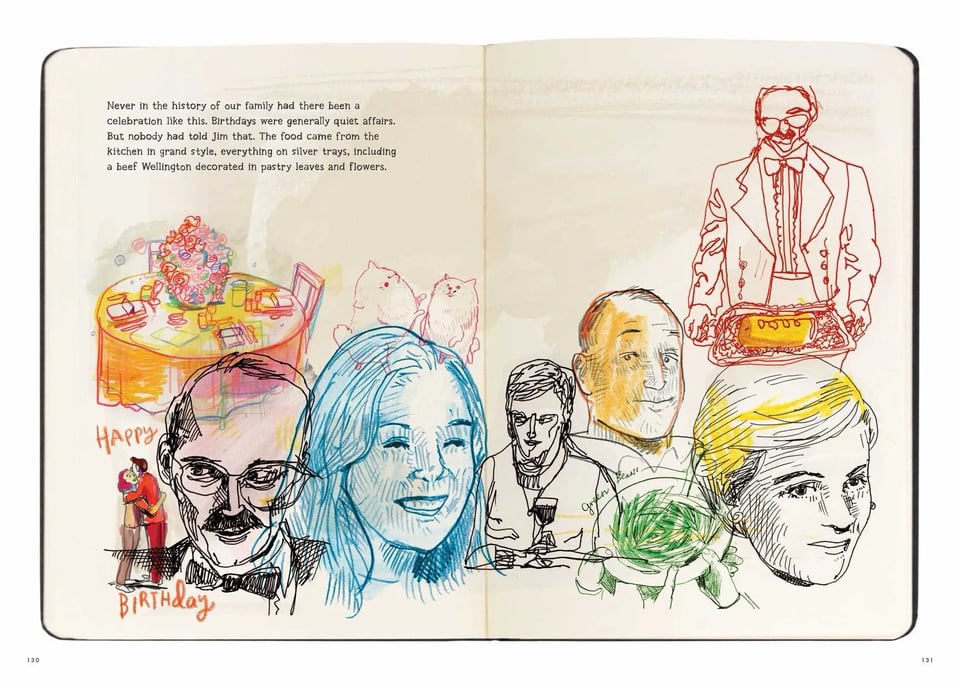
When I was reading Emil Wilson’s debut graphic memoir, The Nightingales, I kept wondering about Wilson’s experience as a cartoonist. I ultimately finished the book with two assumptions, either of which could be equally true: Either Emil Wilson was a voracious reader of comics and graphic novels and had a mile-deep understanding of the history of the medium, or Emil Wilson had never read a graphic novel before in his life.
I say this because The Nightingales violates multiple rules of the comics medium—especially the forms of American comics. Rather than boxing actions out sequentially in a series of panels, Wilson presents the story in a series of sketchbook pages. And while actions are the propulsive energy in most of the comics we read, the emotions are the verb that pull our eyes across the page in the Nightingales.
There’s one page early in the book when our protagonist meets a new houseguest, and Wilson portrays their faces as a jumble of rough sketches spread across the page, layered on top of each other with no panels to get in the way. The characters make eye contact and look away. They eye each other skeptically and they smirk before smiling warmly at each other and then shyly averting their eyes. I’d never seen such a nuanced, wordless encounter portrayed so honestly and so clearly on a comics page.
Wilson, I decided, was either someone who deeply understood all the rules of comics and chose to break them in an inventive way, or he was someone who never became accustomed to the rules of comics—and so wasn’t imprisoned by that knowledge.
Earlier this month, I interviewed Wilson onstage at the Elliott Bay Book Company and the first thing I asked him was his experience with cartooning and comics. His answer was clarifying: “None,” he said immediately. Aside from thumbing through a couple of Peanuts paperbacks in an extended family member’s bathroom, Wilson had never felt drawn to the medium at all.
So how did Wilson wind up deciding to tell a deeply personal story in the form of comics? After a career in advertising, Wilson gathered with some friends of roughly the same age to contemplate turning fifty and the loss of someone in their friend group. He decided that he wanted to take his skills with words and pictures that he had learned in advertising and turn it into a different kind of storytelling career.
So Wilson got into the Center for Cartoon Studies in Vermont and took a crash course in comics. (During our talk, he bragged that he was the second-oldest enrollee the institution ever accepted.) Eventually, he decided to adapt a family story into comics form. And I call it a memoir, but Wilson actually writes himself out of the book within the first ten pages—the story is told by and stars Wilson’s sister, Lou.
Talking with Wilson was an illuminating and inspiring experience. It’s the only author interview I’ve ever done that made me want to immediately open the book and read it all over again, armed with the understanding I’d just gained.
One of my big complaints about modern comics is that some of the biggest and most popular creators are only familiar with comics. It’s hard to picture some of the most popular graphic novelists of our time reading a prose novel, or attending a play and absorbing lessons from the experience that they then incorporate into their work. The field has gotten incestuous in a dangerous way.
Wilson’s total lack of familiarity with the medium has paid off for all of us. The Nightingales is a touching, tender, and inventive graphic memoir that’s unlike anything else I’ve read. I’m so glad Wilson upended his life and launched into this bold second act.
Due to summer shenanigans, there may or may not be an August 30th edition of this newsletter, so the next time I see you might be September 15th. I’m not sure yet. Either way, I hope the downward slope of your summer is gentle and forgiving.
Paul
