
Fear of a Blackberry
In which seeing a berry practically sends me into a panic attack.
Hi!
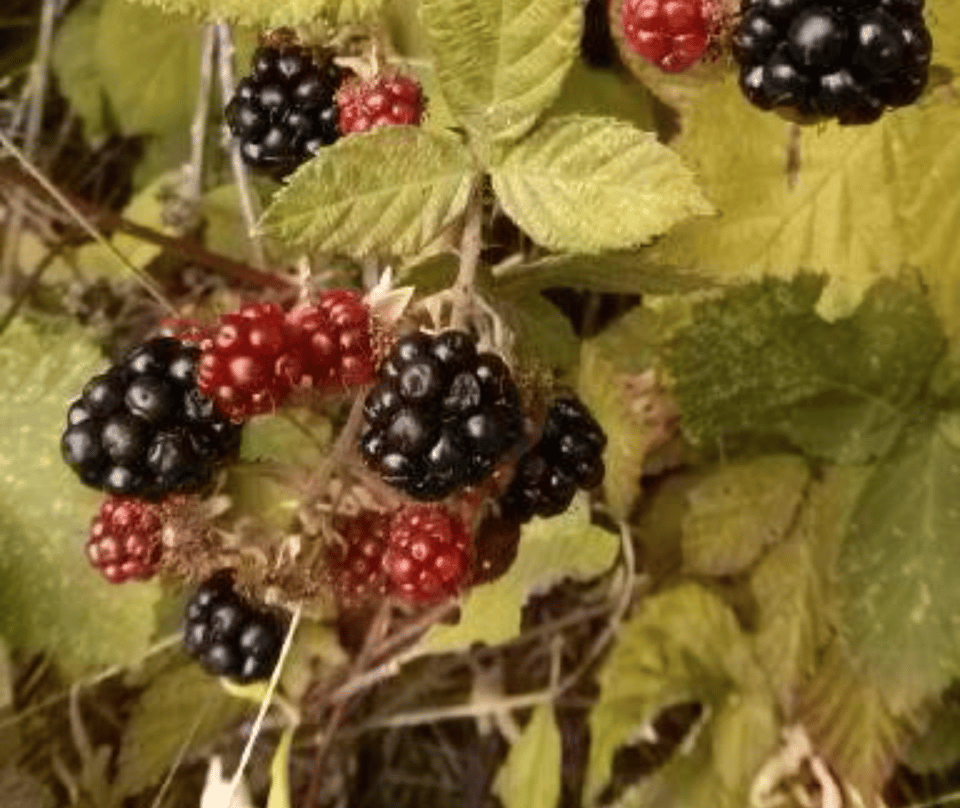
It’s blackberry season yet again in the Pacific Northwest. The blooms have passed their peaks, but the green leaves and branches are still fanning out to soak up the plentiful sunlight. All along the trails I walk every day, thorny bushes are thriving and the blackberries are growing fat and dark.
If you’ve ever bought blackberries from the grocery store, you should be legally allowed to sue for damages. Those tiny styrofoam beads bear no relationship to a real blackberry plucked straight from the bush, sweet and tangy and juicier than a bottle of wine.
Picking wild blackberries is a summer pleasure, but it always takes me a while to indulge. I resist the first few tempting clusters because the appearance of blackberries in Seattle also means that fall is right around the corner. That first taste of blackberry arrives in tandem with the smell of dried leaves.
Please bear in mind that I say all this as a certified Autumn Boy. Fall is my favorite season. But the end of summer sets off an existential fear that feels like it comes from a part of me that is older than my own brain.
There are two German words that most clearly describe my feelings about the season of blackberries. The first is wehmut, which when directly translated means “woe” (that’s the weh) and “mood” (and mut.) But according to some potentially specious online sources, wehmut more accurately describes a fond memory or a moment of joy that triggers a feeling of wistfulness or melancholy knowing that the moment is fleeting. It’s joy cloaked in the sadness of impermanence, or sadness inspired by the impermanence of joy.
The other word is herbstmelancholie, which is a gorgeous word for that feeling when summer inevitably begins to turn the corner into fall.
I was talking about this feeling a long time ago when a former coworker of mine from the Elliott Bay Book Company, the writer Elizabeth Ames, quoted a line from the Robert Hass poem “Meditation at Lagunitas” to me: “a word is elegy to what it signifies.” The arrival of the best berry of the summer also signifies the end of summer.
I had forgotten until I looked the poem up just now that the line previous to that one was “because there is in this world no one thing/to which the bramble of blackberry corresponds,” (the emphasis is Hass’s, not mine.) Clearly, Hass and I are barking up the same thorny bush.
And the last lines of that poem are perhaps the best solution to this dilemma of fearing the portent of the end even more than the end itself:
There are moments when the body is as numinous
as words, days that are the good flesh continuing.
Such tenderness, those afternoons and evenings,
saying blackberry, blackberry, blackberry.
I’ve Been Writing
I wrote this week’s edition of The Pitch, the weekly economics newsletter that is normally written by my boss Zach Silk. I took the opportunity to write about NYC Mayor Zohran Mamdani’s proposal to build five city-owned grocery stores that will sell certain staple foods for 30% less than other grocery chains.
In the Seattle Times, I wrote about the most interesting new paperbacks that will be released in August.
On my blog, I wrote a couple of pieces about notable new books by Seattle-area cartoonists. First is a beautifully hand-printed collection of koan-like Covid-era diary comics by Joe Alterio, It’s Never Easy. And second is a collection of three short comics called Front End Loader by local comedian and cartoonist Brett Hamil. These two books couldn’t be any more different, but they’re both better than the majority of comics I’ve read from the major publishers this summer. Please check them out.
I’ve Been Reading
[Because I’ve started to write longer pieces about books on my blog, I’m shortening the individual reviews in this section and including links to the longer pieces in each blurb. Let me know if you have an opinion either way.]
Ben Fountain’s novel Rasputin Swims the Potomac is about the Trump administration. Many of the names of principals including Elon Musk are tossed into the narrative unchanged, but Trump himself is presented in the prose with a censor bar (“*****,” or “bleep” in the audio version) in place of his name. But his loping cadence and psychological hangups are clearly, unmistakably Trump, so the name gimmick feels too cute by half. The premise of the book is that Trump becomes intertwined with a professional wrestler who is mentioned as a VP pick or perhaps a potential opponent for Trump’s fourth presidential campaign for his third term. And I guess the joke is that only a professional wrestler can beat Trump at his own game? Except the wrestler also believes he’s a reincarnation of Rasputin and he talks in a Russian accent. And there’s a former country star in there, and a Black reporter named Clarence Thomas (no relation,) and some other stuff. But it just kind of thrashes around for a while until it finally ends in the middle of nowhere, and it ultimately feels so impotent and pissy.
I’m glad I finally read Wallace Stegner’s novel The Big Rock Candy Mountain, but it is by no means an easy or enjoyable reading experience. In fact, it is 500+ pages of beautifully composed misery porn, telling the story of an American family on the edges of society in the dawn of the 20th century. The husband is an abusive loser who keeps coming up with and abandoning get-rich-quick schemes, and his family helplessly orbits around him as he travels from North Dakota to Saskatchewan to Utah, leaving nothing but heartbreak in his wake. I learned near the end of the book that it is loosely based on Stegner’s own life and childhood, and that made me appreciate it more. As an act of processing the misery that he experienced, writing Big Rock Candy Mountain must have been a consequential experience. But it’s not the first Stegner book I would recommend to anyone—Angle of Repose or Crossing to Safety are both better recommendations. But if you’re looking for an American saga full of desperation and hope and heartbreak, you’re in the hands of a master with this one.
I did not like comic artist Frank Miller’s new memoir Push the Wall.
And I enjoyed Seattle author Shen Tao’s debut novel The Poet Empress more than I typically like fantasy novels, though it lost steam for me as it pushed toward its conclusion.
Ugh, reading Regime Change was a mistake.
Is This My Song of the Summer?
When it comes to my taste in music, novelty is important. I can’t listen to the same 500 classic rock songs every single day. I like to hear new sounds, track new trends, find new artists.
Every month, I start a new playlist. Then, every time I hear a new song that I like, I add it to the playlist. They usually wind up being a couple of albums long. I thought I would start sharing those playlists, in case anyone else is looking for new and interesting songs.
But first, a couple of caveats: These songs are dumped into the playlist in strict chronological order in terms of when I discover them. That is to say, I have not arranged them into a mix and the transitions are not maximized for pleasant listening. In fact, the song-to-song shifts are often a little jarring. And I only add songs that are new to me, which means they’re not all brand-new music.
I don’t claim to be a musical expert. I like short, catchy, poppy songs and since I’ve started this exercise I’ve learned that I’m more likely to love a song if it features swearing. So don’t play the playlist with the kids in the car, okay?
I prefer Apple Music, so that’s what I’ve got to share. If you use another streaming service and you use Apple devices, I can’t recommend the app Playlisty enough. For a one-time fee, you can easily transport playlists from one streaming service to another. I use it all the time.
Anyway, July’s playlist opens with a Carly Rae Jepsen single from her upcoming album that I’m incredibly excited about. It’s not summery—it’s more of a blackberry than a blueberry if you catch my drift—but it’s fun and a little loopy.
There’s more country on this list than usual. I love the new Andrew Sa album American Rough, which will never get plays on mainstream country radio because it is one thousand percent gay.
I actually first encountered my most-listened song this month in the form of a music video. It’s by the rapper Prof, and the song is called “Kia Boy.” It’s probably too dumb for some of you, but I think this thing is maybe my song of the summer, in large part because of Prof’s charismatic oddball performance in the video:
That’s all for this month. I’ll see you in the middle of August. Let’s hope the smoke season is kinder to Seattle than it has been to the rest of the world this year.
Paul
