
#2: Seasons of the Starship
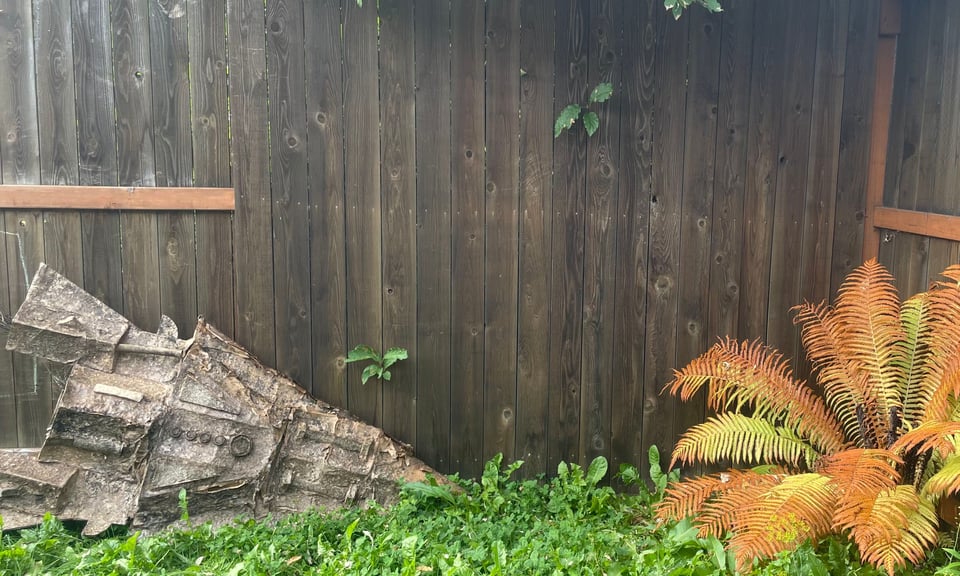
In my small yard in Anchorage, there is still plenty of green, but things are changing. White, wispy seed fluff floats through the air, along with yellowed leaves released from nearby trees. My potted vegetables have all but stopped growing. The ferns display a new shade of orange each day, heading toward rusty, toward brown, to what will be almost black by the end. Also moving in the inevitable direction of decay: an abandoned spaceship.
The spaceship—or, Starship, as I have called it—did not come from elsewhere as its name might suggest. Made of plants, cardboard, paper, flour paste, and wood, it is undeniably terrestrial. Its namesake stars are not those up in the endless expanse above, but the ubiquitous earthbound variety: dandelions, daisies, asters, sunflowers, yarrow, chamomile, wormwood, and so many more1. Each flower a little star. Each flower in fact not one flower, but a burst of many.
When it was first completed, the Starship’s exterior was a more vibrant, leafy hue, with yellowish accents of handmade flower paper. It smelled strongly of earth and green growth, which, for some reason I had not anticipated. It was a satisfying surprise to see people sidling up close to sniff something I had made, opposed to just looking.

Though its first flight took place in a white-walled gallery, illuminated by track lighting, the Starship spent its final months outdoors, under the moon and sun and all the other stars. It hung from a nail in the fence, prow pointing skyward, dried yarrow blasting toward earth, until a strong summer wind blew it free and gravity brought it down. I have left it there, on the ground, for the past month or so, where the microbes and small critters have easier access to it.
Some part of me always planned to send the sculpture to live outside, not to make any particular statement about art materials or the lifespans of objects, but to see what would happen, and to feel how it would feel. Even so, it was not easy to let it go, to let it rot. Like most people, I default toward the idea that artwork should not be treated like compost. After all, I spent quite a few days of my life creating the thing: cutting and shaping the cardboard, sticking it all together with starchy strips of wet paper, gathering plant material, breaking down the fibers, spreading pulp over the sculpture’s form like green stucco, and choreographing fans to manage drying. I brought it into existence. And now, there in the wet grass it lies, that decomposing artifact of my precious time and energy.

I took the sculpture out to the yard once in the deep snow, and then again in the Spring, but each time I ended up bringing it back into the house, motivated by an incomplete desire to preserve my creation. The kids also reprimanded me about leaving it outside (they are still firmly of the mind that everything should be saved, though they cannot tell me where it should all go). I made some half-hearted attempts to repair the cracks it had suffered from temperature and humidity changes. But then, finally, when the dandelions were in full bloom, the yard a galaxy of small suns, I put it out for the last time.
Exposed to the elements, the Starship began to change. It soaked up the rain, then dried in the long hours of sun. It softened and lightened. The sharp corners rounded; the rigid shapes collapsed. Gradually the surfaces transformed, peeling and swelling and bubbling like infected skin. It passed the point of return, the point at which the possibility of restoring it was gone, and the point at which even the kids stopped telling me to bring it back inside.
And then it crashed.

One year ago, the Starship was still a bare cardboard form atop my kitchen table. It was still partly a fantasy. I had no idea how it would hold up, how it would look, how it would be perceived by others. At one point, fearing that it was too late in the season to gather enough material, I almost gave up the idea of dandelions and coated it with plaster instead (that would not have smelled nearly as good). Over the past months, I have watched the sculpture travel in place. I have observed it moving through what would normally be considered two separate processes: creation and destruction, or integration and disintegration, or composition and decomposition. But, looking back, I struggle to identify the exact moment at which it was complete, when it was neither being made or being unmade. Was there such a time? Is there ever, for anything?
1All plants of the Asteraceae family (aster = star)