
Whats in store?
Examining the future of software as infrastructure platforms for autonomous agents and the role of AI in organizational challenges and supply chain decisions.
Thinking of the year ahead
(All opinions that you read here are from yours truly and don’t represent that of my employer)
In the previous post I wrote about how AI dominated mindshare and then over the last week I read bunch of interesting posts talking about the progress so far and what will unfold in the year ahead. So, I decided to sit with it and write my two cents on how it might unfold in our domain.
Tina He writes in her Fakepixel’s newsletter on her 2026 Open Inquiries.
This year’s questions circle a single transformation: software is becoming infrastructure. The apps and dashboards we built for human eyes are giving way to systems designed for machines talking to machines, with humans hovering at the edges, deciding, permitting, revoking, and of course, curating. The interface isn’t disappearing. It’s just no longer where most of the action is.
There is a shift in building software, it now incorporates building for agents that are built around it or interact with it.
Tina also discusses about taste and how intdustrilisation of taste is potentially possible
Turns out discernment can be mass-produced. Generate hundreds of candidates, filter through learned reward models, iterate until output matches stated goal. Research on preference optimizationexplodes with mid-training techniques, post-training strategies, automated evaluation frameworks. …. Aesthetic monoculture becomes plausible. When evaluators converge on similar proxies—coherence, novelty, “vibes”—outputs homogenize across domains. Some fields resist this. Law, therapy, strategy: domains where “good” is irreducibly contextual, where the relationship between practitioner and client matters as much as the output.
Benn Stancil writes about using a chat box for solving organisational challenges in a funny but totally plausible approach.
He writes about decision traces which act as context graphs for LLMs. The tension he is getting to is captured in the following passage.
We want to organize information the way we organize it in our head; we want to solve problems the way we reason through them ourselves. We know this might not work, but we cannot help ourselves: My domain is the exception; my problem is the one that is too entangled for a simple solution, like a bunch of text boxes, for people to write down why they did something.
But if two companies handed their decision-making over to ChatGPT, which one would you bet on? The one that attempted to map every email, Slack message, and database entity into a complex ontological simulacrum and a “semantic mesh,” or the one that figured out how to collect a giant folder full of transcribed voice notes of people describing why they did everything they did? Which one would you trust more: Our ability to model how 1,000 people collectively think, or a state-of-the-art AI, looking for patterns in a large corpus of unstructured text?
What would you do? Try to put it in a chat-box or spend time because some consultant advices you to build an ontology with your data.
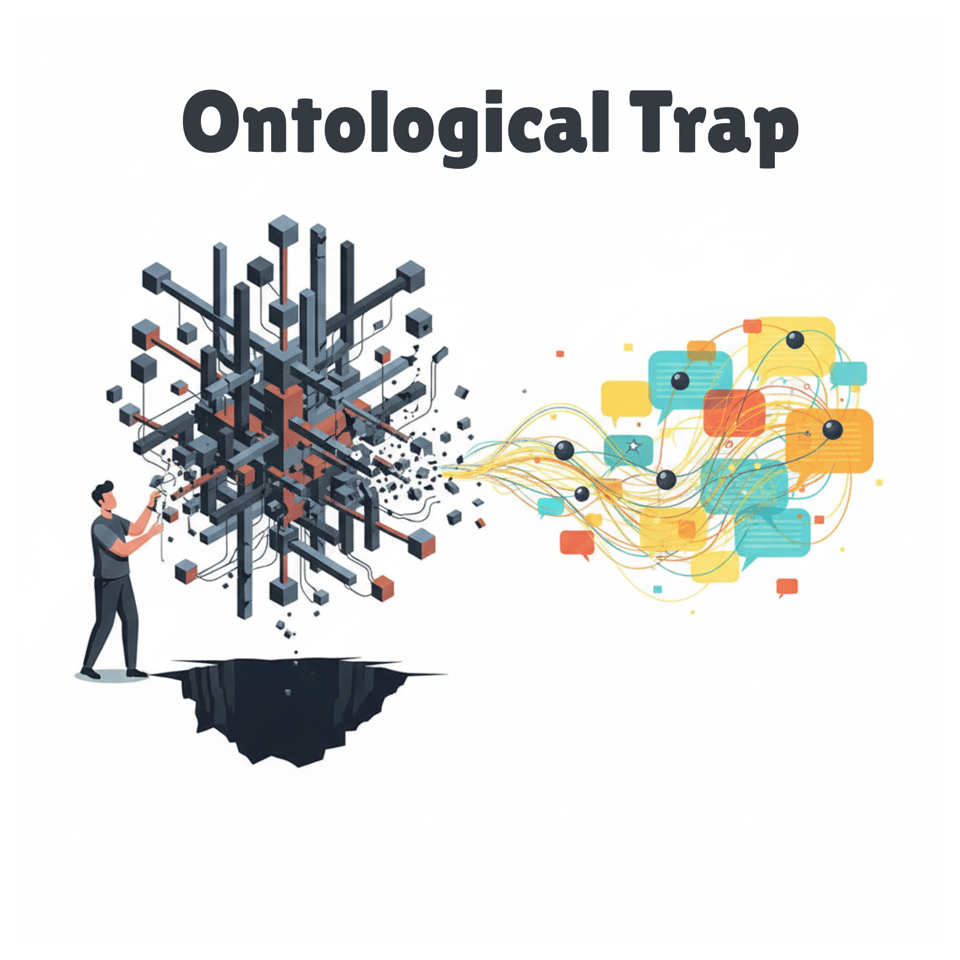
Going back to the definition of agent, it needs to execute a task autonomously. Yet over here we are talking about more primitive set of activities.
What are the tasks that we should execute in the first place? Why are they the ones we should select? What discerns them to be good when executed? How do all of these tasks help us show value to our customers?
Going more concrete, if I am in the supply chain division for a company. I should spend time talking to all the people in the supply chain about what is their work and how they make decisions, extracting the tacit knowledge. Once I record and transcribe these conversations, I put it a chatbox and define the emergent set of tasks we would perform.
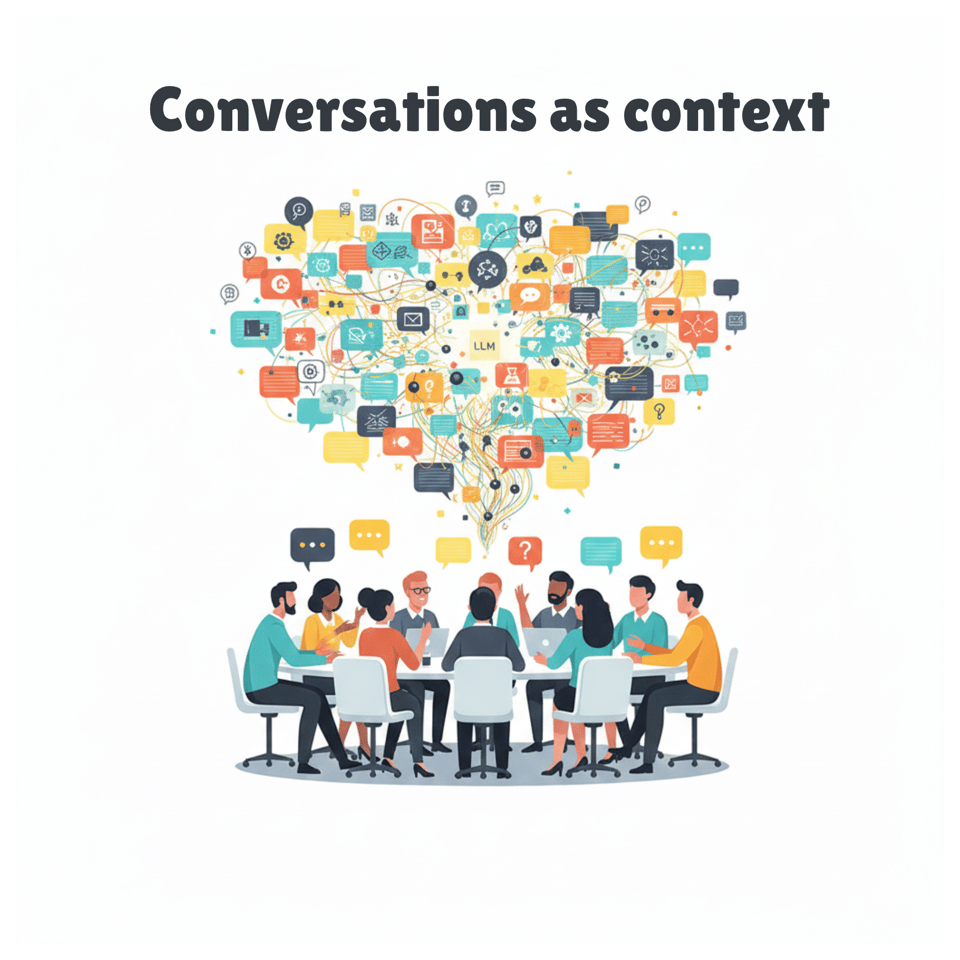
The challenge is then building a platform for agents which can make sense of this context graph and do the task on the software that was designed for this job to be done. Be it in supply chain planning, procurement or control tower.
For this to happen, we need to see what Tina He predicted unfold. We need to turn the software from jobs to be done tools to infrastructure platforms where agents can execute jobs.
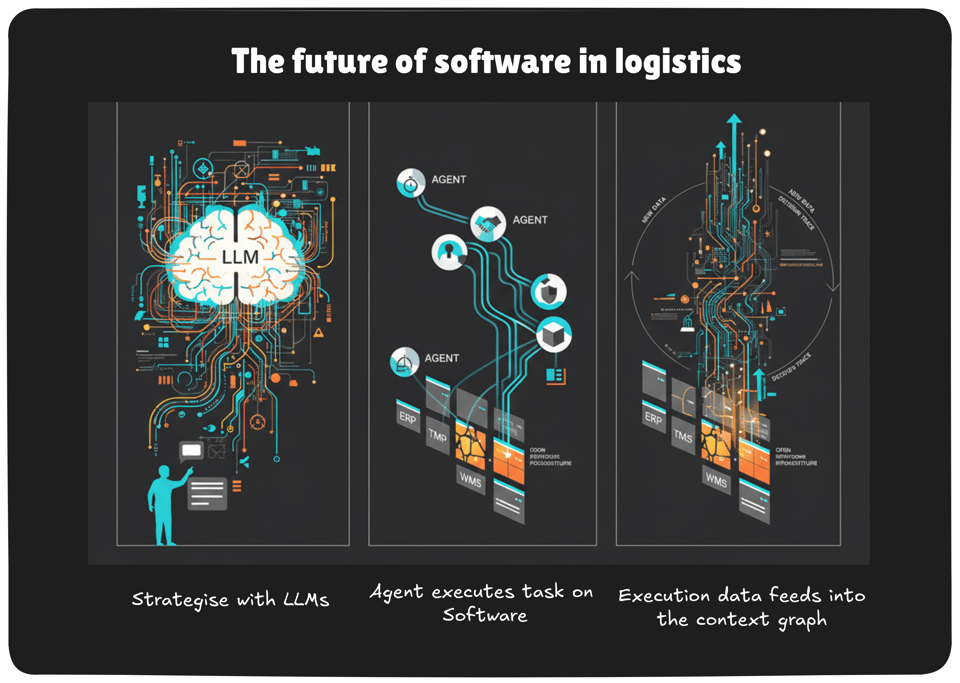
The future that I envision in my beat is that practitioners can strategise with the help of an LLM that can fetch the context of the organisation and history of decisions. Once the strategy is defined, the right outcome is achieved with consecutive experimentation executed by agents on the software platforms. The execution itself generates a set of data that feeds back to the context and decision traces.
A future based on experimentation in the real word, the real alpha that companies can build on to make their work more meaningful.
(All the illustrations were generated using Gemini’s Nano Banana model)
Round up
Last month of the year, I went to a AI roundtable conference at MIT Centre for Transportation and Logistics.
The people attending were curated and many of them had attempted to deploy agents.
Procurement and exception handling sprung out to be two areas where the maximum experimentation is going on.
The takeaway I had from a bunch of conversations is the need for a platform that would enable them to do more experiments. Right now, everyone is either focused on replacing workflows or build parallel ones with a human in the loop. Rather than demanding the platform that would enable what I just laid out in the previous section.
Thats the opportunity software companies in this domain need to supply for customers. There is a role for finding clean data of execution of their jobs but every data point need not be structured. Maybe just putting in a chat-box will suffice. Interestingly, many of participants validated that in those conversations as they used foundation model to do their jobs.
I like Vaugh Tan’s framing of building Boring tools that captures the sentiment I am trying to visualise here. Here is the summary of the post;
tl;dr: This essay is about Boring Tiny Tools—why they’re the way forward for digital transformation. Generative AI coding tools now enable high-utility, highly customised, but narrowly scoped software … but only with a fundamentally different approach to product development that uses meaning making to identify problems solvable with off-the-shelf components.
Links that resonated
Its end of a year and start of a new which happens to be perfect storm for excellent writing that recaps what happened.
Paras Chopra designed his life for happiness and he recaps how his year went. I am so happy to see someone who built his life figuring his way by being self aware and also public about it.
It captures a person deep in the weeds of AI and progress he witnessed over the year. It’s a personal reflection and very long, but stick with it. Lastly, its a love letter to London.
Sign off
Happy New Year and hope you have a wonderful year in front of you. I set some goals and milestones this year for the first time. One of them was writing more regularly over here to you and essays on my dormant personal site.
I think it is essential to write for keeping sanity as I step into a more isolated role at work. I am further removed from any one particular team. And writing will be my main way to influence agents that are working alongside me. My personal preference is to write a note first and then remix it with a chat box over writing a long prompt in the chat box. Makes the written input more permanent.
As the scope of agents and their implementation unfolds, I am reminded more of my earlier writing and how they are much more relevant to make sense of the products that one could develop on an agentic platform.
Singing off till next time,
Vivek, indulging in some reading finally.

