
Innovation in a large organisation
"Exploring innovation types across growth horizons, AI adoption in portfolios, and personal growth in my career journey."
Growth Horizon with 4 types of innovation
I only did 2 jobs across 2 different organisations since moving on. I am furthest away from the environment I worked in during the startup days. I work in one of the segments of a large organisation that is focusing on product innovation in a logistics for enterprises across the globe.
The dynamics at play are multi-fold. The factors to consider to make a customer facing innovation and then taking it to market is complicated process. You are no longer dealing with single product, instead there is portfolio management at play.
The better representation of portfolio management is referencing this McKinsey article on growth horizons.
Horizon one represents those core businesses most readily identified with the company name and those that provide the greatest profits and cash flow. Here the focus is on improving performance to maximize the remaining value. Horizon two encompasses emerging opportunities, including rising entrepreneurial ventures likely to generate substantial profits in the future but that could require considerable investment. Horizon three contains ideas for profitable growth down the road—for instance, small ventures such as research projects, pilot programs, or minority stakes in new businesses
A product mindset newsletter came up with useful annotations on the horizons to communicate the message.
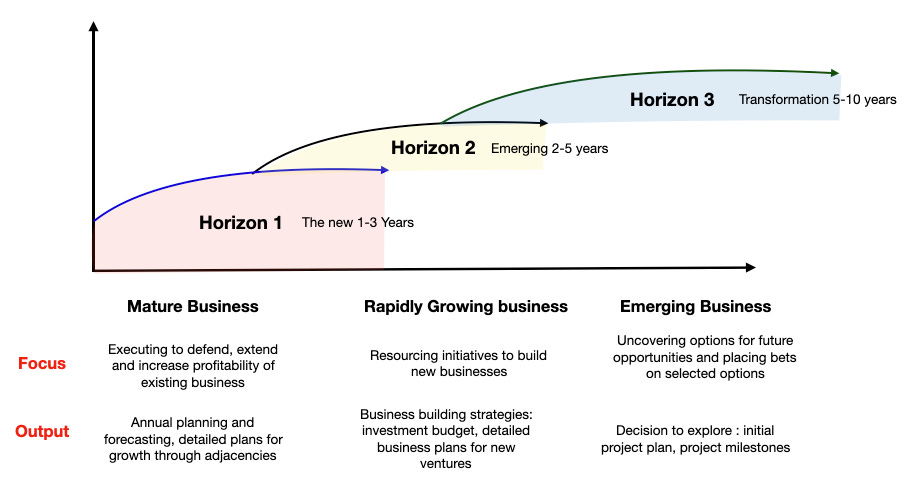
While this framework provides a map around classifying the products and their growth stages, it doesn’t provide you the type of innovation that is required on a regular basis to sustain the growth across the horizons.
I found this illustration from Vaugh Tan from his book “The uncertainty mindset” to be phenomenal in capturing the diversity of innovation a large organisation undertakes simultaneously.
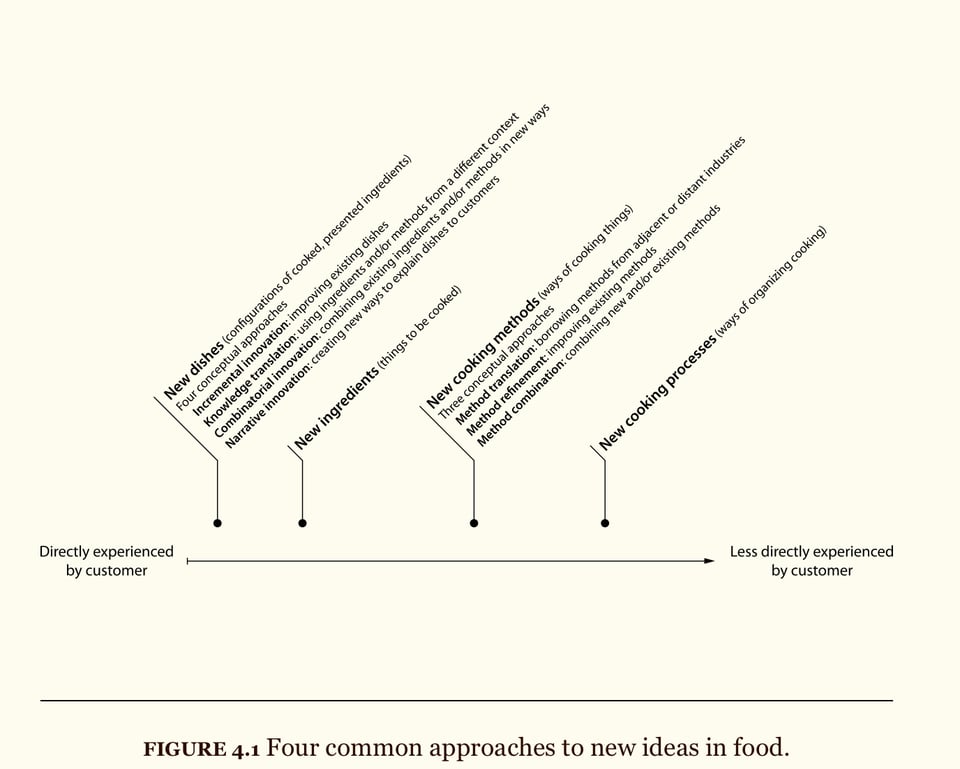
This passage attached to the illustration is even more pertinent in capturing the sentiment of the innovation that unfolds within a large organisation.
A radically new dish is rare when so much cooking builds on deep bases of ingredients, methods, and history. For high-end cuisine today, new dishes can be made using four broad strategies: improving existing methods (incremental innovation), applying methods or ingredients from a different context (knowledge translation), combining existing methods and ingredients in new ways (combinatorial innovation), or by creating a new way to explain the dish to the customer (narrative innovation).
This set of innovation show up in Horizon 3, transformative products. I have rarely seen narrative innovation though. You could bracket products relabelling their assets to the latest trend as a crude example of narrative innovation. It is extremely hard because of its cross functional nature, its not just go to market that need to change this approach.
New Ingredients in the software space comes from technology shifts taking shape. This makes us revisit all our existing workflows and come up with new cooking methods when combined in a different way. And by addressing the workflows in a new way we land in one of the 3 listed innovations in methods - translation, refinement and combination. These sorts of innovation you see in the Horizon 2 type of Growing products. Products that have product market fit and require innovation to make it grow.
The farthest away from customers is New Cooking process - a way to organise things. This innovation doesn’t have any implications to the customer but it may fundamentally change how the product is developed similar to how it is cooked. I believe these innovations fall into the Horizon 1 category where the entire product economics can be revisited.
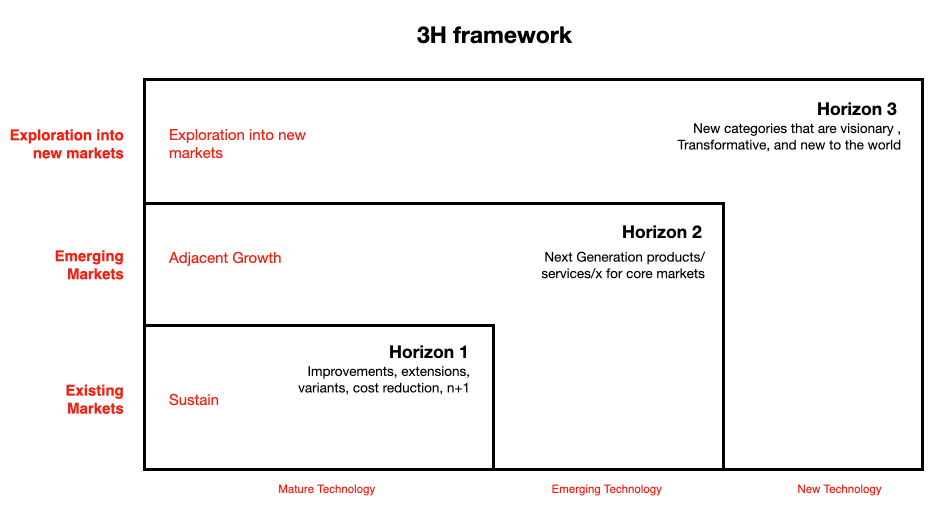
When a technology shift like AI takes place, innovations are across the stack. Customer expect AI features like non GUI interactions, AI is being used to develop new functions like autonomous task execution, AI is being used to code software and AI is used to develop product overall.
Different parts of AI innovation are adept at different horizons. This illustration captures where I think they would play out.
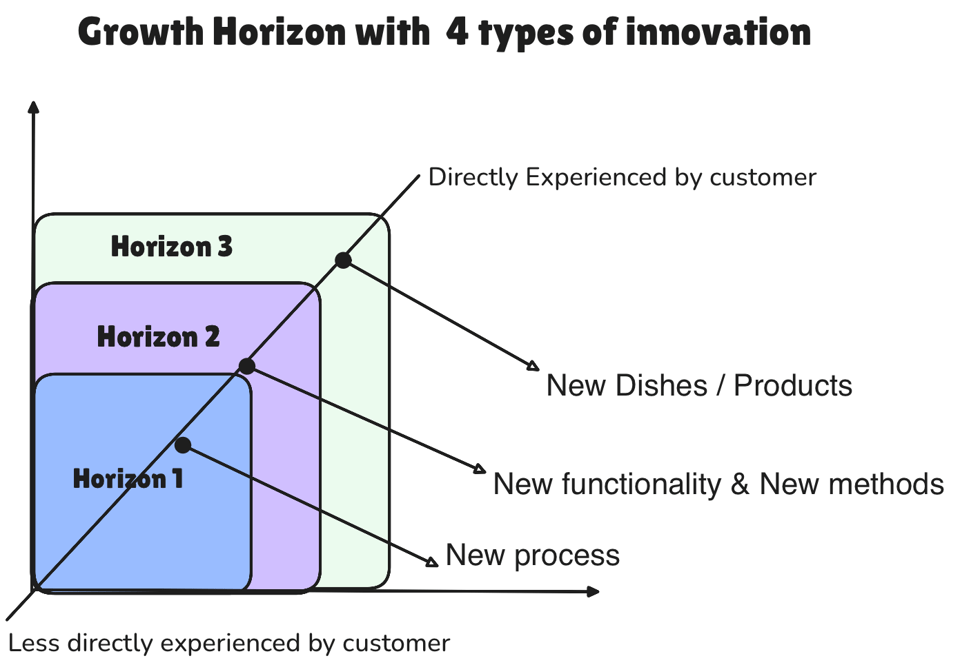
Investing in adopting AI into their product portfolio could approach this methodology basing on the product classification between the horizons.
Round up
The last 4 years felt like I was practising the curriculum of CommonCog. I believe it is one of the best places to be if being a good operator is something you want to strive in business.
Right at the end of my startup phase, I started with the Business triad. In the following 4 years, I have now fully baked it into communicating the betterment they would envision as their expertise increases with the product we offer.
Fundamentally, I don’t think any product or business is solving a problem that has never been solved before in the domains I operate. It’s more to do with bettering the status quo and optimising the work on different dimensions.
Next for the adoption of data as an added sense. The whole series of understanding variation resonated and got quickly adopted. I now view XMR charts - referred as Statistical process control charts every day at my role. This gives a comprehensive picture of how the product is functioning and where should I be focusing my efforts next.
At the start of the year with my move to a new region, closer to customers, sales and go to market functions became accessible. I started the process in March this year and closed out the year by being involved in most of opportunities of the region.
Interestingly, the way Cedric explored the concept of demand helped me in systematically work through the skill of selling. My first stint with selling actively started with value of graded produce to General Trade( mom and pop grocers who buy from the local mandi’s to resell to consumers). The common trend that I saw in both these places is the spectrum of differences in the buyer’s readiness in buying what we are offering.
The approach in both was a form of Challenger sales where you are first changing the perception of the customer you are pitching and then pursuing them to buy from you. The only difference being the average transaction value is orders of magnitude different.
One of the biggest learnings has been that inspite of every possible objection being handled, if the person who is buyer is not the only decision maker. The deal has some form of risk attached to it till it is closed. And often times, it leads to an indecision then an overt decision between yes or no.
There is one topic that dominated the mindshare of public writers I follow on the internet, AI. Even I wrote a bit about it as I was grappling with using it for my own day job. I have improved on how to put it to use in the work that I like to do but I have not spent time thinking through the implications of it as much as my super boss did in his newsletter. He has been the definite guide for me in thinking through the platform shift of AI if you are in the space of SaaS or logistics.
Links that resonated
Imperfect notes my second subconscious
Winnie lim writes a piece that encapsulates the sentiment my own note taking follows. Most of my notes are not perfect. They are hardly filled but each day I make a note and write some things in it. The meaning making part of it happens later when you take a pause and look back at them.
Sign off
This year I am breaking from the tradition of recapping the year that happened to focus on synthesising some concepts I practiced since moving on from being a founder.
As the year comes to close, my brain is grasping to make sense of the year that happened. Yet, I don’t want to tie it neatly into a narrative.
Both professionally and personally I entered many tangents and didn’t fully grasp the change I undertook in the process.
Starting next year I would be stepping further away from direct towards indirect work.
I finally finished this piece sitting in one of my favourite places, Library. I finally crossed that list off my task list to sign up to a local library.
Singing off till next time,
Vivek, struggling to read books

