
Agents vs Agents
One region is focusing on accelerating the agency model while the other is trying to centralised the transactions
Automations within network
(The opinions shared in this issue belong to yours truly and don’t represent the views of current or previous employers)
In the previous issue I wrote about what Landstar is doing and why Blackbuck should be following it.
A commission agent has an AI agent that does all of his or her back office work in a seamless way. So that they can continue to focus on building and growing their network.
This is pretty obvious if you spent any time moving freight in India. Yet the desire to run a managed marketplace is in full swing.
First, lets understand what Landstar wants to do. It runs a 900+ strong agent network who are booking freight with carriers in their network. The agency model is similar to Transportation commission agent in India. Both are independent individuals engaging in finding customers who want to move freight and sourcing trucks to execute those customer shipments. They typically take a percentage cut from the value of the transaction. More matches they make, more revenue they generate.
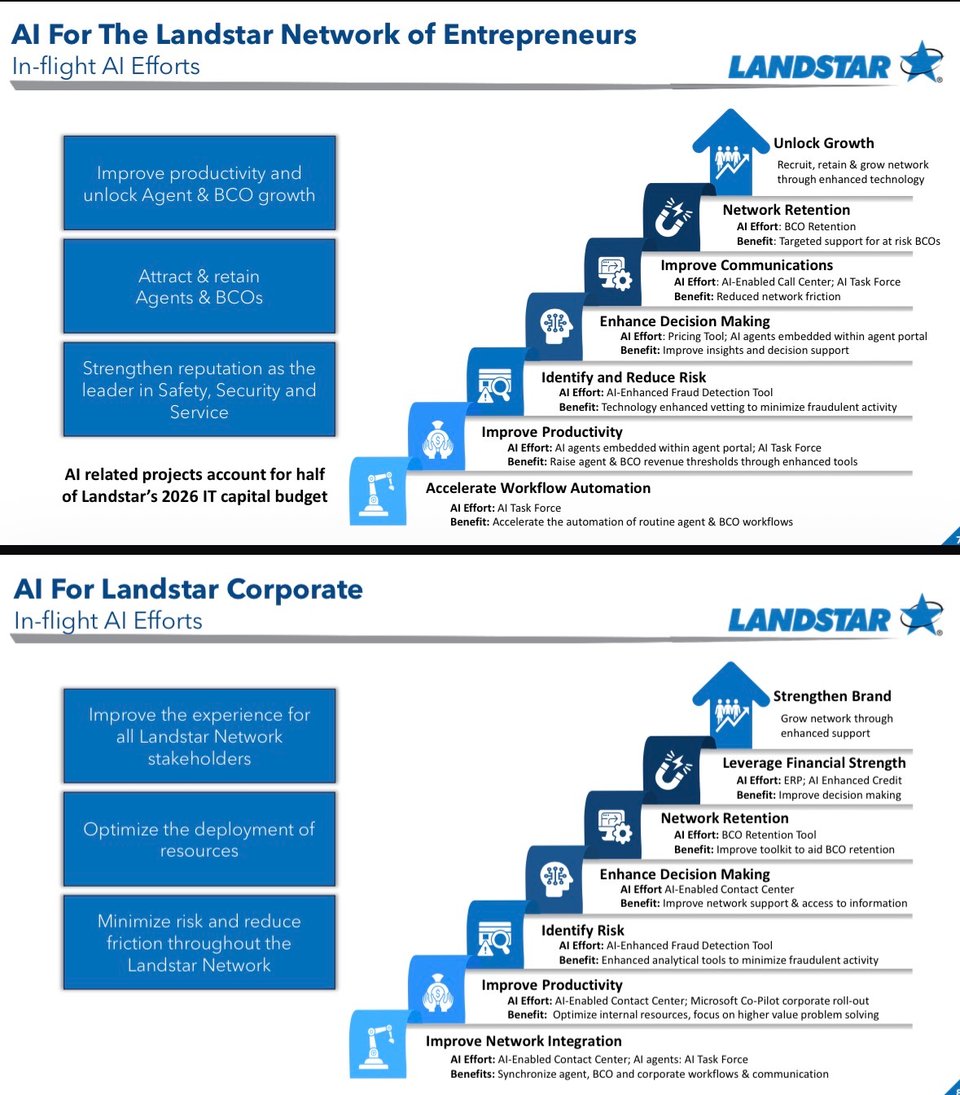
Looking at the topics Landstar wants to address with its AI initiatives. It wants to execute all the front and back office workflows of an agent to improve their productivity. If an agent was doing 10 transactions, they can now push the limit to 20 or 30 basing on the automation that can be achieved.
Quoting from a previous post that I wrote when LLMs started gaining traction.
Instead, we augement the work of transporter by enabling their jobs to be done with agentic workflows.
Let us take the case of booking of truck for transporter.
We have a
Stakeholder DBwith all stakeholders involved for a booking. A transporter tasked with mapping a cargo of the shipper with a truck has to execute 4 workflows(approximate) to get this job done.With LLMs we build an agent that help a transporter execute all 4 worflows without changing the way they work. It replicates the mode of input(talk or rather shout at the agent) but then structure prompt and executes all 4 workflows simulataneously to get the task of booking a truck a fraction of time. - Inform the shipper of the price band for transportation. - Check availability of truck from within their network and negotiate a price with truck owner. - Reference history of lane to prioritise who to call. - Execute this multiple times till a match.
All these take anywhere between couple of minutes to multiple hours depending on different scenarios. If these workflows are executed in seconds and then the data from the execution can be structured and stored for future reference.
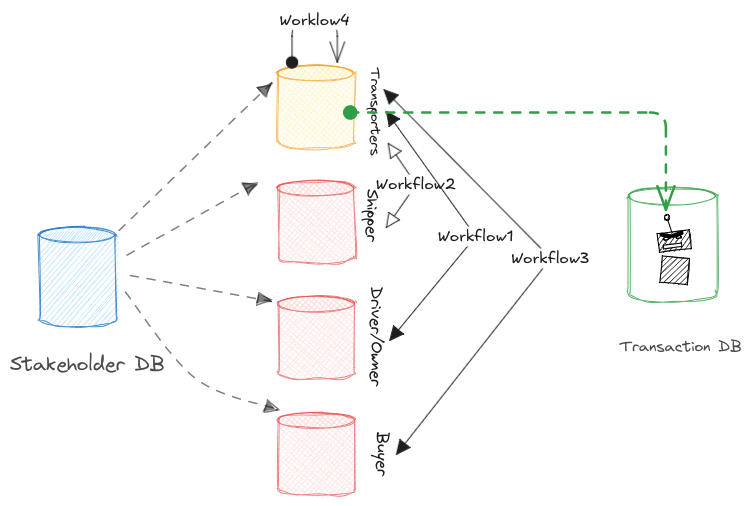
This is just illustrating one workflow. There are many more that can now be autonomously executed. Position or check calls as they call it in US. Payment ledger management and wiring of money can be handled by a single agent.
The end goal as I previously wrote in an issue is to reduce the number of phone calls that a commission agent makes on a particular shipment.
It is simple, if you are successful then people working in Indian trucking will make lesser phone calls overall. The simplicity of vision doesn’t do justice to both the complexity and quantity of challenges you will have to address.
Why do we need commission agents if most of their current busy work can be executed automatically?
While once the stakeholders become known in the network things can be automated. But how does one build and expand their network is the art of trucking sector.
Back in our startup days we wanted to learn what is the actual cost of moving freight a trucker incurs to move our produce. We hired a truck and managed its operations as a fleet owner for couple of months. Prior to this we were privy to booking trucks directly but didn’t know what margins they were making.
Once we hired, we don’t get to reposition the truck to where we want without incurring significant costs. So, we started with finding loads to the loading region of our cargo. In order to get our first load, the driver and our associate had to spend 2 days showing their faces with the truck to get their first load from a commission agent. This shipment would induct the truck into the commission agent’s network. And the truck had to take any load to show that we are serious about this business. So, eventually the commission agent assigned a load to a third location.
After moving that shipment, the team waited couple more days to find a load to the loading region we initially wanted the truck to move. This time around, referring the previous commission agent reduced the wait time to get the next load. Eventually by our 10th shipment, we don’t have to visit the physical location of the agent to get assigned the next shipment. All of this was cost of getting embedded into a network of an agent. Now, repeat this for every new agent on a different lane. Not all agents know one another.
If you ask the commission agent why are such extreme measures necessary? They would answer that there is significant churn in who shows up and our reputation is on line. So we verify not just documentation but establish a common connection with the trucker before moving any freight with them.
Its slightly more formalised in US with ELD mandate very prevalent. India is just picking it up. Produce freight movement is bottom of the food chain, no barrier to entry but significant transaction costs like the case I outlined.
So, its not agents vs agents just yet. For the time being it will be AI agents helping out Commission Agent be more productive when transacting within their network while the are solely focused on growing their network.
Round up
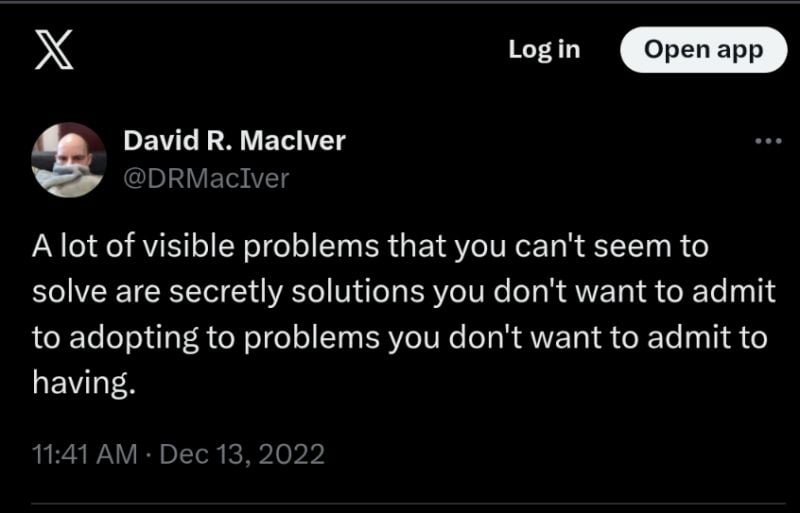
I wrote on LinkedIn about the mental model of problem solving when pitching your product or service in legacy domains. Talking to customers in these domains may seem like running in circles and this frame might help make sense.
A frame you use to sell in legacy domains
If your product or service is solving for the problem that the prospect is not willing to admit. It is a more consultative sales process and you will run into a few who will not engage.
Links that resonated
I want to link to this piece by Prem Panicker talking about the serious writing that happens in sports pages.
Sign off
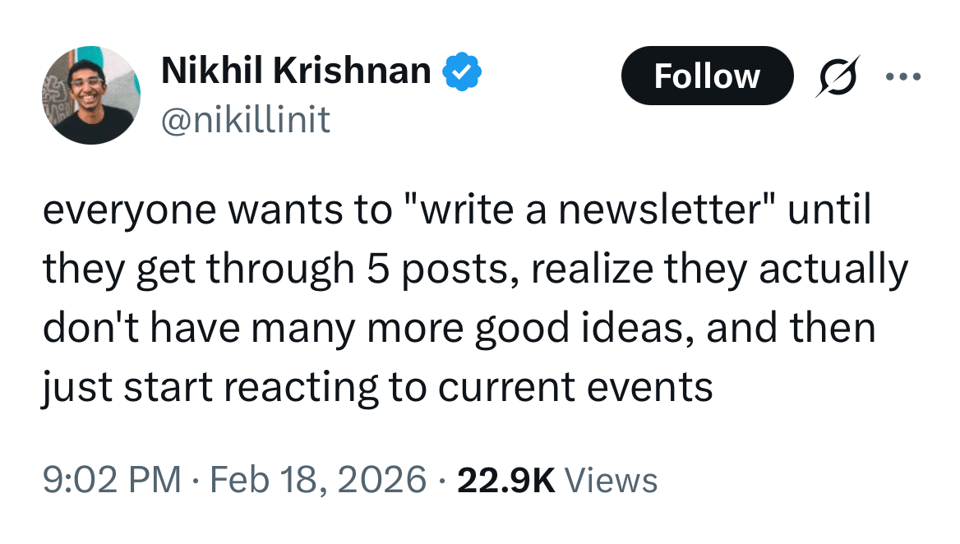
I am guilty of what Nikhil is calling out. Having written 95 of these. I probably had few good ideas. But I haven’t reacted to current events.
This newsletter is mainly an exhaust of topics that occupied my mind in the time since I wrote the previous issue.
And I think thats totally fine. I like this quote from Jason Zweig who was a personal finance writer at Wall Street journal.
I was once asked, at a journalism conference, how I defined my job. I said: My job is to write the exact same thing between 50 and 100 times a year in such a way that neither my editors nor my readers will ever think I am repeating myself.
I believe my motivation here is to write the same set of ideas in multiple scenarios without repeating myself.
Signing off till next time,
Vivek, cursing for missing last week.

