Supervictims, Part II: The Promised Question
"Stop putting 50 links in every piece," they said. "You wouldn't have to split articles if you stopped footnoting every paragraph to hell," they said.
To quote Fray Luis de León, upon returning to his lectern after four years in the clutches of the Spanish Inquisition: As I was saying the other day . . .
I mentioned a particular thought I kept having as I watched AB:CoE, and I think it’s finally time you learn what it was.
To wit:
Can you be a superhero in Spanish?
Surely, in 2026, the answer is yes.
This is the era of Brooklyn’s own Miles Morales, El Paso’s Jaime Reyes, LA’s Robbie Reyes (no relation), Nicaragua’s Alejandra Jones and some undetermined location’s Salvador Romero.1 Araña2 got to share screen time with Dakota Johnson in Madame Web,3 and her father’s deportation is apparently an explicit point. The Question is a Dominican woman. The Green Lantern whose story literally inspired the term “fridging” is allegedly Mexican-American; researching this article, I discovered there’s now a Chicana Green Lantern, which rules because Green Lantern has been my favorite superhero for decades. There’s Cecilia Reyes and America Chavez. Groot is apparently a ceiba tree.4 We’re half a century removed from the introduction of Héctor “White Tiger” Ayala, the very first Latin American main character in comics, who was born in San Juan, Puerto Rico.5
Sadly, much like I probably opted for nicknames in English because I was in a room full of Anglophone teenagers, Marvel and DC operate primarily in the US market—so no matter how Latino their heroes are (a surprising number of them are several different kinds of Latino, as if balancing a one-person ticket), they live and work in New York City, or the Latine mecca that is Portland, Oregon.
There’s problems beyond geographic concentration, too. Araña is now Spider-Girl, because I guess Marvel got tired of paying for those extra tildes. Renee Montoya wasn’t explicitly identified as Latina until ten years after her introduction. America Chavez, whose mysteriously accentless name would be pronounced “a-me-REE-kah” in Spanish, is, of course, the new Miss America,6 with an outfit that’s clearly not talking about the hemisphere. Kyle Rayner—¿cómo se dice?—sucks.
After leaving his original boricua creator, Héctor Ayala became addicted to the tiger amulets that turned him into a superhero, spent twenty years out of print, and returned in 2002 only to be wrongly accused of murder, convicted despite Daredevil defending him,7 and shot dead trying to escape. What a glorious end for the first Puerto Rican protagonist in comics.8
Seven years after Ayala got his very own officer-involved shooting, we had the arrival of Miguel “El Vejigante” Rodríguez, whose backstory is . . . well . . .
Son of Puerto Rican independentistas, Miguel Rodriguez went against his parents wishes and enlisted in the U.S. Army after 9/11. While in Iraq, Rodriguez's squad was hit by an I.E.D., resulting in the death of everyone except Rodriguez and his Sergeant. When a series of R.P.G.'s [sic] came down, Rodriguez panicked and ran, leaving his Sergeant to die as well.
After returning to Puerto Rico, Rodriguez turned to alcohol in order to deal with his guilt and PTSD until one night a mysterious figure visited him offering redemption. The figure revealed that he was the latest in a line a protectors of Puerto Rico and he has chosen Rodriguez to be his successor. The figure bestowed his powers upon Rodriguez and he became El Vejigante, protector of Puerto Rico, vowing to be a better hero than he was a soldier.
I’m not one of those people who needs every depiction of his nationality to be positive. I know El Vejigante’s creator Alejandro Arbona has his politics in the right place. The obvious intent here is to create a complex character who’s got a lot of meat on his narrative bones. In a vacuum (or maybe if there were a few dozen Puerto Rican superheroes) the idea that one of them is trying to move past his cowardice and alcoholism would not only be a welcome complexity, but one I’d want repeated.
In the actual world in which we live, Puerto Rican soldiers are notorious for jumping on grenades to save others, to the disbelief of white officers like Chester B. DeGavre, and I am exceedingly familiar with how quickly people generalize the flaws of the one Puerto Rican they know of to an entire population of eight million people.
Rodríguez’s powers, as befits a superhero named after a boricua institution, are tied to the island: if he leaves Puerto Rico, they leave him. That makes sense, and yet it’s hard to square with a world in which there are twice as many Puerto Ricans, me included, living in the metropole because the United States has pigeonholed the island as a vacation spot and tax haven.9
Most tragically, though, Rodríguez’s encounter with the mystical protector of the island appears to have done something very strange to his crotch, such that artist Juan Doe appears to have drawn it with a ruler.
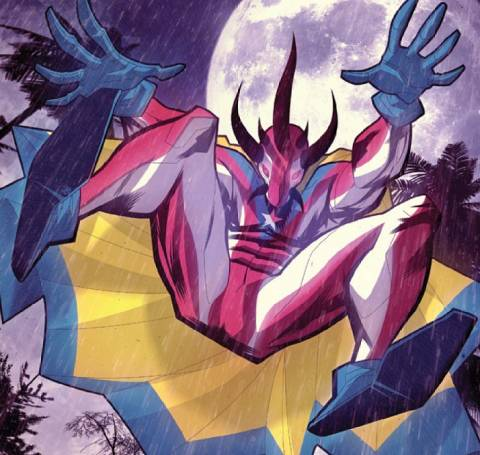
Perhaps you think this was an accident of this particular frame. If so, let me reassure you that it is an actual artistic choice for El Vejigante’s nethers to require Shift-clicking the pen tool.
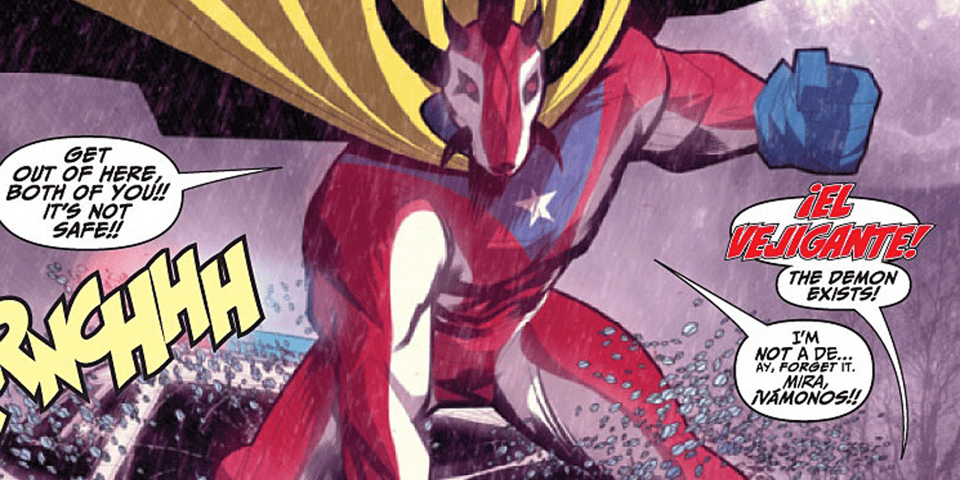
I wanted so badly to crack a joke here about how comics artists are so afraid of Puerto Rican virility that they need to make our superheroes Ken dolls, but Arbona is himself Puerto Rican, so there goes that theory. Plus, I need you to take me seriously for the next couple paragraphs.
When all is said and done, the problem here isn’t El Vejigante. It’s that he’s solely responsible for protecting an entire island of 3 million people, while New York City—with about three times the population—has superheroes out the wazoo. That’s what makes the idea of Hispanophone superheroes hard to stomach: they live in a real world where they have to interact not only with the ways the United States sees us, but internal constructs like latinidad, the tensions and consolations of our layered identities, that sort of thing.
There are good news on that front, sort of, at least for the Puerto Ricans in the room. Edgardo Miranda-Rodríguez, who has had a long and fruitful career marrying art and activism, created the superhero La Borinqueña.
La Borinqueña is Marisol10 Ríos de la Luz, a Brooklyn college student and activist who wears a costume based on the Puerto Rican flag, fights threats like climate change and voter rights rather than beating up street criminals, and is apparently capable of not only working with other heroes, but even enlisting villains like Harley Quinn and Poison Ivy to help her people.
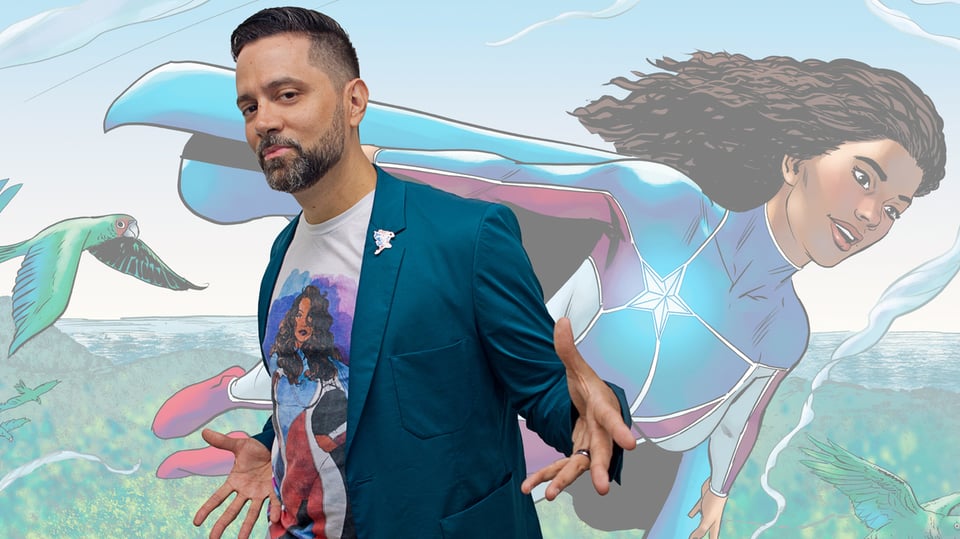
There’s our answer, right? We’ve got a superhero who speaks English and Spanish equally fluently, who combats the real problems faced by her people, and who takes her superpowers as the starting point for her social activism, rather than a replacement for it. How is that not what I’ve asked for this entire time?
Maybe I’m just a nitpicky dickhead with terminal protagonism and no capacity for satisfaction. Let’s set that possibility aside for a moment, though.
La Borinqueña is a step forward. Frankly, since I cannot live in a world where she exists, I would prefer a world where someone creates her. Nor do I believe that superheroes are necessarily obstacles to social progress, or at least they wouldn’t be in a world where we accepted things as they are less often.
It’s more that superheroes can oppose genius supervillains or corrupt cops,11 but somehow I don’t see a hypothetical superhero ripping the roof off LUMA headquarters and throwing every one of those useless suits making a parasitic living off my people into the Puerto Rico Trench, even though those are real villains doing horrible things to real people.12
You can take down a rogue U.S. Army general or Soviet-leftover radioactive mutant, but you’re not allowed to take the world’s entire nuclear stockpile and stick it in a corner of the Phantom Zone unless you’re in an Elseworlds book.
In other words, if you can’t be a superhero in Spanish, it’s because the mathematical problems that classic superheroes confront are, in their simplest forms, individuals: i.e., if This Person is out of the way, at least things will not get worse. That’s how you see things when you think the status quo is just a few tweaks, even big tweaks, away from perfection.
For the world that the United States has created, the problems are wider, deeper, and thornier than getting rid of a few Lexes Luthor. Sure, we also have extremely powerful trillionaires mad at their receding hairlines who murder thousands of Black and brown people at will, but ours have near-unanimous support from our political and economic overlords and operate in a culture that always worships them, even in the guise of hatred.
We are allowed certain fictions—good rich people, solvable climate change, a meaningful counterweight to militarism and authoritarianism—but not the catharsis of punching our actual problems in the face until they bleed.
Why a superhero whose most famous visual element is a flaming skull is particularly hospitable to Hispanic identities would be an undeniably fruitful line of inquiry, but it is sadly beyond the scope of this article. ↩
Araña’s real name is Aña (you read that right; Aña, not Ana, like her parents tried to celebrate Hispanic Heritage Month extra hard) “Anya” Sofía Corazón. I could nitpick that I’ve never heard of a Hispanic woman named “Aña,” because that name would get you bullied so hard you’d go full hikikomori, and that “Corazón” is such a rare surname as to invite suspicion, but maybe Joe Quesada’s mom is just from a different part of Cuba than mine. ↩
I am neither the first nor the smartest person to complain about this, but the fact that a film can officially cost $80 million, make $100 million, and be considered not only “meh” but an actual bomb is why no one believes economic data anymore. ↩
Wikipedia claims Selina Kyle became Cuban at some point, which is the only way a superhero named after a cat could be further up her own ass. (I’m allowed to say this. Check the footnote after Madame Web above.) ↩
Admittedly, the original Miss America was introduced in 1943, so it’s fun to imagine her throwing a real hissy fit on discovering her successor is a queer Puerto Rican. ↩
What happened to being a really good lawyer, Murdock? ↩
Joe Quesada was the editor on Daredevil when this happened. If I were conspiratorially minded, I’d say he has a real problem handling Puerto Rican superheroes—and I’m conspiratorially minded, so I am saying that. ↩
Thanks to this thing called Act 60, whose benefits you can find enumerated on sites with names like “Offshore Freedom” and “Protect Your Wealth,” if I (born and raised in Puerto Rico) decided to move back home and start a business, I would not be eligible for any kind of tax credit or other incentive no matter how well-thought-out my plan was. My wife, whom I love dearly but whose only connection to the island is me, could turn up with a Zodiac cipher in tow and the state and federal governments would genuflect and hand over their vault keys. ↩
Not only is La Borinqueña’s name taken from the Puerto Rican national anthem, but so is her actual name: the last line of it ends del mar y el sol. ↩
Bad cops in comics are either in the vast minority and hated by their upstanding colleagues, or only in the majority because some mobster has bought off the entire force. Strangely, they’re never the prime movers behind wanting to retain their power to commit violence with impunity. ↩
A comic book in which a Haitian superhero singlehandedly ends the 1915 occupation, would probably be the coolest thing of all time. ↩
-
Reading up about vejigantes, I can't help but raise an eyebrow at
The Minor League Baseball team, Scranton/Wilkes-Barre RailRiders, as part of MiLB's Copa de la Diversión initiative, play multiple games each season as the Vejigantes...
I don't know if there's a strong Puerto Rican connection to Scranton or Wilkes-Barre, but I have been caught up in the alternate names MiLB teams use in the Copa de la Diversión... It's got everything from stereotypes (piñatas! luchadores! a popular food to drink associated with some kind of Spanish speaker!) to some that are absolutely better than the teams' usual names: Iowa Cubs is not a patch on Demonios de Des Moines! and how could the Perros Bomberos de Peoria ever go back to being the Peoria Chiefs?!
-
There is actually a surprisingly big Puerto Rican population in that area of Pennsylvania; I used to go down for the Lehigh Valley IronPigs' Hispanic Heritage Night, during which they'd sell pernil and tostones.
As far as Copa de la Diversión, I love almost all of those names. I own Lloronas de Montañas Rocosas apparel from before they became part of the Great MiLB Contraction. Ironically, just about the only name I don't like on those jerseys is the Cocos Locos de Rochester. They're already the Plates; you add green to that gold and brown and they could be the Mofongos!
-
Might "El Vejigante" become the first ever superhero subsumed by the Department of Defense to be aware of it?!
-
Comics Steve Rogers is infinitely cooler than the movie version for exactly this reason: man quit the job multiple times over because he couldn't serve as a symbol of the US government anymore.

Reply: