Mentats in Search of a Butlerian Jihad
We say remembering is an unconscionable burden—which is why we place it only on certain people.


There is a weekly meeting at my workplace. It varies in subject matter, but it is always at the same time.
At the beginning of the year, one superior e-mails us the planned list of meeting topics. This list is easy to access. You can print it out, download it and keep it on your desktop, whatever you want.
One of my coworkers, despite having the same access to email we all do (and being fairly capable with technology) semi-routinely asks me what the meeting is this week. After the first time, trying to be helpful, I mentioned that we all have this list and where to find it. That hasn’t stopped the asking.
Which (and I want to emphasize this point) is fine, because I know my coworker is going through some serious stuff that is much more important than searching an email inbox for something we were sent back in August. Plus, it takes me at most a couple of minutes to find the list and answer the question.
I mention this because, before asking me, my coworker did not know that we both had access to that list. The assumption was that I had somehow acquired that information, stored that information somewhere, and could produce it when asked.
To my mind, that expectation is rather illustrative of the role the world seems to want me to play, despite the fact that I have neither auditioned for nor am particularly interested in it.
“C:\” Stands For “Cerebellum”
Cognitive load is as intuitive a concept as it is useful. After all, no matter how many personal records you out-lift in your pursuit of physical perfection, there is an amount of weight that the laws of physics will not allow you to handle without subsequently reshaping your body into a Cubist nightmare.
Much the same way, no matter how powerful a computer your brain might be on paper, there is a point at which its biological circuits simply cannot hold the amount of information our capitalist hellscape tries to force-feed into it every single day.
This naturally leads to finding ways to reduce that load, or at least optimize it. From the quotidian notepad and to-do list to purpose-built piems and mind palaces of hundreds of rooms, humans have created method after method for the singular purpose of helping us remember things we can’t, or more likely, don’t want to.
Once upon a time, I am reliably informed, some of these were taught in school. Unfortunately, because my earliest schooling was not in English, the only one I can really remember is PEMDAS. Most of the others I’ve picked up, like for the planets (warning: post-Plutonian edition) or Do kiss, please, come on, for God’s sake!, come from books.12
My students still learn PEMDAS, but for the most part, they aren’t really taught to develop their memories, nor do they particularly care.
At first blush, that makes sense. They’re surrounded by electronic devices whose entire purpose is to remember things for you, at the cost of surveilling your every move and selling your data to people who have happily rent the fabric of society. Never mind that having something that can send you reminders of everything does not necessarily lead to using that device to do that. Putting reminders into your phone takes away from your doomscrolling time!
Even if they didn’t have those devices, it has been a truism since long before I started teaching that we care way too much about rote memorization in school.3 The same arguments I heard twenty years ago, which were essentially complaints about taking quizzes on the cacicazgos of Puerto Rico, I hear today about colleagues who explicitly tell students they don’t want them to remember specific names or dates.
Then I met this year’s pack of postpandemic middle schoolers, whose default response to being told they missed a homework assignment is to insist the failure is on your end and who respond to being asked questions they cannot immediately answer by exploding angrily before realizing they know the information, and something became clear.
We are surrounded by the message that remembering things is overrated (that’s what your phone is for!) and that anyone who tries to help you remember things—to defragment your cognitive load, as it were—is doing you a disservice (if they cared they’d let you ask your favorite AI client about it). That doesn’t change the fact that memory is still a necessary skill.
So what do you do, with no mnemonic techniques to enable elaborative encoding, no way to reduce or organize the amount of raw data sloshing around in your brain, and the sneaking, sinking feeling that you’re overloading that circuitry?
Well, that’s what other people are for.
The Cloud Is Other People
Perhaps it should be less surprising that, in an era where people are expected to put their GPUs in service of the world’s most obvious bigger-fool scam, we’ve grown to consider other people ambulatory data centers whose RAM and hard disk space is freely available for our usage.
Like so many other horrors of the present day, some science fiction writers had called this shot decades ago. In Frank Herbert’s Dune (at least the parts that don’t switch pace so suddenly they give you whiplash), the post-Butlerian Jihad4 ban on thinking machines5 means that when the Great Houses need complex problems solved—everything from financial calculations to how to win blood feuds—they rely instead on mentats: monklike figures analogous to court wizards, whose brains have been optimized to do all of these via the usual Herbertian pathway of training and psychotropic drugs.
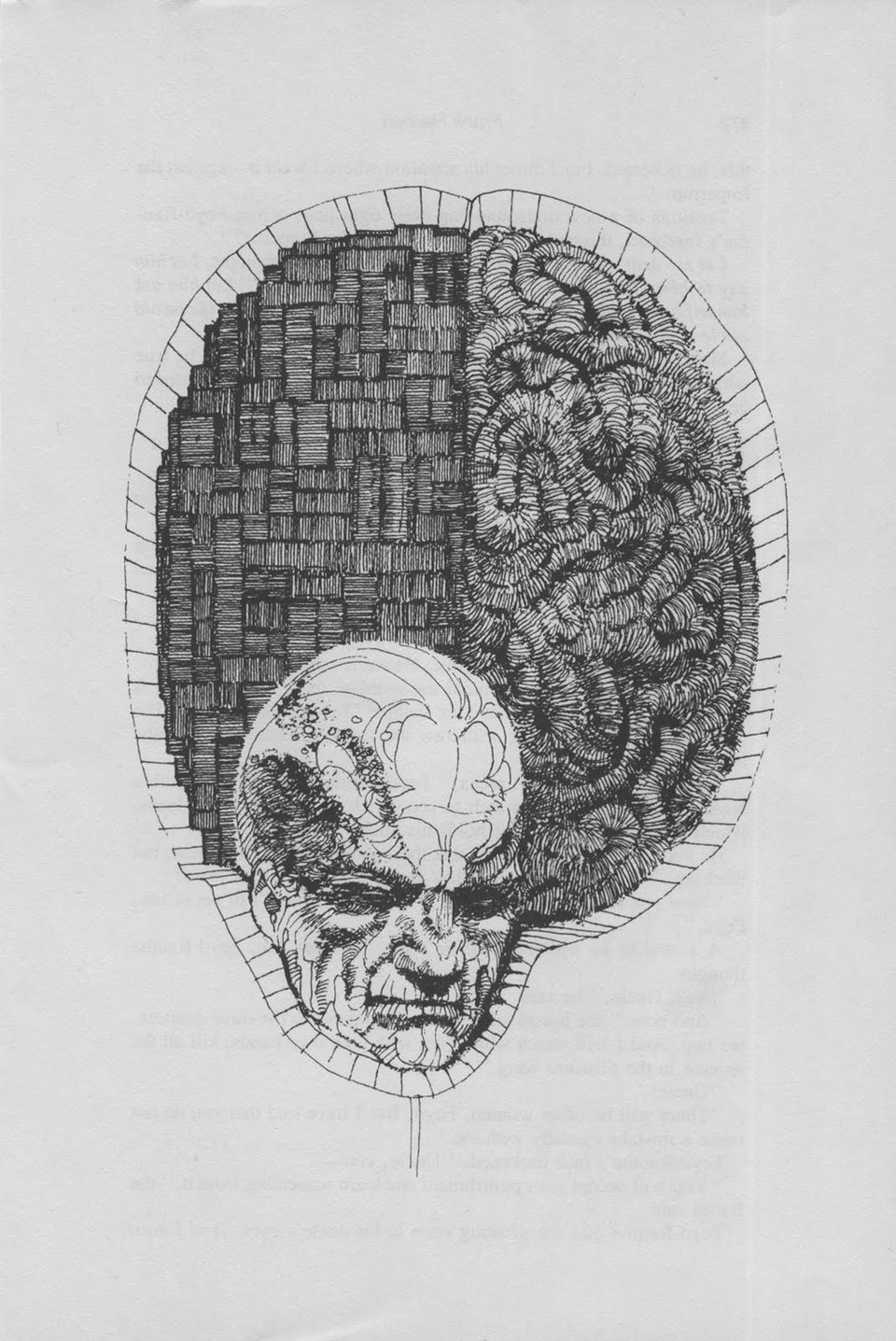
Some of us get shunted, willingly or not, into playing this role. We’re supposed to do all the thinking and calculating and planning and remembering for everyone else.
To me, at least, this became particularly pronounced after the pandemic. Once upon a time, before learning management systems, my students were expected to keep track of their assignments and get them done in a timely fashion. Now, when they can’t, the first questions parents and counselors and administrators ask are directed at us, not at them.6
If it was just the children, though, I wouldn’t be writing an article about it. Suddenly, it is now my responsibility to be competent for two in every interaction, whether what’s at stake is a meeting, a few dollars in overcharge, a package getting to me on time, saving a few hundred dollars in airfare, or the correct charge for a medical procedure. The number of items on my to-do list reducible to “remind this person to pull their own weight for a change” or “point out that this is incorrect” only grows by the week.
Never mind that I’m supposed to maintain this awareness while also doing both a full-time job and the social reproduction necessary to be a good worker—eating, sleeping, cleaning myself up, taking care of my family members, having friends, occasionally checking in on the video games I have time to play, which are the ones that play themselves, etc.
Bluntly put, I have to reorganize my brain into Thufir Hawat’s just to get out of the house in the morning without having a nervous breakdown, and I’m usually only in danger of getting killed by a Nissan Rogue blatantly running a red light.
We’ve been promised, in recent years, that the same solution for every other societal problem can lighten the load on our brains: “AI” tools that make us lonelier, reinforce our worst ideas, and as we’ve all seen by now, are wrong so often we have to work harder to fix them.7
Despite all those promises that remain stubbornly unfulfilled (because they were never the point), the eugenicist techlords behind “AI” control an ever-increasing and ever-dirtier share of the nation’s energy demand, while most of us can’t even take a mental health day without our coworkers being mean about it behind our backs. It’s clear that even if “AI” could ease (some) cognitive burdens (some of the time), its benefits will be limited to the people who already force the rest of us to act as their human address books.
I know, I know: I can feel myself circling the Andy Rooney Danger Zone.
Who Has to Remember?
The key to all this, and the reason I’m not (just) an annoying boomer complaining about how Thanksgiving deserves more respect: this extraneous burden is not equally shared.
In fact, I would argue that in a way, service work is entirely defined by the requirement that you absorb the cognitive load from someone else in order to make their experience as pleasant and frictionless as possible. That’s a kind of emotional labor (you can’t call your customers idiots, even if they are and you really want to) but it’s more expansive than that.
This kind of cognitive labor8 represents an unspoken and extra-contractual obligation on your part to let someone else use you as a thought sink, without requiring them to in turn respect you for your expertise or goodwill.
Think about it as a series of permissions:
Who can expect immediate understanding, without follow-up questions for clarification?
Who can lie, or be completely and obviously incorrect, and expect not to be called out on it?
Who can miss details or get distracted during a conversation without having to apologize?
Who can reflexively hand off work to a subordinate, a machine tool, or some other human or technological intermediate?
Who can forget their responsibilities without suffering any consequences?
Obviously, I feel this strongly as a teacher, and particularly as a teacher of upper-class students who have been raised to believe they are future masters of the universe and therefore above such things as “asking for help” and “taking accountability for their actions,” but I think I was predisposed to this mindset.
One, because as a Puerto Rican—that is to say, a member of a colonized population—I internalized from a very young age that when someone with more social capital tells you you’re wrong, even if you’re 100% sure you’re not, it’s at least worth it to check yourself.
Two, because I grew up in a family that valued self-sacrifice to the point you’d think it was on our coat of arms. From that same very young age, I also internalized that you should be prepared not only to take whatever burdens other people put on you, but to anticipate the ones they haven’t put on you yet, and take them on before they figure that out.9
In a less capitalistic system, this would be a virtue.
In the religion the majority of USians profess to believe, it is, explicitly, a virtue.
In the United States of America in 2026, however, it makes you a sucker, a mark, a cognitive laundry chair that other people—no matter how principled or well-intentioned—detect like a shark going after chum.
People like me are stuck replacing thinking machines that not only haven’t gone anywhere, but which are given the humanity we are denied. We’re asked for memories and psyches that work perfectly and predictably in a world where machines are forgiven for making stuff up or being bad at being machines. We are blamed for wanting respect, but never credited for what we genuinely achieve.
Serena Butler can’t come soon enough, says I.
Specifically, D’Epiro and Pinkowish’s What Are The Seven Wonders of the World?, which taught me that lists can be entertaining without being overly arch, and was probably my introduction to entertaining nonfiction writing. If you’ve got a nerdy kid, you could do worse for a present. ↩
With the notable exception of Walter Bishop’s “she’s a bad mamma jamma,” which appears to have absolutely no correlation to real-world knowledge. ↩
Rote memorization, as a component of education, is fine.10 We must at some point socially accept that we have given teenagers excellent reasons for arguing with anything we tell them they have to do. ↩
Once upon a time, I wondered whether it would have been as easy to lie about Iraq and Saddam Hussein if USian students were required to read Dune. I think it’s obvious why I don’t wonder that anymore. ↩
Canonically, this ban is laid out in something called the Orange Catholic Bible, which is funny, but much less so than the fictional religious traditions represented therein: the article above mentions “Mahayana Christianity, Zensunni Catholicism, and Budislamic traditions.” To Frank Herbert, the religions of the world were dolls you could make kiss whenever and however you wanted. ↩
If I had a few thousand more words to make a post for you, I could get into why allowing children to repeatedly avoid any responsibility for their own work does not lead to a growth mindset or grit or whatever new personality magic bullet has gained currency by the time this comes out. ↩
To say nothing of the fact that a lot of “AI” is propped up by very human and very exploited workers. ↩
Unsurprisingly, a kind of labor done mostly by women. Remind me who dominates service work? ↩
We do not need to get into what long-term damage this probably did to my psyche, but it is probably why I ended up married to my ever-lovely missus, so let’s call it even. ↩
Yes, this is a footnote within a footnote: I guarantee that you agree with this already, because that’s what athletic drills are. The one present-day locus of mind-body dualism is insisting that the same things that train the sportsman are crimes against childhood when done to train the student. ↩
You just read issue #6 of Forsan et Haec. You can also browse the full archives of this newsletter.
-
I really felt this, especially the idea that some of us get cast as the “mentat” whether we signed up for it or not .
I had a small but clarifying version of this just last week. I asked two close friends to join me for an adventure. Nothing extreme, just a long day trip with plenty of advance notice, and both declined. Which, on its face, is fine. But it forced me to confront something I’d been avoiding: I’m the load-bearing friend. If I don’t plan, nothing happens. If I don’t follow up, nothing gets followed through. If I don’t carry the cognitive load, the whole thing just… doesn’t exist. And when it comes time for someone to make some small sacrifice, they simply... don't.
So I decided, at least for now, to stop doing that. Not to cancel plans, but to cancel the creation and maintenance of plans. The itineraries, the reminders, the gentle prodding that turns “we should hang” into something real. The response has been telling about who actually saw and appreciated that effort, and who apparently just assumed I enjoyed playing that role.
This also reminded me of Craig Lambert’s "Shadow Work," which you may already know. His argument about how we’ve offloaded more and more unpaid labor onto individuals—booking, assembling, troubleshooting—feels very adjacent to what you’re describing here, just mapped onto social life. Some of us end up doing that invisible work for the people around us, too.
-
↳ In reply to Eephus Tosser
Dead on. To me it often feels as though those of us who display any kind of detail orientation or genuine desire to learn things get told, essentially, "if you're such a big brain, put it at the service of others."
I have a more emotional sequel in mind to this particular piece, but on this side of things, it's impossible to resist the conclusion that you pay a social and cognitive price for being attentive, responsible, or even just not particularly self-centered.

Add a comment: