Niko McCarty

Archives
Log in

Niko McCarty

Archive

Visuals That Work

Read this essay online →

Words are the best medium for conveying complex ideas. Always bet on text!

But there are cases, especially in science, where words alone may prove inadequate; where an idea has too many moving parts, or is so strange, that language alone would flatten the nuance or wonder it deserves.

This is especially true in biology, a field that (perhaps owing to its complexity or breadth) is often taught as a boring list of facts. “I should have loved biology,” writes James Somers, a contributor to The New Yorker, “but I found it to be a lifeless recitation of names…the Golgi apparatus and the Krebs cycle; mitosis, meiosis; DNA, RNA, mRNA, tRNA.”

#7
May 18, 2026
Read more

Underrated Ideas in Biotech (Part I)

In On Writing, Stephen King says “serious” writers ought to spend at least four hours a day writing; hands on keyboard or pen to paper. Anything less is a hobby.

By that standard, most of my writer friends are hobbyists. They spend their days talking to people, finding ideas, and bemoaning the fact that they haven’t written anything in a week. This (sometimes) describes my own life, too. There are weeks where I’m lucky to get in an hour of writing per day.

The less I write and the more I talk to people, the faster my list of ideas grows. When I started writing, I had maybe 10 decent ideas. Today, that number is 347. Some are great, many are mediocre, and all have varying amounts of notes attached to them.

I’m now resigned to the fact that I’ll die long before clearing out my list. The heap keeps growing, regardless of how often essays get sent out. The space of interesting ideas, even in a “narrow” domain like biotechnology, is too vast for any one writer — or team of writers — to circumnavigate in a lifetime. One could write four hours a day and come nowhere near.

#6
May 13, 2026
Read more

Mark Budde — How to speed up wet-lab biology

My first podcast is out today. It’s with Mark Budde, the CEO of Plasmidsaurus.

I really like Plasmidsaurus, because they took whole-plasmid sequencing from $600 to $15 and turned a "boring" service company idea into a hugely successful company that now serves >70,000 scientists.

We talked about what it means to build a "boring" company, whether the Plasmidsaurus idea could apply to other technologies (like CRISPR screens), and why Plasmidsaurus isn't expanding into China. This podcast is made possible by Astera Institute.

You can find the podcast, THE NEW BIOLOGY, on YouTube, Spotify, and everywhere else.

#5
May 8, 2026
Read more

I'm Writing a Book! "Biology is a Burrito & Other Essays"

I've started writing my book: "Biology is a Burrito & Other Essays." It is an interactive and highly visual look into the beauty, speed, and complexity of a living cell.

I'm planning to print hardcover books while serializing the essays online. The first essay is now available at burrito.bio. My goal is to publish a new chapter every week or two. (If you received this email, you are already signed up to get updates when new chapters launch!)

This book’s design was somewhat inspired by Stewart Brand's latest book, "Maintenance of Everything," which he developed in a serialized form with Works In Progress magazine. One cool thing about that book was that he improved each chapter with reader comments before printing the physical copies!

I'll be doing the same with this book. If you send me feedback that improves the text, I'll credit you online and in the final print version. You can reach me by email at nsmccarty3@gmail.com. Hope you enjoy the book!

#4
April 29, 2026
Read more

This OpenAI Wet-Lab Blog is Actually Pretty Good

There's a recent blog from OpenAI where they used GPT-5 to optimize a common biology experiment, called Gibson Assembly. I've seen criticisms online from people who say things like, "Who cares? A human totally could have done that" or whatever. And that's true. But I still think this blog is nice for a couple reasons.

First, faster iterations is one of the best ways to accelerate biotechnology progress more broadly. Experiments take much too long, and are often much too unreliable, for scientists to move quickly. Therefore, we should invest more resources toward optimizing and improving common methods that seem "mundane".

Second, this is a simple experimental system in which to test AI; indeed, that's the whole point! Gibson Assembly has been around for nearly two decades, is widely-used, and only requires three enzymes. It is therefore a natural fit for AI companies to benchmark their models on biological questions. (The parameter space is not too large!)

To understand what OpenAI actually did, I first need to tell you about Gibson Assembly, a common method biologists use to stitch DNA molecules together. Originally developed in 2009, most scientists use Gibson because it's dead simple: Everything works at one temperature (50°C) and it requires only three enzymes. The DNA molecules to be joined together are designed such that they have 15-40 nucleotides, at either end, which overlaps with the other DNA molecule. All the DNA is then added to a tube and an enzyme, exonuclease, "chews back" several dozen nucleotides from the 5' ends of each molecule, leaving behind long single-stranded "arms." These arms float around in the liquid, collide with a matching arm in another DNA sequence, and hug each other tightly. A second enzyme, DNA polymerase, runs along these touching DNA strands and fills in parts of the arms that don't overlap or are still single-stranded. Finally, DNA ligase seals the "nick" and heals the strands, thus forming a newly assembled, double-stranded piece of DNA.
#3
December 18, 2025
Read more

Underrated Origins of the Protein Folding Problem

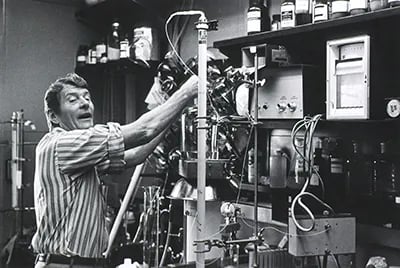
C. Anfinsen, NIH Archives

Students of biology take much more granted. Seemingly simple ideas — like how DNA is the genetic material, or how a protein folds according to the order of its amino acids — are taken as gospel or undeniable “truth,” even though such ideas once bordered on fringe conspiracies. I’m intrigued by the stories of how such ideas went mainstream, so to speak; doubly so if the discoveries were made by people who I’ve never heard of (not the Darwins or Mendels or Cricks).

Christian Anfinsen is one such person. Until last week, I had never heard of him. He shared the 1972 Nobel Prize in Chemistry for his studies of a particular enzyme, called ribonuclease. Specifically, he did a clever experiment in which he denatured this enzyme (meaning he destroyed its 3D shape) and then showed the enzyme could refold, and gain its activity, autonomously. This experiment was the first to suggest a protein's form is encoded by its amino acid sequence, and it heralded the mad rush, by computational biologists, to solve the "protein folding problem." (Anfinsen is also interesting, on a more personal level, because he apparently did his entire PhD at Harvard in just two years.)

Before I describe the experiment, it's important to put everything (briefly) in historical context. The experiment itself was published in 1961, but Anfinsen was working on these ideas since at least 1958. (I say this because he published another paper, also involving ribonuclease and its 3D form, in 1959; and the experiments, getting a paper publishing, and so on all take time.) Even if one uses 1961, the year Anfinsen published his experiment demonstrating that a protein's structure is encoded by its amino acids, as reference, just consider all the things that were not yet understood:

#2
December 18, 2025
Read more

Just a test here.

Just testing this.

#1
December 16, 2025
Read more
nikomc.com
Powered by Buttondown, the easiest way to start and grow your newsletter.