
Pride, WCAG 3, and another podcast episode
I didn’t set out with a theme for this month’s newsletter.
Looking back, though, everything here seems to come back to the same question: what happens when we accept something as normal without ever stopping to examine it?
That question shows up in disability, creativity, and accessibility standards, each from a different angle.
I think it makes for an interesting mix. I hope you do too.
Let's dive in.
In this newsletter
- Pride is the opposite of shame
- From the new podcast
- In case you missed it: Transition to WCAG 3
- Wrapping up
Pride is the opposite of shame
Pride isn't the opposite of struggle. It's the opposite of shame.
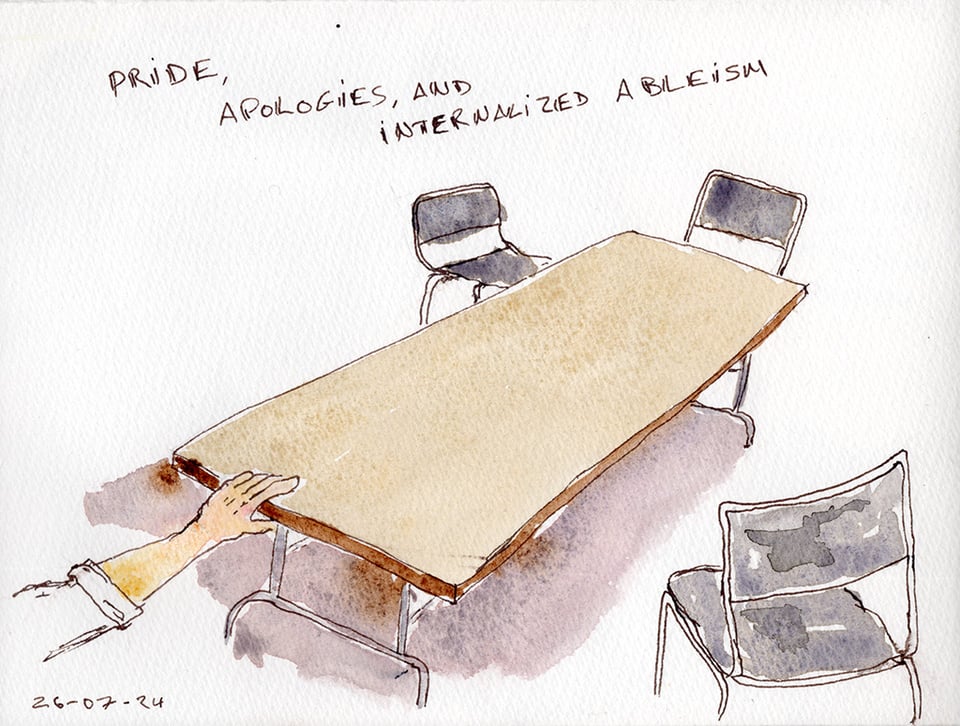
For a long time, disabled people have absorbed the message, directly and indirectly, that we should minimize ourselves: don't be inconvenient, don't ask for too much, don't make other people uncomfortable. If you need access, ask politely. Apologize for the trouble.
Those messages come from schools, workplaces, television, strangers, sometimes even the people who care about us most. Hear them often enough and they stop sounding like someone else's opinion. They start sounding like common sense, woven so deeply into everyday life that you stop noticing them at all.
Disability advocates call this internalized ableism: society's assumptions about disability becoming your own, until you find yourself apologizing for needing access or feeling guilty for taking up space you were always entitled to.
It shows up in ordinary ways: hesitating before asking for captions, apologizing because everyone has to wait while someone unlocks the accessible entrance, feeling guilty because a meeting starts a few minutes late while someone finds you a chair with arms or moves a table out of the way. None of those thoughts begin with "I'm ashamed of being disabled." But shame rarely announces itself so clearly.
None of this is about pretending disability is easy or enjoyable. Disability can be painful, frustrating, isolating, exhausting. Many disabled people also carry grief: for abilities lost, opportunities missed, or simply the exhaustion of navigating a world that wasn't built with us in mind. Pride doesn't make any of that disappear.
What pride refuses is the idea that disability itself is something to be ashamed of.
Moving furniture
A few years ago, I was at a W3C TPAC meeting. I use a wheelchair, and I needed a few tables and chairs moved so I could get into the room properly. I remember apologizing as I asked.
The person who immediately started moving furniture wasn't a volunteer or an event organizer. It was Tim Berners-Lee.
What stays with me isn't that Tim moved the tables. It's that my first instinct was to apologize.
By then I'd been disabled for more than twenty-five years and had spent decades working in accessibility and disability rights. I knew asking for access wasn't an inconvenience. I knew the room should have been arranged so everyone could use it in the first place. None of that mattered in the moment. The apology came out automatically.
It reminded me how deeply those messages can settle in. You can spend years talking about disability rights, consulting on accessibility, helping organizations do better, and still catch yourself acting as though your own access needs are an inconvenience.
Internalized ableism doesn't disappear just because you understand it, or because you've read the books and spent years advocating for change. It resurfaces in ordinary moments, often so familiar you don't notice it until after the words have left your mouth.
Pride can be quiet
Maybe that's why Disability Pride Month matters. Not because every disabled person wants to wave a flag or attend a parade. Those celebrations matter, and for many people they're joyful and affirming. But they're only one expression of pride.
Sometimes pride looks much smaller: catching yourself before you apologize for asking for an accommodation, using the mobility aid that makes your life easier instead of worrying what strangers might think, saying without hesitation that a meeting wasn't accessible, recognizing that the voice telling you not to be a burden was never really your own.
Those moments rarely attract attention. No one applauds because you asked for the accessible hotel room you booked, and no one notices that you stopped apologizing when someone moved a chair. They're invisible to everyone except you.
But that's often how change happens. Not all at once, and not because you've reached some final destination where shame disappears forever. It happens a little at a time: one small decision, one less apology, one moment where you choose not to make yourself smaller for someone else's comfort.
That's pride, too.
The Work Between podcast
Soren Hamby
We spoke about poetry as both necessity and expression, describing how specificity, editing, and constant revision shape their work. They discuss living with vision loss and a late neurodivergence diagnosis, and how writing groups gave them a controlled, accessible way to build community. The conversation lands on disability as "neutral, like water": pushing back on the idea that a disabled life needs fixing or isn't worth living.
And because accessibility matters, every episode includes two human-edited transcripts. One is designed to be read on its own, like an article. The other is synchronized to the audio so you can follow along while listening.
Take a look:
In case you missed it: WCAG 3.0 will create a governance problem most organizations aren't ready for
WCAG 3.0 is still years from becoming official, but the transition it triggers is already worth planning for. When it does land as a W3C Recommendation, most laws, contracts, and procurement rules will still point to WCAG 2.x. Section 508, the DOJ's Title II rule, and the EU's Accessibility Act are all built on 2.0/2.1, and none of them will jump to 3.0 automatically. That means organizations will need to track two standards at once: the one they're legally required to meet, and the one showing where the field is heading. Conflate the two, and you risk setting the wrong expectations, buying products for the wrong reasons, or spending against the wrong priorities.
The post digs into why this version of WCAG is a bigger structural shift than 2.1 or 2.2 (outcome statements, Bronze/Silver/Gold scoring, scope beyond web pages), why vendor claims about "WCAG 3.0 readiness" will get harder to evaluate, and why the standard's new "assertions" (about training, process, and ownership) point toward accessibility as governance, not just testing.
Most importantly, it lays out what to do now, before any of this is finalized: get clear on which standards you're required to meet, which you're only watching, and what would change your mind. That clarity is the real advantage once the two-timeline problem hits.
Read the full post here: https://nicolas-steenhout.com/wcag-3-transition-phase/
Wrapping up
That's it for now! I hope you enjoyed the newsletter. I'd love to get feedback - What was good? What could be improved? What topic would you like me to talk about? I'm not making any promise, but if a topic you suggest catches my fancy, I'll share my opinion on it. Just hit reply to this email, or send an email at [email protected]. I read every response. And a reminder that my content is Human Generated Content #HumanGeneratedContent