
Overcorrection, podcasting, and running on empty
Welcome to my newsletter.
Much has happened since last newsletter. Focused a lot on the new podcast, but also around taking the time to breath and relax and sketch.
I also am dipping my toes into my book writing project again. I'm about 60% of the way through a first draft.
But let's focus on this newsletter writing project!
Let's dive in.
In this newsletter
When Accessibility Awareness Goes Too Far
One of the things I see regularly in accessibility training is people becoming afraid of their own decisions. It almost always starts from a good place. Then it goes too far.
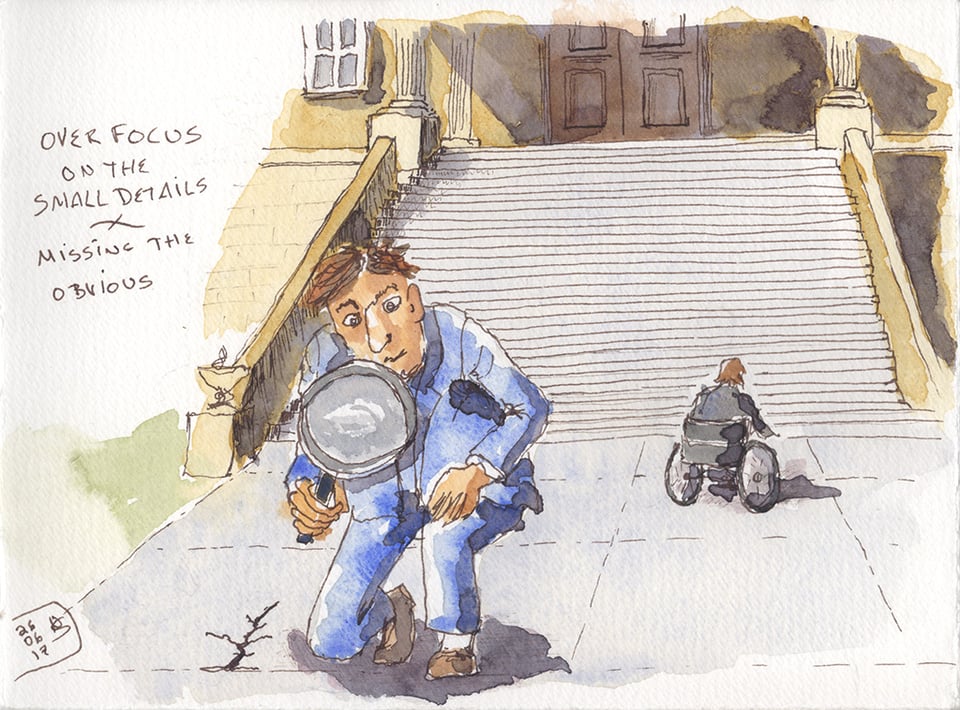
Most people move through the world without noticing the obstacles disabled people encounter. A customer walks past a store entrance that has a step or two for years without a thought. Then they break a leg and arrive on crutches, or show up trying to push a baby stroller through the door. Suddenly that step is all they can see. And they notice all the steps at the entrances of all the shops. A designer may never think about color contrast. A developer may never consider keyboard navigation. A content author may not realize that an image without alt text is invisible to someone using a screen reader.
Learning accessibility changes that. It teaches people to look closely at the decisions they make and the assumptions they carry. It widens their sense of who might be using the things they build.
But many people pass through a stage where awareness turns into anxiety. They become so afraid of excluding someone that they treat every decision as a potential failure.
Looking for problems everywhere
I've seen this happen many times in training. Someone learns about a real barrier, then immediately wonders whether dozens of unrelated things are barriers too.
They learn that flashing content can trigger seizures, and start worrying about every animation. They learn that some color combinations create contrast problems, and question whether color should be used at all. They discover that some people have cognitive disabilities, and begin to fear that any complexity at all will exclude someone.
The same thing happens in code and content. A developer hears that ARIA can help. They start adding it to native buttons and headings that already work. That extra ARIA breaks the very thing they meant to fix. A writer learns that plain language helps many readers, and strips the technical terms from content written for specialists who already know them.
The motivation is good. People want to do the right thing. But accessibility starts running on fear instead of understanding. Instead of asking whether a real barrier exists, people ask whether anyone, anywhere, might conceivably struggle. Those are very different questions.
Accessibility is not the absence of all difficulty
Part of the confusion comes from misunderstanding what accessibility is for. It doesn't mean every experience must be equally easy for every person. It means people should be able to find information, complete tasks, and make choices without unnecessary barriers.
A website can be accessible and still be challenging. A document can be accessible and still cover complex material. A form can be accessible and still take effort to fill in.
Difficulty and inaccessibility are not the same thing. Learning a new skill is hard, reading a contract is hard, filing your taxes is hard. None of that makes them inaccessible.
The fear of getting it wrong
Accessibility is often taught as a list of mistakes to avoid. Don't do this, don't forget that, don't create that barrier. Those lessons matter, but they can leave people feeling like accessibility is a minefield where one wrong step does harm.
So people freeze. A decision that should take five minutes turns into a week of meetings, because nobody wants to be the one who got accessibility wrong.
In one training session, the team spent most of an afternoon arguing about whether a single icon might confuse someone with a cognitive disability. Their checkout form, meanwhile, couldn't be completed with a keyboard at all. They worried over a maybe while a real barrier sat right in front of them.
I saw the same pattern with a content team that spent days messaging back and forth over how to describe one decorative image. In the same library, hundreds of product photos had no alt text at all. They polished the thing that didn't matter and left the thing that did.
Here's the irony. Fear of making mistakes slows accessibility down far more than the occasional mistake ever would.
Focus on real barriers
The most useful question is usually the simplest one. What problem are you actually trying to solve? Can someone get the information, complete the task, and make an informed choice on equal terms?
That question keeps the focus where it belongs. Accessibility works best when it's practical and grounded in the experiences of real disabled people. It works worst when it turns into a hunt for hypothetical problems that may never exist.
Disabled people are not as fragile as people imagine
Underneath the overcaution sits an assumption we rarely examine. We're taught to see disabled people as vulnerable and in need of protection. Most people don't hold that belief consciously, but it runs deep, and it shapes how we think about accessibility.
That picture doesn't match reality. Disabled people navigate inaccessible environments every day. We adapt, we problem-solve, we build workarounds, we learn new tools.
So accessibility sometimes drifts into overprotection. Not from bad intentions, but from trying so hard to avoid harm that we stop seeing disabled people as capable. Good accessibility widens what people can do. It shouldn't shield disabled people from the world. Pushed that far, accessibility stops being help and becomes paternalism.
The Work Between podcast
Dr. Alessondra Springmann
What have laser cutters and 100 year old sewing machines have in common? Well, check out the show and you'll find out.
Loved talking quilting, using recycled fabrics, and how to work around a body that isn't cooperating with Sondy.
Upcoming episodes
I've got 3 recorded conversations, and one upcoming interview. I'm really pleased with how things are coming. You can expect the following chats in the next few weeks:
- Róisín Curé - a comics artist and urban sketcher
- Soren Hamby - a poet and fiber artist
- Me! People tell me they want to learn about my creative process, so this will be your chance
- Devon Persing - Knitting, tabletop gaming, art journaling, who knows where that conversation will take us.
And because accessibility matters, every episode includes two human-edited transcripts. One is designed to be read on its own, like an article. The other is synchronized to the audio so you can follow along while listening.
Take a look:
Running on empty
For nearly two years, I have had an item sitting in my to-do list that simply reads:
"Write about the unexpected side effect of lack of access: PTSD and advocacy."
At the time, I knew there was an idea there, but I could never quite find the words for it.
I understood the exhaustion that comes from self-advocacy. Every disabled person knows it. The constant need to ask for access, explain barriers, challenge decisions, and sometimes fight for things that should never have required a fight in the first place.
I even wrote about that exhaustion in a recent newsletter. But I was missing the broader picture.
The impact does not come only from our own experiences. It also comes from being connected to a community of disabled people. We hear the stories. We watch friends and strangers run into the same barriers we have, and we carry their frustrations alongside our own.
And those stories do not arrive in isolation. When someone shares an experience of discrimination or inaccessibility, it often revives our own. A friend's story about being denied accommodation can bring back memories of our own battles. An inaccessible building can remind us of dozens of others. The new experience lands on top of the old ones, adding weight to a burden that was already there.
Sheri Byrne-Haber wrote something on LinkedIn that expresses this better than I could. When I read it, I immediately recognized the idea I had been trying to articulate all along. It grabbed me by the feels.
Whether you are disabled or not, I encourage you to read what follows. It explains the long-term impact of living in an inaccessible society, and why advocacy is both necessary and profoundly exhausting.
Sheri Byrne-Haber's LinkedIn post
Reprinted with permission
What happens to your personality when you spend years, if not decades, fighting for basic civil rights?
People rarely ask, so let me tell you.
You develop what researchers politely call weathering. Chronic stress floods your body with cortisol, which is designed for short bursts, not forever. It drives up your blood pressure and wrecks your sleep. Poor sleep raises your stress hormones even more, which in turn raises your blood pressure, which in turn wrecks your sleep. All of these impact your underlying disability. It is a vicious circle, and once inside, there is no obvious exit.
It shows up as exhaustion, a short fuse, or an affect in your voice that makes it sound like you have stopped caring, when really you have just run out of spoons. I do not even get to escape it in my dreams. Last night, I spent most of my REM sleep dreaming about an accessibility fight.
This is compounded by the effect of second-hand discrimination. We tend to gather in communities of people who understand us, because those are the only places we get to exhale. But it means I hear about every other person's fight too, travel events that resulted in wheelchairs being shattered, buildings they were blocked from entering, bathrooms they couldn't use, work from home requests denied without a valid reason. That is vicarious discrimination, and it lands on top of what I personally experience. The load is more than personal. It is the entire community's, carried by each of us.
You become hypervigilant. When you spend years scanning for the next inaccessible building, making backup plans for your backup plans, then anticipating the next thing that will go wrong becomes your default setting. It also makes you braced and guarded with people who mean well, which they tend to take personally.
You get blunter. You lose patience for being asked to educate gently, to soften your language, to make your request for basic civil rights more palatable to people who are inconvenienced by providing them. But after years of denials, politeness that will likely get you ignored is something you are no longer capable of mustering up.
There are some gains, too. Sharper purpose. Tighter community. An extremely low tolerance for nonsense. I would not want to give those things up. But, they all have a price, and the price is paid in pieces of who you used to be.
I am not posting this to elicit sympathy, so please don't press the support button. I am posting it to educate non-disabled people about what our lives are really like, 24/7. And to explain why most disability activists are reacting so loudly about the Title II and HHS deadlines kicked down the road another year. Because that's another year that we won't be treated equally. Another year the rug can be pulled out from under us. Because it's happened before and it will happen again, we just don't know when, who, or how.
Wrapping up
That's it for now! I hope you enjoyed the newsletter. I'd love to get feedback - What was good? What could be improved? What topic would you like me to talk about? I'm not making any promise, but if a topic you suggest catches my fancy, I'll share my opinion on it. Just hit reply to this email, or send an email at [email protected]. I read every response. And a reminder that my content is Human Generated Content #HumanGeneratedContent