The War They Didn’t Plan For
The Cost of this War is Bigger than Oil and Energy Prices
Greetings from (our home for now in) Thailand.
Last week we spent a busy Friday visiting several apartments on the island. At each one I’d try to quickly get on the Wi-Fi, and run a speed test because we need a strong enough signal to each run simultaneous online classes.
We found a place. It's solid.
We’ll remain here until a decision is made to return to in-person teaching. My students are similarly scattered all over the globe. It seems about half of them have left the Gulf but we are still teaching on Abu Dhabi local time. My first class of the day is at 12:30pm. In one class this week I had kids on the call as far west as Utah and as far east as Beijing.
We all went through this with Covid and kinda know the routine but it's less than ideal. But to be clear, I understand that on the global scale, these are 1% problems.
Subscribe nowFrom what I can tell from the replies to the last newsletter and podcast episode, the war coverage in the US seems to focus mainly on the impact on energy markets and gas prices. So this week I want to try to capture aspects beyond that narrow focus.
I wrote previously about how the administration failed to prepare the country for this war.
There was no meaningful consultation with Congress, nor effort to build public support for the conflict. There was somehow no expectation that Iran would respond by targeting US assets in the region or move to block the Strait of Hormuz.
Now, a month into the war the US is bringing more forces into the region. First a reported 2000 from the 82nd Airborne, then 2500 Marines, and now the Pentagon is reportedly considering sending up to 10,000 troops. They are doing this all the while claiming the war to be a “total victory" and to have achieved all of their unidentified "strategic goals.”
While notably the US has degraded much of Iran’s conventional military capacity and, by most accounts, retains the ability to inflict damage from the air at will, they don’t seem in control of events in the region. It calls to mind that old line about an army of lions led by donkeys.
They seemingly expected a repeat of the wham-bam-thank-you-ma’am approach in Caracas. But Iran is not Venezuela.
So where does that leave us?
I sometimes feel like I’m taking crazy pills because no one seems to remember the steps that got us here. A stated goal of the administration is to prevent Iran from obtaining a nuclear weapon, which is something Iran had already agreed to under the Joint Comprehensive Plan of Action (JCPA), negotiated by the Obama Administration in 2015. That agreement placed real, enforceable limits on Iran’s nuclear program. But the US unilaterally withdrew from the JCPA in 2018, during Donald Trump’s first term. So now a best case scenario for the conflict is to get us back to that 2018 status quo.
Prior to this war, Iran was contained. There were no missiles raining down on the Gulf States, nor were ships being restricted in their passage through the Strait of Hormuz. That is clearly no longer the case.
In an interview yesterday, the Secretary of State essentially conceded that control of the strait now belongs to Iran. In doing so he called on the G7 to help solve the problem the US has created. He notably starts by saying “now that we’re done with our objectives…”
Again, I do not know how to take a man seriously when he claims they have accomplished all of their strategic goals while putting their opponent in charge of the single most important choke point in global energy markets.
Most important there’s the human costs.
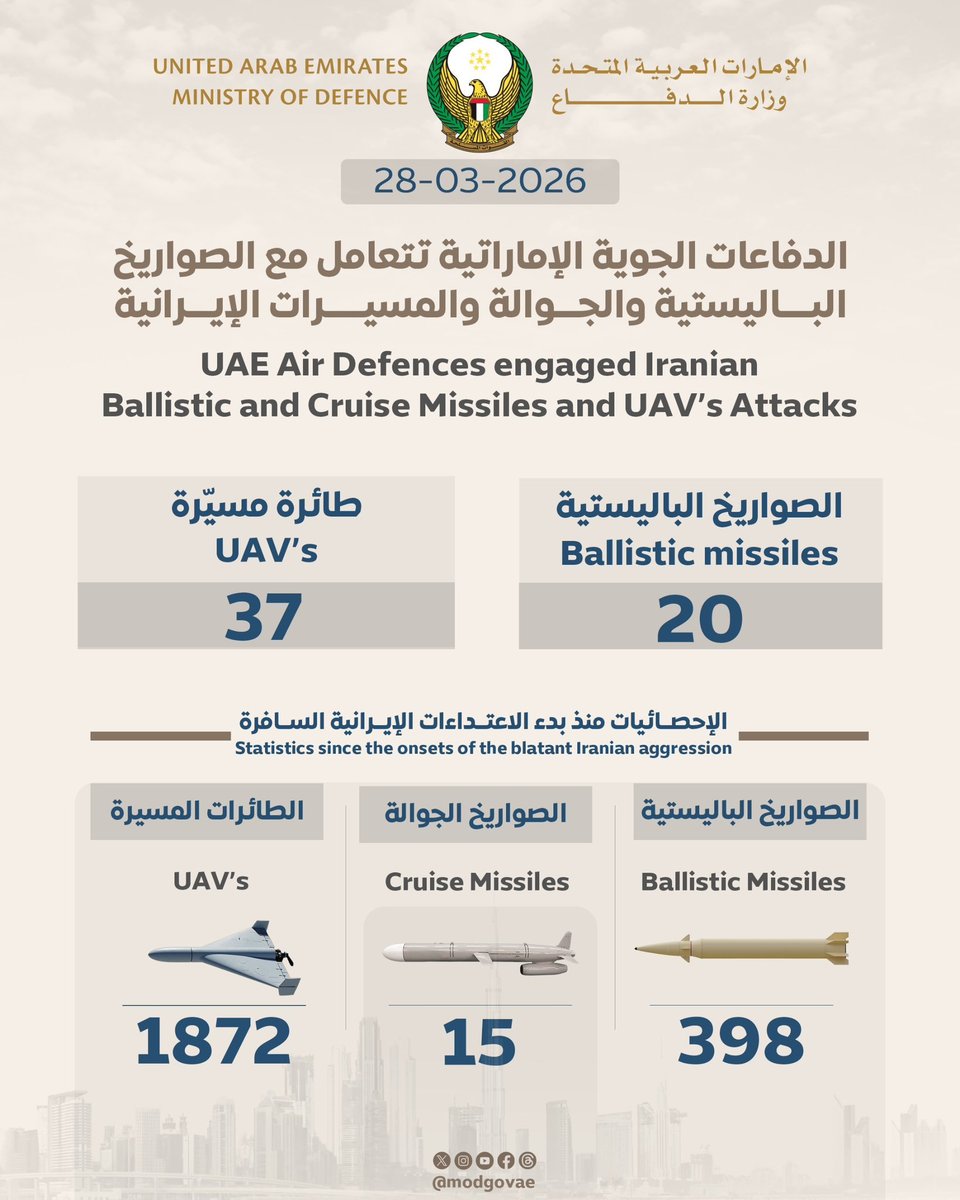
Two people died this week in Abu Dhabi from falling missile debris. This brings the civilian death total to eight, plus two members of the armed forces. The UAE and other Gulf States are protected by strong missile defense systems (here are the latest figures from the Ministry of Defense).
However, there are no such systems in Southern Lebanon which has increasingly come under fire from Israel in their ongoing war with Hezbollah. The AP are calling it an invasion and note “Israel has invaded Lebanon four times in the past 50 years: 1978, 1982, 2006 and 2024.” In this invasion the IDF is continuing their pattern inflicting harm on civilians.
The stats are dire: Over one million people displaced from their homes. More than 1100 people have been killed in the country, including 120 children.
They are also targeting medical personnel. A report from Reuters on Thursday put the number of medics killed in Lebanon at forty-two. Then, according to the WHO, on Saturday nine more paramedics were killed and seven other wounded on March 28.
The only person with the power to end this seems in over his head and unable to de-escalate the war he started.
I don’t have a crystal ball about when we’ll return to Abu Dhabi and to in-person teaching but after the US or Israel struck major universities in Iran, the IRGC is warning US universities in the region about retaliation. Here’s a quote from Le Monde (since US media seems to not be reporting on the strikes on the campuses in Iran nor the threat of retaliation):
Iran's Revolutionary Guard on Sunday, March 29, threatened to target US universities in the Middle East after saying US-Israeli strikes had destroyed two Iranian universities. "If the US government wants its universities in the region to be free from retaliation... it must condemn the bombing of the universities in an official statement by 12 noon on Monday, March 30, Tehran time," said the statement published by Iranian media.
The statement added: "We advise all employees, professors, and students of American universities in the region and residents of their surrounding areas" to stay a kilometer away from campuses.
Our school is located next to the NYU Abu Dhabi Campus.
So we’re taking it all one day at a time.