The King's Speech
The story from Washington is victory. The story in the region is much messier.
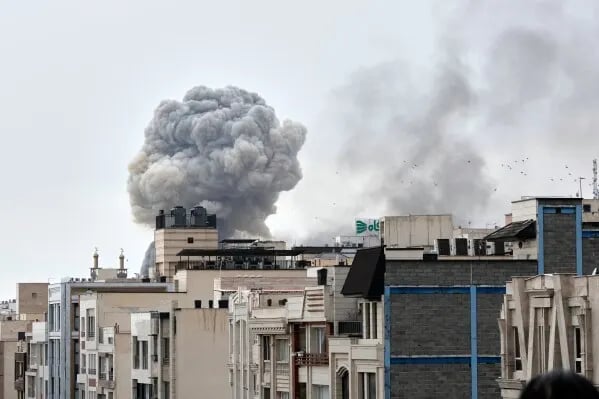
Greetings from the end of our third week on the road.
Despite the actions of our own government, we continue to be safe and well.
Subscribe nowOn Thursday morning, local time, just prior to my US Government class, the President addressed the country about the war on Iran.
The speech was a reminder of how unmoored from precedent this moment is.
It was the American President facing the nation, making the case for the war he started over a month ago. The speech was full of statements that don’t stand up to scrutiny and was off-puttingly self-congratulatory:
“Core strategic objectives are nearing completion" — The Strait of Hormuz which was open before the war is now closed and as I will highlight below, Iran retains the ability to strike US forces and their neighbors in the region.
"America, as it has been for five years under my presidency, is winning and now winning bigger than ever before” — As others have argued, this war is going to leave the US with a lower global standing and an emboldened, more hardline government in Tehran.
"We're going to finish the job and we're going to finish it very fast” — Very fast? The President began declaring victory in the war on Truth Social as early as March 3rd; it is now April 5th.
Speaking of the US, he said the country has become "the hottest country anywhere in the world” — No one with two brain cells to rub together thinks this.
I know many people have tuned him and the conflict out but, beloved, that’s how we got here in the first place.
Form-wise: it’s a speech no head of state should give and no democracy should tolerate. It was rambling and braggadocious. It seemed off-the-cuff, neither informed by history nor constrained by facts.
Purpose-wise: it is the kind of address presidents deliver to Congress when asking permission to use force, not retroactively justifying it. It was like a kaleidoscope version of George W. Bush’s 2002 “Axis of Evil” State of the Union Address.
Note that date:2002 (video below).
President Bush began making the case to the US public in January 2002; his war began in March 2003, fourteen months later. He had enough respect for the electorate to try to sell his misadventure for over a year.
This President delivered the longest State of the Union address in US history on February 24th. In that wandering, one hour and forty-seven minute address, he barely saw fit to mention Iran, but chose to initiate war with them four days later on February 28th.
Forgive me if I sound irritated as I write this, but I am. I’ve been put in danger by my own country and forced to uproot my life. I am living out of a backpack and low-key am getting sick of wearing the same damn seven pairs of underwear.
If you listen to the US government, Iran has been “utterly decimated” and their military capacity “totally eliminated.” But if you’re my students in Abu Dhabi, you’re ducking out of online classes to take shelter from incoming missiles and drones, when you should be learning about Protectionist Trade Policy and Import Quotas in developing states.
I think my readers are more informed than the average person but I think it's worth interrogating the chasm between events on the ground and the rhetoric from the Whitehouse. Brian Floyd explained the situation well: while the US military is racking up tactical victories, the war is a strategic failure.
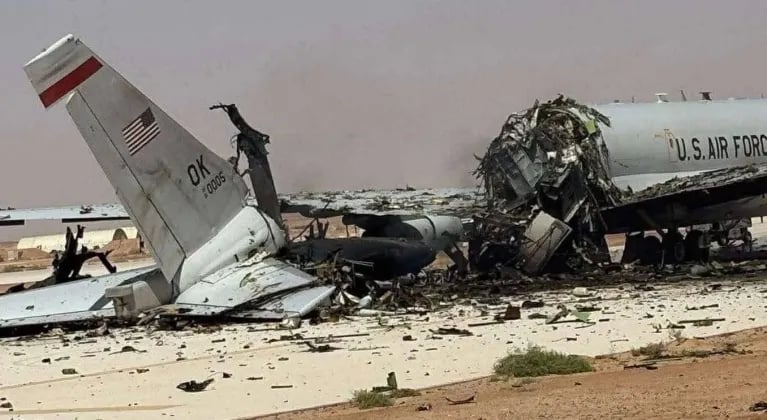
For example, on or around March 27, Iran destroyed an E-3 AWACS at a US air base in the region. This is a $700,000,000 (700 million USD) plane that serves as an in-the-sky communications platform, extending the radar range of US forces. According to Tyler Rogoway at Yahoo News, the loss is a “major development”:
The aircraft are critical for spotting incoming barrages and coordinating the air war. The US sent six to the Middle East prior to the war beginning and additional airborne early assets may be headed that way, if they are not already in theater now.
The US only had 16 E-3s remaining, with the rickety fleet nearly cut in half as it struggles to maintain readiness in its old age.
If you are like me, that $700 million replacement cost for the E3 likely caught your attention. As should the prospect of replacing the 16 that now remain in service (16 x $700,000,000 = $11,200,000,000 or 11 billion, two hundred million dollars).
But don't worry.
This week the Whitehouse chief spokesperson floated the idea that the President wanted the Gulf States to pay the cost of the war; this was reported by Reuters on March 31st. As of now, it’s unclear if this is absolutely never happening money is accounted for in the $200,000,000,000 (200 billion USD) supplemental budget request the DOD made to Congress for Iran operations on March 20th.
US policy is incoherent and its proclamations increasingly elicit mockery and derision.
Over the course of a single day, the President moves between declaring the war all but finished and hinting at dramatic escalation; between touting successful negotiations and claiming there is no one left to talk to; between insisting the Strait of Hormuz must reopen and suggesting it does not matter if it stays closed.
You get my point.
I will close this week with this video from Claude Malhuret, a center-right French MP. He took the President to task for among other things starting a war without consulting his allies and then trying to bully France and others into helping clean up the mess he made.
Elsewhere in the speech Malhuret repeated a Turkish proverb that I’ve seen pop-up several times recently: “When a clown moves into a palace he doesn’t become a king, the palace becomes a circus."
I am sick of watching the circus.
–
For some more personal takes on the conflict, here’s the latest episode of the podcast and a bit from Hope, psychoanalyzing her own cope.