Slave Patrols and ICE: A Shared History
America's authoritarian approach to immigration enforcement is an echo of its past
Whenever I write about the things that I’m gonna unpack today, I shed a handful of subscribers, but truth is a currency I value.
I got frustrated with myself this week. I'm at the limit of my ability to articulate my views about the state of affairs without sounding like a shrill alarmist or in a way that causes normies to tune out what I'm saying. So I’m just going to call it how it is.
An US city is under siege.
Masked federal agents are breaking into homes without warrants.
A record number of people are dying in their custody.
The number of ICE agents in and around Minneapolis eclipses the total number of local police in the region and they're all being told by the administration they have “federal immunity” for their crimes and actions.
Yesterday, ICE agents murdered an ICU nurse in the city; in doing so they pistol-whipped him in the face repeatedly before firing several shots into his back.
Meanwhile, military backup is reportedly on standby to invade the city.
In December, I spent time in Viktor Orbán’s Hungary, a country that has become shorthand in Western political discourse for creeping authoritarianism. Orbán governs through nationalist rhetoric, hostility to migrants, and sustained pressure on democratic institutions. And yet, during my time there, at no point did I worry that I might be stopped in the street and asked to prove that I belonged. I did not think about where my passport was. I did not rehearse explanations in my head. The question “How will I demonstrate that I am here legally to this stranger with state power?” never crossed my mind.
Weeks later, I spent time in England, moving through Manchester, Sheffield, and Derby. The UK has its own punitive immigration but my same absence of fear held. At no point did I worry that immigration agents might snatch me off the street or detain me. In both places, immigration enforcement exists as a bureaucratic and administrative reality, not as a roving presence embedded in everyday public life.
Living abroad on a work visa sharpens that contrast further.
In the UAE, being in the country illegally is treated as an administrative violation rather than a criminal one. Enforcement is firm and consequences are serious, but it is largely bureaucratic and centralized, not carried out through random street stops or roving internal patrols requesting papers on-demand from passersby.
For reasons we’ll get into in a moment, US state power is alone among similarly wealthy states in its comfort with on-demand proof of legitimacy. This “show me your papers” ethos did not emerge out of nowhere. It is an inheritance from the antebellum South.
This is likely where many of you will stop reading.
Critics of aggressive immigration enforcement often reach for Nazi or other mid-century fascist analogies. But a more historically honest move is not to ask whether the US is becoming 1930s Germany. It is to recognize that Nazi legal architects themselves studied US race law, including slavery, segregation, and immigration restriction, as they built their own system. This is a grounding premise of Isabel Wilkerson’s book Caste and this relationship was a topic we tackled on an episode of the podcast in 2021, featuring Erin Jones, Halley Knigge, and the President of Pacific Lutheran University, Allan Belton.
If we want to understand the particular authoritarian flavor of US immigration enforcement, we need to look inward, not outward.
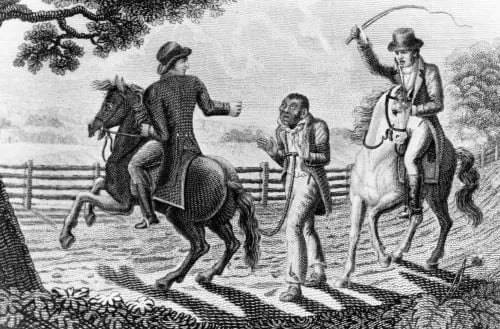
Before the Civil War, the South developed an extensive internal security apparatus to maintain slavery. Slave patrols, established as early as 1704 (decades before the founding of the country), were organized groups of white men authorized to monitor, stop, interrogate, and punish enslaved people. Patrols searched plantations for weapons, broke up gatherings, enforced curfews, and, crucially, stopped Black people on roads and demanded proof that they were authorized to be where they were.
Enslaved people traveling beyond their plantation were required to carry passes issued by their enslavers. Free Black people, especially in slave states, were often required to carry papers proving their status. The absence of documentation was itself treated as evidence of criminality. Is any of this sounding familiar?
Patrols were empowered to detain, whip, or kill on suspicion alone. The law presumed guilt and demanded proof of innocence.
Slave catchers were not merely symbolic figures. They were professionals. Men like Fontaine H. Pettis built careers on crossing state lines to seize human beings, often abducting free Black people along the way.
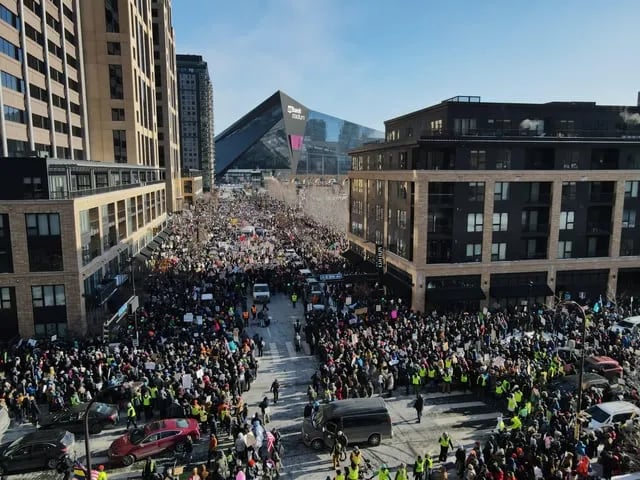
Northern cities responded by forming vigilance committees to protect their residents. Sit on that one for a moment and think about Renee Good, Alex Pretti, and the work the community in Minneapolis is doing.
After the Civil War, the formal institution of slavery ended, but its enforcement logic did not disappear. Southern states repurposed and repackaged patrol practices into Black Codes and later Jim Crow policing. Being unable to prove employment or residence could land a Black person in jail or on a chain gang. The state continued to treat mobility itself as suspicious when exercised by the wrong people.
This history matters because modern immigration enforcement in the US operates on the same foundational assumptions. ICE agents do not need to witness a crime to initiate an encounter. Immigration law treats presence without documentation as a civil violation, but enforces it through detention and armed raids, often in collaboration with local police. Like slave patrols, ICE is oriented toward identification, capture, and removal. Its power rests on the ability to interrupt daily life and demand proof of legitimacy on the spot.
Many countries have harsh immigration policies. What is distinctive about the US is the depth of the internal enforcement culture and the ease with which the state claims the authority to question someone’s right to exist in public space.
This is where the Nazi comparisons require care.
The influence ran in the opposite direction of the analogy most people make. The US did not borrow racial legal structures from the Nazis. The Nazis borrowed from the US.
Understanding this lineage reframes contemporary debates. When immigrants in the US fear consequences from not carrying their documents at all times, their fear is not paranoia. It is historically rational. It is the inherited memory of a system in which freedom was conditional, mobility was policed, and papers are the thin line between belonging and disappearance.
The country survived for 216 years without a paramilitary immigration enforcement force roving its cities.
The US Constitution was ratified in 1787. ICE, in contrast, is a creation of my adult lifetime, established by Congress in 2003 during the long post 9/11 national fog. Its creation, like the Patriot Act and Iraq War, was a mistake.
It's always the right time for justice. It's time to abolish ICE.