New Year, News Detox
Balancing the desire to avoid misinformation and state propaganda while still staying informed
A repeated theme in this newsletter is my obsession with making sure my news diet is as free as possible of propaganda and misinformation. I try to be circumspect about what I consume and what I share. For example, you’ll note that most of the time when I’m linking to an outside source or a story about a news event, I try to link to a reputable outlet such as the Associated Press or Reuters rather than blogs or other opinion pieces.
This gets at one of the core issues with the information environment in the US; Americans are awash in opinion masquerading as news.
The primetime lineups on cable news channels, watched by millions, are largely pundits pontificating about events. The outrage-bait New York Times op-eds (Did Liberal Feminism Ruin the Workplace?) are not news. Generally, any podcast, blog, or newsletter you consume, including those produced by yours truly, are founts of opinion.
Don’t even get me started on your Facebook feed or your TikTok FYP.
Both in my classroom and in my life, I try to emphasize the importance of actually consuming news about what’s going on in the world and staying informed, without partisan bias and hot takes.
At the same time even our “hard news sources” are failing to live up to the moment.
Last week in the newsletter I briefly addressed the shooting by ICE agents of Renee Good, an unarmed woman in Minneapolis. This week I found myself flabbergasted by the coverage of the shooting from CNN. The Department of Justice is actively investigating the person who was shot rather than investigating the actions of the officer that shot her, while running a misinformation campaign to discredit her in the public eye.
Here is CNN shamefully taking the bait:
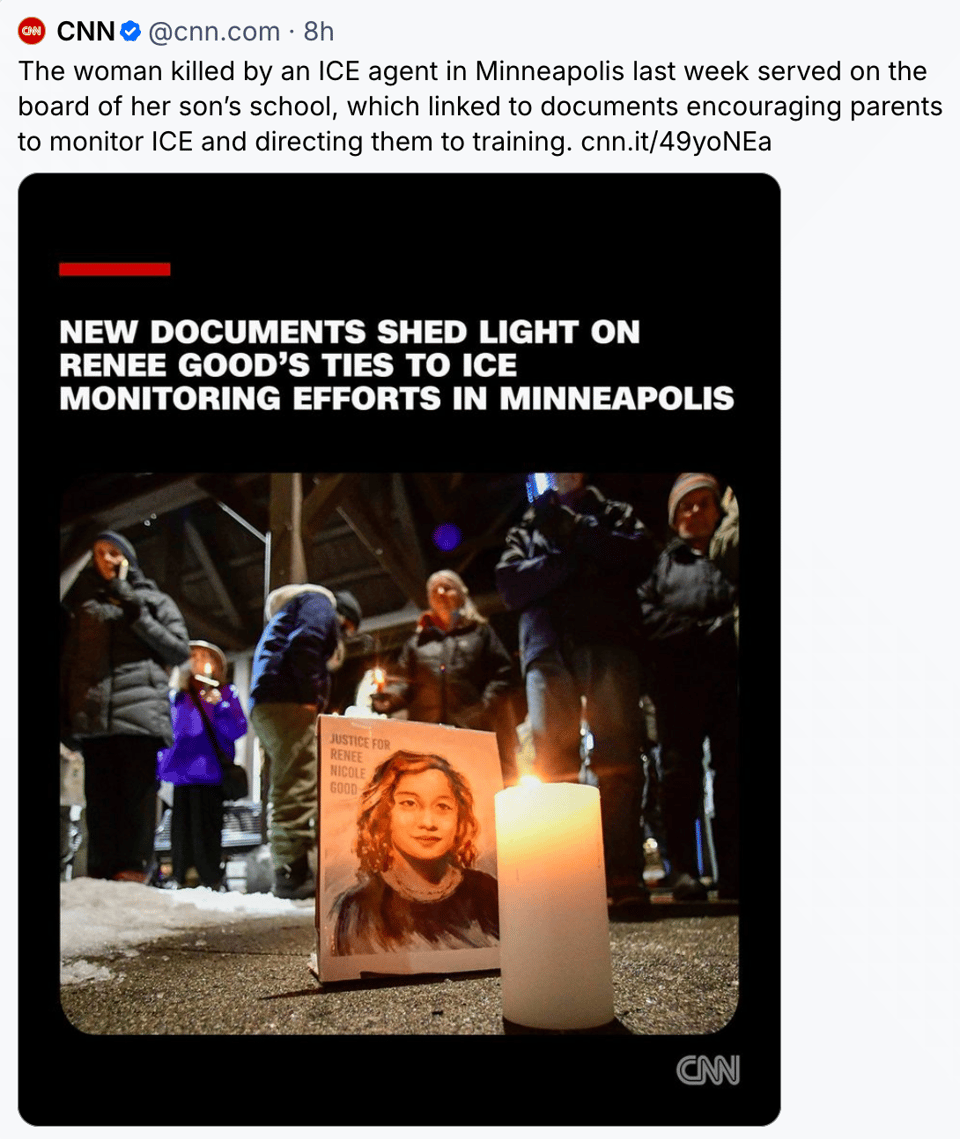
To be clear, her ties don’t effing matter! A victim of murder should not have to have their affiliations litigated in the public afterwards. But this is the game the DOJ wants to play and the path ostensibly reputable media sources are following them down. The problem here is they know better and they say as much in the piece, but far more people are going to see that social media post than make it to paragraph four or five of the article where they get around to stating the obvious:
But four legal experts who reviewed the documents for CNN said they largely describe nonviolent civil disobedience tactics practiced at American protests for generations – far from the sinister depiction of extremism and domestic terrorism portrayed by Trump administration officials like Homeland Security Secretary Kristi Noem and Vice President JD Vance.
“There’s nothing in there that suggests attacking ICE agents or engaging in any other form of physical harm or property damage,” said Timothy Zick, a professor at William and Mary Law School who wrote a book on protest law. “This is authoritarianism 101 where you blame the dissenters and the activists for causing their own death.”
That headline is journalistic malpractice; there's no other way to describe it. And on Wednesday evening ICE agents subsequently shot two more people in Minneapolis.
To that end, this week I want to talk a bit about a specific aspect of my news diet. My wife and I have worked together at the same schools for over a decade; this means we share a commute. Our drive here in Abu Dhabi is about 20 minutes door to door. No matter how much you love the other person, there is a finite amount of small talk you can have in the morning, particularly after more than a decade of mornings together.
Sometimes we listen to music.
Other times we listen to audiobooks.
For example, we listened to the entire Silo series by Hugh Howey a few years back. Last year we listened to Jordan Harper’s Last King of California on our commutes.
We are both avid podcast listeners, but we have very different tastes. My preference is for soccer podcasts like Stadio or The Athletic FC. She prefers something a bit more conversational, like the Slate Culture Gabfest or Higher Learning.
At some point, we decided to give “daily news podcasts” a shot. We’d listen to the show and talk about it afterwards or on the way home. By now we have cycled our way through all the major ones. What follows is a review of each.
The Good
Reuters World News. I view UK-based Reuters to be among the most reputable English language news sources out there and their podcast lives up to that standard. Each episode is roughly 10 minutes and gives you a broad glimpse at what's happening around the world. The host does near-zero editorializing and there's not even much commentary from “experts.” It is just a blow-by-blow of the headlines. It's neither sensationalist nor sane-washing; it is just a recap of events the prior day and preview of what’s ahead.
It's actually kind of boring. There's no gimmicks or banter like with the Vox show. You just get the news from a revolving cast of reporters based in New Zealand, London, and New York.
It's the best of the bunch and if you are interested in being informed about the world from an international perspective, without American partisan baggage, it's one thousand percent the move.
The Bad
Vox: Today, Explained. The rotating casts of hosts are each delightful human beings, and the editorial tone of the show is more aligned with my technocratic worldview. But there are just too many damn ads! There are also too many gimmicks. I’m listening to you on my way to work because I want to know what’s happening. I’m not really here for host banter. It's vexing because I use Vox videos in my classroom to help teach about various happenings around the world and their videos are much more “just the facts ma'am.” But the podcast is doing too much and being too cutesy and in between that and the commercials I find it unlistenable.
The Daily from The New York Times, hosted by Michael Barbaro. At one time I was a fan of this show and an evangelist for it, but somewhere along the way I fell out of love and it departed from what made it essential.
The show has developed an editorial bent that I find exasperating. It presents itself as a news show, but it has a reactionary orientation that became especially difficult to listen to during the Black Lives Matter protests in 2020. Eventually, it became untenable for me and I dropped it from my diet.
I also find the contrived voice Barbaro uses to be insufferable.
The Ugly
BBC Newscast. I think people give the BBC more credit than it deserves. Its daily news podcast, Newscast, is horrible. They offer a steady diet of “man on the street” (or random pundit perspectives), but don't balance them out with subject matter experts.
Instead, you'll get an unhinged Floridian talking about how the Trump administration should overthrow some Latin American regime with no regard for the constitutionality of said act nor its legality under international law. I also get the sense that the editors at the BBC have concerns about accusations of anti-semitism so they overcompensate by being far too deferential to the Netanyahu government when talking about events in Gaza and the West Bank.
It’s shockingly bad.
The Journal from The Wall Street Journal. My relationship with Rupert Murdoch’s Wall Street Journal is complicated. In many ways, I think the WSJ is a better newspaper than the New York Times, but the Opinion page is unhinged, reactionary pablum—the print equivalent of an episode of The O’Reilly Factor in its heyday. On the other hand, I’m kind of a closeted finance bro, so I went into this show expecting decent news coverage with a strong financial bent.
This show does its listeners a disservice by sanewashing the excesses of the administration. Rather than discussing the legality of the President’s actions in a given instance, it focuses on political response and aftermath. In doing so, it grants legitimacy to acts that are clearly illegitimate and, in some cases, illegal.
The Journal normalizes the abnormal while providing surface-level discourse about genuinely pivotal societal issues. I’m going to link below to an episode about Robert F. Kennedy Jr.’s MAHA movement. If you can make it more than seven minutes into it, you are a better person than me.
We are living in extraordinary times and I think many of us are tempted to unplug from the world. But what we really need to do is evaluate our information environments and guard our attention and energy. If that makes sense to you or you are on a similar journey I would love to hear where you are getting your news or wherever you are in this process.
–
If you dug this edition of the newsletter, you’ll likely enjoy this conversation on the podcast with UPS Communication Professor Nick Brody about what he calls Morally Motivated Networked Harassment. These are the online pile-ons oft driven by influencers that plague social media.
See you next week.