It's Giving Rogue State
The US has no regard for the institutions it helped create and the results are predictably terrible
Greetings from our temporary home in Koh Lanta.
Welcome to the rare midweek edition of the newsletter. Sunday was a sort of transition day for us in our new temporary situation. I would be lying if I said my head isn’t spinning a bit. We went from the sound of missiles being intercepted overhead to the sound of monkeys crawling on our roof.
It's all a bit surreal.
Far more people subscribe to and listen to the podcast than read the newsletter, but (my beloved) newsletter readers correspond more. I'm not a stalker and don’t pay for granular subscriber data, so I’m not always sure how much the audience Venn diagrams overlap. Thus, if you want a more detailed discussion of how things are going for us personally, I suggest the most recent episode of the podcast, called An Update from Gulf War III.
If you were a show listener in the past, I’d be honored if you would check out the most recent conversations. Rather than the usual interviews, they are 20-ish minute discussions between Hope and me about the war and its destabilizing impact on the Middle East and our lives.
Subscribe nowWhen I started seeing people call the war on Iran Gulf War III, it helped illustrate the go-it-alone, rogue-state energy emanating from 1600 Pennsylvania Avenue.
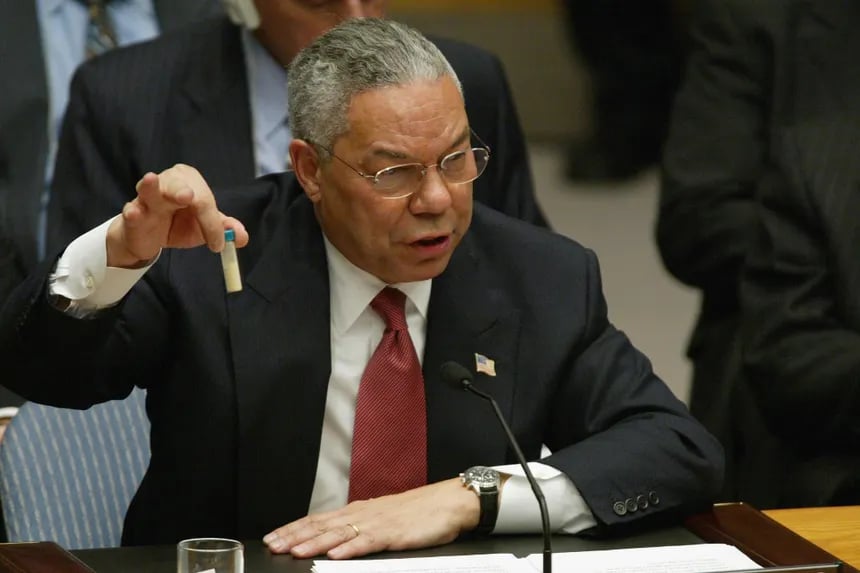
In early February, my colleague [Redacted] came into my classroom and, as we are wont to do, we had a brief conversation about regional politics. This was the moment when the US was building up its forces in the Middle East, sending a second carrier group into the region. He noted, astutely, that the President was skipping “the going to the UN phase.” We’re both old enough to recall when Colin Powell went to the UN and waved vials of alleged chemical weapons , talking about scary “yellowcake uranium” and “aluminum tubes” to the Security Council. That attempt to gain the UN endorsement for a war failed, but the fact the Bush Administration tried it is telling.
To further understand Gulf War III, let’s briefly look at each of the prior US wars and what they tell us about the decreasing concern over international legitimacy and public opinion.
In 1990, President George H. W. Bush went to the UN and received Security Council approval for the use of force following Iraq’s invasion of Kuwait. He then built a broad international coalition of more than forty countries, including key Arab states, to participate in what became Operation Desert Storm. He also sought and received authorization from Congress before launching the military campaign.
In 2003, his son President George W. Bush went to the UN Security Council to argue that Iraq had weapons of mass destruction and was violating prior resolutions, but failed to secure authorization for the invasion, with major powers like France and Germany opposed. The coalition that followed was smaller and less representative than in 1991. Even so, the administration still went to Congress and obtained bipartisan authorization for his war.
You see the pattern.
In 2026, the President is alone.
The US is increasingly acting outside of the post-World War II international order it helped create.
No attempt at UN authorization.
No consent sought from Congress.
No attempt to explain the case for the war to the American people during his State of the Union address.
No attempt to build a coalition of allies before the war.
I am not making normie lib complaints about “the international order” — this is instead a warning about an entire system in collapse.
This president is uniquely indifferent to the art of statecraft, and now finds himself trying to build a coalition three weeks into the war, with thousands of dead civilians in the region, at least 200 US servicemembers injured, with no end in sight.
I'm not the kind of cat who goes around quoting the slave-owning founders as some sort of moral figures. Nor do I think much of those who do, but the concept of separation of powers goes back at least as far as Montesquieu in 1750, and the requirement for congressional consent to war is about as straight-forward as anything in the whole Constitution.
This war is not just dumb, it's illegal under both international and US law. But none of that seems to matter right now.
What do you call a country in which one person with no regard for public opinion or the legislative process can launch a war?
What do you do when the person elected to the highest office in the land seems to have no idea how anything works on the international stage nor any interest in learning?
What do you do when a person who probably couldn't locate Iran or the UAE on a map decides to start a war where they have no discernable strategic goals nor sense of the very predictable second order effects, like the closing of the Strait of Hormuz?
I kind of can't believe that it's come to this. But this is what you get when an electorate is motivated mainly by spikes in gas prices and moral panics about the bathrooms transgender people should use.
Who will tell him “no”?
Who can tell him “stop”?
The war is a trap of his own creation.
–
Here’s a bit from Hope with her perspective on the war and how it disrupted the region: Is this your first war?
I'm going to leave you with a Moment of Zen, a picture from my morning commute