A Zero Consequence Society
The total lack of accountability for elites is the worst type of "American Exceptionalism"
Happy Sunday, and Ramadan Mubarak to those observing.
Hope and I took a road trip up the coast to Umm Al Quwain, one of the Northern Emirates last weekend, hence the newsletter hiatus. We stayed at the Palma Beach Resort, which is famous round-these-parts for once using an abandoned Russian cargo plane as a billboard.
The aircraft had belonged to Viktor Bout, the so-called “Merchant of Death,” who ran weapons into conflict zones across Africa and the Middle East in the early 2000s. Bout was eventually arrested, extradited to the US, put on trial, and sentenced to twenty-five years in prison.
But in 2022, Bout was released to the Russian government in Abu Dhabi as part of a prisoner swap for WNBA star Brittney Griner.
That story is mostly an aside. But these are the rabbit holes I fall into on Wikipedia when sitting poolside.
A defining feature of the American experience in my adult life has been the absence of consequences for elites.
I first noticed it after 9/11.
The country suffered numerous catastrophic (that word isn’t nearly strong enough) intelligence failures. But no one was fired; no one was forced to resign. The 9/11 Commission identified systemic breakdowns across agencies, enough to warrant the creation of a brand new cabinet department: Homeland Security. Yet at the highest levels of government, there was no meaningful accountability. Careers continued. Reputations endured. Some random guy at a flight school in Florida was blamed more than the intelligence community or the national security apparatus.
We saw it again after the Iraq War.
The US invaded the country under false pretenses about weapons of mass destruction. Roughly 4400 servicemembers were killed. Hundreds of thousands of Iraqis were killed in the war and civil war that followed. The entire Middle East region was destabilized and economist Joseph Stiglitz estimated the total cost of the war and occupation at $3 trillion.
The architects of the war remained fixtures in public life. Hell, the last time I was in DC, I sat next to Paul Wolfowitz, one of the war’s intellectual architects, in the hotel lobby.
Then came Hurricane Katrina.
Images of Black residents stranded on rooftops in New Orleans became part of our national memory. We watched people abandoned by every level of government, begging to be rescued. In one incident, people trying to evacuate, rather than being rescued, were attacked on the Danziger Bridge by law enforcement and vigilantes.
Nearly 2000 people in total died in the storm and the aftermath.
The failure in New Orleans was obvious. Accountability at the highest levels was not.
In 2008, the financial system collapsed under the weight of subprime mortgages packaged into “triple-A securities” called Collatorialized Debt Obligations (CDOs). Millions lost their homes and savings. Very few senior executives at major financial institutions faced criminal prosecution, and none of the chief executives of the largest banks went to prison.
You can trace the pattern for decades. Catastrophic failure. Enormous human cost. Minimal elite consequence.
This week, however, offered a stark contrast.

In South Korea, former president Yoon Suk Yeol was found guilty of leading an insurrection after declaring martial law in 2024 and sending troops to surround the National Assembly. He was removed from office. He was prosecuted. He was sentenced to life in prison.
In the United Kingdom, Prince Andrew was arrested and held for questioning on suspicion of misconduct related to sharing confidential trade information with Jeffrey Epstein. Police searched his former residence. The British government is considering legislation to remove him from the line of succession. He has already lost royal titles.
Two weeks ago, British Prime Minister Keir Starmer faced intense political pressure because of his tangential connections to the Epstein scandal. Starmer was not accused of any direct involvement, but in British public life, even a second-degree connection brings fierce scrutiny.
Starmer’s chief-of-staff, Morgan McSweeney, resigned after it emerged that a person he had recommended for the position of UK ambassador to the US, Peter Mandelson, appeared in the Epstein files. Mandelson was also forced to resign.
This is what accountability looks like in a functioning democracy.
Now consider the US.
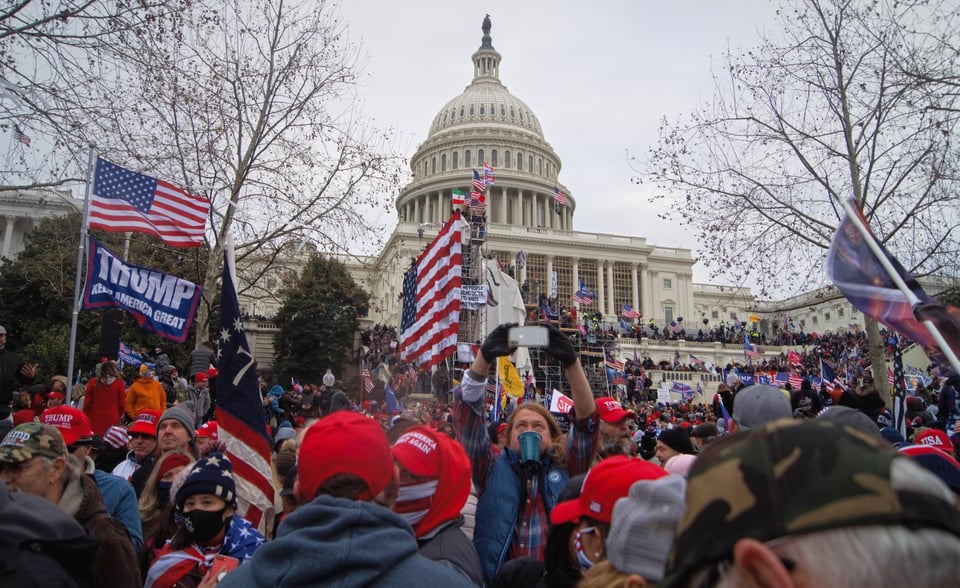
On January 6, the sitting president attempted to overturn an election and inspired a mob to attack the Capitol. Donald Trump remains the dominant figure in his party and central to American political life.
When he regained power, he pardoned the Capitol rioters.
In the most recent DOJ release from the Epstein investigation, that same President’s name appears thousands of times. The President claims the thousand of mentions absolve him of any wrong-doing (see video below).
In a rational and functioning democratic state, either of these events would be career ending for an executive. In the US, it is simply absorbed into the partisan bloodstream and normalized.
Over time, that absence of consequences changed us. It eroded our institutions and their competence. We started to expect and accept conflict of interest, corruption, and graft. And it’s most corrosive when mixed with the elixir of partisanship, where the other side can do no right and your chosen clique can do no wrong.
As a veteran educator, I’ve seen several children raised in consequence-free households, shielded from responsibility for their actions. They don’t learn from mistakes—they make excuses. Everyone else is to blame.
The danger is not only that powerful people get away with too much. It is that everyone else notices. And once a society internalizes the belief that accountability is a fiction, the moral foundation of self-government begins to give way.
We can argue about when it started. We can debate which scandal mattered most. But the pattern is undeniable and the contrast with other democracies is impossible to ignore.
–
Check the podcast feed for two back-to-back episodes this week. One is a conversation with Minnesota State Teacher of the Year and author Tom Rademacher about his decision to leave the US in January and subsequent events in Minneapolis.
The other is a conversation with University of Puget Sound History Professor Douglas Sackman about the Gilded Age and the lessons we can learn from that historical moment.