A loop is a loop is a loop
Negative feedback is good, actually

Hello friend, thanks for clicking in!
This week, some thoughts about feedback and why we need a cybernetics renaissance.
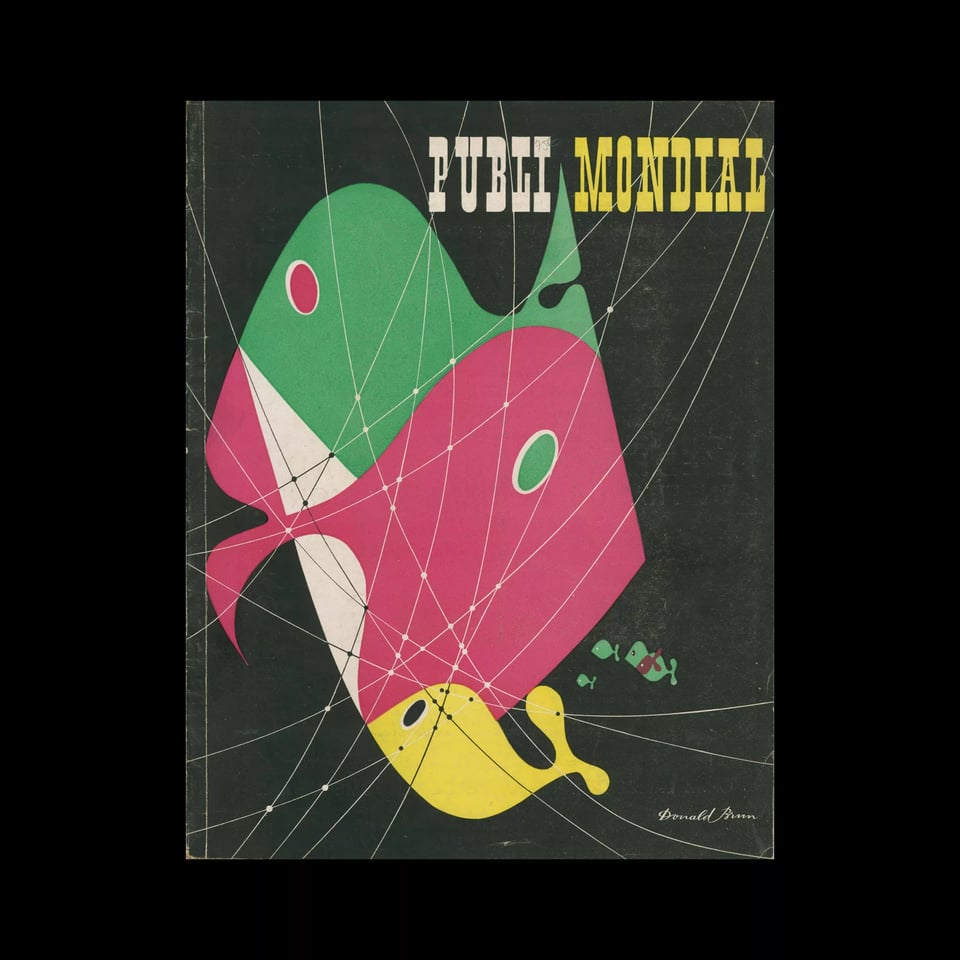
Scroll to the end for a trippy modernist fishing trip from the same year Norbert Wiener’s first book came out.
More after these messages…

Friday, November 20 @ 10am PST How to Sell | Oh, the weather outside is frightful, but getting your ideas, your services, and your stuff to the people who need them is delightful.
🌦️
Thursday & Friday, December 10 & 11 @ 10am PST | How to Present with Confidence | Spend 6 hours in a small, supportive group tearing your story down to the studs and building it back up again.
🤯
Does your organization need help busting through an uncomfortable conversation to get to the productive harmony on the other side? We now offer Snap Facilitation.
Feedback, we’re talking about feedback
Years ago, while working with a non-profit media organization, we hit a confounding impasse.
It was one of those major website redesign projects, the ones you hear tell of in legends. We had gone through the discovery research and all was well: mutual understanding, positive regard, and excitement to move forward. We completed information architecture without a snag.
Then we got to the visual concept. Diverge-converge. Explore variations, narrow to a direction, move ahead to detail out the design system. Familiar territory…to us.
The first couple rounds were normal. We presented some sketches. The client team made comments. We asked clarifying questions and made changes and refinements. We were on schedule and everything was seemed good. The client approved a direction. Great!
Then, at the next meeting it got weird. We showed the final form of the concept they’d approved. They made complimentary noises. But they didn’t sound excited. The following Monday, ten pages of very detailed notes showed up on the project site. A follow-up call ensued with reassurances. Then, revisions and another meeting.
And it the same thing again.
This is all great.
We’re happy with the direction.
There are just a few little things.
Over the next four weeks, the words stayed more or less the same, while the tone felt off in a way we couldn’t interpret.
The notes ran longer, more detailed, more contradictory, with links to other websites as polite suggestions. We made revisions. We put our Gantt on the rack and stretched.
Finally (this was the first time anything like this had happened, so it took a minute to snap out of it), I called the executive director directly.
What is going on? I asked.Your team says positive things in the meetings, but no one sounds happy. Then we get a stack of notes with highly specific, yet inconsistent feedback. We are so confused, and we’re making no progress.
Oh, he replied, everyone actually hates the direction we’re going. It’s just not right. We keep hoping you’ll show something different.
…
Once I’d recovered, I said,You know, you have to tell us when something’s wrong. Otherwise, we’ll keep taking you at your word when you say it’s right.
The thing is, he said, they all like your team so much they didn’t want to demotivate you with negative feedback.
You know what’s demotivating? Being misled (even out of misplaced kindness), and ending up a month behind on a flat-fee job.
It was such a relief knowing the truth, though. The truth is something we can work with. We wrote up a set of feedback questions with explicit instructions.
They followed the instructions perfectly and answered the questions in one unified voice. We received this useful, coherent input, and turned around a new, much stronger set of designs, which they loved.
Deep sigh.
On every subsequent project, we’ve prefaced every presentation with a little speech
We’re professionals. You can’t hurt our feelings. Assume we have no feelings. Your direct communication and honesty is critical to the process and your negative feedback is far more useful than your positive feedback.
We never found ourselves in that particular situation again. Other situations, sure. But we’d learned that — especially in non-profit organizations — nice people often need explicit permission to give negative feedback, and they need instructions. Building that ritual into the process was a huge time-saver.
I wasn’t thinking about it at the time, but this whole interaction is a fantastic illustration of a core principle of cybernetics.
Positive feed-back adds to the input signals, it does not correct them. The term feed-back is also employed in a more restricted sense to signify that the behavior of an object is controlled by the margin of error at which the object stands at a given time with reference to a relatively specific goal.
All purposeful behavior may be considered to require negative feed-back. If a goal is to be attained, some signals from the goal are necessary at some time to direct the behavior.
“Behavior, Purpose, and Teleology” Rosenblueth, Wiener, and Bigelow Philosophy of Science, Volume 10, Issue 1 (January 1943)
Teleology is the philosophical approach of explaining causes in terms of goals. According to this paper, a goal doesn’t imply a conscious mind or a will. It’s not a mental state, but an end state with a self-correcting mechanism that refers to it.
Building on this paper, mathematician and philosopher Norbert Wiener defined the term cybernetics in his foundational book. Cybernetics: Or Control and Communication in the Animal and the Machine, in 1948.
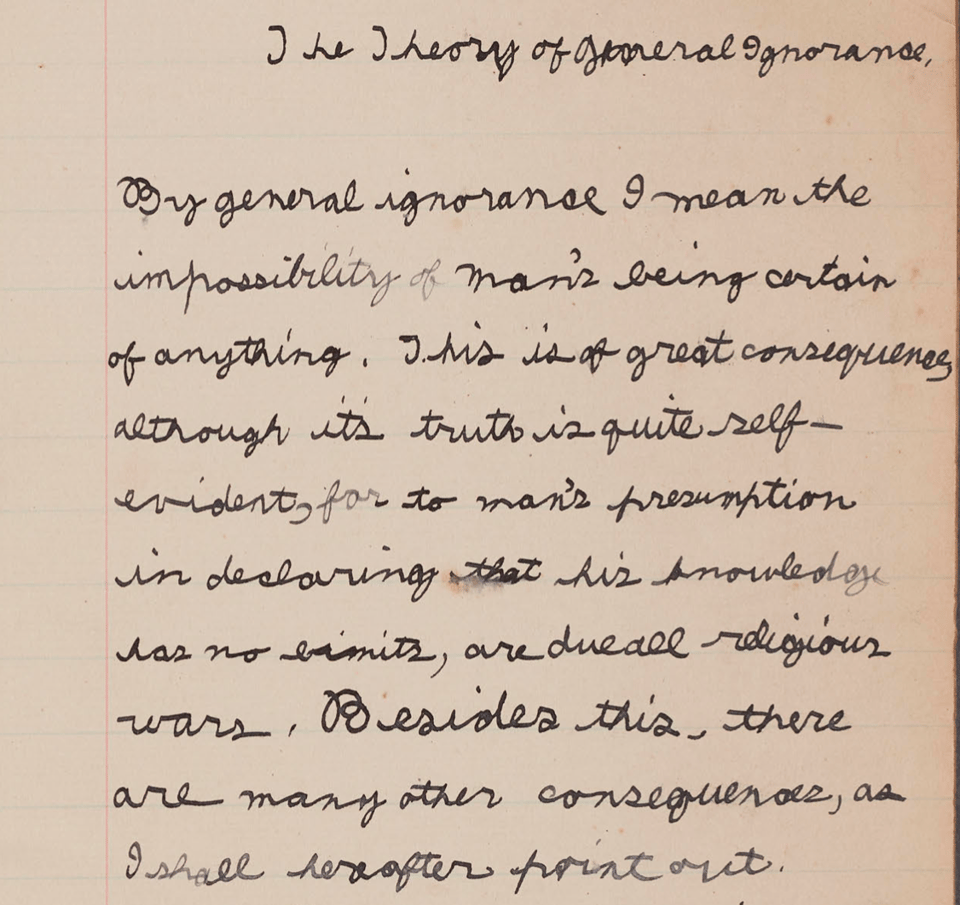
Cybernetics is the study of communication, control and regulation in organizations, machines, and systems. As child prodigy and mathematician Wiener had already began boldly at age 11 with “The Theory of Ignorance,” arguing that human understanding is limited and absolute certainty is impossible.
According to this framing, nothing goal-directed will correct course without negative feedback, a signal that the current trajectory is off the mark (and by how much and in what direction). But to many people, who do not think in terms of cybernetic feedback loops, negative feedback has negative connotations. Acting as a source or conduit of helpful, intentional feedback is a skill, and an underdeveloped capacity in many organizations.
(And then there are the dangers of chatbot sycophancy.)
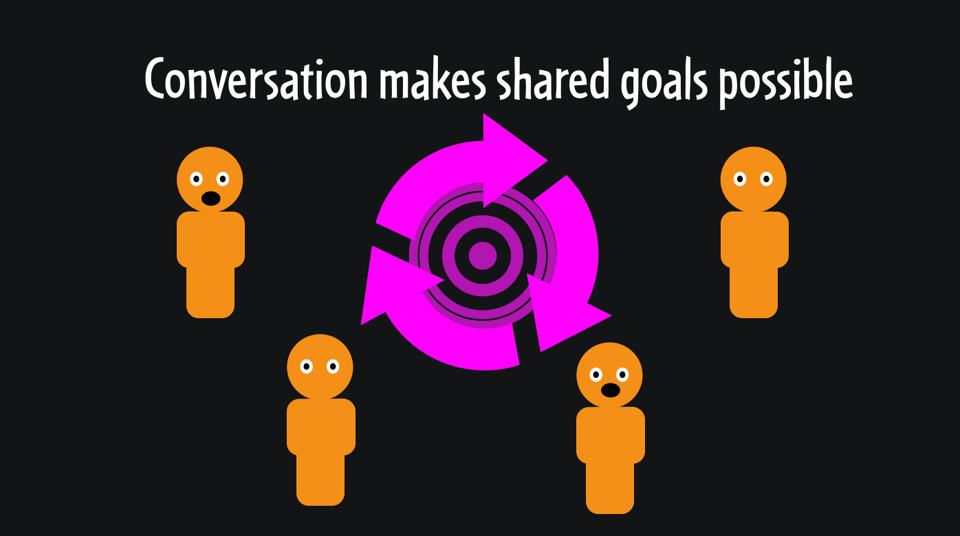
We’ve never found the speed of making artifacts to be the limiting factor. It’s always the clarity of communication and order of decisions. Because design is foremost a conversation.
A lot of communication called “feedback” is actually a personal reaction that’s more about the source than the signal, and may or may not contain useful information. (The literary critic I. A. Richards proposed feedforward as a more future-focused, anticipatory mechanism. This term is used in several fields with varying technical definitions, and sometimes shows up in management articles as an alternative to feedback, because it sounds more like making progress. But there are downsides in many contexts to ignoring past errors in favor of an idealized model.)
It’s always a good practice to pause and reflect on your goals before you give any input.

Cybernetics comes from the Ancient Greek κυβερνήτης (kybernētēs), boat steersman or captain. French physicist and philosopher André-Marie Ampère (yes, amperes), who was keen on Greek, first used "cybernetics" in 1834 to refer to the science of governing, inspired by the ship of state metaphor that goes all the way back to Plato.
Imagine then a fleet or a ship in which there is a captain who is taller and stronger than any of the crew, but he is a little deaf and has a similar infirmity in sight, and his knowledge of navigation is not much better. The sailors are quarrelling with one another about the steering—everyone is of opinion that he has a right to steer, though he has never learned the art of navigation and cannot tell who taught him or when he learned, and will further assert that it cannot be taught, and they are ready to cut in pieces anyone who says the contrary. They throng about the captain, begging and praying him to commit the helm to them; and if at any time they do not prevail, but others are preferred to them, they kill the others or throw them overboard, and having first chained up the noble captain’s senses with drink or some narcotic drug, they mutiny and take possession of the ship and make free with the stores; thus, eating and drinking, they proceed on their voyage in such manner as might be expected of them.
— Plato, The Republic, Book VI (The Philosophy of Government)
Plato would have enjoyed Below Deck.
The Macy conferences, source of many foundational ideas in the field, take their name from Josiah Macy, Jr., himself a sea captain and oil company executive. Boats.
William Gibson popularized cyberspace (“a consensual hallucination experienced daily by billions of legitimate operators”) in his fiction as a narrative device, but the term first appeared in the late 1960s, when Danish artist Susanne Ussing and her partner, architect Carsten Hoff set themselves up as Atelier Cyberspace.
It’s wild how the words that become a part of our cultural infrastructure just pop out of someone’s brain via mouth or hand. Gibson had this to say in the 2000 documentary No Maps for These Territories:
All I knew about the word "cyberspace" when I coined it, was that it seemed like an effective buzzword. It seemed evocative and essentially meaningless. It was suggestive of something, but had no real semantic meaning, even for me, as I saw it emerge on the page.
Cyber is just a cool prefix, I guess. Maybe there’s no cyberspace, but I am hyped for Neuromancer on TV.

There are a lot of reasons why cybernetics fell out of favor and artificial intelligence keeps coming back around after each successive failure to build-a-brain. I think a lot of it comes down to the fact that “AI” is a really compelling metaphor and humans just have an easier time with storytelling than with systems thinking.
That’s how we end up with doomer rhetoric about applied linear algebra that sounds more like Sinners in the Hands of An Angry God than computer science.
There is no Want of Power in God to cast wicked Men into Hell at any Moment. Mens Hands can’t be strong when God rises up: The strongest have no Power to resist him, nor can any deliver out of his Hands.
Jonathan Edwards, OG doomer, July 8, 1741
Read that bit about getting dangled like a spider over a fire in 10th grade and it sticks.
It’s easier to conceive of inventing an omniscient, omnipotent entity that will decide everything for us than to take responsibility for understanding and intentionally intervening in the complex systems we construct and participate in.
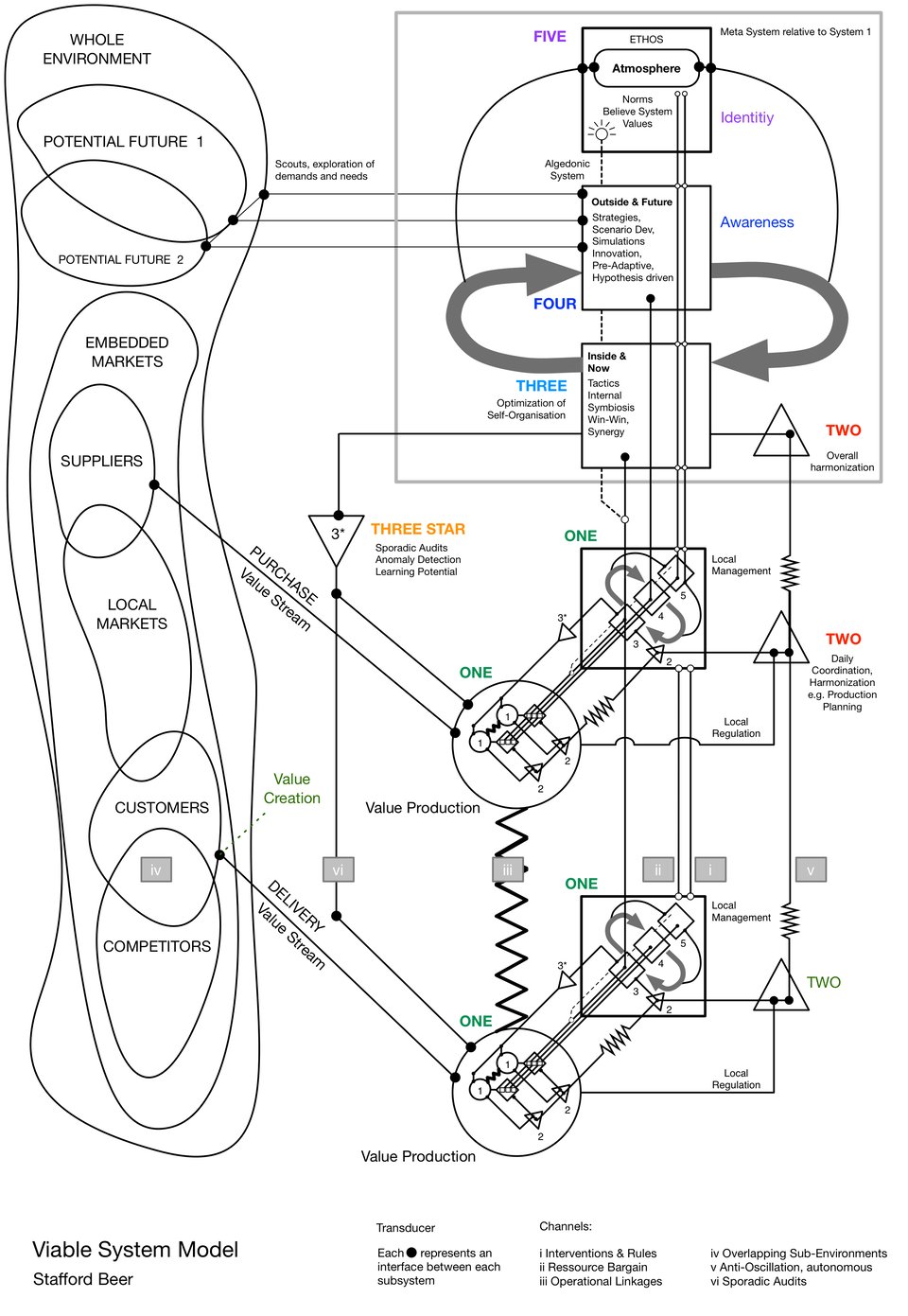
The irony of cybernetics as a field is that it offers such a useful framework for understanding ourselves and conceptualizing and intervening in real-world complex systems, but so many of its proponents have failed to package the ideas as effective inputs into the systems they want their ideas to change (academia is chock full of busted feedback loops). Or they’ve been thwarted. Stafford Beer was certainly thwarted. A CIA-backed military coup put an end to Cybersyn, the cybernetic socialist experiment in Chile. And even after Beer’s death, broad access to his work is up against a truly mystifying pricing strategy. It shouldn’t take a lucky find at a London estate sale to read his books.
Fernando Flores, the Chilean government official who recruited Stafford Beer was an early consulting inspiration when his work with speech acts was getting some press, but I’ve found his work to be another case of good ideas in a challenging package.
Dan Davies took up the cause in The Unaccountability Machine, a book I’ve been recommending to everyone who wants to understand why everything is so broken and maybe help fix it. His description of why cybernetics fell off the map, points the way forward:
Cybernetics had been conceived as an interdisciplinary project, with
a very large input from the medical and social sciences. But it got
unbalanced really quickly. People were just too good at inventing
transistors.
The current state of things demands interdisciplinary thinking. Davies describes Beer’s theory of cybernetic management narratively with no diagrams whatsoever, which is maybe challenging in its own way, but probably a good place to start.
We clearly can’t keep maximizing on a limited planet.
One fish, two fish
We need to start more print magazines.