How to make art in these times
How do you stay an artist in these times?
Next Friday, Mule Summer School continues with me and Erika talking about “How to Just Do Things.” It’ll be a fun hang.
This week’s question comes to us from Liz Mikolaj:
How do you stay an artist in these times?
There are over 55,000 art museums in the world.
That number may require a certain amount of salt, since it came from Google, which isn’t what it used to be, but it feels right enough for our conversation today. And I’m sure that among those 55,000 there are some duds, including places that might be debatable as museums (as well as things that may be debatable as art), but it also probably doesn’t include a lot of places where art can be found that don’t call themselves museums. Like galleries, private collections, freeports, and temporary spaces on highway overpasses. It also excludes art that may not fit into museums, like site-specific art, landscape art, mural art, art of subway cars, etc etc. Art tends to leak out of the buildings we try to put it in. Nor should we use museums as the ultimate measuring stick of art, which is like deciding whether people are good conversationalists by visiting their graves. But for our purposes today they’ll do as a measurement of something.
My point is that people have been making art for a very long time, and continue to make art at a pretty good pace. Enough that we’ve had to come up with special large climate-controlled buildings to both store it and show it. And while we can, and should, argue about who’s been included and excluded in those collections, we cannot argue with the fact that people make a lot of art and have been doing it for a long time. What’s harder to argue is that within the context of human history, “these times” (as you put it) can refer to several, if not most, points in history. Although these particular “these times” are certainly very these times-y.
We have always made art during these times.
There are over 55,000 art museums in the world. And while there are certainly museums that aren’t art museums (my favorites being natural history museums because I love dinosaurs and dioramas), we have yet to build a museum of corporate mergers. Or a museum of LinkedIn engagement. Or a museum of sucking up to your boss. (If any of these actually exist, I’d ask that you honor my request of allowing me to remain blissfully unaware of their existence, please and thank you.) But there is a reason fascists destroy art, and build monuments to show you the proper way of sucking up to your boss.
There are generally two reasons why we build museums: to preserve things, or to not do them again.
Erika and I were in Berlin for the 2016 US Presidential Election. We were speaking at a conference. I was lucky enough to speak the day before the election, she was not. The day after the conference we found ourselves at the Berlin Topography of Terror center, which is very much one of those museums we built to remind us not to do something again. The museum documents Adolf Hitler’s rise to power, and the subsequent terror he unleashed. We were startled at how closely his rise to power mirrored Trump’s own. From their starts as irritating buffoons, to their ability to speak to what the “aggrieved” wanted to hear, to their manufacturing of fake enemies, to their being underestimated by centrist governments, and finally to those same governments ill-fated attempts at appeasement. (No, I will never forgive Joe Biden’s “Welcome home.”) We left that museum feeling justifiably terrified because even though we’d built this museum to remind us not to do it again, we were absolutely doing it again. Then, because we were very very stupid, we decided to do it yet again.
Let’s go back to talking about art.
Actually, let’s stick with Hitler. On April 26, 1937, during the Spanish Civil War, Hitler’s Luftwaffe bombed a small Basque town as a favor to his fascist buddy Francisco Franco. There was no strategic military reason to bomb it, it was part of the fascists’ reign of terror among the civilian population. A show of fascist force. Over 1,600 people died during the bombing. Most of the dead were women, children, and the elderly, since men of fighting age were off at war. And as horrible as that (hopefully) feels to read that, the truth is that in the human history of “these times” an event like that would’ve come and gone, most likely remembered locally possibly with an annual remembrance and a wreath placed in the local cemetery for those we lost. As the horror of war unfolds, the bombing of small towns tends to get sanded away from our collective memory, replaced with vague terms, because the collective noun for the bombing of small towns is war.
Except the name of this small town was Guernica.
Of the over 55,000 art museums in the world, Guernica lives in the Museo Nacional Centro de Arte Reina Sofía in Madrid. It was, of course, painted by Pablo Picasso. But you already knew that. We know about Guernica because we know about Guernica.
(A short aside about Pablo Picasso: Pablo Picasso was a piece of shit, most especially to women. He was also an incredible painter. I’m not a believer in genius, nor am I one of those idiots who believes that you can, or should, separate the work from the people who made it. I believe that we need to tell the full and complete story about people. Pablo Picasso was a piece of shit who painted really well and treated women like shit. Both are true. Both parts of that story are important. If your take on this is different from mine, it is incorrect.)
In 1937, Pablo Picasso was living in Paris. He found out about the bombing of Guernica two days after it happened, on April 28, 1937. Guernica, the painting, was finished on June 4, 1937. It measures 11 ft 5 in by 25 ft 6 in. If you’ve ever had the privilege to see it in person, you know its monumentality. You know it owns the room. You know what it does to you on a visceral level. It is a raw, raw painting. Motherfucker painted it in thirty five days.
Pablo Picasso wasn’t painting a historical event. He was anchoring a current event to history. He wanted us to remember. He wasn’t letting history sand this event from our collective memory.
We know about Guernica because we know about Guernica.
On August 27, 2026, the Minnesota State Fair opened. I love a state fair, and although I’ve never had the pleasure of attending the Minnesota State fair, my good friend Kristina lives close enough to the fairgrounds that she complains about people parking in her driveway. And when she goes she sends pictures. I get pictures of weird food. I get pictures of weird animals. I get pictures of weird events. But nothing makes me happier than pictures of state fair art, which tend to fall into two categories: sculptures made out of butter (unironically outstanding), and paintings made out of beans. I’m sure crop art artists would call that reductive, but it’s mostly beans—and that is great.
A particular painting caught my eye this year:
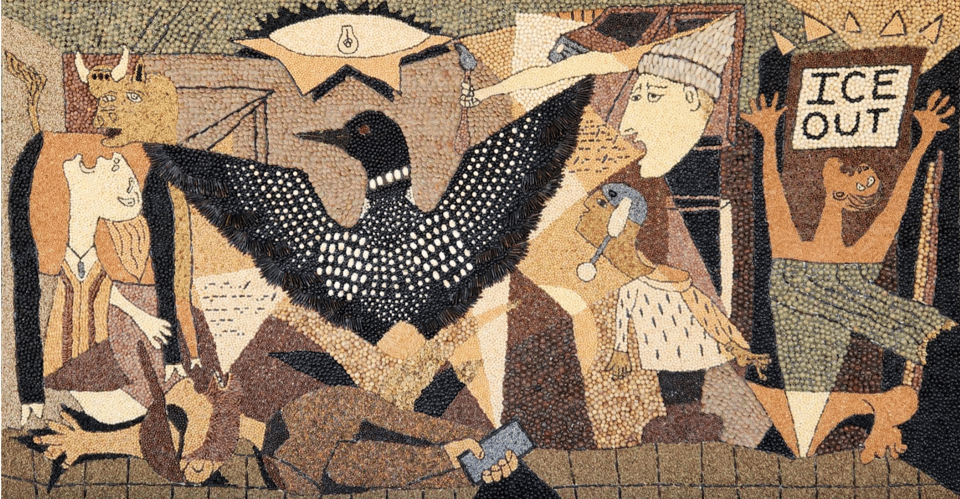
The artist is Jennifer Nelson, and I’ll let her tell it in her own words (which I got from a PDF called Crop Art Tributes to the Minnesota Resistance):
“My piece was inspired by Picasso's Guernica, a work that was his response to the Nazi's bombing of the Basque town. I thought there was a fitting parallel between these incidents about the high price paid by ordinary people when aggressive regimes try out new tactics of war, as well as a fitting juxtaposition of the darkness of living such an experience and the light we shone through it in our own resistance and care for one another. The patterns near Renee Good and Alex Pretti’s mouths are actually their last words in Morse code: ‘I’m not mad at you,’ and ‘Are you okay?’”
This painting is why we make art in these times.
We paint (and sculpt, and weave, and collage, etc, etc) so that we—the collective we—can’t forget. Because we tend not to pay attention to those museums that we build to remind us not to do that again, we inevitably end up doing it again. And yes, that does make me want to hit my head against a wall over and over, which is neither good for the wall nor the head. So better to use the wall (and the head) for something else. So we make art.
We make art as a warning. We make art as an anchor. We make sure that what is happening here will be remembered by those that come after us. We make sure that what is happening here and now can at least serve as evidence of what we’re going through, and who we’ve lost. But we also make art to celebrate every victory, no matter how small. Because those victories need to be remembered as well.
And we make art so that you can’t sand the edges off the history that you’re making.
Picasso ended up trapped in Paris during the Nazi occupation, and while this may or may not be apocryphal, I like to think it’s true: When a Nazi officer was ransacking Picasso’s apartment he saw a photo of Guernica that Picasso had stuck to the wall and asked “Did you do that?”
Picasso replied, “No. You did.”
We make art, in these times, so they can’t forget what they did.
🙋 Got a question you need answered? Ask me.
💰 Making art costs money! Your $2/mo buys paint and pays studio rent.
📓 Enjoy this story? I got a whole book of ‘em!
🍉 Don’t let history sand the edges off what’s happening in Palestine. Give what you can.
🏳️⚧️ Trans people are not the enemy. They are our community. Help take care of our community.