
How to love comics
This week’s question comes to us from Betsy Streeter:
What is the most powerful artistic medium and why is it comics?
Because it’s the most accessible.
When I was a little kid growing up in the Logan section of Philadelphia there were two stops I’d make on my way home after school. First was the public library. It was a majestic red brick building with columns on the front. It looked important. And for me (and I assume for many other people) it was. Having a place where I felt welcomed was everything. (It still is.) And there were books. So many books. They let you borrow them! Libraries are fucking magical.
But we’ve already written about the library. Today I want to write about the second stop, which at the time was called Mister Grocer. Mister Grocer was your standard grocery store, closer to a 7-11 than a corner bodega. It was a free-standing building and had a parking lot. It was WaWa for neighborhoods that WaWa avoided. (Real Philly will understand what I mean.) Mister Grocer was where you stopped for a drink (remember those little juices that came in plastic bottles shaped like barrels) (juice is a kindness in that description) (they were 80% sugar, 10% water, 5% Three Mile Island runoff, and 5% lead because in Pennsylvania everything contains at least 5% lead), candy, and comics. Mister Grocer had comics.
The comic stand was one of those rotating wire things, next to the magazine rack. (I miss magazines. Yes, I know there are still magazines, but there aren’t magazines in the same way that there used to mean magazines) (no, I don’t mean porn) (I kinda mean porn) Anyway… the comics were in a rotating wire thing, and they were to the left of the front door where the high school kid working the counter could keep an eye on them. Amazingly, the counter was to the right of the front door. Which meant if you really wanted to steal a comic you had a greater than 50/50 chance (since the kid behind the counter had to either leap the counter or go around the corner to stop you and minimum wage makes athletes of no one) of making it through the door before you got stopped. Not that I ever stole a comic, but that was less about an ethical dilemma and more about being a fat kid. I would’ve gotten caught before I made it to the door. (Nothing in this paragraph advanced our narrative. Deal with it.)
Comics were 25¢ when I started going to Mister Grocer after school. Which meant all I had to do to get a comic was to find a quarter somewhere. And quarters were kinda magical as a kid. They didn’t come around every day. But every few days you’d come across one in between the couch cushions, or just minding its business on the kitchen table, or left on the edge of the bathroom sink by my father as he prepared to go out for the evening. Quarters weren’t given. They appeared. And they quickly disappeared. Into my pocket. To be traded for a comic at Mister Grocer the next day. All of which were neatly stacked in the closet of the bedroom I shared with my brothers. In a box. With a pile of sweaters on top. Not because they weren’t allowed in the house, but because I was afraid that my parents would discover that I cared about something. Growing up, caring about something (or someone) made it a target of my parents violence.
But that little stack of comics was an amazing escape from my young shitty life, which is why I guarded it so carefully. The Avengers. Spider-Man. Batman. Swamp Thing! Doctor Strange! Fantastic Four. Captain America. Howard the Duck absolutely fucked me up in ways that it took me years to understand. (This is a positive.) The Inhumans. And Jack Kirby, wtf?
Jack Kirby made me want to draw like Jack Kirby. Jack Kirby made everyone want to draw like Jack Kirby. I spent so much time as a kid copying Jack Kirby artwork. Badly. I absolutely loved/hated/loved every minute of it. I was so bad at it. (I was nine years old.) But every failed attempt sucked a little bit less than the previous one. I’d spend hours just trying to draw Black Bolt’s wings. Medusa’s hair (ok, not just her hair). Lockjaw was fucking impossible. And I was terrible at it! Until I got, if not good, then serviceable at it. And there’s a feeling that washes over you as you do that. A feeling of… capability. Competence. Achievement. Or as Loki would say… glorious purpose! The idea that you can sit down and try to do something, fail a hundred times, and then get to a point where you realize you didn’t fail a hundred times, it just took a hundred steps to get there. And the journey was worth it cause the current feeling is pretty good. (Yes, this is about what AI is stealing from our children.)
For a kid that had to find his own joy growing up, those moments were everything.
Comics are the most powerful artistic medium because they’re the most accessible. Human beings love to tell stories, and human beings love to hear stories. Comics are the perfect vehicle for both. It’s easy to make a comic. Anyone with a piece of paper, or the inside of a shopping bag, or a piece of cardboard, and a pencil, or a crayon, or a marker, can make a comic. You don’t even have to be able to draw like Jack Kirby to do it. (None of us ever will.) And a comic is generally meant to be passed to another human being. To be shown. To be shared. They are communal. And everyone can make them. Comics are human-scale. Some of our greatest comics are made of stick figures. Some of our greatest comics are made from recycled clip art. And yes, some of them are very elaborate. But our attraction to comics tends to be more about the vibe than the execution. We like Garfield because we like Garfield. Not because Jim Davis is a particularly great artist. I mean, he’s absolutely fine. He’s a great storyteller. What draws us to Garfield is that in three panels we get a full story that resonates with us. Maybe not in a profound way (you need Garfield Minus Garfield for that). But we enjoy these little vignettes into a lasagna-eating cat’s life.
Human beings love being told a story. Especially a pocket-sized story that we can enjoy for a minute while reading the paper before we move on to the pocket-sized story below it. (God I miss reading comics in the paper. Especially on Sundays. It was a whole section. And it was the absolute best way to start a Sunday morning.) Movies and television—which I also love—are just comics going very very fast. One sequential image after another at a speed where the human brain grants them the power of movement. But at heart, they’re also comics. (Marvel proved as much.)
In their soul, deep down in their soul, all artistic mediums are a way for me to tell you my story, and for you to tell me yours. We are engaging with one another. We are sharing a world that we’ve created and our audience is saying yes, that looks like a fun/terrifying/safer/more exciting world. Tell me more! We are working through our feelings on a thing and our audience is saying yes, I also feel that way, or I had no idea you felt that way, or knowing how you feel has changed the way I feel! We are documenting our history in a way that gives that history the audience it needs. We are bearing witness to joy. We are bearing witness to horror. We are bearing witness to the human experience in a medium that makes it accessible to as many humans as possible.
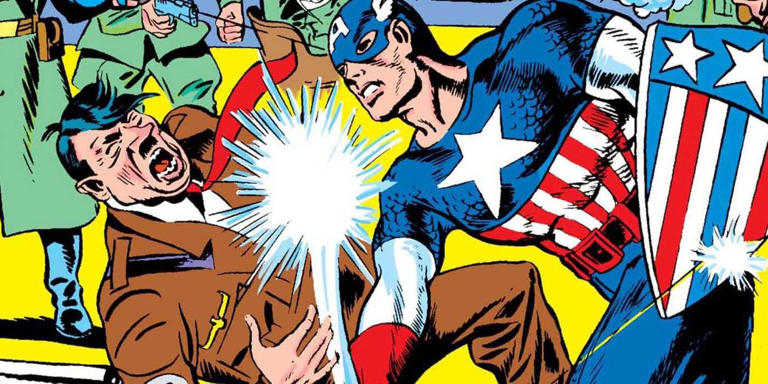
Comics taught me it was OK to punch Nazis.
Over the years comic books went from 25¢ to 35¢ to 50¢ (to this day I vividly remember the Marvel Comics starburst that said STILL ONLY 35¢ and can probably draw it from memory) and eventually they made their way to a dollar. (They are much more now, of course.) And in time, the little spinning metal stand at Mister Grocer turned into a proper comic book shop in downtown Philly, Captain America turned into Maggie and Hopey, Gotham City turned into Palomar, The Incredible Hulk turned into a dozen different angry Peter Bagge characters, Jack Kirby turned into Simon Hanselmann and Julie Doucet, Marvel and DC turned into Fantagraphics, Drawn & Quarterly, and a hundred other comics publishers that have come and gone. Even the grumpy Simpson’s comic guy, based on so many actual comics shop owners, gave way to a bunch of genderqueer kids running their own shops, making their own comics and zines, running their own distribution networks and making sure their stories are told and read. And one day your daughter is handing you a copy of Super Late Bloomer because she has a story to tell, and she understands there’s a medium for telling it perfectly.
At heart, deep in their soul, comics have always been the medium where the marginalized could share their voice the loudest. Anyone can make a comic. Anyone can mail a comic to someone else. That means you. That means me.
I love comics.
❤️ If you’re sharing this newsletter online, and I hope you are, please include some of the great comics I’ve forgotten to include in here—ESPECIALLY if you made them!
🙋 Got a question for me? Ask it. I promise to give a rambling answer.
📣 I’ve got a few spots left in next week’s Presenting w/Confidence workshop. If you’re dealing with the shitshow of applying for a job this workshop will do wonders for your confidence. Promise.
📓 Buy my new book, How to Die (and other stories), directly from me and get a secret story, stickers, and I personalize it!
💰 If you’re enjoying this newsletter WHICH IS NOT ON SUBSTACK and want to support it, you can join the $2 Lunch Club.
🍉 Israel is insane. The ceasefire is a lie. Please support the children of Palestine.
🏳️⚧️ Please support Trans Lifeline. And if their is a trans child (or adult!) in your life please remind them they are loved.
❤️ Not gonna lie, I had a shit week. So if you wanna hit reply and just say hi it would mean the world.