
Family Secrets in Patrick Radden Keefe's "London Falling"; plus, recent bylines
A review of Patrick Radden Keefe's new book "London Falling," a more intimate and smaller offering than his other recent hits. Plus, housekeeping and recent bylines.
This newsletter is free to the public, and appears infrequently due to my chronic illnesses. If you would like to support me, you can subscribe to my podcast's Patreon here. Although I'm on leave, this still helps. Otherwise, feel free to send me a couple bucks through Ko-fi.

As you all know, it’s a weird and bad time for journalism and for books. Rahawa Haile published a great, detailed piece at Scratch today about the forces screwing over nonfiction books, and by extension their authors (many of whom are or were journalists). In that context, it feels pretty silly to be writing about London Falling, one of the few surefire nonfiction hits of the year, but the heart wants what it wants. I love Patrick Radden Keefe and I love reading and thinking about his books. I’ve been slowly picking away at this and turning over my thoughts for a couple weeks and it’s been satisfying to go back to the book which I devoured the second I got the galley a few months ago.
I do generally try to highlight books that haven’t gotten much attention and the dismal stats in that piece made me want to try to focus more on nonfiction. It also made me go, Okay Morgan, you have to actually publish your 2025 nonfiction list even if it is objectively absurd to do so in May 2026. I WILL do this soon, and hopefully you’ll find some books on there you haven’t heard of and that you’re interested in reading. As ever, request stuff at your library and hopefully they can get copies in for you.
Before the bulk of this post, I want to give a shout out to Fansplaining, which relaunched as a website with a subscription service today. My friend Elizabeth Minkel is the visionary behind this and she is truly a brilliant analyst of fandom, fan culture, trends, fanfiction, and so on. I have multiple pieces in the works for the site, the first of which will go up next week, and it has been so fun to work on stuff with a friend: I have been fortunate to work with really great editors the last couple years but with someone you already have a relationship with (and who you also trust as an editor) idea generation is really fluid and exciting. I’m excited about this site. You can subscribe for free, support the site to read everything, or pay for individual episodes which I think is really important given how many things we’re all subscribing to these days.
My recent bylines are below:
An interview with Karan Mahajan about his novel The Complex for Electric Lit. This is one of the best books I’ve read so far this year, absolutely brilliant. I’m really interested in Hindu nationalism, and especially in how it’s been portrayed in fiction, and this is a really great example of that.
An interview with Vigdis Hjorth about her new novel Repetition for Electric Lit (though we talked about Will and Testament too). Hjorth is one of my newly discovered literary heroes and I still can’t believe I got to do this.
An interview with Kylie Lee Baker about her new horror novel Japanese Gothic for CrimeReads. You’ve probably seen me gush about her previous book for adults, Bat Eater and Other Names for Cora Zheng, one of the best COVID books to date. This new one is great too.
A bonus episode of Overinvested on Patreon discussing the second season of The Pitt. We did not like!

A couple weeks ago, the Times ran a story titled “Can a Journalist Be a Celebrity Anymore?” The answer to that question, I immediately concluded, was “yes,” because without any further information I knew whom the subject of the article must be: Patrick Radden Keefe. Yes, his new book London Falling: A Mysterious Death in a Gilded City and a Family’s Search for the Truth, was pending, so he was an obvious candidate for a newspaper profile. Even so, Keefe is the only writer I can think of (certainly the only nonfiction writer) that practically every serious reader I know talks about with cult-like reverence. The sources journalist Jonah E. Bromwich talked to for his piece, who actually know him, did not dispel the notion that Keefe is not like the rest of us: Cody Keenan, President Barack Obama’s chief speechwriter, describes Keefe as “the coolest guy ever.” Fellow New Yorker writer Jia Tolentino says, “I feel like he’s solved multiple murders.”1
Plus, he’s appeared in J. Crew ads (see above; objectively funny); was featured in Laura Poitras’s documentary All the Beauty and the Bloodshed, which chronicled Nan Goldin’s life and her activism against the Sackler family (his book Empire of Pain told that family’s story); and recently appeared in a cameo on the show Industry. (In an earlier episode, a journalist had referred to him colloquially as “Paddy Radden Keefe.”) Celebrity is probably more atomized now than it has ever been, but if these signifiers don’t make a writer a celebrity, what does?
Despite all this external nonsense, it’s worth pointing out that Keefe’s success is almost entirely down to his output. Yes, he’s a handsome and charismatic white guy, but people are crazy about him because of his books. How refreshing! As Bromwich notes, Say Nothing “blew up” in America not because American readers had been crying out for a new account of the Troubles but because the book was so utterly propulsive, morally gripping, and, unlike virtually all true crime, actually contained the answer to the murder mystery at its heart. I remember everybody wanting to talk about that book the year it came out here: it felt like a genuine phenomenon. (More recently, a college student I know read and loved it, too.) Empire of Pain didn’t have the same hook, because anyone who had been following the opioid crisis even superficially already knew that the Sacklers were the murderers going into the book. But like Say Nothing, Empire of Pain similarly mimicked the novel, this time aping the family saga and the corporate thriller rather than the spy thriller and murder mystery. Keefe’s ability to create this kind of narrative tension and psychological depth while telling real stories is, to me, what makes him so special.
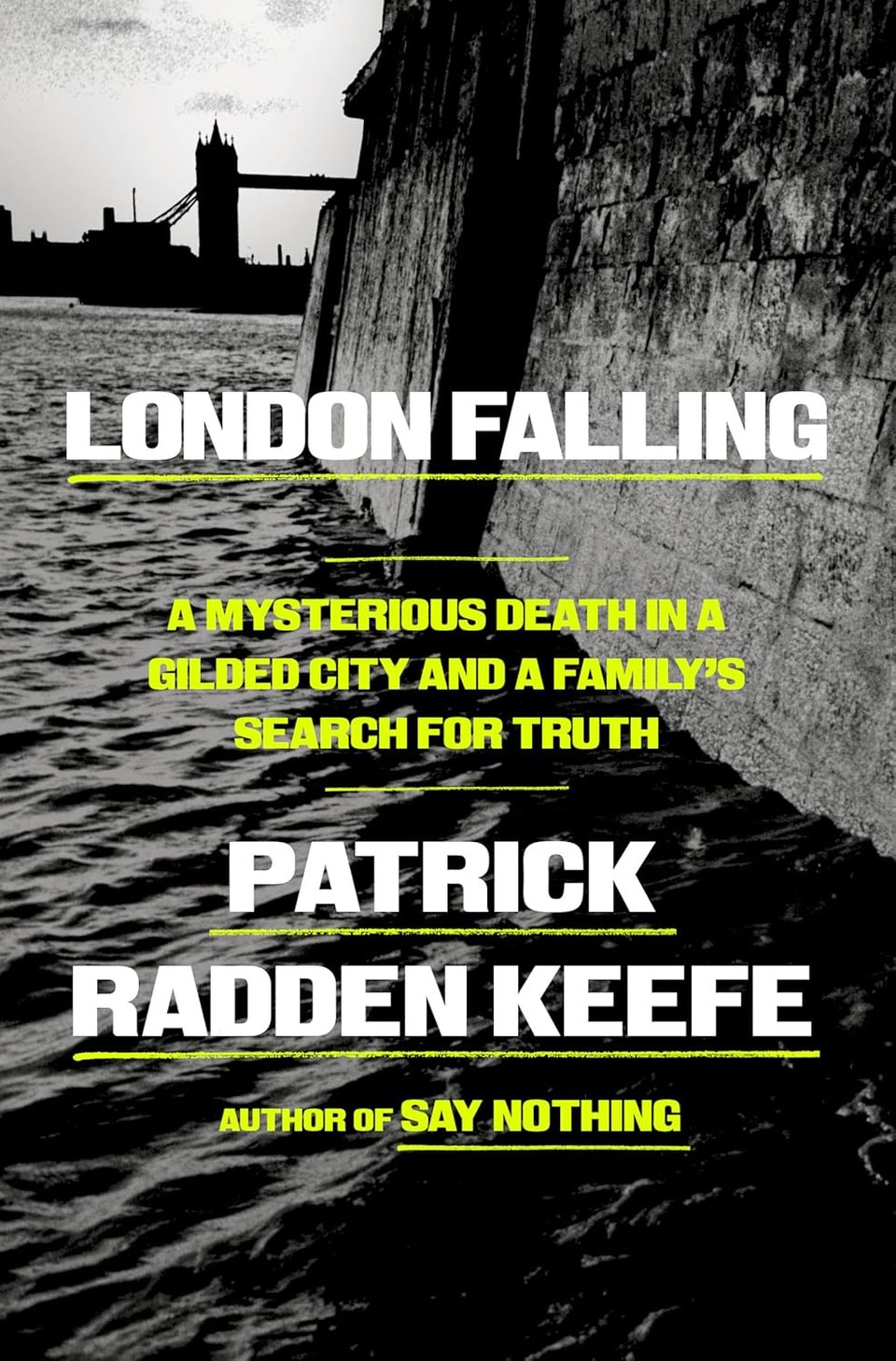
London Falling is, unquestionably, a smaller book than the two that preceded it, both literally in terms of page count and abstractly in terms of scope. It grew out of a New Yorker article that ran on February 5, 2024, and which described the mysterious death and hidden life of Zac Brettler, a 19-year-old young man from an affluent London family who had, unbeknownst to his parents, been passing himself off as Zac Ismailov, the son of a Russian oligarch. On a November night in 2019, Zac jumped off of a balcony of the Riverwalk, a luxury apartment building in London that overlooked the Thames, falling to his death. London Falling tries to answer the question of why he jumped: was it a suicide, or did he jump because he was afraid of something inside the apartment?
As I made my way through the book, I was interested in the fact that Keefe was not making an overarching argument about a wider societal issue, and instead focusing on a smaller-scale human drama. The opioid crisis has wracked America for decades; by comparison, one family’s tragedy may not feel so significant (to outsiders, anyway). But though I don’t love London Falling quite as much as those other books, Keefe’s writing remains propulsive and suspenseful, a remarkable feat given that we know Zac is dead from the beginning of the book.
This is largely thanks to how the book is structured and paced. (As an intern in college, reading film scripts, the first note I wrote as feedback to every single writer was: “Structure and pacing!” If you do those two things well, you can make a great story out of almost anything.) In an interview with Traci Thomas on her podcast The Stacks, Keefe describes his aversion to the braided structure of nonfiction writing: an A-B-A-B format in which the writer alternates between past and present events that has become very popular in narrative nonfiction. Instead, he says, he focuses on keeping the reader engaged and surprised:
The last thing I want you to do is … get to the end of one chapter and … say, Oh, I know where we're going to start the next one. So I'm always thinking about trying to maintain some element of narrative surprise … It has to feel like it has a design. … I, as a reader, love the experience of feeling like the writer has all the cards and they've thought a lot about them, and then they're dealing them out to me in exactly the right order.
Part of making the narrative work in London Falling was to reveal information selectively, keeping the reader roughly aligned with Zac Brettler’s parents, Matthew and Rachelle, as they tried to figure out what had happened to him and why. Disturbingly, they first realized something had gone very wrong when, not long after Zac disappeared from the family’s apartment, a strange and aggressive man showed up at their door demanding to see him. “Who are you?” Rachelle asked. “Who are you?” the man replied, while on the phone with someone. When she told him she was Zac’s mother, the person on the other end of the phone said, “That can’t be his mum. His mum’s in Dubai.” Rachelle began to panic. Not much later, Zac was dead. Matthew and Rachelle would go on a quest to figure out what had happened to Zac, and why he had been living a lie. Some of these questions had concrete answers they might be able to figure out; others would remain unknowable.
In the expanded space of a book, as compared to a magazine article, Keefe has the room to explore these questions much more deeply. He’s also able delve more deeply into Matthew and Rachelle’s backgrounds (notably, both their fathers were Holocaust survivors), and to build complex portraits of the two men who were in the apartment with Zac on the night of his death: Verinder Sharma and Akbar Shamji.
At first, Shamji presented himself to the Brettlers as a mentor to Zac and an ally to the family, someone who wanted to help Rachelle and Matthew sort out the confusion around Zac’s fabulations. He promised, further, to cooperate with the police: “I don’t want to get myself implicated in anything,” he told them. “I want [Zac] found and put into a place where he can get treated [for alleged drug addiction]. Before he gets us all into trouble.” By the time this conversation happened, however, Zac was already dead, and Keefe makes a compelling argument that Shamji knew it.
Rather than the congenial mentor in business to Zac that he claimed to be, Shamji was a chronically unsuccessful businessman following in the footsteps of his father, Abdul. The Shamji family came to Britain after being expelled from Uganda, and Abdul set out to rebuild the family name and fortune. He solicited loans (including from the Scottish government) that he did not repay, a strategy that worked for a time: Tatler named hime one of Britain’s “Upper Crust Asians,” and he purchased Wembley Stadium. Ultimately, these schemes failed, with a former executive telling a journalist, “The appearance of [Shamji’s] Gomba Group was evidenced by the chauffeur-driven Rolls-Royce, the yachts, the executive jet charters, the Park Lane offices … The reality was wages not getting paid … suppliers not being paid … writs being issued. That was the reality.”
In an attempt to regain his father’s masquerade of wealth and prestige, Shamji attempted similar, if smaller-scale, schemes—producing music, trying to run a club—that were even less successful. Hence, eventually, him winding up in a position to potentially hustle an ultra-rich teenager out of money. It’s hard to think of few schemes more pathetic than scamming a kid. So neither Shamji nor Verinder Sharma, an even more nefarious character who’s also known by his gangster nickname Indian Dave, are particularly sympathetic figures in Keefe’s telling. But there is something pitiful about Shamji’s attempts to succeed and to impress that mirrors Zac Brettler’s own attempts to inflate his own person. Zac grew up in an affluent and seemingly happy family, attending an exclusive prep school (though, crucially for him, not one of the most exclusive). But that wasn’t enough: he evidently dreamed of being one of the most elite, the son of a billionaire who had access to reserves of money and power that someone like the real Zac Brettler could only dream of.
If you’re enjoying what you’re reading, subscribe below:

London Falling’s most direct societal critique comes in its indictment of London’s Metropolitan Police, who mounted what can only be described as a half-assed investigation into Zac’s death. If Sharma (and to a lesser extent Shamji) represent powerful forces operating outside the law, this aspect of the narrative shows how power can operate within the law to deprive people of justice and agency within their own lives. In audio recordings captured by Matthew Brettler, Detective Rory Wilkinson, who handled the case for the Met, offers extremely unconvincing answers in response to Zac’s parents’ questions about why he and the Met have failed to interview practically anyone involved, or potentially involved, in their son’s death. It becomes increasingly clear that, because of how wealthy and powerful various other people involved in the case are, it would be deeply inconvenient to the Met to pursue to the case with its full investigative power.
This is hardly the first time British law enforcement, or the British state as a whole, have made decisions to avoid challenging powerful people. In 2023, Heidi Blake reported for The New Yorker on the extreme control the rulers of the UAE exert over their daughters, and the efforts those daughters have made to escape captivity. One of those women, Princess Haya, escaped to the United Kingdom, where various other members of her family also like spend time (as wealthy people across the world love to do); Blake recounted many instances in which these men were allowed to do pretty much whatever, including rape young women, with impunity. Coincidentally, the head of the Emirates was friends with Queen Elizabeth. Russian oligarchs, meanwhile, have found London a friendly place to launder money. (Keefe reported on this for The New Yorker.)
In this context, it is perhaps unsurprising that the death of a teenage boy who somehow got tangled up in the lives of people with a lot more money, power, and criminal connections than he had was not a priority for the Met. The explanation for the Met’s disinclination to investigate isn’t a straightforward as “Britain can’t afford to offend the royal family of Dubai,” but Keefe makes a strong case that Sharma was a police informant. A police informant potentially driving a teenage boy who hadn’t committed any major crimes to jump off a building? This would not be a great look for the Met. It would be so much easier if the case vanished and Zac’s death was presented as the tragic suicide of a delusional young man (who may or may not have been addicted to drugs).
The Brettlers were press-shy, characteristic of their respectable bourgeois milieu, and avoided speaking publicly about Zac’s death for years. They also, thanks to their background, trusted the cops. The Met therefore had free rein to neglect them, avoid investigating the case, and rule Zac’s death an accident. After this determination, Rachelle and Matthew had little formal recourse within the law: though they wanted to appeal the decision through a process known as Victims’ Right to Review, as Keefe writes, “they received a letter that read, ‘Sadly, a meeting cannot be offered to you as these are only provided to families who have been bereaved through homicide.’” The inquest was something of a joke. This led the Brettlers, eventually, to Keefe himself. Official lines of inquiry had failed them, and the press was the only remaining option.
For all of London Falling’s criticism of the Met and its broader observations about corruption and crime, it is ultimately a story about one family trying to figure out what happened to their child, and reckoning with the fact that they didn’t know that child as well as they thought. Keefe used family stories to illuminate larger societal questions in Say Nothing and Empire of Pain; in this case, the book is more about the family than any larger issue or question. That makes the book, to my mind, more “minor” than Keefe’s larger tomes, but that doesn’t mean London Falling isn’t deeply affecting, in some ways more so.
The McConville family of Say Nothing certainly didn’t get much satisfaction that their mother had been murdered and disappeared as part of a sectarian conflict, but the conflict provided some context for that act of violence: the murder wasn’t really “about” Jean, which I imagine could make family members feel better or worse about it depending on the day. The Sackler family are not the victims in their story but the perpetrators, so though Keefe does recount awful things happening to various members of their family, they provide context for why the family is so soulless. There is no bigger story within which to locate Zac Brettler’s death. He’s just a kid who died due to a set of random, incredibly unlucky circumstances. I can’t imagine being the parent who has to reckon with that, in addition with the knowledge that he was someone who lived with so many secrets.
It’s incredibly moving, then, to read about Rachelle and Matthew struggling through, muddling along, and eventually learning to find joy in their lives even though those lives have been permanently blighted. Keefe ascribes this, in part, to the legacy of their fathers, who survived the Holocaust. In his interview with Thomas, he describes attending a 25th birthday party the family held for Zac, which he feared would be a morose event, but which was actually filled with joy and reminisces about his life. “I didn't think of [descending from Holocaust survivors] as actually being this … gift that these two people had been given by their fathers, which was the a lesson in how to live joyously in the face of catastrophic loss,” he said. That’s not to say that they are somehow over it. But, as Matthew tells Keefe in the book’s final pages, “You’ve got to keep going.”
I can’t track this anecdote down, but I’m pretty sure I remember hearing someone on a podcast—I think the books producer of All of It—talking to middle school students about what they’d recommend, and one student bringing up… Patrick Radden Keefe. When the middle schoolers are reading your true crime books, you’ve hit the big time. ↩

