determinate tomatoes
on cities, matter, energy, roots, and dragonflies
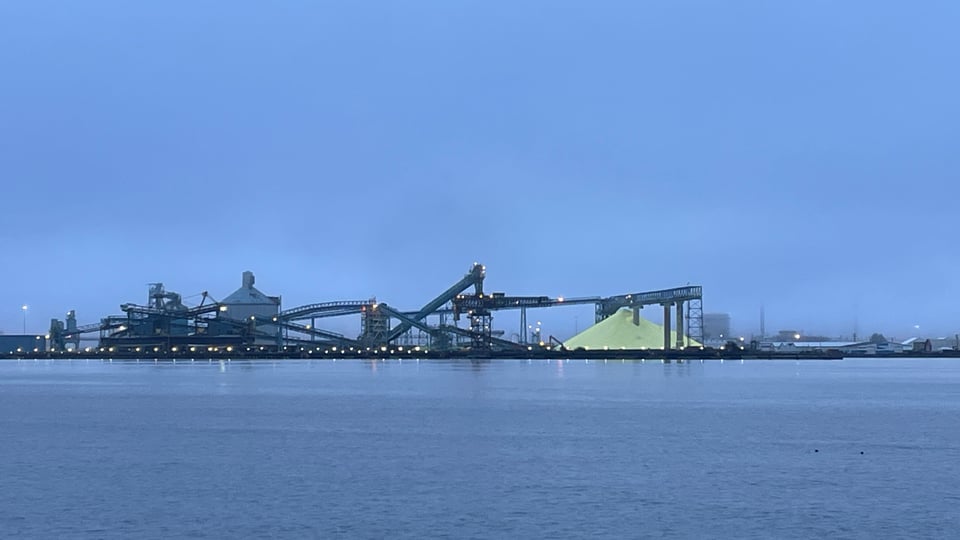
I recently read Alexis Madrigal’s The Pacific Circuit: A Globalized Account of the Battle for the Soul of an American City. I’ve been waiting to read it since long before it was written — possibly since I met Alexis (and also Robin!) at their East Bay studio a decade ago, when I was in San Francisco working on the Situated Systems project, and certainly since his 2017 Containers podcast. When the book came out, last March, I was just beginning to get an inkling that I would be consumed by moving my own household to the West Coast just a few months later.
There are ship-to-shore gantry cranes visible from my desk here in East Vancouver, but The Pacific Circuit made me really also think about what it means to be living in a city. I grew up inside the familiar narrative about how immigrants put down roots — buying property, having children who fall under jus soli, raising them in your adopted home (when you’re the one growing up, of course, it’s just ‘home’), but I didn’t follow that familiar trajectory when I became an immigrant myself. I’ve semi-jokingly described myself as having put down roots in the Boston area and in my adopted country, just not like a tree standing alone in the suburbs and reaching deep into the soil. I’m more like prairie grass, where much of the mass of roots is in the topmost layer of soil, binding the plants with each other and the ground and so creating a robust grasslands ecosystem.
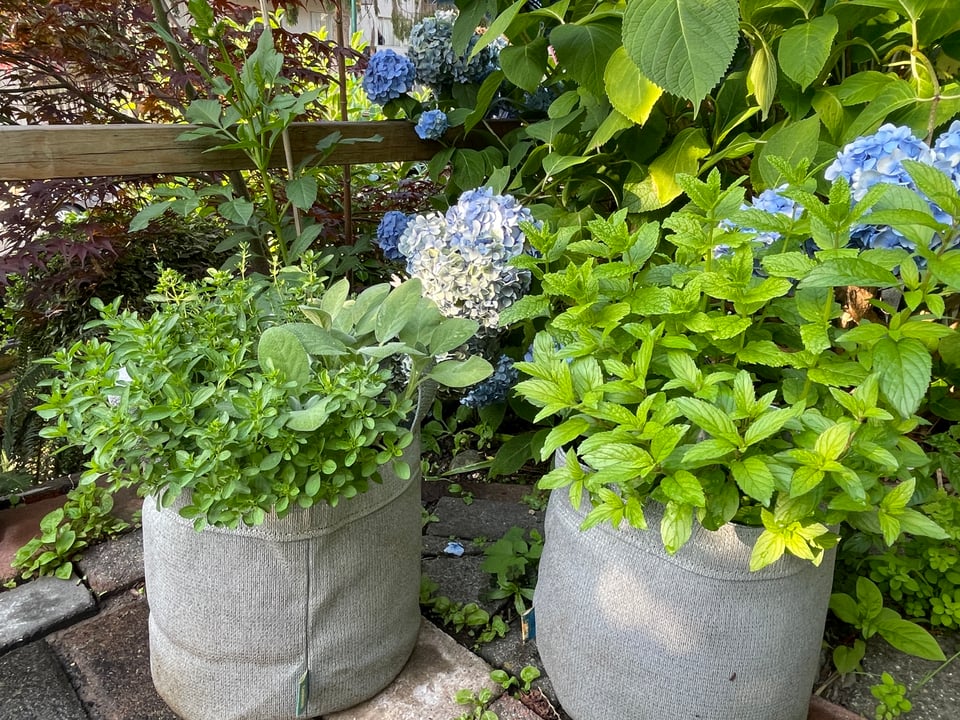
Looking back, I can see how much of my time and energy this past year was put towards growing out new roots, both metaphorically as I explored the city and began to find community here, and also literally — I have a small patio, and so I planted a kitchen garden for the first time in many years. It followed the decision I made in the spring to remain on a leave of absence from my home institution, which means I’ll be here for the fall harvest. Since it’s my first growing season here, I put indeterminate tomatoes in the ground by the tree-shaded fence but I also planted bush tomatoes in containers so I could maximize their sun exposure. Now that everything is setting fruit, it’s beginning to seem like there might be…rather a lot of incoming tomatoes for one human and one small furry obligate carnivore.
Reading the conclusions of Alexis’ book, I was struck by how we both came to similar places from different directions. “Logistics,” he writes, “is, fundamentally, a system of flows, an attempt to deterritorialize, to let economies push through whatever they want.” Infrastructural networks are flows too, pulling resources from the hinterlands and directing them to the metropole, externalizing and displacing the harms and impacts. In How Infrastructure Works, I described them as creating a relationship between the people who live in a place, the landscape all around them, and the past and the future of that place. We might be the beneficiaries of these networks, live in a world of unprecedented mobility, and spend much of our time engaged with the abstractions of language, culture, and the digital realm but, as Alexis points out, “The land is the key. The land itself cannot be rearranged for the benefit of logistical flow.” It’s not ‘land’ in the cadastral sense of demarcated property. Instead, it’s almost a metonym for nodes on these networks of energy and matter, which are intrinsically and unavoidably spatial for embodied beings. We all have bodies, and we are all present somewhere on the planet.
Not unrelated to all this: Every time I come across the material reality of, well, reality elided by proponents of digital technology (as in: ‘AI will fix x’), which is unreasonably often, I feel like Samuel Johnson refuting Bishop Berkeley by kicking a rock, hard.
Questions of energy, matter, and material reality are an ongoing focus of mine, unsurprisingly.
I wrote a piece for the Future Observatory Journal of the Design Museum (London) about how the energy transition — replacing the combustion of fossil fuels with renewable sources — both enables and requires a transition in how we use matter and materials:
There is no sustainable future where we address the energy side of fossil fuels without using that energy to rethink how we handle materials. The best reason to go as hard as we can into renewable energy is not just to power data centres and EVs – it’s to bring our technological society in line with the physical reality of our planet, where energy is abundant, but every atom has to go somewhere.
Read “Energy and the Matter Problem”.
Some of these ideas also showed up in interview for the Imaginize World podcast; you can listen (or read the transcript) here.
I drew on the history of electricity for an essay I wrote for the “Energy” issue of Arup’s report series on the future of data centres:
Nobody [in the 19th century] could have envisioned in any detail all the ways in which we use electricity today, just like we can’t fully predict what computational services might make possible in the future. But framed this way, we understand that what we want from our data centres is much the same as what we want from our electricity systems – reliable, affordable and universal provision, contributing to the achievement of human potential. What would it take to make this happen?
Download the issue [PDF] to read this essay.
Lens-based media artists Kaya & Blank invited me to write a piece for the reader which accompanied their first solo exhibition, Infrascapes, at basis e.V. in Frankfurt earlier this year:
The roll of aluminium foil in my kitchen cupboard reveals little about where it came from or the global flows of energy and matter that brought it to my home. If we think of them at all, we think of these planetary flows as invisible traceries. The wake of a container ship dissipates into the waves behind it, airliners navigate to their destination along invisible highways marked by radio beacons. But just as physical devices aren’t perfectly energy efficient, the networks that move atoms around are imperfect and lossy, leaving traces all along the paths they follow.
Download the full reader [PDF; my essay, “Network Traces” is pp. 16-19, in German and English]
If you’re in the Los Angeles area, where Kaya & Blank are based, you can see their piece “Intermodal” at the Built on Water show in San Pedro (an important node of the Pacific Circuit!), through August 22nd, 2026.
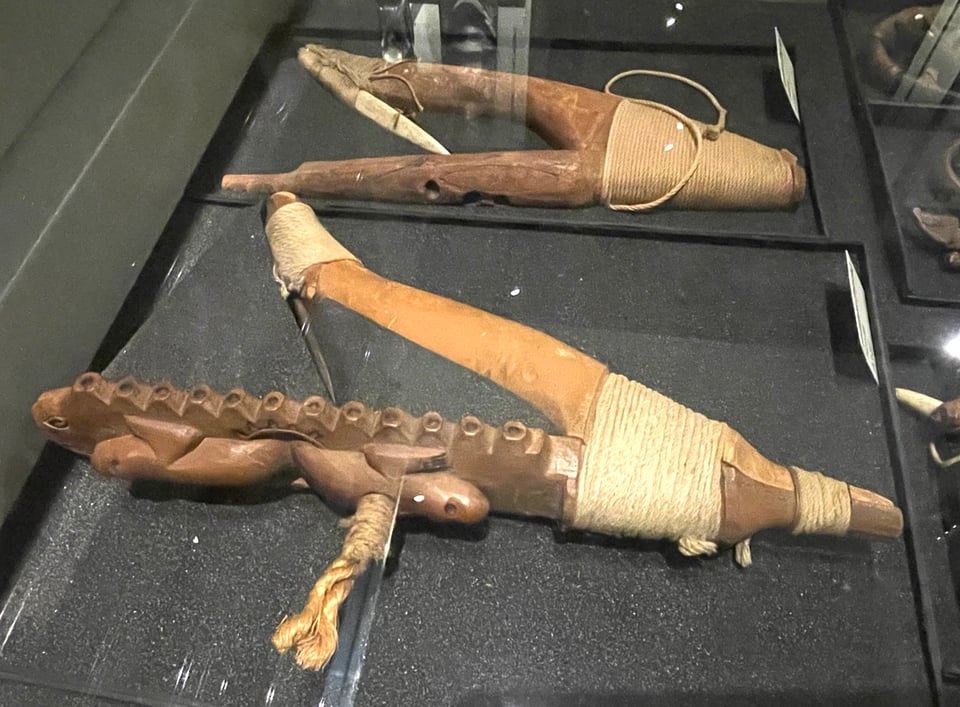
I was invited by the Weltmuseum Wien to contribute an article to their house journal, WMW NOW. A vague memory of seeing handmade wooden Pacific halibut hooks at the British Museum productively collided with my recent purchase of a DeWalt cordless drill/driver. Together with Paul Graham Raven’s essay about infrastructure fiction, they gave me a way to think and talk about the evolution of technological complexity:
A halibut hook and a cordless electric drill are both technologies. … The wooden halibut hook on its line is a technology that serves as an active interface between the fisher and the fish, just as the power drill is a technology that is an active interface between me and the wall. But if I set my drill next to a wooden halibut hook, even one made with modern materials such as twine and metal, it would be evident which of the two tools has a design that is thousands of years old. For that matter, next to the power drill that Raven described only a decade or so ago, mine would be easily identifiable as the newer object.
While that piece is print-only for now, those ideas will be showing up in my work for a while yet.
Thanks to my friends at Superflux for the connection; if you’re in the vicinity of Vienna, you still have time to visit their solo exhibition The Craftocene, at the Weltmuseum Wien through August 16th, 2026.
I wrote short pieces for Hilobrow about my ongoing media diet (including a visit to the Museum of Anthropology at UBC to get up close and personal with those Pacific halibut hooks) and about the enduring influence of my childhood encounter with The Hitch Hiker’s Guide to the Galaxy. The best thing about being part of a Hilobrow series might be the company; scroll down to the bottom of those two linked pieces to see contributions from Lucy Sante, Annie Nocenti, Stephanie Burt, Mike Watt, and others.
I’m also in stellar company with my interview for the Uniqueways podcast, where everyone answers the same set of questions about their creative and intellectual practice. You’ll scroll past Paola Antonelli (#305) and Keller Easterling (#303) to get to me at #300. Listen at Apple Podcasts here or find it via your fave podcast app.
I knew that while I was on leave I’d be without an on-campus office (or lab!) for the first time in my working life. A year on, I’m still unreasonably happy about following Austin Kleon’s advice to have an analog and a digital desk instead of making my kitchen table continue to do triple duty for meals, for my computer, and as my general work surface. My digital desk is in my front room, by a window that looks out towards the North Shore. And my analog desk is a large, paper-covered table in a dedicated workroom, which is lined with bookshelves and storage for all the physical tools and materials I’ve accumulated over the years.
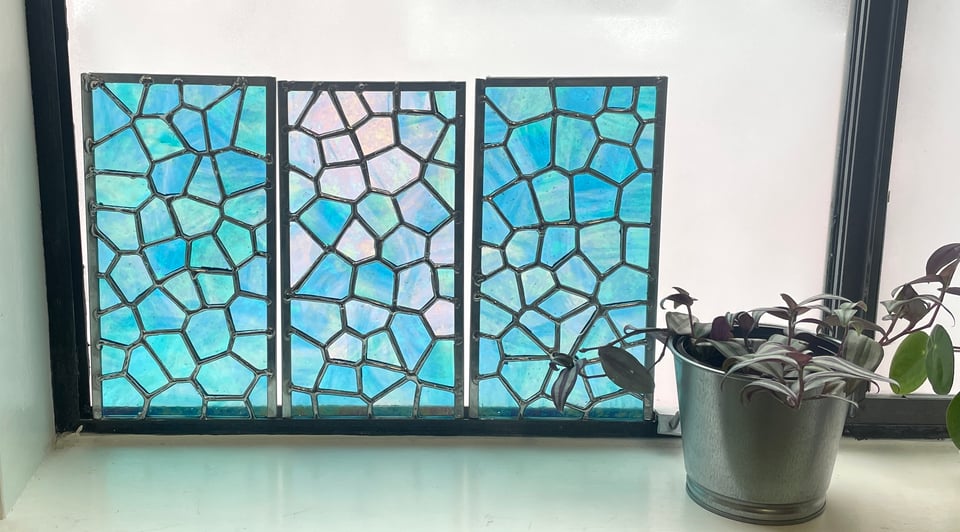
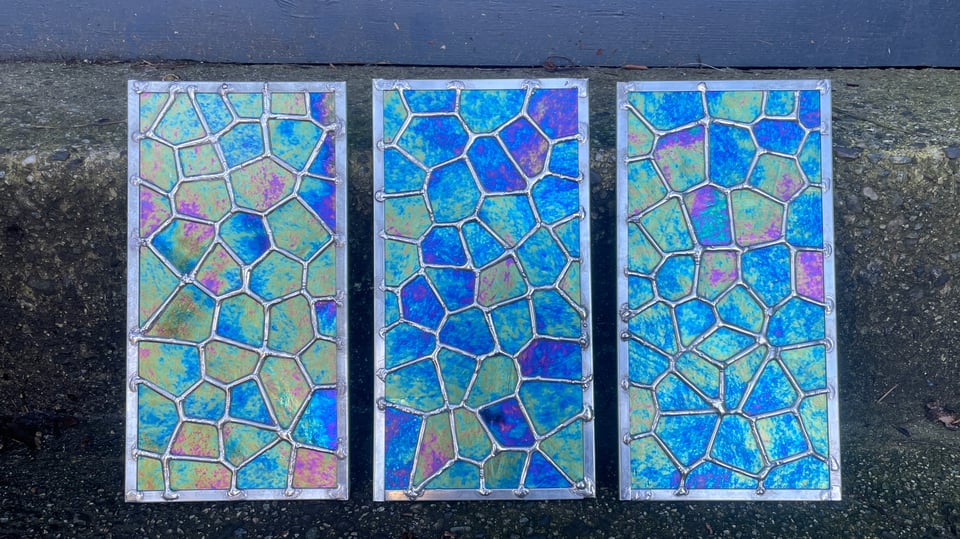
I did a residency at a local makerspace at the beginning of the year, learning to use their equipment and facilities. During that time, I designed and fabricated a number of pieces, including these small stained-glass panels inspired by the venation of dragonfly wings. The Voronoi patterns for the three panels were randomly generated, and I used an iridescent glass that is delightfully, resolutely unsuited to being fully appreciated in photographs.
I’ve become something of a one-person case study for how (hyper)local transportation infrastructure shapes behaviour. I used to walk every day and either drive or take the subway most days, but I’ve become a daily cyclist, in part because my new neighbourhood doesn’t have quite the density of Central Square, Cambridge (where my nearest coffee shop was on the ground floor of my building, so literally twenty feet away on the z-axis). Vancouver, unlike Boston, has bike-inclusive road patterns and cyclist-aware, if not always -friendly, drivers. I now rarely get behind the wheel of my car and only occasionally take public transit, but I still appreciated the invitation from Dezeen to write about how the FIFA Men’s World Cup host cities managed transportation for the games:
Self-serving though its motives probably are, FIFA essentially forced American cities, even car-centric ones, to run month-long experiments in public transit. A whole bunch of people no longer have to only imagine an alternative to cars – they get to live it for a while. But more broadly, the World Cup matches across North American cities are a unique opportunity to make different approaches to urban transit visible to everyone in a way they would never be under normal circumstances.
You can read the full piece here.
It wasn’t until I was thinking about the challenge of getting tens of thousands of people into their seats at the same time that it finally dawned on me: without mass transit, the time required to funnel thousands of cars into stadium lots on game day means that, like it or not, fans will have hours to kill between parking and kickoff. So American tailgate party culture was pretty much inevitable.
In between biking around Vancouver and taking care of my burgeoning garden, I’m working on some new projects (more on these as they bear fruit, or at least put out flowers). As I don’t have formal academic responsibilities at least through the end of the year, I do continue to have availability for collaborations, writing, and speaking opportunities. (I recently got to talk about infrastructure at BugBash 2026, hosted by software reliability firm Antithesis; you can watch my talk here.) Do reach out if you’d like to work together, or just to say hello, or perhaps you live locally and would like some tomatoes?
I realize this has been a large and perhaps unexpected harvest! Please know that I always appreciate your time and attention.