
Describing Danchi Days (Part 2): Neighborvania & Adventure Novel
Throughout Danchi Days' (out now!) development we came up with various ways to describe the game. Most of these didn't end up being particularly helpful when it came to labeling the game for marketing purposes, but I think in terms of critical analysis these terms could be of interest.
They are:
- "Shakai-kei" (Societal) games
- Neighborvania
- Adventure Novel
- Post-Cozy
- anti-RPG (we didn't come up with this one)
In a previous post (https://buttondown.com/melodicambient/archive/describing-danchi-days-part-1-shakai-keisocietal/) I discussed Shakai-kei. For this one, I'll talk about Neighborvania and Adventure Novel.
Neighborvania
Neighborvania has a nice ring to it, but I didn't use it much because the vania part is misleading. Danchi Days doesn't have combat, ability upgrades, checklists or maps to fill out, after all!
However, if we step back from combat/completionism in vania-type games and think more about the sense of poking around and exploring a world, then the term neighborvania becomes a bit more suitable.
After all, Danchi Days is split into a bunch of interconnected maps - a central Plaza, a walking path bordering a highway, a small grove, the interior of a biulding, etc. Access to these maps is gated via story events, and the maps have multiple routes through them, so as you play the game, you build up a map of the game in your mind. There's even a few fast travel options - both explicit ones (the fountains) and more organic shortcuts (the river, plaza, and Big Road, which connect to multiple other areas.)
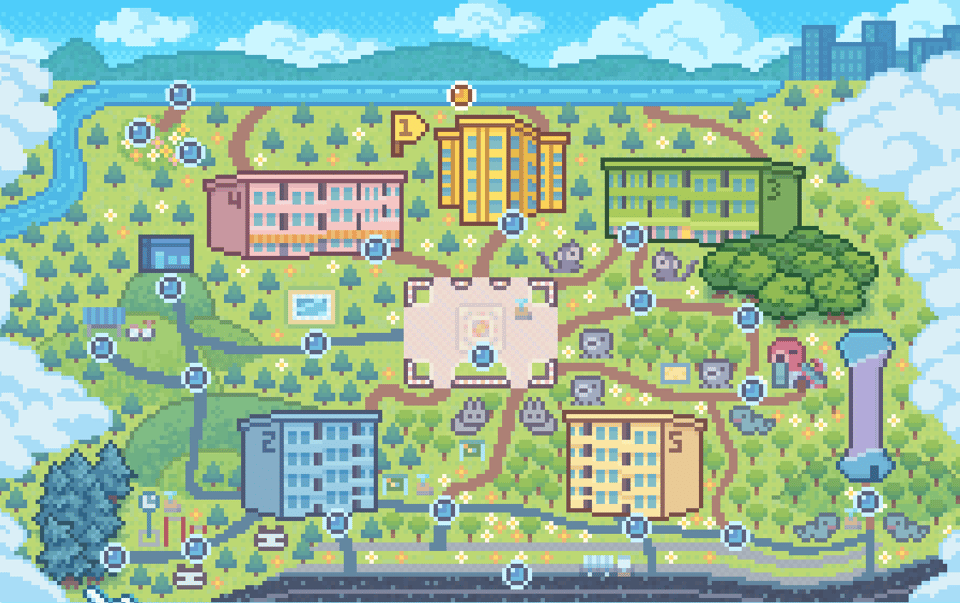 Above: The full map of Danchi Days, which gradually unlocks throughout the game. Much like a metroidvania, there are some areas that act as hubs or main arteries: for example, it's faster to get from the water tower (bottom right) to the Pandawood (bottom left) by walking along the Big Road (bottom).
The exploration (the "vania"-ness) is connected to neighbors you meet in Danchi Days. Learning about the sewers from one character might let you learn how to explore the sewers more thoroughly, so it's a bit of a knowledge gate. A character's blog might encourage you to revisit a part of the game and find something new. RSVP'ing certain characters will quietly open up their rooms, allowing you to enter them and learn about some of their friendships.
So Danchi Days is about exploring both a physical setting (the danchi) and an online setting (the websites), and as you explore both, you collect neighbors' festival RSVPs, and also learn more about characters and the world.
If you're not familiar, the goal in Danchi Days is to collect 51 RSVPs to the summer festival the protagonist Hoshino is holding. Some RSVPs you get through main story cutscenes, others are more involved and involve reasoning or exploration. It's essentially an organic way of framing main/side quests.
This RSVP mechanic was borrowed from the GBA game Sakura Momoko no Uki-Uki Carnival, where you try to get people to RSVP to a carnival. The difference is that in Uki-Uki Carnival, the RSVP's aren't tied to an overarching story like in Danchi Days. And, unlike Danchi Days where every RSVP ultimately comes in-person, in Uki-Uki, you can get a lot of RSVPs on its in-game internet.
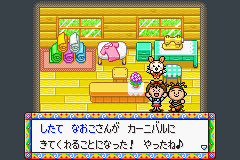
Above: a screenshot of getting a Carnival RSVP in Uki-Uki Carnival
I like the RSVP quest structure because it adds clarity into running into new characters. You know they're RSVPable in some way, even if it's not immediately apparent. You also know that by pursuing a character's RSVP, you'll progress in the game and story. It's also a good way to make the quests not feel as artificial, since you're forced to write and design them to the lens of RSVPing, which makes them fit into the game better.
When calling Danchi Days a neighborvania, "getting an RSVP " is kind of like defeating minibosses or bosses within metroidvanias. You might come back to a boss later when you're ready for it, and likewise, in Danchi Days you aren't always required to RSVP a character right away. You can come back later and try to figure it out.
 In the above image, you can keep track of which neighbors you've met (silhouettes) and which have RSVP'd (non-silhouette characters).
Well, regardless of my explanation, calling this game a neighborvania would give the wrong idea. But I still think it's a cool term haha, since it lets us rethink what exploration should look like. It doesn't necessarily need to be tied to combat or upgrades, we can tie exploration to a mundane setting.
Adventure Novel
This label comes from the term Visual Novel, which if you are unfamiliar, are games which primarily focus on reading text against illustrated backgrounds and character portraits.
We thought of the term 'adventure novel' because Danchi Days combines storytelling practices from Visual Novels (and JRPG cutscenes) with adventure game mechanics. Another way you could look at it: an Adventure Novel is adjacent to a JRPG, except it doesn't have battles or stats.
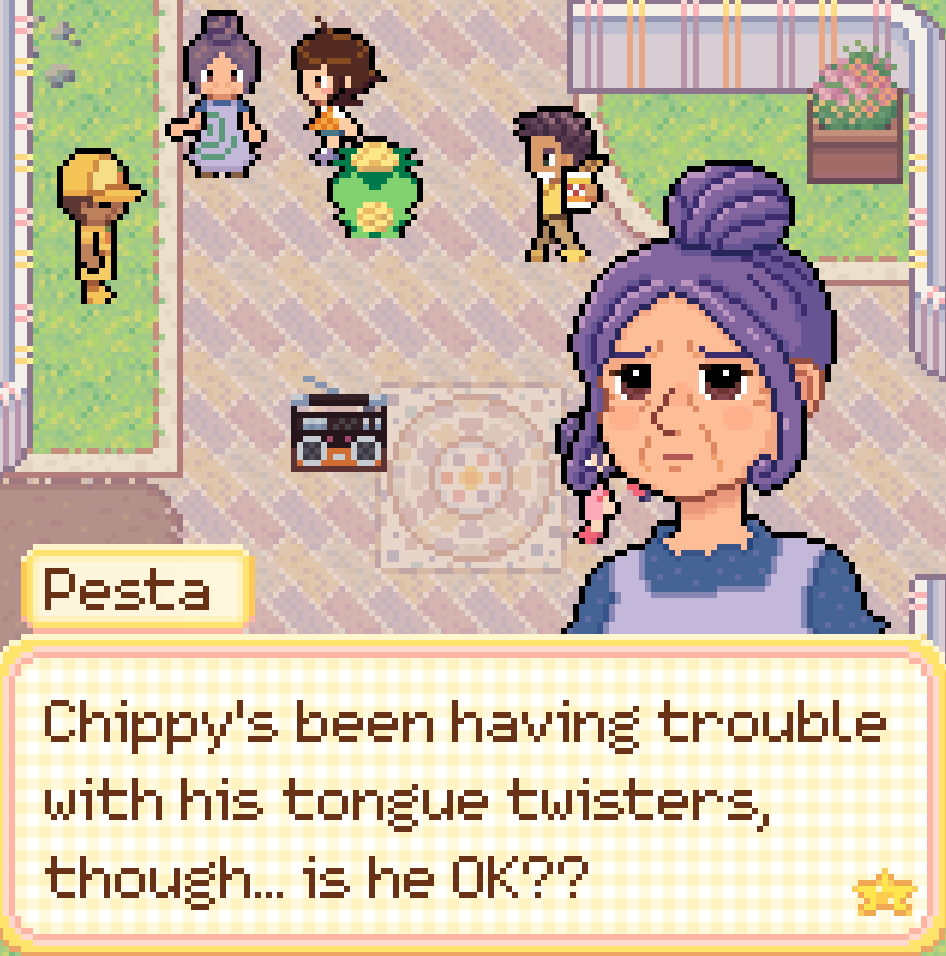
Above: A screenshot of Danchi Days
Because of the emphasis Danchi Days puts on reading, it makes sense to call it an "Adventure Novel" instead of simply an Adventure game. In Danchi Days you control the protagonist, taking her between different scenes in the story, and you get freedom along the way to decide the pace and order in which some events play out. The game is reading heavy, but exploring and walking around or browsing the internet are a key part of pacing out that reading.
In the Adventure Novel's interplay of designed environments, movement, and text, there's some similarity to the lineage of western Point-and-click's and CRPGs, but ultimately I think an Adventure Novel has to come more from a Japanese storytelling/gameplay lineage. For example, complex item puzzles (like you see in point and clicks) aren't a big part of Danchi Days, nor are there many 'choices that matter' which you see in many CRPGs.
There are some other games I'd categorize as Adventure Novels: Rakuen, To The Moon, Ihatovo Monogatari come to mind, all focusing on stories without battles while letting you walk around as a character.
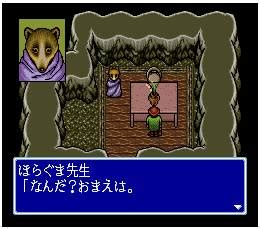
Above: A screenshot from Ihatovo Monogatari, a game adaptation of some of Kenji Miyazawa's stories.
There's some games that are Adventure Novel-ish, but not to the extent of DD and the previous games. Hamtaro GBA games could count if they were less focused on puzzles and had more text. One of our inspirations, "Sakura Momoko no Uki-Uki Carnival", doesn't focus on much of an overarching story, so I wouldn't call it an Adventure Novel, although it does have a lot of reading on the in-game internet.
Games like The Silver Case or Flower Sun and Rain are both unique adventures, The Silver Case being more of a visual novel. I don't think I'd call them similar to Danchi Days, but I bring them up to point out that there are a lot of unique takes on the "adventure game + story, without RPG mechanics" genre.
As you can see, the label itself is kind of slippery to the point I wouldn't officially call Danchi Days an adventure novel in a store page or marketing capacity. But it's still useful to try to define this term, as it can allow us to see the ways in which Danchi Days (or other games) relate to other games.

Add a comment: