
Book of Bumpslash: Bosses (Part 1 of 3)
Part 1 of a series of posts talking about Angeline Era's bosses. Part of the "Book of Bumpslash" a series of posts about Angeline Era's design: https://buttondown.com/melodicambient/archive/the-book-of-bumpslash-design-and/
Note from Melos: Brief dev update at the bottom
Angeline Era's 16 bosses were a fun and challenging task for Marina and I. 1/3 of the bosses (Dulla & Han, Fish, Bugdog Mass, Poison Tree, Neo-Kerygma) were designed in Q1/Q2 2023, while the remaining bosses were done in the back half of 2024 (we didn't have time to do any additional bosses in 2025).
Generally we followed this process to make the bosses: - Boss Concept -> Moveset Brainstorm -> Coding (with placeholder art) -> Testing -> Art/Music/SFX. Often there was a large gap between Testing and the Audiovisual tasks.
If you want to see the bosses, I've linked two boss rushes by players here (in case one ever goes down).
1 (Melos Trick, Level 1 - by hertz)
2 Normal - moon blooms - playing for score IIRC
Boss Design Principles
The bosses don't all follow these principles, but these are what I came up with thinking about what I liked about the bosses the most.
- Keep it Bumpslash-y
Refers to the game's distinct, physical feel to the bumpslashing, and my early observation that getting in the zone in AE feels a bit like playing sports like tennis. In this sense, the boss encounters ought to work hand in hand with this feeling. Just like regular combat, you need to think about your positioning, which zones on the battlefield are riskiest, and where to move next. This idea is essentially the same as what makes regular Bumpslash combat levels work.
Contrasting boss design styles from other games are Reactive bosses (you see these in Soulslikes, Metroidvanias, many action games - they focus on parrying or dodging at precise timings), Mario bosses (focused on dodging and waiting for a weak point 3 times), Zelda bosses (more of a puzzle focus with some action required for execution). There's Ys 6/Oath-style bosses which SOMETIMES occupy something of their own design space - the focus is on being aggressive while minimizing mistakes. And there's something like maybe a arcade beat-em-up boss (I'm really just thinking God Hand which I played a bit) where you're constantly under threat trying to proactively shut down threats.
I think AE occupies its own unique space - but its bosses are closest to some aspects of Ys Oath, and occasionally arcade action and sometimes some Zelda puzzly bosses. But for the most part AE's bosses are their own design space.
- Keep it Unique
Each boss should try to not overlap with any other boss as much as possible. Phrased another way, each boss should have a distinct feeling to fighting it. I never quite liked running into the same boss multiple times in games like Elden Ring. Or the way humanoid bosses in e.g. Metroidvanias or Souls-likes sometimes feel like their moves could be interchangeable.
With a few semi-exceptions (Gunnadoir and the Duelists repeat encounters, which have narrative justifications to their repeat encounters) we did a good job with this. One way to achieve this was to try and design movesets from the boss's physical design itself, rather than simply a set of moves. Because Bumpslash is expressive enough, we're able to use things like "Neo Kerygma is tied up" to help guide boss design.
- You can always be aggressive (but not thoughtlessly)
I decided on this rule of thumb very early on, at latest when designing Dulla & Han at the start of 2023(!) about 3 years before release. I learned this rule from playing a bunch of the 2000s Ys games and hating how some made you wait around, and liking ones where you could really try to fight as fast as possible but it'd feel risky. With (almost) every single boss in Angeline Era you can theoretically always be aggressive, just your chance of making a mistake and taking a hit goes way up.
This is a really nice principle to have because it stops us from designing moves where the boss is invincible or you have to wait. Rather than splitting boss phases into "can't attack / can attack", players can (partly) set the pace of the fight.
Throne is an exception here, but it's balanced by being an mentally heavy fight, so actually moments of downtime are a welcome reprieve from how mindbending that fight can feel. And Throne has enough leeway that there are ways to be riskier and make the fight go faster (using the lightning/bubbles)
- "Heat Meters"
This helps to balance out the fact that the player can somewhat set the pace of the fight, and I tried using based on some ideas from arcade games (rank, timers). I started to program the bosses to have an internal "heat" value that was based on time elapsed, and on remaining health. This value would be used to speed up the boss, its attack timings, intensity, etc, which let the bosses both become harder as they got closer to death - but also subtly encourage you to play a bit faster because if you just sat around things could get too intense and you'd die. This is pretty noticeable on bosses like Yukata Woman's imp spawns, or Caitlin's thorns/fireballs. I don't believe the first 5 bosses used these ideas as much but I could be wrong.
I like these because they counterbalance the ability to run away or sit out of a fight.
- Emergent move complexity
I've personally never been much of a fan of the usual way of designing bosses where they whip out one tricky move after the next and you have distinct moments that feel like you most obviously should attack there. It overall feels like a memorization test to me... the only thing I really like memorizing might be music. I think this style of boss design is very popular because it feels very choreographed and cinematic - you're essentially an actor trying to correctly complete the "shot". (See this rant about "Animaction")
This is also partly why Angeline Era boss fights don't look as "cool" or "flashy"... even though in a lot of cases they can be much more intense!
Instead, inspired by how the regular levels in AE work, what we liked to do with our bosses was think about the ways the boss's different moves could interlock to create challenges that were dodgeable with movement/jumping.
This direction is a bit more like... riffing almost. Maybe jazz... like there's a base expectation to do but you're afforded a decent range of flexibility on how you reach the goal. Whereas with classical music it's a much stricter requirement (although you are allowed some wiggle room in terms of tempo/dynamics/expressivity)
Though not all AE bosses necessarily do this. For example, Dulla & Han - as the first boss we designed - is mostly pretty normal (there's only ever one thing to worry about with the fight, although Marina had the idea to add the circling sword which helped spice the fight up). In other bosses, there's multiple things going on you need to juggle. For example, the Boar King's position along the field, its grenades and claws, and the spikes on the ground itself.
There are exceptions - Niamh and Unformed Beast, which are balanced by the fight being heavily positioning-focused. Fish is another exception, partly because it was designed early on, and also partly because it has to obey its very specific "gag" of the only hazard being the laser fish.
- None of those god-forsaken MMO-esque 'danger zone' markers on the map
I hate this stuff so much lol because they lead to a type of design where the bosses feel disconnected from their moves and it feels super game-y. Of course we didn't avoid this with all bosses (e.g. Sorcerer's laser projectile tells, the bumpslashable thing Arkas shoots from the ground) but for the most part we did. I don't like this style of design because it allows the designer to do whatever they want because the moves are easier to be disconnected from the physical limitations of the boss's visual design, which I think leads to design patterns that are more like "Dodge a ton of random spawned bullets/hazards"
- Try to downplay ranged attacks
This ties to #6. I think this is impossible to avoid, but when brainstorming moves we tried to deprioritize ranged attacks because of the tendency for bullet attacks to become detached from the physicality of the boss. E.g. if bosses were to shoot out arbitrary bullet patterns. I think this helped with not just relying on that design style which is sort of the easiest route with boss designs because you can literally do whatever you want.
Boss Types
Early on I had more of a divide of "Sportsy" bosses (Fish/Bugdog Mass) vs. "Action-y" bosses (Dulla & Han) vs. "Gimmicky" bosses (Poison Tree/Lamb), but we moved away from this sort of divide in favor of this divide:
- Complex Humanoid - melee (Niamh, Duelists)
- Complex Humanoid - ranged (Sorcerer, Caitlin)
- Bouncy/Physics (Gunna, Fish, Bugdog Mass, Unformed Beast)
- Big Body + minions (Throne, Boar, Arkas, Neo Kerygma, Poison Tree, Yukata)
- Other - Dulla & Han, Kids
But I think these ended up being more loose categories because some bosses definitely overlap categories haha.
Still, these loose categorizations are helpful when initially brainstorming a boss and trying to keep it unique against your other bosses.
Now I'll talk about some bosses' design! Just 5 to start, with 11 more in the future.
1. Dulla & Han
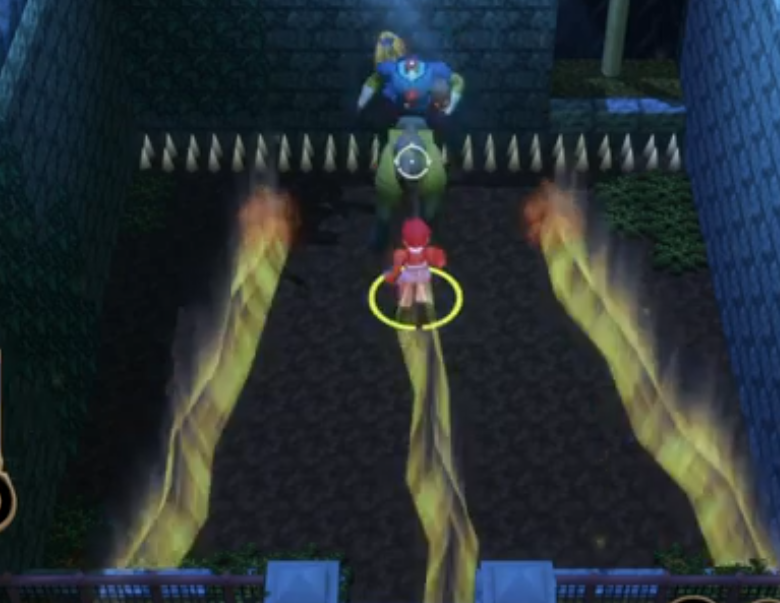
I'll be discussing bosses in the order they were created.
I still remember how fun prototyping this one was, I put on "Bloody Battle" from Einhander to make sure the fight felt intense. I think this fight established a few things. For one, that we weren't going to signpost moves with those awful danger zone markers. I think a normal game probably would have had the shockwaves from this fight be telegraphed by three ugly rectangles. In fact one of our first testers of this boss fight commented on how a modern game would probably do that. If that were the case, the player would no longer be paying attention to where the boss was facing and trying to gauge how risky they want to be with positioning, people would simply just tank the boss's hits and then move into the safe zone.
I find it interesting watch people play this boss, some people take a overly safe approach (they try to dodge every shockwave and not attack) - but the problem with that strategy is that the fight takes a really long time and you probably will make enough mistakes elsewhere. I like that this fight encourages you to be more aggressive.
Also did you know hitting the rider does critical damage? It's a fun little thing you can do if you're good.
Likewise, some people are also overly safe during the charge - but you can pretty much double-jump crit the boss on every single charge if you're really good! Just watch out for getting clipped when the boss is turning around...
Fun fact here: the shockwave attacks used to be far more tightly spaced. The fight was better this way IMO... but I chickened out and made them farther apart.
Something we also tried was using the environment in the fight - which was breaking the pillars. I think we moved away from this direction for various reasons (IMO I think it's too puzzly/straightforward - it's a little boring to have to break the pillars each fight).
Overall... this is a fun boss but it's probably lower on my list of ones that are most interesting because of how standard feeling its moves and design feel.
Melos's Rating (From D to S): B-Rank. This boss, though simplistic (especially with the more narrative moves like the pillar breaking or death whirlpool), is fun to fight, especially trying to just do it really fast and riskily. It feels pretty Ys-y to me compared to other fights in the game, likely owing to its early timeline for design. I do think the pillar-breaking and instakill move are pacebreakers though which is why I give it a B. It's also kind of an easy boss, although you may not feel that way depending on what difficulty you picked initially, lol
2. 32 Fish
 I made this boss almost right after Dulla & Han. I believe this was inspired by some early level design direction wanting to be inspired by extreme sports and humor (Takeshi's Challenge), I also just thought the whole gag of the fish multiplying was really funny. We ended up nerfing this fight a bit for the final game and used it as the tutorial fight, which I sometimes regret - maybe I should have put in a bit more effort and kept the HP values higher on Hard+.
I think this boss captures a lot of pillars of AE's combat. For one - the humor. 32 Fish has a pretty traditional comedic escalation... you think you've seen the punchline but then it just keeps going. I like that it sets up for players kind of a situation where the the player's expectation that "this is the last phase" sets them up for the punchline of it NOT being the last phase
There's also the push towards finding small weird strategies specific to the exact enemy layouts. Like spinning in a circle really fast at the start of the 32 Fish phase, jumping into an outer corner of the 16 fish and tanking hits.
There's also an introduction to the game's combat style, which is about anticipating enemy movements and positions. The fish battle becomes a lot easier once you internalize the enemy movements and shapes, letting their movement work for you (like letting the 1 Fish come towards you, or knowing how to not move too much for the 2 Fish). The thing you have to avoid is fairly obvious (the lasers, which don't have many tricks), the trickiness is more from figuring out how to safely handle getting in each hit.
There's also the sportsyness. I feel like AE is a game about hitting balls back with a tennis racket, something I like doing in real life. I think making the Fish Boss so early was good because it illustrated a lot of what's fun about the combat... it's like going around trying to smack balls safely. If I could design a sport you'd be put in a cylindrical chamber with tennis balls launched at you from all directions, and your score would be based on how many you can hit back (and how fast you hit them back). Have you ever played tennis and volleyd a shot back? Or spiked a shot into the other side? I think I wanted to capture those kinds of dynamics with AE's bumpslash. Now I want to play tennis.
32 Fish is also the "Refund Window" boss. I think if someone ends up being humorless enough to really dislike the game they'd just refund the game at this point and that's it. Sometimes people don't, though, and they go on to write low-score Backloggd reviews. But for those who push back I think they generally end up on board with (almost...) everything else
Okay, but what about the actual boss moves?
1 and 2 fish are pretty simple, they're about managing the position and rotation of the fish. Because the lasers are rotating this emphasizes that the 360 degrees (or 8 directions if you're on keyboard lol) of your movement are actually quite important to the game
4 Fish focuses a lot about managing your position but also anticipating the fish positions, I think it's easy here to trip yourself up and hop into a bad position. You can also learn that the center can be way more dangerous than the corners.
8 Fish actually has some design issues, I wanted it to be like.. you needed to double jump sometimes but watch out for your head, but I feel like my strat is always to stay to the ground, and in the full game there aren't really that many hazards at full double jump height. However I do like this phase's focus on trying to hit two fish at once, which is something you often want to do in the rest of the game.
16 fish is a bit puzzly, I like how this phase emphasizes the observational and planning aspect of the game, because if you go at it brute-force you'll get hurt more than you need.
32 Fish is more the conclusion of the joke than anything. I made it kinda hard to actually get hurt by the lasers, so it's really about just managing your nerves.
Melos's Rating: A-rank: I just think this is a funny fight and each phase is distinct enough to be fun to replay. Even though 32 Fish runs a bit long and the middle phases are kinda easy, it's a nice little slice of Angeline Era overall so I like it a lot.
3. Bugdog Mass
 A bit later we worked on this one. Part of it its design was that early in 2023 we didn't have that many enemy designs on hand so I decided to do something around the ubiquitous Bugdogs by mashing a bunch of them together.
There was a concept we threw around early on - "leaky bucket" - where the progress you make in combat gets undone via healing or something else. The prototypical example being a puzzly button you shoot but need to shoot frequently enough to fill up a meter and open a gate. We didn't use that concept that often in the game outside of a few contexts (the Kids Love meter, Arkas's health, the moving wall enemy you have to knock back, Neo-Kerygma's Phase 2 Arm), but you also see it a little in how Bugdog Mass heals itself.
What I like about this boss is how it gets harder if you attack it really fast because then you need to prioritize handling all the bugdogs that spawn, especially on the 4th phase where it starts spawning bugdogs at you while aggressively chasing you. I like that in the other phases you need to be a little careful about what part of the boss you hit, so that you get a favorable spawn for the enemies. It also pushes you to use the gun well so you have ammo for taking care of distant bugdogs.
During the first 3 phases you can go slower, but a protracted fight only makes a 4th-phase loss feel worse, so I like that you feel a bit of a push to just do it faster and more chaotic.
The fight feels similar to Fish in some way which is part of why we moved to other styles of bosses so they didn't feel too similar.
Also reviewing footage for this boss I realize the 2nd phase is flat out just glitched? The boss is supposed to move in a simple pattern around the arena. I'll have to fix this sometime...
Something else I like is that there's an accidentally deleted floor tile on the right side of the arena. So you can just fall through the fucking floor LOL but it kind of makes sense, like... you're in a bunch of big trees, maybe one's rotting and the park district hasn't gotten around to cutting it down yet.
Melos Rating: A-Rank: Excusing the fact the 2nd phase is bugged in the released version, I liked how this fight quickly shifts between overwhelming and manageable based on the state of the battlefield, and how the 4th phase feels like this chaotic time-bomb you're trying to stop. Also the location in the game is cool.
4. Neo-Kerygma
 The brainstorming for this boss started fairly early on, before the whole Haunted Mansion mini-arc came along. Originally I was trying to come up with a 2D fight inspired by the weird platforming of Mother Brain in Metroid, but the 2D combat segments of the game didn't end up working too well, so at some point we landed on the Lamb Fight.
The Kerygma Fight ended up being kind of puzzly, like you don't want to attack it too fast or else too many wool balls fly off and generate shockwaves. I do like that this risk is manageable though once you know the nuances of those shockwaves (they're easier to dodge if you're near them and airborne as they're spawning).
That being said I personally think this is one of those cases there the story has priority of the gameplay, where you're playing through the narrative of discovering the boss, then it opening up its arms and wanting you to kill it by exposing its arms while its arms attack you. There is a bit of stuff to spice up the fight (the moving lasers, the bouncing sheep), but at high level repeat play this boss is not as exciting because there's a very particular strategy for winning, especially in phase 2 where you just safely stick on the top-right until you can get onto the hand for a few slashes. I think this might stem from the fact the boss like... can't move haha. So we had to be creative with how to fulfill those narrative needs while having an engaging fight. Still, like most other games' puzzly-style bosses it still works well for a first playthrough.
Oh yeah, and there's some of that leaky-bucket design with Kerygma's arm falling down/raising up.
Melos Rating: C-rank: Bosses with a puzzly/story focus are generally just less exciting to replay and test because the way the fight go gets repetitive more quickly. That being said, the RNG with the wool ball placement does keep things a little spicy, but this boss does feel a bit straightforward once you get good.
5. Poison Tree + Fairies
 I don't remember where the idea for a poison tree came from exactly, but I think the design spec was fleshed out in 2023 after some initial brainstorming. This boss ended up on the puzzlier side as well, and probably came about from wanting to have a boss with some focus on the gun. In particular I had an idea about a fight where you'd want to conserve some of the enemies (the slugs) for a later poison phase the fight.
Like Kerygma, this boss has more of a narrative arc to it - you're exposing the tree's heart before killing the fairies defending it. I think overall this boss feels a bit odd having such distinct phases (especially phase 2 which is kinda simple and repetitive), but I like that it acts as a guardian to the Forfeit Growth region of the game.
Phase 3's execution was kind of messy. It's very hard to safely navigate the poison swamp early on so the meta is to stay on the rock at first to handle the charging fairies. I think I would have liked if I made this fight feel like you could really be in the swamp area more easily, but it's a very swingy part of the fight on high difficulties.
I had to add a bunch of hacks so this boss is beatable gunless and in Bugdog Mask mode (bugdog gets the gun magically, and gunless, you can damage the fruit to do damage in phase 1).
Melos Rank: C-Rank: The variety of stuff you do in this fight is neat, and I appreciate it occupies a unique corner of AE's design space. But I think the gunplay ideas ended up feeling a little flat / straightforward in the end, and the platforming on the branches is a bit fiddly especially with dealing with the last phase. So on high-level replays it feels too straightforward in phase 1/2 while phase 3 feels more dice roll-y. But narratively I like how the boss blocks off stuff like the Spear/Forfeit Growth.
Conclusion
There's still 11 bosses to go. But here's my tier list so far in terms of personal enjoyment.
S: ???
A: 32 Fish, Bugdog Mass
B: Dulla & Han
C: Kerygma, Poison Tree
D: ???
Who will be the S-ranks? The D-rank? You'll have to wait till next time...
Unrelated Dev Updates (2026/07/26)
- Analgesic had our 14th Studio anniversary in June!
- As part of gingham games, I am mostly working on Danchi Days nowadays alongside mogumu and sandy powder. On track for an October Release. Look forward to it!!
- Angeline Era Console port news will be soon!
- Marina and I are occasionally working on our next game. Marina's been prototyping gameplay prototypes, and I've been brainstorming story stuff in my spare time. I think the game has a pretty unique presentation method so I'm excited to share it at some unspecified point in the future. It's unlikely we'll really be working that intensely until my Danchi Days work slows down sometime in September or October. Since it's commercial we're probably gonna wait till a summer showcase to announce anything

Add a comment: