Compost of thock
Hello hello, it’s me again.
Welcome back to Meanwhile, a newsletter about good stuff made by humans. It’s been a while, hasn't it? In summary: a little break from newslettering turned into a lengthy hiatus turned into a full on existential crisis and I forgot how or why I was doing this in the first place. But here I am again to furnish your inbox with clusters of hyperlink to bung up your already unmaneagable tabs.
A big inspiration for returning to the fray was reading this post by Jez Burrows, in which he elegantly illustrates his approach:
“I sometimes think about this newsletter like one of those water features in Japanese gardens. A hollowed-out bamboo tube rests on a pivot just beyond its balance point, which is slowly filled with water. Eventually the weight of the water causes the tube to tip, emptying out its contents and swinging back, hitting a stone and making a satisfying thock. The internet tells me these are called sōzu, but belong to wider category of devices called shishi-odoshi—literally ‘deer-frightening’ or ‘boar-frightening’—intended to scare pests away from your garden. I don’t have a pest problem, or even a garden for that matter. But I always send these emails after a slow trickle of feeling has reached critical mass—I’ve found something essential or profound, and I finally feel like I can justifiably thock into your inboxes and share it.”
So yeah, that gave me a kick up the bum. That and Nora. Always Nora.
Over the years, Meanwhile has come to you from Mailchimp and Tinyletter and Squarespace and Revue and, most recently, Substack. This overdue missive is coming from yet another new home, because … you know … the reasons. So far, the service and support from new home Buttondown has been second to none. It’s absurd that it’s come to this, but one big thing going for them is that they refer to emails as “emails”, not “buttondowns”. I’m quite done feathering somebody else’s questionable nest thank you very much.
Of course, none of this should change how you get these emails. If you’re on the mailing list, you’re on the mailing list. And you can always unsubscribe! Or tell a friend! These emails are free to everyone, but you can support Meanwhile for a meagre £2 a month if you absolutely must.
Okay, back to usual service now. Things! Stuff!
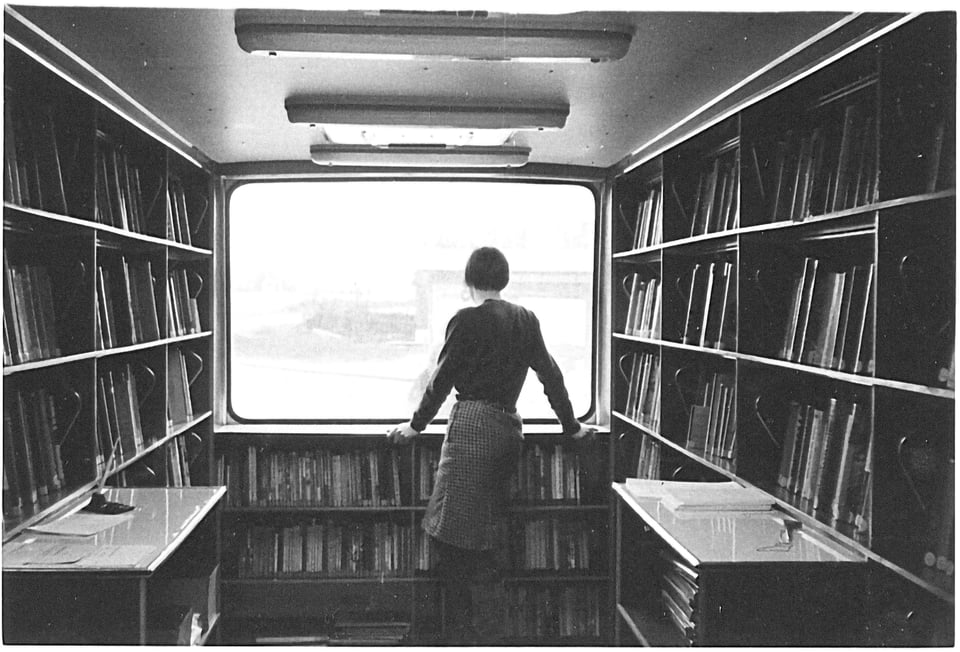
Bibliobussen — That up there is one of my favourite photographs, stumbled upon in this collection of Dutch library buses. It’s dated 12 February 1967, but there are no other details. It’s just a perfect picture, no notes. Other modes of mobile library are available.
Design Reviewed — Matt Lamont’s incredible design archive is becoming a book, currently open for backing at Volume. Spanning a century of graphic design history, it includes everything from rare graphic and architecturally focused periodicals – such as Typografia, Architectural Design and Typographische Monatsblatter – to posters, stamps and print ephemera from around the world.
Who did Drew draw? — An absolutely invaluable database of actors immortalised by the late poster maestro Drew Struzan. Warning: may trigger impromptu Police Academy binge.
The history and evolution of shadows in art — an excellent long read that says a lot about how our funny little brains parse two-dimension images:
“In many cases, the rules of physics that apply in a real scene appear to be optional in a painting; they can be obeyed or ignored at the discretion of the artist to enhance the painting’s intended effect. Some strong deviations, such as Picasso’s skewed faces or the wildly colored shadows in the works of the Fauvist school, are meant to be noticed as ingredients of the style and message of the painting — they serve communication purposes. On top of that, an alternative physics operates in many paintings, one that few of us ever notice but is just as improbable. These transgressions of standard physics — impossible shadows, impossible colors, impossible reflections or contours — often pass unnoticed by the viewer and do not interfere with the viewer’s understanding of the scene. Because we do not notice them, transgressions of physics reveal that our visual brain uses a simpler, reduced physics to understand the world. Artists can endorse this alternative physics precisely because these particular deviations from true physics do not matter to the viewer: The artist can take shortcuts, presenting cues more economically and arranging surfaces and lights to suit the message of the piece rather than the requirements of the physical world. In discovering these shortcuts or strategies of image compression, artists act as research neuroscientists or as visual hackers, and we can learn a great deal from tracing their discoveries. The goal is not to expose the ‘slipups’ of the masters but to understand the human brain. Art in this sense is a type of found science — science we can do simply by looking.”
Solarpunk — Tired of dystopian sci-fi that blends seamlessly into the day’s headlines? Here's a recent literary genre that imagines what happens when our climate changes — and so do we. Features lots of domed cities and people plugging stuff into trees.
Imperfection as design strategy – Elizabeth Goodspeed asks what does “analogue” actually mean when most things are made, shared, and consumed digitally:
“For every person declaring that analogue is back, there’s someone offering the same explanation why: AI and other digital tools have made perfection cheap, fast, and easy, so imperfection now signals authenticity. But if analogue only matters as a foil to the digital, why are analogue aesthetics being embraced without analogue tools? If the goal is to prove something wasn’t made by AI, faking ‘realness’ on a computer doesn’t really get us anywhere new. It just reflects a different kind of dissonance (call it fauxbi-sabi). Case in point: I noticed that one vendor selling ‘analogue’ Photoshop actions advertises them with the tagline ‘Save time, focus on being creative’, a promise suspiciously similar to every argument made in favour of AI.”
Cattle brand – from Alistair Hall’s excellent We Made This blog, a crash course in the original art of branding, including some lovely type designed specifically for hot-poking cows.
Jason Kottke’s rolodex, a glorious union of blogroll and RSS reader. Precisely the kind of web I like, one where people, not algorithms, are the conduits. Very much within the realm of Russell Davies’ internet of unmonetisable enthusiasms..
Do Interesting — Actually, while I’m invoking Russell, let’s throw this nugget from his book Do Interesting onto the newsletter inspiration pile:
“Ideas mostly come from the slow, quiet accumulation of seemingly banal and obvious habits. It’s just doing the right things to make sure your mind and your life are brimming with hearty compost.“
That is all.
Thock.

