Issue #2: Nov. 6 deadline, and the rovers start prospecting
Mars Mining Weekly Briefing, issue #2. By Mars Mining Desk.
 Image: NASA/GRC (VIPER test rover, SLOPE Lab)
Issue #1 went out yesterday, so this one skips the repeats and leads where it should have: with things you can apply to. Then a short news run, because NASA talks Artemis tomorrow.
Opportunities
The nearest deadline is Nov. 6. The Matthew Isakowitz Commercial Space Scholarship closes at 11:59 p.m. ET that day. It is for graduate students, including people who will start a master's or PhD program after finishing a bachelor's this year, and winners are considered for a Washington-area summer internship. Listed 2027 hosts include SpaceX, Blue Origin, Rocket Lab, Planet Labs and The Aerospace Corporation. You need a resume, a transcript and three essays, one of them a 400 to 600 word policy memo or investment thesis. It is open only to U.S. persons, so read our ITAR explainer if you aren't sure where you stand. Two weeks is enough time for a good memo. It is not enough for a good memo written in the last two days.
Further out, NASA's summer 2027 internships close March 1. The full list lives on our deadlines page.
Five early-career roles posted this week, picked from the internship board and the entry-level board:
- Inversion Space, AI and Internal Tools Software Engineer, Summer 2027 intern (Playa Vista, Calif.)
- Ursa Major, In-Space Propulsion Engineering Intern, Summer 2027 (Berthoud, Colo.)
- Varda Space, Pharmaceutical Lab Intern (Crystallization), Summer 2027 (El Segundo, Calif.)
- Relativity Space, Software Development Engineer in Test I (Long Beach, Calif.)
- Muon Space, RF Test Engineer I, Testbeds and EGSE (San Jose, Calif.)
The Varda listing is the one to notice if you think space jobs need an aerospace degree. It is a chemistry lab role. Ursa Major alone posted ten summer internships on Oct. 19, marketing and people operations included.
This week's homework
Pick one project from portfolio projects that get interviews and scope it to something you can show before the summer 2027 application deadlines above. A finished small project beats an ambitious one with a README and no results. If you don't know which track you're on yet, the roadmap will sort that out in a few clicks.
The news, briefly
NASA's Moon Base rovers get a prospecting job. NASA's Oct. 20 update lists five duties for the rovers, and resource prospecting is one of them, alongside transport, mapping, science and tech demos. Orbiters have told us where hydrogen probably is. Only something that drives and digs can say how much ice sits in a given patch of ground. Our test is the payload list: a neutron spectrometer and a drill would make this a prospecting program, while a camera would not. For job seekers, this is mobility, navigation and instrument work, paid for before anyone sells a liter of lunar water. Our take.
An AI computer rides a lunar rover. HPE's Spaceborne Computer-4 will fly on Astrolab's FLIP rover on a mission expected to launch this year, Payload reports. It will test language models, visual and LiDAR processing and autonomous monitoring, with NASA and Deloitte running workloads too. The three earlier versions flew inside the ISS. This is the first exposed to vacuum, cooled by a radiator with no fans. We care for a dull reason: a prospecting rover that can flag interesting ground on board spends less of its limited downlink on boring ground. If the hardware has to throttle itself through radiation events too often to be useful, that argument weakens. It's also the clearest example yet of the AI-at-space-companies roles we keep saying are rare and senior.
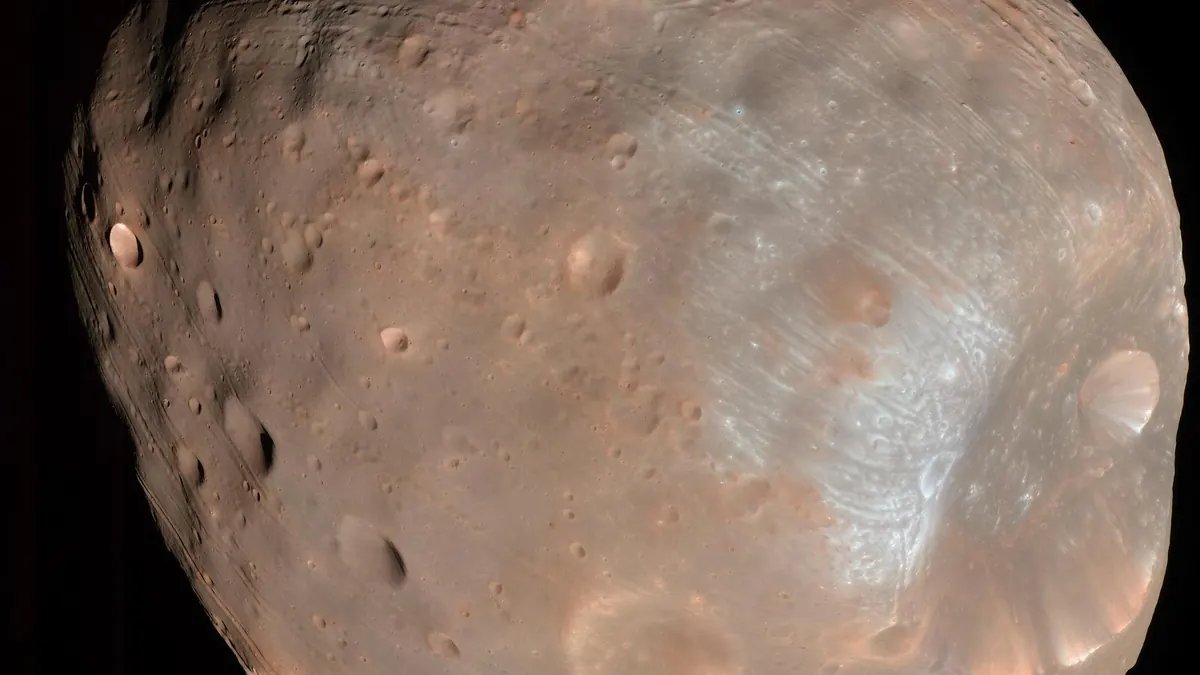 Image: NASA/JPL-Caltech/University of Arizona (HiRISE, PIA10368)
MMX is on its way to Phobos. JAXA launched its Martian Moons eXploration mission on Oct. 19, carrying two NASA instruments and built to return a Phobos sample. Whether Phobos is a captured asteroid or Martian debris decides what it's good for. Water-bearing minerals would revive the depot idea, and dry rock would make it a parking spot. More.
Tomorrow, 11 a.m. PT. NASA briefs on Artemis and its 2028 crewed-landing goal from Kennedy. We're listening for whether Artemis III moves and whether any mission is described as depending on local resources rather than testing them. What to watch.
Read next
If the rover story got your attention, start with lunar water ice, explained, then lunar regolith. The rest of the paths are on the topics page.
What would change our mind this week: a Moon Base rover payload list with no prospecting instrument on it. That would turn "prospecting" back into a line in a slide deck.
See you next Thursday.
Mars Mining Desk