Past to Present. Machines of Perfection: Max Factor’s Beauty Lab
Today I want to tell you about two gloriously odd bits of beauty technology dreamed up by the Max Factor company: the Beauty Micrometer and the rather wonderfully named Mechanical Osculator. I was lucky enough to see both in person at The Hollywood Museum in Los Angeles a few years ago and they have been on my mind ever since.
Let’s start with the Micrometer, unveiled in 1933. And yes – let’s address the obvious straight away. It looks like something between a medieval torture device and a piece of deeply suspect “science.” It has all the trappings of phrenology and eugenics – that awful urge to measure, categorise and ultimately “correct.”

The Micrometer was developed by the legendary Max Factor who believed – quite earnestly – that beauty could be broken down into a series of precise, measurable and solvable problems. The idea was that the face could be mapped with scientific accuracy, assessed for deviations and then “fixed.”
And to measure this – rather than waving a ruler vaguely at someone’s face – he came up with a “beauty calibrator” – a device intended to take these measurements in a more scientific manner.
The (remarkably patient) subject would have this contraption lowered over their head like a helmet. It covered the entire face and left only the neck exposed. Running across the mask were metal bands – with over 300 tiny adjustable screws embedded within them – each one ready to be tightened.
As the technician adjusted the screws, the bands would inch closer and closer to the contours of the women’s face and neck, effectively mapping ever dip and nonconformity. This in turn would produce a kind of cosmetic formulary: a list of “corrections” to be made. And it’s worth stressing that these adjustments were to be achieved with makeup (Max Factor brand, of course) rather than surgically.

Predictably, the more faces they measured, the more the whole premise began to wobble. Because when you start quantifying beauty at this level, one thing becomes abundantly clear: almost everyone “fails.”
The plan had been to roll out the Micrometer widely, installing it in salons so that women everywhere could have their faces assessed. But yet, for all the initial enthusiasm, only one of them was ever seemingly made and it stayed in Max Factor’s laboratories and, eventually into its historical archive.

The Mechanical Osculator – also known as the Kissing Machine arrived on the scene for entirely different reasons (and with much less eugenics!)
By the late 1930s, the beauty industry was in hot pursuit of something like its own Holy Grail: the truly indelible lipstick.
This challenge was rather more complicated than it first appeared. Because an indelible lipstick has to do three things at once. It needed to stay put (obviously), it had to remain the same colour after application and it had to be comfortable to wear for long periods of time.
Earlier attempts had managed one, occasionally two, of these requirements, but never all of them at once. The real sticking point was irritation as the very ingredients that made a lipstick long-lasting often made it deeply unpleasant to wear. Drying, tightening, sometimes even slightly burning – this was hardly the stuff of effortless glamour.
But, once again, Max Factor (in the form of Max Factor Jr. as Max Factor Sr. had died in 1938) was on the case.
In their labs, new formulations (built on the back of indelible dyes that the company had patented in 1939) had been created that seemed hopeful.
But what they really needed – what they wanted – was a live test to prove that they had, indeed, solved the problem.
So, Jr. did what any sensible head of a cosmetics empire might do and asked for volunteers among his staff. Among those that responded positively was, apparently, a salesgirl engaged to a man in the accounting team. And this is where the story takes on that slightly hazy, half-mythical quality that all good industry anecdotes seem to acquire over time.
The names most often attributed to the volunteers are Joseph Roberts and June Baker. They were instructed to arrive half an hour early for work each morning and to spend that time kissing. Baker would apply the lipstick, place a square of white tissue over her lips, and then kiss Roberts. Jr. would then examine the tissue, judging adherence by the faint tint left behind. This process was repeated many times over the course of those 30 minutes.
How long this arduous task went on is a matter of some debate – it could have been weeks, perhaps months. And why it ended is even less clear. Some accounts suggest they simply tired of the early starts. Others hint that Roberts became the subject of workplace teasing. There’s also a wonderful dry observation that, after a time “their enthusiasm began to vanish and thereafter their osculation’s weren’t up to standard intensity.”
Whatever the real reason (and Jr.’s explanation that when humans kissed the pressure wasn’t systematic is probably the right one) it was soon apparent that they would be better served by creating a machine to standardise the experimentation. Enter the Mechanical Osculator – also known far more memorably, as the Kissing Machine.
Rubber moulds were made of Baker and Robert’s lips – scaled up to roughly three times their natural size. These were then mounted onto a device fitted with a hand crank and a pressure gauge capable of measuring up to 30 pounds.
The next step was to define what, exactly, constituted a kiss. After some deliberation, it was decided that five pounds of pressure equated to a polite peck on the cheek. A “proper” kiss – what Jr described as “a first-class, full-blown kiss” required five pounds from each side, totalling ten. More passionate encounters could register up to 25 pounds, though these were deemed “unusual.”
By 1939, the machine was up and running and the “goal” set around the ten-pound mark. The process echoed the earlier human tests with lipstick applied, tissue placed between the lips then the mechanism set into motion. It could deliver kisses at a remarkable rate – up to 1,200 an hour. Technicians would, once again, examine the tissues and count how many impressions they could get before the colour began to fade.
It was a useful bit of tech but, just as importantly, the press and the public loved the idea. It was reported on in the media and even employees and visitors to the building began pocketing the used tissues as souvenirs.
Eventually when they had done enough testing and refining of their formulation and Max Factor launched Tru-Color lipstick: a range of carefully calibrated reds.
And when it launched, Max Factor did not hold back with their claims.

They billed it as “the world’s first perfect lipstick … a lipstick that imparts a life-like red to the lips … that is non-drying but indelible … that eliminates lipstick lines … and that is safe for sensitive lips.”
And while I am, of course, interested in the end results I am more interested in what happened to the Kissing Machine once its initial purpose had been served. There is some evidence that it continued to be used into the next decade.
In 1942, during the Second World War, the company donated several dozen sets of the Kissing Machine’s rubber lips to “the nation’s scrap rubber pile.” There is something rather wonderful about that isn’t there – these oversized, slightly surreal objects, being melted down for entirely different purposes.
There are hints that it continued to be used, or at least maintained, after the war. A 1948 article, for instance, mentions the starlet Zana Siggins serving as the model for some updated “plastic-flesh casts.” The same piece notes that the device was still being used to test the durability of new lipstick compounds.

But whenever it stopped being used the Kissing Machine definitely enjoyed a far more prominent afterlife than the Micrometer ever managed – most notably as the cover image for Greatest Hits by Red Hot Chili Peppers in 2003.

It went up for auction in 2010, described rather forlornly as “damaged,” and failed to sell. A year later it did find a buyer – though for an undisclosed sum. Tracking its movements becomes a little hazy but by the following year it definitely appears to have been at the Procter & Gamble archives in Cincinnati. And then in 2015, its story comes full circle when P&G donated its entire collection to the Hollywood Entertainment Museum, returning the Kissing Machine to its first home and reuniting it with the Micrometer in the building on North Highland Avenue that the Max Factor company had used – in various configurations – until the early 1980s.
Have a great day and thanks for reading!
Lucy
P.S I have a talk coming up
9 June 2026
The Cosmic Catwalk: A Journey Through the History of Space Travel and Fashion
New York Adventure Club
From orbiting satellites to moonshot dreams, the Space Race did more than transform geopolitics — it reshaped how the world imagined the future. How did visions of life beyond Earth make their way onto runways, television screens, and into everyday wardrobes? It’s time to explore the cosmic influence of space travel on 20th-century fashion and pop culture.
Join New York Adventure Club as we uncover the fascinating intersection of space exploration, fashion, and design, and how the Space Age aesthetic moved from scientific innovation into mainstream culture.
Register: https://www.nyadventureclub.com/event/1989030878902
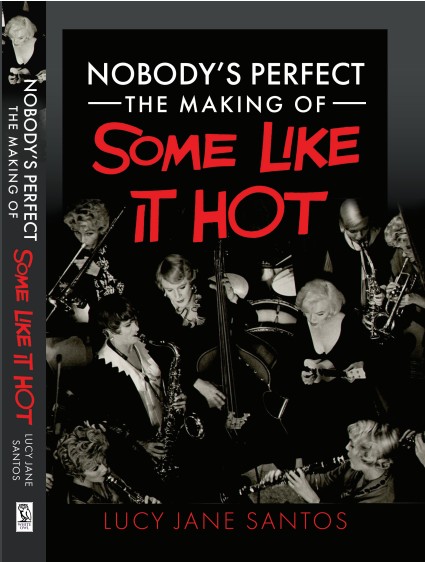
And don’t forget my book Nobody’s Perfect: The Making of Some Like It Hot is available for pre-order. More details https://linktr.ee/NobodysPerfectProject