Five incredible things you could do with radium
For a 21st century audience radioactivity is a bright yellow warning sign; an explosion and a poison. Artificial radioactivity (the kind made in a laboratory that revolves around nuclear reactors and bombs) – for that is what we are all so scared of – is the threat of the end of the world. But there was a time when radioactivity was revered, not feared; when it seemed that everyone was clamoring for more of it, not less.
In 1895 Wilhelm Röntgen discovered a new type of powerful (and invisible) radiation: known as ‘X’. The following year Henri Becquerel identified the phenomenon of radioactivity and Marie Skłodowska Curie named it. In 1898, with her husband Pierre, Skłodowska Curie identified two new radioactive elements, polonium and radium. Forming a group with uranium, thorium and actinium, these elements posed a challenge to the seemingly irrefutable rules of chemistry. that elements were a stable, fixed substance.
Out of all these radioactive elements, one – radium (represented by the symbol Ra) – had the most momentous impact of them all.
It took four years (and eight tons of source material) of hard work to isolate one- tenth of a gram of radium chloride (RaCl2– a compound of radium and chlorine which looks like salt).
With such an initial protracted production process owning radium salts conferred great social and professional prestige. In the early years of the 20th century it was the most expensive, and most desirable, substance in the world.
So lets look at a few things that people did with it in those early years.
You could give it as a present
British chemist and science journalist Sir William Crookes (famed for the development of Crookes tube in the early 1870s) was the unlikely originator of THE Christmas present sensation of 1903. Crookes had debuted his Spinthariscope – derived from the Greek word spintharis which means a flash of light – at a scientific soiree at the Royal Society in Piccadilly in May of that year. Crooke’s spinthariscope, which is essentially a cross between a kaleidoscope and a Geiger counter, captured the imagination of those present and was soon available in shops.
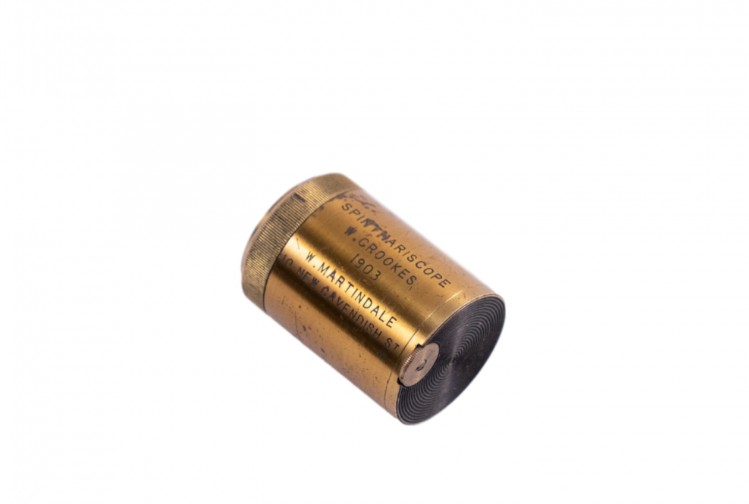
A stunning version, gold-mounted in a velvet-lined case, was given to Queen Alexandra, the wife of Edward VII (who reigned until 1910) as a Christmas gift. It was deemed the must-have gift for Christmas 1903, even though the updated ones aimed at the non-scientific market cost the equivalent of $1300 in todays money.
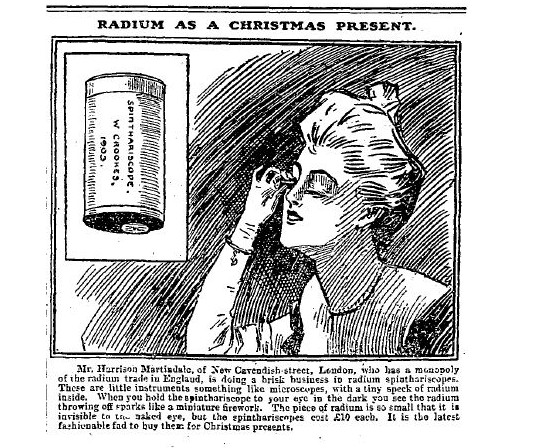
Despite its hefty price tag, the popularity of the Spinthariscope meant that stocks of radium were quickly plundered: leaving very little for pure medical and scientific experimentation. But it was certainly value for money. In his book The Interpretation of Radium, first published in 1909, the chemist Frederick Soddy pondered the implications of the spinthariscope ’s legacy referencing radium’s radioactive half-life: ‘The owner of the instrument will pass away, his heirs and his successors, and even his race will probably have been forgotten about before the radium shows any appreciable sign of exhaustion.’
You could watch it
Radium is pretty remarkable because it glows faintly on its own (essentially radioactivity agitates nitrogen that is naturally present in the air, creating a buzz of energy which is perceptible as a shimmer of light). Scientists and entrepreneurs wasted no time in exploiting this trait and began experimenting with adding sticky substances to radium salts to create glow in the dark paint. By 1904 this started to be used in theatres when Lester D Gardner, an engineer based in New York City, made an agreement with the legendary theatrical producer F.C Whitney to supply radium paint for his upcoming Broadway production Piff! Paff! Pouf! Gardner’s glow in the dark paint was used on the costumes of the dance sensation, The Pony Ballet, a vaudeville act of eight teenage girls who specialized in a strict synchronized style of dancing said to imitate horses’ movements with exact precision and perfect harmony.
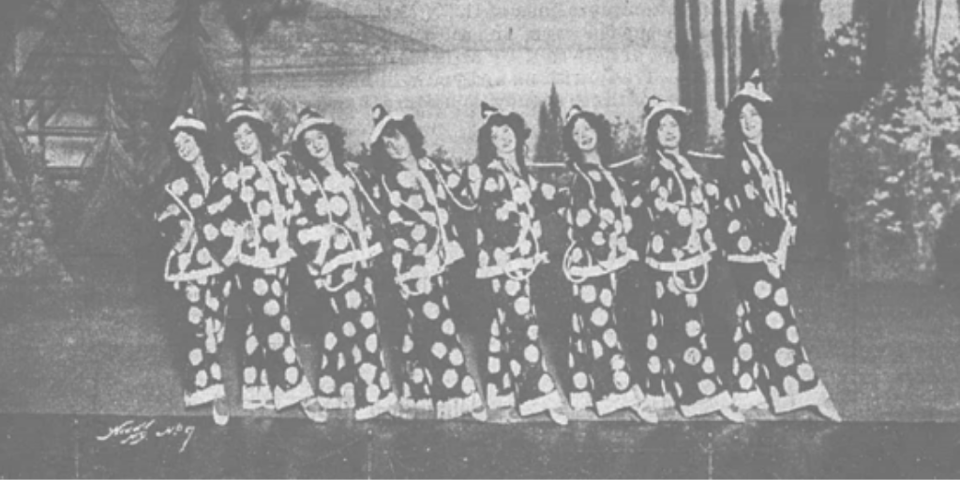
The stage was plunged into darkness, and the orchestra (the baton of the conductor was also apparently painted with glow-in-the-dark paint) began playing the piece of music written especially for the play by Jean Schwartz: the Radium Dance. Half of The Pony Ballet appeared on the darkened stage dressed as Pierrots with sugarloaf hats and skipping ropes; the other half were dressed as Pierrettes, with coronets, ribbons and special shoes all glowing in the dark. They now performed the dance, which seems to have involved a lot of synchronised skipping (using ropes that were also painted) in time to the music: a rather conventional ragtime number with a fast beat and a catchy tune that had nothing to do with radium.
You could drink it
Whilst radium salts were hard work to acquire the explanation of one of the properties of radioactive elements (that they are constantly turning into something else) suggested another source. Uranium, for instance, decays into thorium, which in turn becomes radium. After that comes radon. Eventually, after multiple transformations, the uranium decay chain ends with a ‘stable’ element – lead – which emits no more radiation.
Wherever deposits of uranium rocks were found therefore you could find natural sources of radioactivity. The gas radon is easily released into the environment by escaping through natural cracks in the ground, emerging onto the surface or into the water. Radium could also be present in the rocks that waters trickle over: in which case it infuses the water with radioactivity.
In the US alone places such as Hot Springs (Arkansas), Saratoga Springs (New York State) and Springdale (Colorado) were established to have radioactive waters of one kind or another. Facilities and treatments sprung up all based on the theory of mild radium therapy, that exposure to radium in small doses (most commonly administered by drinking radium laced water or by breathing in radioactive gas) is beneficial: triggering a chain of physiological reactions that boosts the immune system in many different ways.
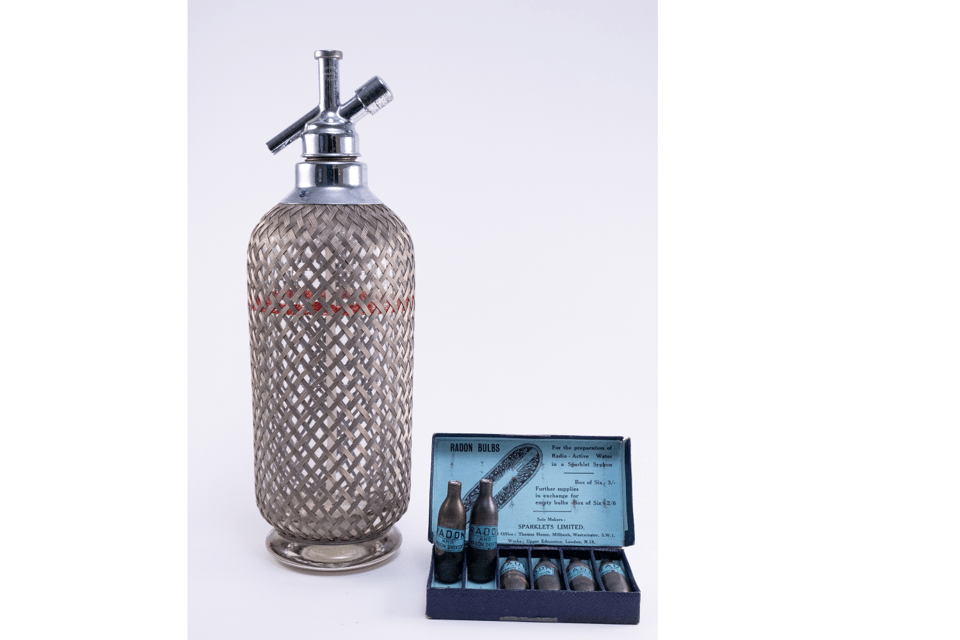
But it was also possible to bring radium water into your homes. The firm Sparklets marketed a product that could turn ordinary water radioactive. The Sparklets Syphon was a reinforced glass bottle with a mechanism to add bulb containing compressed carbon dioxide. Carbonated water would then squirt out of the nozzle. On sale since the 1890s it was a relatively simple matter to extend their range to include a bulb containing an unspecified radioactive substance.
In May 1914, The New York Times reported that these ‘So-called Radio-Active Siphons’ would see a trend for orders of ‘brandy with a dash of radium water.’
You could tell the time with it
Watches, in the form of pocket watches, had always been an essential part of an officer’s kit but their usefulness was brought into question by new methods of fighting during World War One. A pocket watch was impractical to use on horseback, or in the open cockpits of early aircraft or in the cramped conditions of the trenches. Wristwatches were an innovative solution but didn’t solve the problem of being able to see one’s watch in the dark (and striking a match might risk giving away your position to the enemy) Watches with luminous dials therefore quickly became an essential safety element: a must-have gadget.
LUMA, made by the Radium Dial Company, Pittsburgh, emphasized this use in one of their marketing brochures: ‘During the war LUMA ceased to be a convenience and entered the ranks as a necessity, serving where the need was greatest- quietly but effectively. In the trenches, in the camps, on the seas and in the air it made light at night unnecessary. Navigators now compare LUMA to the stars. With their nautical instruments LUMAnated the peril of darkness is removed.’
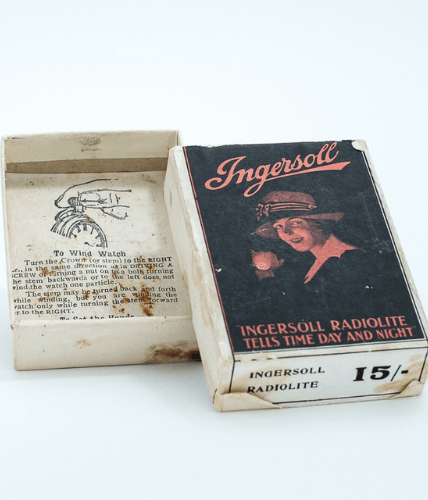
The wearing of wristwatches by officers and soldiers created a fashion that spread through wider society. It has been estimated that over 4 million glow-in-the-dark watches had been produced in the United States by 1920.
You could use it keep pain free and beautiful
In early 1914, the company Radior Ltd tossed a new product into the already crowded rheumatism cures market, launching the ‘Radior Pad’ with advertisements in a wide variety of British newspaper publications. Advertised as ‘comfortable to wear’, the Radior Pad was a cloth- covered cushion designed to be strapped to the troublesome part of the wearer’s body. The Radior Pad was priced at just five shillings and was said to ‘expel the dreaded Acid Crystals in all uric acid complaints.’ The pad was sold with the ‘Radior Guarantee’ promise that it did actually contain radium and a cash penalty payable if anyone could prove otherwise.

After several years of successful sales in Britain Radior opened an office on Fifth Avenue, New York City, in late 1918 with the intention of conquering the US market. One of their most successful products were their Hair Tonics and Shampoos which promised to produce health hair using ‘the marvellous rays from Radium …. The most effectual way of rejuvenating and beautifying the hair. These rays, constantly emitted, penetrate to the hair roots, follicles, pigmentary glands ... and promote a steady growth of new, luxuriant, glossy hair.’ Radior also produced radium cosmetics: offering creams, rouge and face powder ‘guaranteed to contain actual radium and remain radio-active for 20 years’.
But it wasn’t just Radior the curious properties of radium also found expression in a wide range of products and services that were aimed at the general consumer: from the deadly (Radithor radioactive water) to the bizarre (the O-Radium Hat-Pad: ‘whenever you are wearing your hat, you are subjecting your hair to beneficent rays’) to the simply fraudulent (Radol, which claimed to be a radium-impregnated cancer cure). And sometimes, as in ‘Nutex Radium Condoms’, there was no suggestion that the product contained any radium but it didn’t stop the company using the name.
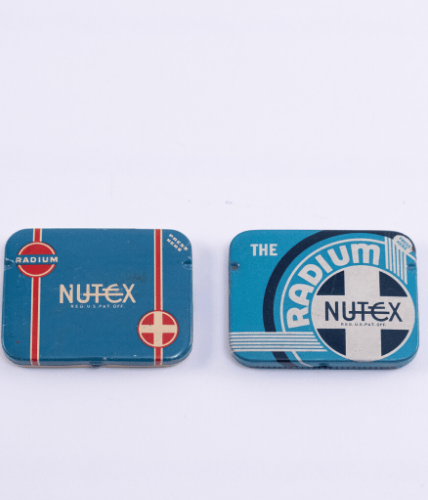
This has left us with an incredibly rich material culture that can be glimpsed through advertisements and the objects themselves – which survive in surprising numbers. In hindsight it seems inconceivable that people would ever touch, let alone buy these obviously dangerous goods. It would be tempting, as well as highly reassuring, to assume that only a few radioactive products were ever on sale. It is true that some of these goods existed only as patents or trademarked ideas and were never actually made. But far beyond the hospital or the laboratory, many were widely available to buy: in department stores, via mail order or in beauty salons.
I can’t exactly remember the first time I became aware of radium but I can remember the first time I ever held a radium product in my hand. It came in a large box from an auction house: bought on the spur of the moment, sight unseen. It was with a treasure trove of items from a house clearance somewhere – lipsticks, eyeshadows, perfumes and hair curlers. Among all of the half-used pots and tubes was a pot of face powder which according to its packaging was made with radium bromide and thorium chloride. After the shock of discovery came many questions: who used this? What did they expect it to do? Surely no one thought this was a good idea?
Without an obvious answer I decided to research the topic and ended up writing my debut book. Half Lives: The Unlikely History of Radium explores how our relationship with radium and radioactivity has changed over the last century. Afterall the history of radium, irrational, confusing and conflicting as it is, is still a subject that impinges on important social and political issues of today.
Have a great day and thanks for reading!
Lucy
P.S I have a few talks coming up
5 May 2026
The History of Television: From Static to Streaming
New York Adventure Club
Join New York Adventure Club as we explore the fascinating history of television, from its earliest mechanical beginnings to the digital platforms that now deliver endless content at the touch of a button. Along the way, we’ll uncover how TV reshaped communication, entertainment, politics, and everyday life across the globe.
Register: https://www.nyadventureclub.com/event/1986807216869
6 May 2026
Dream Journeys: Concorde, Queen Mary and the Orient Express
Warner Library
Visit their website for more information https://warnerlibrary.org/
29 May 2026
The Golden and Silver Age of Passenger Trains (Re-Air)
New York Adventure Club
Join New York Adventure Club as we uncover the history of passenger trains, from the first transcontinental railroad of 1869, to the railroad boom of the golden age, through the twilight years of the silver age when the luxury rail experience was in full swing.
Register:https://www.nyadventureclub.com/event/1988206762949
9 June 2026
The Cosmic Catwalk: A Journey Through the History of Space Travel and Fashion
New York Adventure Club
Details and bookings to be released shortly
4 July 2026
War, Women and Lipsticks: Cosmetics in war-time
New York Adventure Club
Details and bookings to be released shortly