
lots to win: the Riff Raff Party
Why and how politicians should campaign on sortition

I want to propose a new American political party, but let me be clear: not really.
America is all but immune to new parties. Poli-sci geeks will offer Duverger’s Law, which says that voting systems like ours (one representative per district, most votes wins) will tend towards two parties. But that doesn’t explain why we’re so much more stuck in the two-party quagmire than, say, India, the UK, and Canada – all of which have more parties despite similar systems. For that you have to look at how our primaries suck up candidates’ attention and our presidential elections suck up the public's. Taken together, it adds up to a highly effective three-pronged two-party trap.
But regardless of why we’re stuck with two parties, the point is we’re stuck, and it’s a fool’s errand to try to break the stranglehold without reforming the system. Then again, how will we reform the system without reorganizing ourselves politically?
So to break the doomloop, I propose a party-in-name-only: The Riff Raff Party.
The Riff Raff party is, again, not a real political party. It won’t be registered as a party. It won’t appear on ballots. It won’t try to convince you that members of the other parties are out to destroy all that is good, beautiful and true.
But it will offer a rallying cry for those want to advance democracy – real democracy – in America.
The goal of the Riff Raff Party is to vastly expand our use of civic assemblies. Civic assemblies (or rabbles, or mini-publics) are groups of everyday citizens selected by democratic lottery (or sortition) to deliberate and deliver policy proposals together. Such assemblies have proven extremely successful in many states and across the globe at reaching large supermajority agreement on solutions to problems that have stymied elected politicians.
It is important, critical really, that sortition and civic assemblies not become heavily associated with one of the two major parties; that will all but ensure that the other comes to oppose them, undercutting the legitimacy they need to thrive. That’s why we need this separate party-like space: to step out of hardened battle lines.
Riff Raff should welcome folks of all political stripes to advocate strongly for engaging everyday citizens in deliberative democracy. And it should avoid weighing in on any other political issue under its pseudo-party banner.
Party "members" can and should tackle other issues in their campaigns, of course – having no answers at all except to defer to future civic assemblies is not likely to prove a winning campaign strategy. But anything outside of assembly democracy is outside of Riff Raff’s scope. Folks running in real parties or as independents are welcome to call themselves Riff Raff as long as they commit to empowering everyday citizens to deliberate and shape policy.
So...why would anyone join? Because civic assemblies are a perfect response to the political moment.
No politician can meet the zeitgeist without going a bit anti-establishment. Americans have a dismal view of their institutions. Last spring the Pew Trust found only about 17% of the country thought their federal government did the right thing all or most of the time. Poll after poll confirms disdain for the status quo. Team Keep Up the Good Work is not going to thrive at the ballot box.
But nor is Team Tear it all Down, suggests a recent NYTimes/Sienna poll.
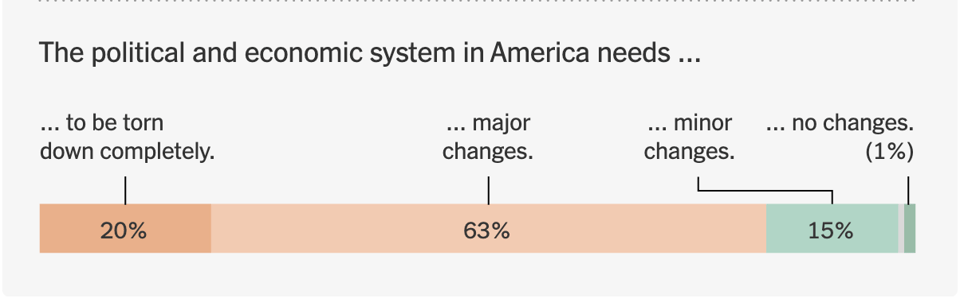
By and large America wants major change, not demolition. Meanwhile, the most insistent “major change” agent on the horizon, the large language model, is unpopular too. Even and especially among the young, who have repeatedly broken into raucous boos at the mere mention of AI in graduation speeches. We're not happy, we want major change, we see major change coming, and we're not happy about that either.
How can a political campaign respond to all this? It's a poser. Especially so, given that elections don’t exactly open doors to deep discussion; to succeed, you need a message that lands in a few words. How can you fit an adequate response to a crazy moment like this within the confines of a campaign ad? With a limited word budget, you can certainly defend the status quo. You can advocate for minor tweaks. You can call for tearing things down. The public wants none of those. The public wants major change; how can you pitch that attractively, credibly, and concisely?
Not with detailed designs for institutional reform – those are too complex for election messaging. Not with pledges to trust experts – the public is in no mood for technocracy.
What you need is new democratic methodology.
Candidates need to provide legitimate hope that our politics, our institutions, and our technology can someday be a source of human wellbeing. So here's your pitch: the people rule. This means government by
- Everyday people, not politicians.
- Humans, not bots
As concise as that is, it opens the door to a host of dramatic, and very healthy reforms. It's a compact, campaign-friendly way to offer genuine major change.
The people don’t like the government. They don’t like the parties. They don’t like the new technology. So what now? Well, when all else fails, we could always try democracy.
The Riff Raff Party
The people rule.
everyday people can riff together to solve problems.
everyday people can overcome the poison of partisan politics.
Send in the riff raff.
Say you’re a politician. What’s in it for you?
I mean, the sortition movement has a decidedly anti-politician viewpoint (although it spends considerably less time bashing politicians than most politicians do). They want to move power away from politicians. Many go so far as to envision a post-politician world; this year alone has seen the publication of Hélène Landemore’s Politics Without Politicians and Terrill Bouricius’s Democracy Without Politicians. Do you really want to team up with the folks who want to give your job to randos?
What's in it for you is savvy politics. First, there’s the fact that it will help you get elected. Poll after poll shows Americans are disgusted by our polarized political scene; you can offer them a genuine way out. Citizen democracy polls very well. And it offers a credible narrative for why your leadership will succeed where others have failed.
Then there’s the fact that this strategy will help you once in office. Civic assemblies give politicians permission to enact pragmatic solutions, even when they don't fit partisan narratives. Whether the movement likes it or not, politicians have often been very successful in using civic assemblies for political cover. Blame it on the randos.
But most importantly, there’s the fact that sortition is actually what we need to thrive in this moment. It’s how we solve intractable problems. It’s how we bridge divides. It’s how we figure out what we as a whole think about rapidly moving topics. It’s how we create barriers to autocracy.
It will help you get into office. It will help you succeed in the role. Don't let the fact that it's the right thing to do discourage you; it's still smart politics.
Riff Raff National Platform (proposed)
America Unstuck
We must call large national civic assemblies to propose solutions for vital issues that Congress is too divided to address, including:
- Artificial Intelligence
- Immigration
- Social Security and Medicare
And help fund state civic assemblies on Housing and Affordability.
Thereafter citizen agenda councils will select topics for further assemblies. We will insist that Congress act on all recommendations proposed by these assemblies.
The Party to End All Parties
In the long term civic assemblies should replace parties as the primary engine of political discourse.
In the short term we should depoliticize appointments that must be shielded from electoral influence. To achieve that, we support handing nomination and oversight tasks to juries of everyday citizens.
- Nonpartisan Courts. Juries, not politicians, nominate and oversee judges.
- Nonpartisan Research. Juries nominate and oversee heads of research agencies and grantmaking institutions
Democracy not Dictatorship
Presidents of both parties increasingly wield power in their self interest. We advocate new guardrails using citizen deliberators protected from partisan politics.
- Independent Justice. No more weaponization from either party. Juries nominate and oversee the leadership of the Department of Justice, FBI, CIA, DEA, and other DoJ agencies
- Fair Pardons. Juries can block pardons with conflicts of interest
- Citizen Electoral Board. Elected politicians and appointees are too biased to oversee elections.
Renew the Republic
It is not enough to implement temporary solutions that the next administration can unravel. To empower the people to codify democratic progress, we will call for Constitutional Conventions of the People, both nationally and in every state, with conventioneers selected by lot.
We do this not because we can control them, but because we can’t. We trust the people.
Sparks not Spoilers
We’re here to spark change, not to spoil elections. After losing a major party primary, we will not field a candidate in any race we have no chance to win.
So… what now?
For the moment, this piece is an open call, not an announcement. It’s an invitation to organize, not an invitation to an existing organization.
What will make the idea fly is if someone with an itch to run for office – an itch I've never had – sees the power of the political opportunity and the wisdom of distancing sortition solutions from entrenched political battle lines.
Will sortition advocates jump on board? Hard to say. The movement is largely populated by folks whom electoral politics nauseate. But by and large they know it's a long-term project and will welcome opportunities to bring attention to genuine democracy, especially in collaboration with people they genuinely believe will help advance the cause in office.
But sortition advocates aren't the target audience: everyday people are. And promoting their political power beyond election day has the makings of a winning electoral strategy. It’s hard to imagine a single solution answering more of what today’s voters are demanding.
Add a comment: