
Year 2, Week 38
Sept 12-18 – and back again
Hello friends,
I’m back from our trip to Brazil! We were there to visit the world’s largest freshwater wetlands, a region called the Pantanal. If you’re keen on gorgeous photos and extraordinary descriptions of nature, keep an eye out for Ed’s upcoming photo essay.
I often struggle to talk about trips once I’m back. I can tell you about the jaguars and anacondas we saw, and the devastation of wildfires and clear cutting in the region, but I find it difficult to talk about what it actually meant to be away. I’m grateful to be physically, personally, reminded of just how vast the world is.
This was Year 2, Week 38. It’s so good to be home, and painful to know how fragile it is.
What’s happening in science & higher ed
While I catch up on the news1, I wanted to begin by sharing two perspective pieces I really appreciated:
Over in Science, collaborators I deeply admire have a short new letter about defending academics’ freedom of movement. It’s not the end of a story by any means, but narrating wins and success is a critical—and often forgotten—part of effective advocacy.
And a recent Nature Physics correspondence does a beautiful job of framing the threat that an unconstrained and unlawful executive branch poses. This is calibrated nicely for those who just want to keep their heads down and stick to the science, “Failing to engage now will leave us with little science to which we can stick. It is time for all citizens, especially those interested in the betterment of society through science, to stand up for the checks and balances guaranteed by the US Constitution.”
One day before it was due to take effect, Judge F. Dennis Saylor IV blocked the new mandatory four-year cap on visas for international trainees (at least for now).2 Although he stopped short of issuing summary judgement to strike down the DHS rule, Judge Saylor did affirm that the academic plaintiffs have a “substantial likelihood of success” on procedural grounds. For specific details of what this decision means in practice, I think the AILA3 is extremely helpful.
On the infectious disease front, right now, half of American kids don’t have access to the latest approved COVID vaccines. Since 1993, the federally-funded Vaccines for Children program has ensured that kids can be immunized whether or not their families have the health insurance or disposable income to cover them. The program operates by having the CDC buy the doses and distribute them to state and local health organizations. Earlier this week, the WSJ broke the story that the CDC has not yet initiated purchases. Whether this is thanks to the chaos around ACIP recommendations, an OMB approval delay, or some other anti-vaccine machinations, I don’t know. I just hope it is resolved rapidly, because COVID shots are recommended for all little ones between 6 and 23 months. If you’re upset about the situation broadly, you might want to weigh in with a public comment on the HHS “Categories Used in Federal Vaccine Recommendations and the Role of Shared Clinical Decision-Making.” (You’ll need to do that ASAP, it closes after September 20.) I also strongly encourage you to join the September 28 webinar from the Infodemiology Initiative to learn about data-driven insights for public health communications this fall.
The latest on the self-described “largest deregulatory action of the U.S. power sector in history” landed earlier this week. EPA administrator Lee Zeldin announced the repeal of a rule constraining emissions from coal- and natural gas-fueled power plants.4 He claims that the agency will not only “rescind all remaining greenhouse gas emissions standards for power plants,” but that they’re going to also somehow prevent future administrations from regulating these polluters too.5
And the latest NSF memo …sure is something. Among other things (like golden tickets6), it announces The Grand Research Challenges and Frontier Initiatives,7 as well at the Office of Metascience. It certainly looks like this continues the trend of consolidating power under the NSF Office of the Director and diverting resources away from the infrastructure that supports science in the long term so that they can be poured into monetizable efforts.
Researchers are suing the NIH for first amendment violations. Specifically, they are arguing that scouring proposals for blacklisted words and phrases to terminate or “renegotiate” grants is censorship. This is worth watching because it is a different legal strategy from the procedural arguments that have been successful to date.8 This is also a class action suit, meaning it has the potential to benefit everyone whose grants have been affected. The case asks the court to declare the current NIH processes unconstitutional, restore the language scientists were forced to change, then require the agency to re-review affected proposals and reinstate terminated awards.
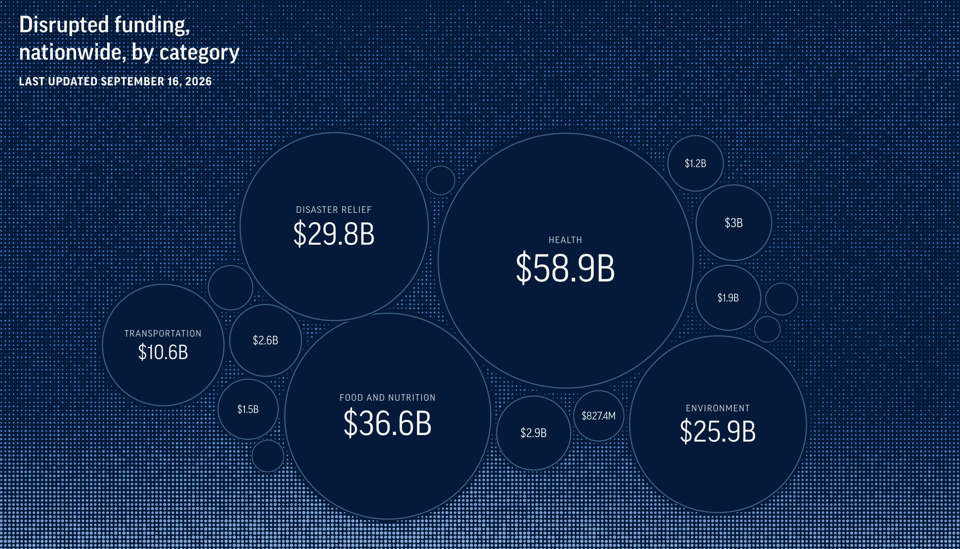
Congratulations to the team at Grant Witness, who not only have a fantastic new website, but also just launched a massive new project called Lost Funds in partnership with States United. You can now explore exactly how $177 billion dollars of funding cuts and slowdowns under the Trump administration so far are affecting your own state, and how states are fighting back.
And what’s next
Dr. Chanda Prescod-Weinstein has a new essay on the Spectrum of Allies. Instead of treating folks as simply with or against us, she argues that our morale and our strategies both benefit from getting more specific in our categorizations. I am finding it to be useful to think about what I’ve privately labeled slippage: instead of just raging about the allies who are downgrading from active to passive or neutral positions, I can ask myself about the dynamic that might be driving those shifts.
I also immediately pre-ordered the new book she recommends, For the Long Haul: How to Stay in the Fight for a Better World. The author, Chris Dixon, calls himself a happily deprofessionalized academic, which made me smile. He’s asking all the right questions about how to keep going, and how to do it in a principled, sustainable way. He talks about “the long view” in a way that reminds me of how Clint Smith honors, “generations of people who fought for something they knew they might never see, but who fought for it anyway because they knew that someday someone would.”
Clarity and perspective: maybe this is what it means to travel, whether that’s to far-flung locations across the globe, or deep into our history in books and stories and memory. Across all the miles and years, across all the cultures and experiences and ecosystems, I’m so grateful to benefit from many perspectives on what is possible, and how we can do what we must do.
Let’s get to it,
Liz
As ever, thanks for reading & thinking with me!
This work is supported in part by Solving For Science. Meeting the Moment will always be free, but if you want to contribute, you can ⤵️*
set up a subscriptionIf this email was forwarded to you, hi! 👋 I write briefings on the week’s news for those of us who care about science and higher education. If you like what you see ⤵️
you can get this delivered weeklyThe new, it seems, that did not, in fact, stop happening? A shame. ↩
I wrote about this in Week 31, and you might remember it as the ‘Duration of Stay’ issue. ↩
American Immigration Lawyers Association. ↩
We’ve known this was coming. I wrote about it in Year 2, Week 7, and I never let myself think about this without remembering that this is wildly unpopular and the legal challenges to it will be immediate and fiery. ↩
"For a million million years. No, infinity years. No wait, infinity TIMES infinity!" ↩
Which allow some proposals to leap-frog pesky peer review. It’s not a new idea and program officers have always had latitude to advance proposals regardless of scores, but you’ll forgive me if I am deeply skeptical. ↩
Not to be confused with e.g. the Gates Foundation flagship Grand Challenges program, nor any of the other similarly-named programs. ↩
As I understand it, we’re getting into the difference now between “You can’t do that” vs “You can do that, but you have to give more notice than you did.” ↩

