
LLTT Newsletter - July 2026 - The Beginning? Or the End?

LLTT Newsletter - July 2026
The Beginning? Or the End?
Take the following two sentences, both nineteen words long, that are useful in showing how misleading "word count" can be.
A. I am not in the habit of going to work on the train; I prefer to ride my bike (19 words - syllabic count of 1.1)
B. Multinational organisation executives await investigation outcomes with anticipation while regulatory bodies determine whether reported financial practices remain fully compliant. (19 words - syllabic count of 2.9, almost 3x!)
Read them aloud at the same pace and they take the same time. Nineteen words is nineteen words. A stopwatch doesn't care what the words mean. And yet, to your ear, they will definitely not sound the same.
Nor are your brain and hand doing the same amount of work in each case.
The first sentence consists of mostly monosyllables: train, work, bike, ride.
The second is longer words, one after another, that never let up.
What's the point?
Ask yourself: have I worked on building up the reflexes for the patterns these multi-syllable words open or close with? Or am I about to try to spell the whole thing out because I've never learned the proper shortcuts?
If it's the latter, thankfully that's not a speed problem you need to grind away at for months. It's a specific, nameable gap, the same kind as any special outline you haven't learned yet. And like any special outline, it's fixable in an afternoon with an index card. You don't need to become a faster writer. You need to start working on closing the gap.
Take "organisation" or "investigation."
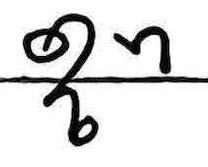
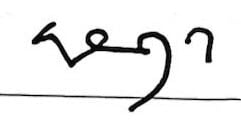
You could start out writing these the way you'd write any Teeline word: following the spelling, letter by letter. But you don't need to spell your way all the way to the end. Both words tail off into a sound that turns up everywhere in English: organisation, investigation, occasion, decision, motion, station. The moment you reach it, you can stop spelling. Write a small N in the T position, close to the preceding outline (or in some cases, attached) and the word is done.
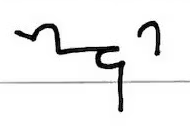
It works at the front of a word too. Start writing "anticipate," "antidote," or even "antibiotic" and the word beginning (ANTI) is one you've seen a hundred times before: Rule: “AN”, disjoined, in the T position.
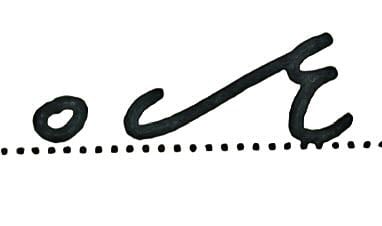
Even words like "semicircle" and "semi-detached" work the same way. Use the Teeline ‘S’, disjoined, on the writing line, and place before the next word.
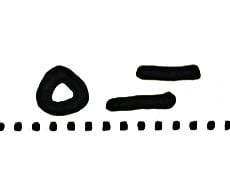
Word beginnings and endings aren't optional in Teeline. Certainly not if you’re aiming for speed, anyway. They're as much a part of the system as the Teeline alphabet and the blends.
Skip them, and you haven't finished learning Teeline. You've just stopped partway through.
To the point, miss enough of them and the multi-syllable word starts to feel harder than it should, not necessarily because the word itself is hard, but because a piece of your learning is missing.
Teeline doesn't shorten long words by analysing them. It gives your hand a shortcut for the bits that keep repeating across hundreds of words; so that a long word isn't necessarily a problem every time.
The real question isn't necessarily ‘how do I handle long words?’ Rather, it’s: ‘Have I built up the reflexes for the known patterns?’ A five-syllable word with a drilled ending can go down almost as fast as you can think it. A short word with no drilled pattern in it can be the one that trips you up.
So your job this coming month is to revise on Word Beginnings and Word Endings. Take any passage you're working on: a council report or perhaps a piece of legal reporting. Go through it word by word. Sort every word into one of two piles: has known word beginnings, or has known word endings. Then revise on those patterns that Teeline has provided you.
Easy to do. Easy not to do. But if you’re interested in building up your speed and automaticity, it’s not really a speed problem that you’re dealing with. It’s simply a specific set of patterns that you can get smarter about.
The Let’s Love Teeline Together YouTube video series covers word beginnings and endings in real depth. Lessons 15 to 18 take you through over, under, self and trans, then auto, after, multi, above, semi and super, before finishing with micro, magni and anti.
As always, if you have suggestions or topics you'd like to see covered in future newsletters, please contact us:
https://www.letsloveteelinetogether.com/contact-us
If you find this newsletter helpful, please help us spread the word and forward it to a friend!
A Parting Thought
Be sure to visit us at the LLTT Website, YouTube, Facebook, Instagram, Quizlet and Soundcloud.
Looking to build speed, sharpen your reading skills, and improve your Teeline shorthand without hours of aimless dictation practice?
Here's what LLTT+ can do for you:
Spend less time practising and make more progress — because every session is focussed, not accidental
See outlines you've been avoiding finally click into place, so you stop hesitating at the exact moments it matters most
Build reading fluency alongside writing speed — the most overlooked skill in shorthand, and the one that holds most learners back
Experience greater confidence walking into a dictation knowing you've genuinely prepared, and not just hoped for the best
Master word groupings and special outlines that experienced writers use
Stop wasting time on material you've already mastered; work instead on the specific outlines that are slowing you down
Identify your bottlenecks — because your overall speed is only as fast as your slowest outlines
Develop the kind of automatic, fluent responses that come from practising the right things, not just practising more
LLTT+ grows alongside you, from early stages through to exam standards and beyond.
Find out more at letsloveteelinetogether.com/llttplus



Add a comment: