When Is A Glass Not Just A Glass? An Outline Of Causal Depth Perception
How objects, tools, and symbols carry hidden context and what better design can do about it.
Why Some Minds See The Whole Map
Not Just The Object
A field guide to the stories your tools and spaces are already telling, and why some people cannot help but hear every line.
TL;DR (for Busy Humans)
Some people see a glass.
Other people see the brand, the story, the ethics, the social signals, and the timing, all at once.
That is not overthinking. It is how their perception works.
This is causal depth perception.
When tools, policies, and spaces assume people can ignore context on demand, those with high resolution minds pay the price first. They pick up the friction long before it shows up in metrics.
Flip it: treat meaning as part of design.
Align objects, tone, policy, and practice so they tell the same story. Clear signals, gentle edges, and honest intent make work kinder and easier for everyone, especially for Neurodivergent folks.
Clarity in meaning is a design choice, not a personality trait.
The Glass That Was Not Just a Glass
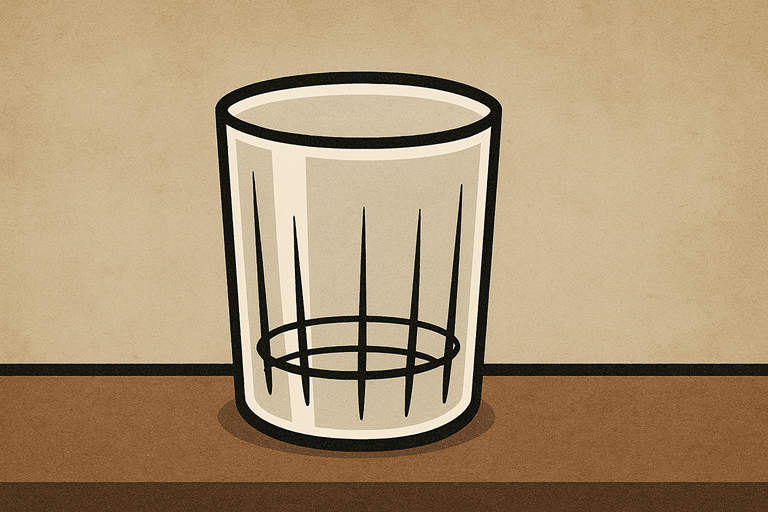
I went to pour orange juice for my boy.
The dishwasher was running, so options were thin.
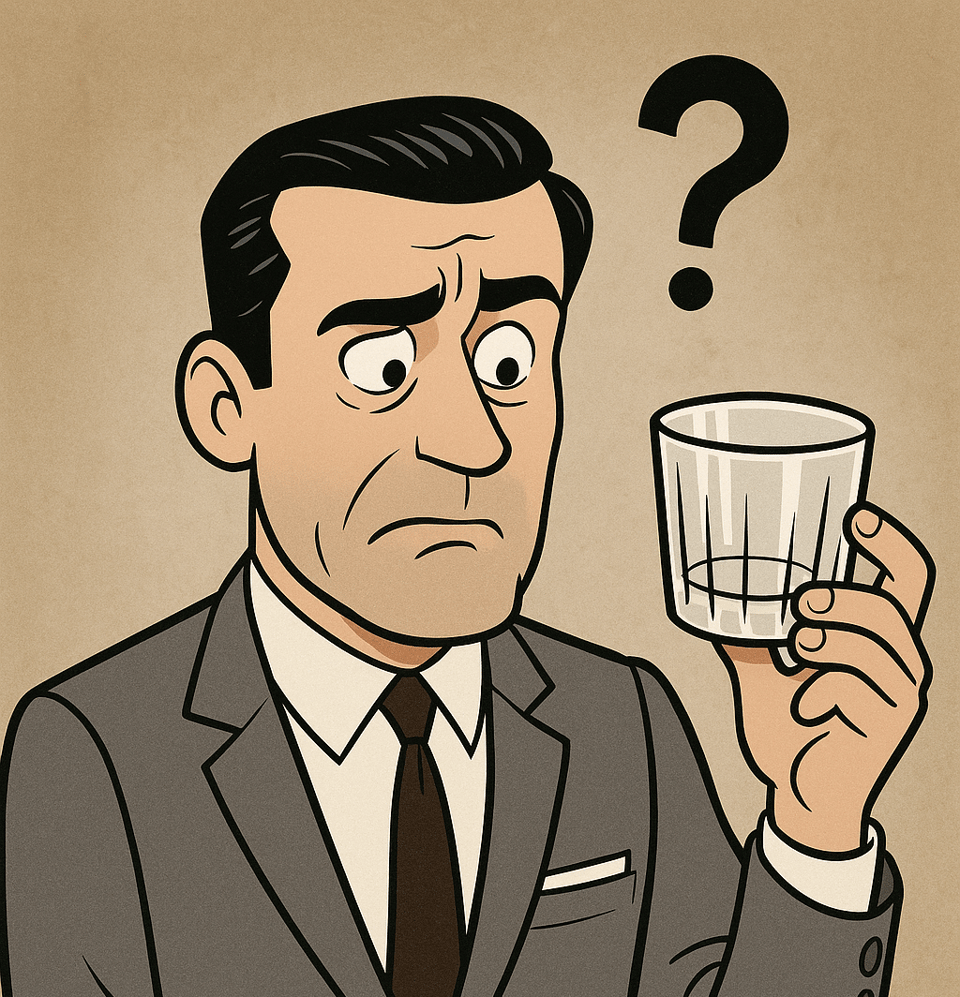
I reached for a branded whisky tumbler, paused, and put it back. The glass was clean. It would have worked. But it was not just a vessel in that moment.
My mind did not stop at “can hold liquid.”
It loaded:
alcohol branding
family histories
social signalling
addiction stories
the feeling of handing a child juice in a glass that quietly says whisky
It was all there at once. Object and story arrived as a pair.
For many people, the glass is just a glass.
For others, the object arrives with its whole network of meaning attached. That is what we are talking about here.
Causal depth. Minds that see the whole map, not just the icon.
What is Causal Depth Perception?
You can think of it like this:
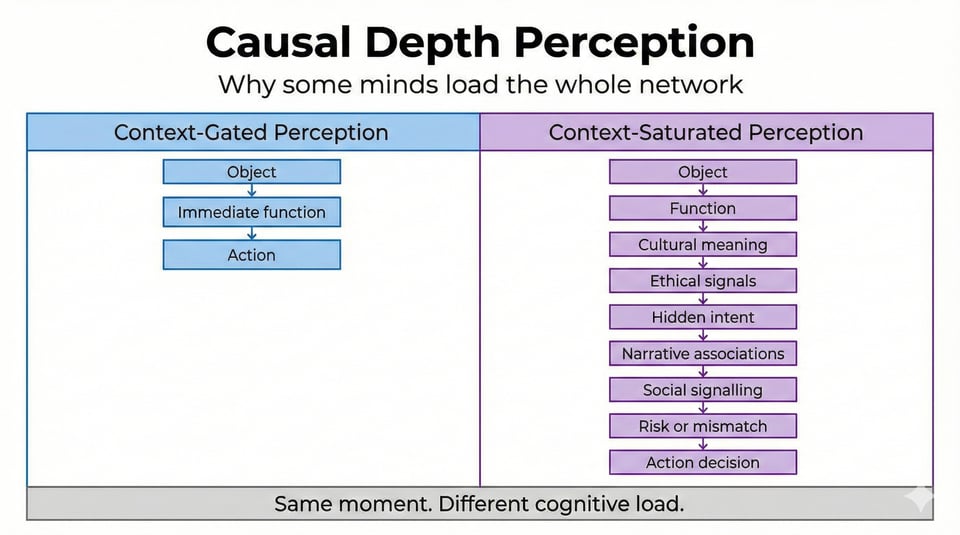
Some brains run with a mini map:

Enough detail to navigate, lots of background context quietly drops away.
Other brains run the full map.
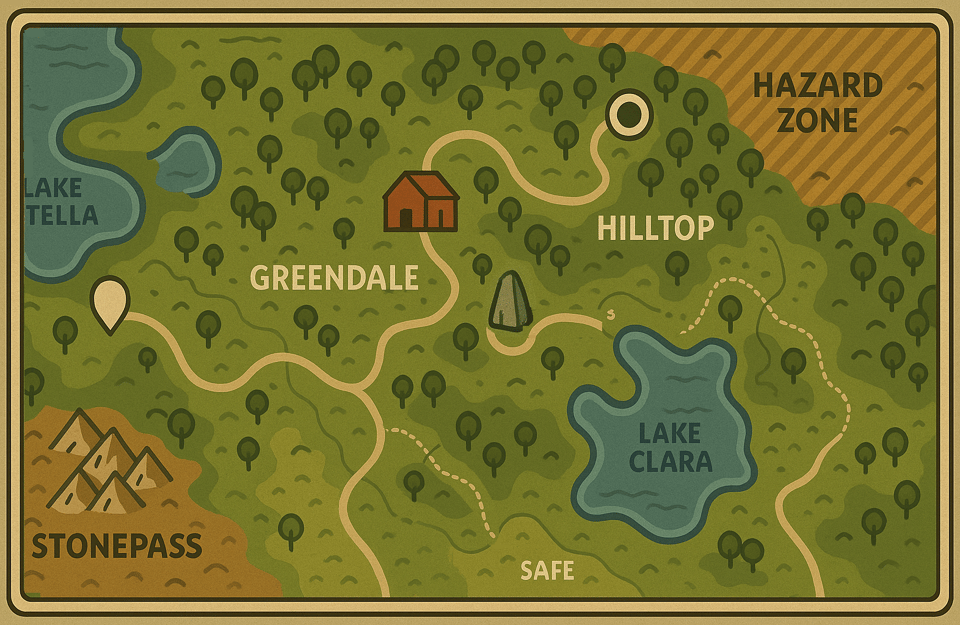
Labels, histories, social rules, ethical cues, intent, risk, and past experience all light up at the same time.
The mechanism is not magical, mystical or inherently better, no. It is basically:
Object appears
Associations fire
Network of meaning loads
Fit with the moment is checked
Body and brain register yes or no
For people with this style of perception, that whole process feels instant. The hesitation at the whisky glass came before the words did.
Most of us do some version of this, but for many Neurodivergent folks the volume is turned up and the filter is thinner.
Less gets dropped. More gets in.
Causal Depth in the Wild (you’ve seen these)
The “Fun” Swag That Is Not Fun For Everyone
Team hoodies and mugs covered in in-jokes and crunch culture. Some see belonging. Others see unpaid overtime and burnout repackaged as banter.
The “We Care” Slide Next To the Layoff Email
Town hall decks full of empathy, followed by a blunt announcement in a different tone. The clash between the two lands harder than either on its own.
The Dark Pattern Signup
Soft, friendly language paired with tiny grey opt out text. Users with causal depth perception spot the mismatch between tone and intent immediately.
The Values Wall Nobody Believes
Posters about trust and psychological safety, inside a culture that punishes bad news. The space itself tells a different story to the words on the wall.
The Mascot or Logo With a Shadow
A playful character that accidentally evokes a stereotype, a painful history, or a power imbalance. Some minds cannot unsee that once it is noticed.
In each case, there is the thing, and then there is the shadow it throws.
Causal depth perception includes both by default.
Why This Hits ND Folks First
These misalignments nibble at everyone eventually, but ND colleagues often feel them as a full bite much earlier.
Common costs:
Interpretation load
Every object or change needs to be checked for what it might really mean. That is extra processing before work even starts.Ethical load
When the story, the branding, and the behaviour do not match, fairness alarms trip faster. It is hard to relax into a system that feels off.Emotional resonance
Tone, symbols, and artefacts carry a charge. Jarring combinations can feel like walking with a stone in your shoe.Masking load
Spots of misalignment that everyone quietly agrees to ignore still have to be carried. Pretending not to notice is its own effort.
Same job, higher energy cost.
That is design debt, not a personal weakness.

Five Ways To Design For Causal Depth
You cannot remove meaning from objects, but you can stop tripping people with it.
1. Treat objects as messages, not neutral props
Office swag, onboarding gifts, internal campaigns, UI elements, room names, brand mascots. All of these say something. Ask what.
What does this item say about who belongs here
Does it quietly glorify overwork, drinking, crunch, or competition
Would I be comfortable handing this to my kid, my parent, or someone who has been on the losing end of that story
If the answer is no, rethink it.
2. Align tone, policy, and behaviour
People with causal depth perception spot gaps instantly.
If the policy says “we trust you” but the system tracks every minute, believe the system
If the slide deck says “family” but people are cut by email on a Friday, believe the email
Fixing this is not about better messaging, it is about bringing actions into line with words.
3. Make intent explicit
High resolution minds will go looking for the intent behind a change anyway. You can save them some steps.
Say why a new tool is being introduced
Say what will not change
Say what trade offs were made, honestly
Clear intent creates trust. Hidden intent creates work.
4. Give people a way to flag “story friction”
Make it easy, safe, and normal to say “this symbol, this phrase, this screen, does not sit right.”
Give a simple route:
One channel or form
No essay required
A habit of acknowledging the signal, even if the fix takes time
You are not obliged to change everything, but you should want to know where trust is quietly leaking out of the system.
5. Put high context minds in early design passes
If you only test new systems with people who naturally drop context, you will not see the trouble coming.
Include at least one or two people who:
notice wording
question visuals
ask “what does this say about us”
They are not blocking progress.
They are showing you where the story breaks before your users do.
Two Week Story Alignment Experiment
A light pilot that does not require a rebrand.
Week 1
a) Pick three things to audit
One artefact in the space, one internal communication, one UI flow in a core tool.
b) Ask three questions of each
What is this trying to say
What might it accidentally be saying
Who might feel friction here first
c) Collect signals
Invite a few people, especially ND colleagues, to share where the story or feeling jars. No debate yet, just listen.
Week 2
d) Make three small changes
Swap one object. Rewrite one line. Fix one piece of UI that sends a double message.
e) Check the effect
Two quick questions in a team pulse:
“Did anything feel more ‘like us’ this week”
“Did anything feel less confusing or less off”
Small shifts in story can create big shifts in ease.
Metrics That Show It Is Working
You do not need a giant dashboard, just a few gentle indicators.
Fewer “this feels off, but never mind” comments
More people saying “this fits us better” when a change lands
Drop in low level complaints about tone, symbols, or brand voice
Fewer surprises when policies are applied
ND colleagues reporting less grinding discomfort around the edges of work
You can also watch for the absence of quiet eye rolls in town halls.
Not scientific, but surprisingly reliable.
Pocket Responses To Pushback
“People are reading too much into things.”
→ People are reading exactly what is there. If it sends the wrong story, you can change the story.
“It is only a logo / mug / slide.”
→ Then it will be easy to swap. If it is not easy, it was never just that.
“We cannot design for every interpretation.”
→ True. You can design to avoid the most obvious collisions.
“Nobody else has complained.”
→ Someone just did. That is an opportunity, not a nuisance.
In Closing
Causal depth perception is not a bug. It is a sensitivity to how things fit together.
When a glass is just a glass, life is simpler. When a glass arrives with the whole history of alcohol use, family stories, and social signals around it, life is more complex, but also more informative.
Your Neurodivergent colleagues often live in that high resolution space. They feel the snag when symbols, tone, and behaviour do not match. If you follow those snags back to their source and tidy them up, you make work smoother for everyone.
Design is not only what a system does on the surface.
It is also the story it tells and the weight it carries.
Make those stories kinder and more coherent, and you will feel the friction drop.
Thanks for reading,
Brian McCallion
Founder, Kind Mechanics
About Kind Mechanics
Kind Mechanics helps organisations pay down design debt in how they work, so there are fewer leaks, clearer signals, and kinder defaults. I write about practical fixes that make things easier for everyone, especially Neurodivergent folks.
Clarity as the Standard. Kindness as the System. Usefulness as the Goal.
Human-readable by default.
