katexic clippings logo

katexic clippings

Archives
Subscribe

katexic clippings katexic clippings

Archive

|k| clippings: 2017-02-26 — you're squidding

WORK

"…we come astonishingly close to the mystical beliefs of Pythagoras and his followers who attempted to submit all of life to the sovereignty of numbers. Many of our psychologists, sociologists, economists and other latter-day cabalists will have numbers to tell them the truth or they will have nothing. Can you imagine, for example, a modem economist articulating truths about our standard of living by reciting a poem? Or by telling what happened to him during a late-night walk through East St. Louis? Or by offering a series of proverbs and parables, beginning with the saying about a rich man, a camel, and the eye of a needle? The first would be regarded as irrelevant, the second merely anecdotal, the last childish. […] We must remember that Galileo merely said that the language of nature is written in mathematics. He did not say everything is. And even the truth about nature need not be expressed in mathematics. For most of human history, the language of nature has been the language of myth and ritual. These forms, one might add, had the virtues of leaving nature unthreatened and of encouraging the belief that human beings are part of it. It hardly befits a people who stand ready to blow up the planet to praise themselves too vigorously for having found the true way to talk about nature.

—Neil Postman
—from Amusing Ourselves to Death

WORD(S)

agnotology / agnatology /ag-nə-TAHL-ə-jee/. noun. The study of cultural ignorance or doubt, particularly relating to scientific research and data. A recent coinage by Robert N. Proctor and Iain Boal combining Latin agnosia (ignorance) + ology (from Latin logy, the study of). See also misology (the fear or hatred of knowledge) and the earlier philosophical area of agnoiology. Thanks, Reader S.

“We need a political agnatology to complement our political epistemologies.” (Robert N. Proctor)

“Agnotology serves as a counterweight to traditional concerns for epistemology, refocusing questions about ”how we know“ to include questions about what we do not know, and why not. Ignorance is often not merely the absence of knowledge but an outcome of cultural and political struggle.” (Londa Schiebinger)

“Another element of agnotology consists in contending that the dismissal of science is supported by public opinion because people have a poor level of education and training.” (ed. Matthias Gross, Linsey McGoey)

WEB

  1. A Million People Live in These Underground Nuclear Bunkers

  2. I’ve never been a particular fan of his acting, but Hanks sure seems like a good guy… → Tom Hanks is coming out with short fiction anthology revolving around typewriters

  3. The Forked Tongue Map is an interactive graphic that lets you explore—with graphics, video and text—59 endangered languages spoken in Queens, NY (in which there are an astonishing 500+ languages spoken in total).

  4. Library Hand, the Fastidiously Neat Penmanship Style Made for Card Catalogs | Atlas Obscura [before you complain about “another Atlas Obscura link,” read the comments below].

  5. In the longest such study ever conducted, what some might consider common sense is confirmed…our personalities when we are “old” are basically nothing like when we are teens. → Personality Stability From Age 14 to Age 77 Years

  6. Every Noise at Once is an “an algorithmically-generated, readability-adjusted scatter-plot of the musical genre-space.” In other words, a massive, interactive map of musical genres from opera to deep tech house…and seemingly everywhere else.

  7. Turns out, there’s more to the Mall of America than meets the eye. → Writer-in-Residence - Mall of America

  8. Speaking of quintessentially American writing → Walt Whitman’s lost novel The Life and Adventures of Jack Engle found

  9. ITUNES TERMS AND CONDITIONS: The Graphic Novel

  10. Today in 1616, Galileo Galilei is officially banned by the Roman Catholic Church from promoting, teaching or defending his heretical view that the Earth orbits the Sun. Officially, he is to “abstain completely from teaching or defending this doctrine and opinion or from discussing it… to abandon completely… the opinion that the sun stands still at the center of the world and the earth moves, and henceforth not to hold, teach, or defend it in any way whatever, either orally or in writing.” Galileo didn’t relent and in 1633 was put on trial for heresy, threatened with torture and finally sentenced to indefinite house arrest, which he remained under until his death in 1642. Pope John Paul II officially “rehabilitated” Galileo in 1992. Fortunately, the Flat Earth Society is still fighting the good fight.

WATCH/WITNESS

"Am I Typecast?" starring Michael K. Williams [click to view]

Powerful acting by a favorite in this short piece → Michael K. Williams Asks: Am I Typecast?

WHAT!?

You're Not Hallucinating. That's Just Squid Skin. | Deep Look [click to view]

Squid speak a unique, undeciphered language using their skin

REPRISES/RESPONSES/REJOINDERS/RIPOSTES

  • Reader M. has a gentle complaint: “The Nüshu link would have been more interesting if I hadn’t seen it already because…Atlas Obscura! Doesn’t everyone read their site anyway?” — I do worry about featuring aggregators or other ‘must read’ sites too often. FYI: of 4228 links shared in Katexic Clippings so far, only 21 have been from the rightly venerated Atlas Obscura.

  • Reader C. is happy: "I was delighted to see George MacDonald Fraser’s words in Katexic. I’m agog each time I discover a friend who hasn’t read any of the deliriously funny Flashman novels.

  • So is Reader G.: “So much to stir up the imagination with this posting! Loved the WORK, I was not aware of the ‘tjukurpa’ and found the information interesting and curious. What a pity more is not known about it now. I also appreciated the list from other readers of more apocalyptic writing. One of my favorite subjects to indulge in, I’m always looking for good suggestions. Thank you!”

  • Reader B. knows his post offices: “I had not yet read your entry about Winifred Gallagher tells the story of how The Post Office Created America. Did I not just send you an envelope postmarked from the B. Free Franklin post office? If not, I’ll do it tomorrow. It is the only post office in the USA that does not fly the nation’s flag.”

  • The same Reader B. muses on willpower: "With regards to this subject, when I think of willpower, I think of Leni Riefenstahl’s propaganda film for Hitler, Triumph of the Will. I then console myself with a quote from Dashiell Hammett’s novelette, This King Business:

“Mentally, he wasn’t a heavy-weight. His revolution was crude stuff. It would get over chiefly because there wasn’t much opposition. He had plenty of will-power, I imagined, but i didn’t put a big number on that. People who haven’t much brains have to develop will-power to get anywhere.”


I welcome comments, suggestions, thoughts, feedback and all manner of what-have-you. Just press ‘Reply’ or email to: clippings@katexic.com.

Enjoy the WORK section? Check out my other little project: concīs » http://concis.io/

And please feel free to share anything here as far and wide as you want! If you want to give a shout-out, please link to: http://katexic.com/.

#331
February 27, 2017
Read more

|k| clippings: 2017-02-19 — the eye of the beholden

WORK

Every Aboriginal newborn is assigned a ‘tjukurpa’ – a story from the time of the world’s creation which, in its details, will tell them everything they need to know about where to find food, medicine and water for hundreds of miles around. It will teach them about magic and spirits and detail an elaborate moral code. A tjukurpa is a cross between a Bible parable, a Just So story, a supermarket plan and a travel guide. It is a multi-dimensional map of life that speaks of time, space and meaning. Events in the story’s plot – battles and birthplaces and hideouts – correspond to actual facets of the physical landscape, so you will know that you can find carrots, for instance, in the spot where the bush carrot beat the bush potato in a fight. Tjukurpas are incredibly complex. They are taught in stages, with each new level of detail being revealed by elders when an individual is considered ready. They are imparted in as many ways as possible: dance, song, body-painting, rock-carving and sand-drawings that cover a hectare. But they are highly secret. They are passed down strictly between members of the same ‘skin group’. Men do not know the women’s tjukurpas, and women do not know the men’s. White people have only ever been told as much as the youngest Aboriginal children. The paintings that artists such as Shorty produce are highly codified and obscured, so that their tjukurpas remain hidden. But they are all based on these essential, ancient lessons.

It is said that the Australian Aboriginals belong to the oldest surviving culture on earth. It appears profoundly different from ours. But I have come to believe that, in one crucial sense, we are just like the Aboriginals. We share their means of negotiating reality. Our lives, to an almost unimaginable degree, depend on stories.

—Will Storr
—from The Unpersuadables: Adventures with the Enemies of Science

WORD(S)

garboil / garboyle /GA(R)-boil/. noun. A tumult; a confusion; a commotion; an uproar; a hubbub; a hurlyburly. From Old Italian garbuglio (a tangle, a mess) < possibly from Latin bullīre (to boil).

“Far from the moiling crowd and garboyle of the world.” (The National Review)

“Yet others have disappeared, snatched from their places of refuge, to vanish into the prisons of the Exfernal Powers, denied trial, forbidden even to know the names of their accusers. Their minds may already have been destroyed by drugs and torture, their bodies melted into garboil.” (Margaret Atwood)

“…the most terrifying din and the principal uproar arises from the anguished howls of the devils, who, lying in wait in that confused garboil, receive chance blows from swords and suffer ruptures in the continuity of their substances, which are both aerial and invisible.” (Francois Rabelais)

“Then in ’82 there had been the Egyptian garboil I mentioned a moment ago; Joe Wolseley had asked for me point-blank, and with the press applauding and the Queen approving and Elspeth bursting into tears as I rogered her farewell, what the blazes could I do but fall in?” (George MacDonald Fraser)

WEB

  1. I’m an unashamed member of #TeamSpeed when it comes to most audiobooks and podcasts. I am not alone in this ‘overclocking’.

  2. There’s something beautifully weird and obsessive about Waclaw Szpakowski’s “labrynthine” single-line drawings.

  3. Speaking of the beautiful weird, have a listen to Emil Amos’ Drifter’s Sympathy show.

  4. Play The Great Language Game and see what languages you recognize.

  5. Browse The Food Lab’s Top 30 Hot Sauces. My favorites are all in there except WUJU. Any others missing?

  6. Thanks, Reader B. for sharing an intriguing story On Dracula’s Lost Icelandic Sister Text.

  7. From Reader C., some links that should convince even the crustiest Clamorites that Twitter can be useful: @medievalpoc, featuring fascinating information about people of color in European Art History, and @discarding_imgs, routinely sharing tasty medieval images.

  8. Serial Killers Should Fear This Algorithm

  9. Remembering Nüshu, the 19th-Century Chinese Script Only Women Could Write

  10. It’s a good day for sweets and the sweetums who love ’em: on this day in 1906, Kellogg’s is founded as the “Battle Creek Toasted Corn Flake Company,” an offshoot of the Kellogg brothers work at a religion-based sanitarium (T.C. Boyle’s fabulous book Road to Wellville is based on this history); today in 1913, more than 100 years after its debut, Cracker Jack began putting toys in their tasty, eponymous product; and today in 1985, Cherry Coke is rolled out to the public a few years after a very successful taste test at the 1982 World’s Fair in Knoxville, Tennessee.

WATCH/WITNESS

"Tower" a video by Independent Lens [click to view]

Available for streaming this month only, TOWER is a riveting—partially animated and partially live action—look into the infamous 1966 University of Texas Tower shooting.

WHAT!?

sclera (eyeball) tattooing by Luna Cobra [click to learn more]

“First and foremost, I, Luna Cobra, am the inventor of eyeball, or sclera, tattooing (tattooing the white of the eye in a solid or mix of colours). I first attempted the procedure on sighted human eyeballs in 2007 on three well-informed and consenting parties. Since then, I have fine-tuned both the technique and materials to increase the safety and minimize the risks of tattooing the eyeball.”

REPRISES/RESPONSES/REJOINDERS/RIPOSTES

  • Reader T. riffs: “Thanks for the nudge into old-time TV on YouTube with the link to ‘Frankfurter Sandwiches.’ Mr. Harry Rose is cool, but ‘second hand rose’ Peggy Lennon, who also wrapped her talents around the ‘Frankfurter,’ is a revelation. Speaking of gems on YouTube, may I also suggest going back in further to old-time radio? The premiere episode of Gunsmoke is one of my all-time favorites of any medium.”

  • Reader J. brings on more about the apocalyptic: “Yes, Beyond Thunderdome! which borrows some of its linguistic babble from the great Ridley Walker. Also I’d much recommend two horsewomen of better apocalypses than Margaret Atwood’s–Doris Lessing (especially her Memoirs of a Survivor, but also the spooky pair, Mara and Dann and The Story of General Dann and Mara’s Daughter, Griot and the Snow Dog) and Angela Carter (her absolutely wonderful Heroes and Villains).”

  • Reader B. wasn’t happy with the same selection: “I certainly disagree with Tea’s book list, which is biased towards recent works and leaves out both giants and excellent exempla. For example: Mary Shelley’s The Last Man. Or, more recently, Cormac M’s The Road. Margaret Atwood’s recent trilogy. Not a single post-nuclear title? Not one? Not Earth Abides or On the Beach? Or Canticle for Liebowitz?”


I welcome comments, suggestions, thoughts, feedback and all manner of what-have-you. Just press ‘Reply’ or email to: clippings@katexic.com.

Enjoy the WORK section? Check out my other little project: concīs » http://concis.io/

And please feel free to share anything here as far and wide as you want! If you want to give a shout-out, please link to: http://katexic.com/.

#330
February 19, 2017
Read more

|k| clippings: 2017-02-12 — blooming lilacs

WORK

For one of my age, I have seen very little of the drama. The first presentation of Falstaff I ever saw was your Leer last winter or spring. Perhaps the best compliment I can pay is to say, as I truly can, I am very anxious to see it again. Some of Shakespeare’s plays I have never read; while others I have gone over perhaps as frequently as any unprofessional reader. Among the latter are Leer, Richard the Third, Henry Eighth, Hamlet, and especially MacBeth. I think nothing equals Macbeth— It is wonderful.

Unlike you gentlemen of the profession, I think the soliloquy in Hamlet commencing “O, my offence is rank.” surpasses that commencing “To be or not to be.” But pardon this small attempt at criticism. I should like to hear you pronounce the opening speech of Richard the Third. Will you not soon visit Washington again? If you do, please call and let me make your personal acquaintance.

—Abraham Lincoln
—from an August 17, 1863 letter to actor James Henry Hackett

WORD(S)

logodaedalist /lawg-ə-DEE-də-list/. noun. One who is highly skilled in the use of words. See also logodaedaly (skill in using words). From Greek logodaidalos, from logos (word) + daidalos (skillful).

“He was well-read. He knew French. He was versed in logodaedaly and logomancy. He was an amateur of sex lore. He had a feminine handwriting.” (Vladimir Nabokov)

“‘raking out the clinker’ was a phrase of Kipling’s that appealed to Wodehouse, and polishing them to a near-final 1,500 next morning in revision was a pleasurable chore, logodaedaly following logorrhea.” (Richard Usborne)

“I am Bosco, the logodaedalist.
It’s my job to repair broken-down words…”
(James Laughlin)

“Words can be endlessly drawn upon to cancel out other words, when the spokesman is such a logodaedalist as Berowne. Not for nothing is he the predecessor of Mercutio, and both live under the aegis of Mercury — ‘the President of Language…’” (Harry Levin)

WEB

  1. Move Over, Wikipedia. Dictionaries Are Hot Again

  2. Is Willpower a Finite Resource, or a Myth?

  3. A little perspective… → Hubble Space Telescope captures death of star in Rotten Egg Nebula

  4. Why monkeys can’t talk—and what they would sound like if they could (answer: unsettling). Pairs with ►Orangutan Found To Mimic Human Speech.

  5. Reasonable people may disagree with The Guardian’s Top 10 Books About the Apocalypse. What say you?

  6. Moij Design’s origami inspired dishes, concrete art and ornaments. Thanks, Reader M.

  7. Phonetic Calligraphy (@IPAcalligraphy) combines the beauty of calligraphy with the charm of the International Phonetic Alphabet.

  8. Introducing Open Access at The Met, more than 200,000 images, all of which are searchable as part of the 10,000,000 images you can search with the new Creative Commons search engine.

  9. The opera-loving sisters who ‘stumbled’ into heroism

  10. Today in 1809, future United States President Abraham Lincoln is born in a one-room log cabin in Hardin County, Kentucky. Certainly one of the most important US presidents, Lincoln saw the country through its deepest existential crisis, the Civil War, and who knows what influence he might have had on the fallout of that war and the end of slavery were he not assassinated in 1865. Lincoln was a deep thinker, significantly more complex than many popular cultural portrayals would have us believe on everything from slavery and authoritarianism to his own melancholy (that we’d now call clinical depression). The best way to know Lincoln is through his own words and the words of those who’ve studied him most closely, for which I highly recommend The Annotated Lincoln and the Library of America’s The Lincoln Bicentennial Collection. Also, given the WORK I chose today, you might enjoy “Men of Letters: Shakespeare’s Influence on Abraham Lincoln”.

WATCH/WITNESS

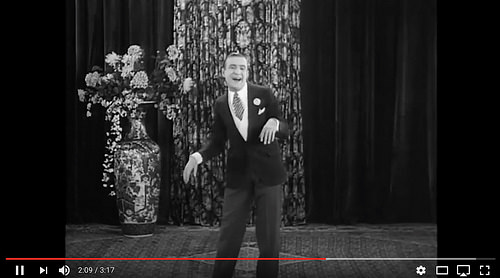
Harry Rose performs "Frankfurter Sandwiches" (1929)

Vaudevillian ►Harry Rose performs “Frankfurter Sandwiches” in 1929. See also, ►Peggy Lennon’s 1967 performance on the Lawrence Welk show. And if none of that is on point enough, enjoy a ►pseudo-retro burlesque take by “Varla Jean Merman”.

WHAT!?

BRAHMS V. RADIOHEAD [click to view]

“A symphonic mash-up of the Brahms 1st Symphony and Radiohead’s ‘OK Computer’” re-composed, arranged and conducted by Steve Hackman. Performed by the Colorado Music Festival Orchestra with vocalists Andrew Lipke, Kristin Newborn and Will Post.

REPRISES/RESPONSES/REJOINDERS/RIPOSTES

  • Reader A. echoed the sentiments of more than a few: “I watched Ten Meter Tower multiple times. There was something about the fear and the vulnerability of those would-be divers that was more naked than if they’d been unclothed.”

  • Reader V.: “The only thing more disappointing than YOLOCAUST being removed is that more people aren’t still talking about it!” — Note you can still access YOLOCAUST in the Internet Archive.

  • Reader K.: “John McWhorter is a funny, persuasive writer. He single-handedly brought me to the descriptivist side of the eternal linguistics wars. My world is so much richer without spending mental coin on that fight!”


I welcome comments, suggestions, thoughts, feedback and all manner of what-have-you. Just press ‘Reply’ or email to: clippings@katexic.com.

Enjoy the WORK section? Check out Notabilia…it’s practically made for you!

And please feel free to share anything here as far and wide as you want! If you want to give a shout-out, please link to: http://katexic.com/.

#329
February 12, 2017
Read more

|k| clippings: 2017-02-05 — I can remember anything

WORK

So many of us walk around letting fly with “errors.” We could do better, but we’re so slovenly, so rushed amid the hurly-burly of modern life, so imprinted by the “let it all hang out” ethos of the sixties, that we don’t bother to observe the “rules” of “correct” grammar.

To a linguist, if I may share, these “rules” occupy the exact same place as the notion of astrology, alchemy, and medicine being based on the four humors. The “rules” make no logical sense in terms of the history of our language, or what languages around the world are like.

Nota bene: linguists savor articulateness in speech and fine composition in writing as much as anyone else. Our position is not—I repeat, not—that we should chuck standards of graceful composition. All of us are agreed that there is usefulness in a standard variety of a language, whose artful and effective usage requires tutelage. No argument there.

The argument is about what constitutes artful and effective usage. Quite a few notions that get around out there have nothing to do with grace or clarity, and are just based on misconceptions about how languages work.

—John McWhorter
—from Our Magnificent Bastard Tongue: The Untold Story of English

WORD(S)

hyperthymesia /HIY-pər-thiy-MEE-zhə/. noun. The condition of possessing an extremely detailed autobiographical memory, sort of a photographic memory for life experiences. From Greek hyper (excessive) + thymesis (remembering).

“In one study, even people with the disorder hyperthymesia, which causes them to remember every event in their lives in painstaking detail, were susceptible to false memories at roughly the same rate as the rest of us.” (Erik Vance)

“The technical term psychologists nowadays apply to super-memory is ‘hyperthymesia’, or ‘Highly Superior Autobiographical Memory (HSAM)’. The condition was first clinically described by psychologists in 2006. Super memorisers were, however, anticipated years before in Borges’ story, the wonderfully titled ‘Funes the Memorious’.” (John Sutherland)

“Jill Price has the first diagnosed case of a memory condition called ”hyperthymestic syndrome“ — the continuous, automatic, autobiographical recall of every day of her life since she was fourteen.” (Jill Price)

WEB

  1. An astounding project, YOLOCAUST “combined selfies from the Holocaust Memorial in Berlin with footage from Nazi extermination camps.” The project, the response—including from those in the original photographs—and the ensuing conversations are intriguing. You can see the original images in the Internet Archive (roll over the images). :: Pairs with Forever present: Digital immortality for the Holocaust’s last survivors

  2. “Bundespraesidentenstichwahlwiederholungsverschiebung isn’t just a mouthful—it tells an annoying political story” → Austria’s Word of the Year Has 52 Letters

  3. Be the best bard you can be! → Crowdsourcing for Shakespeare

  4. “Russian futurist book art from 1910 to 1915 combines dynamic lithographs with the sounds of zaum poetry. This interactive exemplifies the interplay of word-image-sound through audio recordings, Russian transliterations, and English translations of 10 poems, presented directly within the pages of the artist’s books.” → Explodity

  5. Cool visualizations → Constellations of first sentences from each chapter of short stories

  6. Weird, and I need to make this work for me. → Knowingly Taking a Placebo Still Reduces Pain, Studies Find

  7. From the Constitutional Post (est. 1774) to today, Winifred Gallagher tells the story of how The Post Office Created America in this 99% Invisible story and interview. See also, the New York Times review that includes Gallagher’s book.

  8. You don’t need to be a linguist to enjoy browsing the newly open Lexicons of Early Modern English site.

  9. Ha! → List: Concepts for Which I Suspect Germans Have a Single Word

  10. Today in 1951, cartoonist and artist John Callahan is born in Portland, Oregon, USA. A quadriplegic since a car accident at 21, Callahan drew his rough, dark, occasionally macabre, taboo-busting and very funny cartoons by holding a pen between his two hands. See also: Callahan’s NYT Obit and the Independent’s obit, Prophet of bad taste. Just a few months ago, there were reports that Gus Van Sant and Joaquin Phoenix had a Callahan biopic in development.

WATCH/WITNESS

Ten Meter Tower video [click to view]

“We sought to capture people facing a difficult situation, to make a portrait of humans in doubt. We’ve all seen actors playing doubt in fiction films, but we have few true images of the feeling in documentaries. To make them, we decided to put people in a situation powerful enough not to need any classic narrative framework. A high dive seemed like the perfect scenario.” → Ten Meter Tower

WHAT!?

TV Floor Plans [click to view more]

Detailed renderings, derived from obsessive watching, of Famous Television Show Home Floor Plans.

REPRISES/RESPONSES/REJOINDERS/RIPOSTES

  • Reader B.: “Here One is fascinating. Thank you.”

  • Reader J.: "Ahhh… ‘You know, culture needs stewardship, not disruption.’ POPOVA quoting Sullivan ¶ All the time I have just now. But, Lovely. Ahhh.

  • Reader B., who shared the Bibliomania link, adds: "I can’t get enough of this. ¶ Going into a bookstore and asking for their books on books section is like muttering a password for a secret chamber.

  • Reader F.: “Your bit from David Foster Wallace’s essay on Federer doesn’t make me want to read his sports-writing. But it reminds me that I’m glad my sports-phobia didn’t prevent me from reading his other essays, which are (dare I say it?) ace. Never did finish Infinite Jest.”


I welcome comments, suggestions, thoughts, feedback and all manner of what-have-you. Just press ‘Reply’ or email to: clippings@katexic.com.

Enjoy the WORK section? Check out Notabilia…it’s practically made for you!

And please feel free to share anything here as far and wide as you want! If you want to give a shout-out, please link to: http://katexic.com/.

#328
February 5, 2017
Read more

|k| clippings: 2017-01-29 — pother do you think they'll drop the bomb?

WORK

There are three kinds of valid explanation for Federer’s ascendancy. One kind involves mystery and metaphysics and is, I think, closest to the real truth. The others are more technical and make for better journalism.

The metaphysical explanation is that Roger Federer is one of those rare, preternatural athletes who appear to be exempt, at least in part, from certain physical laws. Good analogues here include Michael Jordan,7 who could not only jump inhumanly high but actually hang there a beat or two longer than gravity allows, and Muhammad Ali, who really could “float” across the canvas and land two or three jabs in the clock-time required for one. There are probably a half-dozen other examples since 1960. And Federer is of this type — a type that one could call genius, or mutant, or avatar. He is never hurried or off-balance. The approaching ball hangs, for him, a split-second longer than it ought to. His movements are lithe rather than athletic. Like Ali, Jordan, Maradona, and Gretzky, he seems both less and more substantial than the men he faces. Particularly in the all-white that Wimbledon enjoys getting away with still requiring, he looks like what he may well (I think) be: a creature whose body is both flesh and, somehow, light.

—David Foster Wallace
—from “Roger Federer as Religious Experience”
—found in Both Flesh and Not

WORD(S)

pother (alt. puther) /PAW-t~her/. noun or verb. A vocal commotion; loud turmoil; a thick cloud of dust or smoke. As a verb, to cause a pother (naturally) but also to trouble one/oneself over a mundane or trivial matter. Origin unknown, but likely derived from the rhyming bother. See also: dither, ado, tizzy, flap and hurly-burly.

“Then thank heaven we can discuss facts calmly, without a lot of useless pother … facts which I have got from Miss Osgood. For instance, that you are what Mr. Osgood – and many other people – would call an unscrupulous blackguard.” (Rex Stout)

“All this pother of coming to England and seeing lawyers wasn’t to marry her, but to prevent her from marrying anybody else.” (Virginia Woolf)

“What a wonderful pother is here, to make all these poetical beautifications of a ship! that is, a phenix in the first stanza, and but a wasp in the last…” (Samuel Johnson)

“I wish at any rate that any book could wait until I produce the Silmarillion. I am constantly interrupted in this – but nothing interferes more than the present pother about ‘me’ and my history.” (J.R.R. Tolkien)

“Away up the road was a puther of dust, then the flash of glass as the automobile turned.” (D.H. Lawrence)

WEB

  1. This On Being interview with Maria Popova is a few years old, but just too good not to share. And it couldn’t be more timely, really. And I adore Popova…if you aren’t a regular Brain Pickings reader, you should stop reading this and go there now (but do come back). → Cartographer of Meaning in a Digital Age.

  2. At first I thought, “yet more wireless earbuds.” But Here One is something else: AI-assisted personal listening. With big implications for the future of all kinds of audio experiences.

  3. Speaking of amazing developments hinting at a fascinating future, how about growing human organs in animals? → The Early Days of Organ Farming Are a Bit Gnarly. See also: Mice cured of diabetes by cells grown inside rats — are humans next?

  4. Google News Lab’s The Year in Language: 2016 is interesting and includes some fun interactive widgets to delve into the results (even if the by-state results don’t include Alaska or Hawaii. Grr.).

  5. Bibliomania: the strange history of compulsive book buying [Thanks, Reader B.!] :: See also, earlier WORKs from Nicholas Basbanes’ book A Gentle Madness that explores this topic.

  6. Hey, this newsletter is partly intended for word nerds, after all! → Interview with a Lexicographer (Jane Solomon)

  7. What Lincoln called the “hot letter” is a habit worthy of reconsideration. → The Lost Art of the Unsent Angry Letter

  8. Research says…at least until the next study. → Smart, Emotionally Stable People Enjoy Morbid Humor

  9. Cat faces recognized as human and human faces recognized as cats by face-detection algorithms. → Cat or Human

  10. Today in 1964, Stanley Kubrick’s brilliant black comedy, Dr. Strangelove, Or: How I Learned To Stop Worrying And Love The Bomb is unleashed upon the world after a delay due to U.S. President John F. Kennedy’s assassination. Good reading: Almost Everything in “Dr. Strangelove” Was True, Art of the Title on Dr. Strangelove and the 1964 New York Times review.

WATCH/WITNESS

Moreschi - the only recorded castrato [click to view/listen]

Allesandro Moreschi, though in his fifties at the time, is the only castrato singer ever recorded. It’s not what he would have sounded like in his prime singing days, but intriguing, haunting and sad nonetheless. Listen also: Moreschi singing Ave Maria and “Hostias Et Preces”.

WHAT!?

Gary Gulman standup on Late Night with Stephen Colbert [click to view]

Not a WHAT!? entry because it’s weird or bizarre, but because it feels like Gary Gulman’s comedy is based on direct observations of my brain…and thus I suspect it will resonate with many Clamorites as well.

REPRISES/RESPONSES/REJOINDERS/RIPOSTES

  • Reader C. follows up: "The Everything is F**ked Syllabus reminded me of the Lexicon Valley podcast episode “Seven Centuries of F–ks” that includes your fave John McWhorter.

  • Reader B.: “Thank you for the additional carnage.”

  • Reader N.: “Really appreciated the link to Bowie’s fav books. I’m adding a bunch to my list.”

  • Reader M.: “Chris, aside from all the rest, thanks so much for this.”


Thank you for reading! I welcome comments, suggestions, thoughts, feedback and all manner of what-have-you. Just press ‘Reply’ or email to: clippings@katexic.com.

Enjoy the WORK section? Check out my other little projects: concīs (a literary journal of powerful concision) and Notabilia (a daily newsletter featuring a single, carefully curated short work for loving readers).

And please feel free to share anything here as far and wide as you want! If you want to give a shout-out, please link to: http://katexic.com/.

#327
January 29, 2017
Read more

|k| clippings: 2017-01-22 — het up and havoced

WORK

“But then they danced down the streets like dingledodies, and I shamble after as I’ve been doing all my life, because the only people for me are the mad ones, the ones who are mad to live, mad to talk, mad to be saved, desirous of everything at the same time, the ones who never yawn or say a commonplace thing, but burn, burn, burn like fabulous yellow roman candles exploding like spiders across the stars and in the middle you see the blue centerlight pop and everybody goes ‘Awww!’ What did they call such young people in Goethe’s Germany?”

—Jack Kerouac
—from On the Road

WORD(S)

carnage /KAR-nəj/. noun. Extensive, indiscriminate slaughter, most often of human beings. A collection of carcasses. From French carnage, from Italian carnaggio (murder, slaughter), from Latin carnaticum (slaughter of animals), from carnum (flesh). Various sources note that “[Robert] Southey tried to make a verb of it,” so I’ve included that example as well.

“The carnage of 9/11 generated an intense surge of patriotic solidarity, even with America’s Babylon, a city scandalously and notoriously indifferent to Heartland values.” (Simon Schama)

“More athletes actually got killed in the hand-to-hands, but they lacked the dramatic, cathartic aspects of football, the sheer carnage when 144 men were involved at once, the drenching of the arena stands with blood.” (Ursula K. LeGuin)

“Mark! where his carnage and his conquests cease!
He makes a solitude, and calls it – peace!”
(Lord Byron)

“…And swords rage where the Eagles cry & the Vultures laugh saying
Now comes the night of Carnage now the flesh of Kings & Princes…”
(William Blake)

“All poets adore explosions, thunderstorms, tornadoes, conflagrations, ruins, scenes of spectacular carnage. The poetic imagination is not at all a desirable quality in a statesman.” (W.H. Auden)

“…there was vast confusion, havoc, conflict, honourable death, bloody battle, horrible consternation, and upon Tal Mavra, a thousand banners: there was an outrageous carnage, and the rage of spears and hast signs of violent indignation.” (Robert Southey)

WEB

  1. Thousands of terms for drunks and drunkenness → The Drunktionary :: Pairs with our previous links to an interactive “Timeline of Slang Terms for Drink, Drunks and Drunkenness” and maybe “Drunk Shakespeare: The Trendy Way to Stage the Bard’s Plays in the US & the UK.”. Oh, and Thomas Nashe on Eights Kinds of Drunkard.

  2. I encourage you to check out the free and open FutureLearn course Japanese Culture Through Rare Books, if only to watch (or download!) the extensive series of videos on Japanese books, materials, binding and culture. Fascinating.

  3. I try to stay away from direct politics here, but: Postal Service business is up, deficit is all politics.

  4. I prefer the magazine title “Those Magnificent Women and Their Typing Machines” → These Women Reporters Went Undercover to Get the Most Important Scoops of Their Day.

  5. Enter Chaumont’s Le Signe, France’s graphic design museum.

  6. Everything is f**ked: The syllabus :: Pairs well with Calling Bullsh*t in the Age of Big Data — Syllabus and “F*ck Nuance” a paper by Kieran Healy.

  7. Words of the Year 2016 from: Oxford English Dictionaries & Dictionary.com & The Chronicle of Higher Education & Merriam-Webster & The American Dialect Society (PDF).

  8. Imogen Foxell’s OED Word of the Day illustrations.

  9. David Bowie’s 75 Favorite Books.

  10. Today in 1561, Sir Francis Bacon—philosopher, writer, scientist and orator—is born in London. Bacon was a true renaissance man, excelling as a philosopher and scientist…and the field in which they overlapped. Bacon’s most significant legacy is likely his thoughts on the scientific approach to the natural world and what that means for our own conception of our place within and, possibly, over it. This was a particularly vital area given that Bacon lived and wrote during a time when science was beginning to challenge—and sometimes displace—religious thought. I’ve learned most from Bacon’s work through his letters and his commonplace book, even if the latter has been used by deluded conspiracy theorists to claim he (as leader of a cabal) must have been the real author of Shakespeare’s work (though the story of the audacious, brilliant, unrelated and not-a-little-cuckoo Delia Bacon, who originated the theory, is fascinating).

WATCH/WITNESS

The Globemakers [click to view video]

“When Peter Bellerby couldn’t find the perfect handmade globe for his father’s 80th birthday, he took matters into his own hands. He spent the next few years learning and perfecting the lost art of globemaking, which turned out to be a difficult, detailed process.” → ► The Globemakers: Craft with a Modern Spin

WHAT!?

Still from "Fingers of Steel" [click to view video]

“Chris Heck fought his way up over the most dangerous, life-threatening tricks, with numerous sore finger injuries, and nervous breakdowns to where he is today.” → ► Fingers of Steel

REPRISES/RESPONSES/REJOINDERS/RIPOSTES

  • Reader J. shares: “Though I dispute (my back, indeed my chine disputes) the idea that everything old is new: some old things just get older. However, to anyone who’s missed seeing All That Jazz, it wouldn’t hurt to start with ► the Youtube excerpt of this song-and-dance piece. This is a movie that stands with 8 1/2 (to which it builds a gorgeous system of homages) as the greatest metatext about artistic creation in the history of film; and it stands with Singin’ in the Rain as (not only a great piece of metacinema, but) an epochal transformative text in the history of movie musicals. La La Land? It’s show time!”

  • Reader B: “The typewriter story is grand.”


I welcome comments, suggestions, thoughts, feedback and all manner of what-have-you. Just press ‘Reply’ or email to: clippings@katexic.com.

Enjoy the WORK section? Check out my other little project: concīs » http://concis.io/

And please feel free to share anything here as far and wide as you want! If you want to give a shout-out, please link to: http://katexic.com/.

#326
January 22, 2017
Read more

|k| clippings: 2017-01-15 — burnin' boilin' love

As Peter Allen said in his song, “everything old is new again.” And so it is with the return of Katexic Clippings in 2017 and today’s WORK, apropos for Martin Luther King, Jr.’s birthday and our energetic political times.

WORK

“One of the great liabilities of history is that all too many people fail to remain awake through great periods of social change. Every society has its protectors of status quo and its fraternities of the indifferent who are notorious for sleeping through revolutions. Today, our very survival depends on our ability to stay awake, to adjust to new ideas, to remain vigilant and to face the challenge of change.”

—Dr. Martin Luther King, Jr.
—from The Radical King

WORD(S)

chine /CHIYN/. noun or verb. The spine or backbone. The rim of a cask formed by the ends of the staves. In cooking, a cut or joing that includes the spine and connected flesh. In geography, the crest of a ridge though also, historically (and oddly), a fissure or crack in the earth. In shipbuilding, the change in angle of the cross-section of a hull, where the bottom and sides meet (such as a sharp chine). As a verb, to cut through the spine when butchering. From Middle English chyne, from Middle French eschine, then things get hairy but it appears to be a blend of the Germanic source of shin and Latin spina (spine).

“A prodigious chine of roasted bear’s meat.” (J. F. Cooper)

“We then struck the roughest of descents, down broken outcrops and chines of granite.” (Sir Richard Burton)

“It has been but a month from putting in the eight-by-threes, treated with creosote and laid a foot and a half apart in the long northernish rectangle of our cabin’s base, construction fir let into grey marl on the chine of an island, to the last sheet of shingling on the roof.” (Guy Davenport)

“In a very few minutes a hard chine launch came swiftly to them from the carrier…” (Nevil Shute)

“Its iron-rimmed chine struck the nape of his neck, dislocated vertebrae and crushed the spinal column.” (Annie Proulx)

“…the head is so obtuse as to go absolutely crazy over a pair of hunkers, which is no more than a chine of beef.” (William O’Rourke)

WEB

  1. Music’s Weird Cassette Tape Revival Is Paying Off

  2. You should definitely read this magical Twitter story about typewriters and travel

  3. I’m unreasonably excited about Jim Jarmusch’s new film ► Paterson because it uses prose poems by the great Ron Padgett and stars Adam Driver, who I find intriguing. The New York Times has a solid, positive review. For more on Padgett and Jarmusch’s film, see interviews in Town & Country and Bleecker Street. And Padgett’s own site links to a solid, short profile of Padgett for readers.

  4. The headline is a bit click-baity, but the whole thing is still really cool (be sure to read the comments) → The mind-blowing AI announcement from Google that you probably missed.

  5. ’Tis the season… → ►DIY Science: How far does a sneeze travel? and the accompanying research articles: Snot Science: A snotty setup + Snot Science: Results are nothing to sneeze at + Snot Science: Taking mucus to the next level.

  6. Hey grrrl, let’s go on vacay. → 25 Words Turning 25 Years Old in 2017

  7. I was sure I’d shared this before, but Reader C.’s suggestion prompted me to look and apparently I’d kept it to myself. Word buffs using a Mac, enjoy! → You’re probably using the wrong dictionary

  8. This is actually good advice for anyone who makes things, whether a Trump supporter or not. → John Scalzi’s 10-point plan for getting creative work done in the age of Trump

  9. The title makes clear what it’s aboot → Why Do Canadians Say ‘Eh’?

  10. Today in 1919, 2.3 million gallons of molasses erupt from a broken holding tank in Boston, Massachusetts, creating the Great Molasses Flood, AKA the Boston Molasses Disaster. The 25-foot (at least) tall wave—moving at 35 miles per hour—engulfed the city’s North End, tearing buildings from their foundations and crushing them, killing 21 people and wounding more than 150 others in the process. Ultimately attributed to faulty tank construction and lack of testing before filling them, nearly 100 years later a group of scientists and students discovered why the winter conditions made the spill significantly more deadly. And more research. The Atlantic published some amazing pictures of the aftermath. See also: a story of the day from 2014, the London Beer Flood.

WATCH/WITNESS

still from "Boiling Water Freezes in Mid-Air" [click to view]

Those of us in northern climes have all tossed (sometimes boiling) water in the air to watch ►the frosty display. But, it turns out, the Mpemba Effect—the idea that boiling water actually freezes faster than cold water in this context—is weird and controversial.

WHAT!?

Orion Reborn album cover [click to view story]

The strange, sad story of Jimmy Ellis, aka Orion, the Man Who Would Be Elvis and how many thought he was Elvis when all he wanted to do was take off the glittering mask.

REPRISES/RESPONSES/REJOINDERS/RIPOSTES

  • My thanks to those who inquired about Katexic Clippings during the unannounced holiday hiatus; my apologies to those I neglected to answer.

  • Reader J.: “Enjoying reading what you clip. Enjoying thinking about other things, again. Motherhood is a blast, but it sucks the life out of everything for at least a little while.”


I welcome comments, suggestions, thoughts, feedback and all manner of what-have-you. Just press ‘Reply’ or email to: clippings@katexic.com.

Enjoy the WORK section? Check out my other little project: concīs » http://concis.io/

And please feel free to share anything here as far and wide as you want! If you want to give a shout-out, please link to: http://katexic.com/.

#325
January 15, 2017
Read more

|k| clippings: 2016-11-27 — turn off and go on down

WORK

"I dig Strauss and Wagner, those cats are good, and I think they are going to form the background of my music. Floating in the sky above it will be the blues – I’ve still got plenty of blues – and then there will be western sky music and sweet opium music (you’ll have to bring your own opium!), and these will be mixed together to form one. And with this music we will paint pictures of earth and space, so that the listener can be taken somewhere. You have to give people something to dream on.

The moment I feel that I don’t have anything more to give musically, that’s when I won’t be found on this planet, unless I have a wife and children, because if I don’t have anything to communicate through my music, then there is nothing for me to live for. I’m not sure I will live to be 28 years old, but then again, so many beautiful things have happened to me in the last three years. The world owes me nothing."

—Jimi Hendrix
—from Starting at Zero: His Own Story

WORD(S)

engastration /en-ga-STRAY-shən/. noun. A method of cooking in which one animal is stuffed inside the other, most often fowl-in-fowl. The most famous example is the turducken (a deboned chicken stuff inside a deboned duck which is stuffed inside a turkey), but there are many variations including the Pandora’s Cushion (a goose stuffed with a chicken stuffed with a quail), gooducken (goose stuffed with a duck stuffed with a chicken) and the turbacon which is made of “a 20-pound pig with an 8-pound turkey, a 6-pound duck, a 4-pound chicken, a Cornish game hen, a quail, lots of bacon, 6 pounds of butter and a splash of Dr Pepper.” Sign me up.

“Upon particular occasions, a wild boar used to be dressed whole and stuffed with all kinds of animals, one within another; this dish was called the Trojan Horse […] The passion for engastration seems to have had its admirers in all ages.” (The School for Good Living)

“…if there is any philosophic engastration, it may be the geometric discourse that contains the metaphoric one by making it possible and by lending meaning to its terms.” (James Elkins)

“The cherpumple [a three-layer cake with cherry, pumpkin and apple pies baked in] is a sweet variation on engastration…” (Josh Friedland)

“Not satisfied with merely cramming creatures into one another for the consumption of their masters and mistresses by means of what is now known as ‘engastration’, Tudor cooks can also be credited with physically combining animals for their feasts by a process of culinary grafting. Perhaps the most famous example of such mind-boggling creativity is the so-called ‘cockentrice’, which was produced by sewing a pig’s upper body on to the bottom half of a capon or turkey.”

WEB

  1. The 2106 Attitudes to potentially offensive language and gestures on TV and radio, improved this year by “(i) including a larger number of words; (ii) involving a broader range of minority groups as participants; and (iii) considering potentially offensive gestures for the first time,” is fun and fascinating reading. See the full report (PDF) or the handy Quick Reference guide (PDF).

  2. National Novel Generation Month always yields some ingenious results, but Liz Daly’s Blackout may be the best yet. Using Mary Wollstonecraft’s A Vindication of the Rights of Woman as its source, Daly’s program created the short book of blackout/erasure poems The Days Left Foreboding and Water. Previously in Katexic Clippings: Daly’s 2014 NaNoGenMo project.

  3. I have this Jabberwocky Diagrammed poster on my office wall. The oddly diminutive diagram of a sentence from Infinite Jest might make a nice companion piece.

  4. “For several years, a data firm eventually hired by the Trump campaign, Cambridge Analytica, has been using Facebook as a tool to build psychological profiles that represent some 230 million adult Americans […] the sometime-defense contractor known for its counterterrorism “psy ops” work in Afghanistan, the firm does so by seeding the social network with personality quizzes.” → The Secret Agenda of a Facebook Quiz.

  5. Fascinating look at mining data from maps based on how they’ve changed over time. → He Collected 12,000 Road Maps—Now We’re Discovering Their Secrets.

  6. Time Magazine selects The Most Influential Images of All Time.

  7. Need a gift for your hard-to-please friend concerned about preserving our languages for our eventual alien overlords? The limited, numbered edition Wearable Rosetta Disk is just $1000. See also: a short video on the making of the wearable disk.

  8. “One researcher the book cites clocks inner speech at an average pace of 4,000 words per minute—10 times faster than verbal speech. And it’s often more condensed—we don’t have to use full sentences to talk to ourselves, because we know what we mean.” » Fascinating stuff in the Atlantic article “The Running Conversation in Your Head: What a close study of ‘inner speech’ reveals about why humans talk to themselves”.

  9. “Scientists have discovered a ‘lake’ in the Gulf of Mexico. Everyone, who enters this pool at the bottom of the sea will suffer horribly.”.

  10. Today in 1942, James Marshall “Jimi” Hendrix is born in Seattle, Washington, USA. Caught joyriding and forced, at 19, to choose between prison or the Army, Hendrix chose the latter, becoming a paratrooper in the 101st Airborne (the “Screaming Eagles”) before being honorably discharged as “unsuitable” just over a year later. Though he would die of an accidental overdose just eight years later, in that short time Hendrix would become one of the most influential and celebrated rock guitarists of all time, using the wah-wah pedal, distortion, feedback and the “piano style” of holding a bass note with his thumb while playing the melody (aided by his use of right-handed guitars turned upside down and restrung for left-hand playing) in new ways that would influence every succeeding generation, not to mention establishing himself as a premier instrumentalist in a part of music that was still almost exclusively populated by white men. Some classic listening: ►“The Star Spangled Banner” and ►“Voodoo Child (Slight Return)” both at Woodstock, 1969; an ►acoustic version of "Hear My Train A Comin’; the ►album version of “Hey Joe”. Some tasty but less well-known cuts: ►Jimi with Curtis Knight and The Squires, “Gloomy Monday”; ►Lonnie Youngblood and Jimi, “Goodbye Bessie Mae”; ►Little Richard and Jimi, “Hound Dog” (just for fun).

WATCH/WITNESS

"The One Moment" video by OK Go [click to view]

OK Go has created another ►stunning video. I can hardly imagine the planning that went into the timing of this 4.2 seconds of physical, explosive effects. Check out the ►behind the scenes video. Mindboggling.

WHAT!?

UWF in 120fps [click to view video]

►Underwater Flatulence in 120 Fps kind of—umm—speaks?—for itself.

REPRISES/RESPONSES/REJOINDERS/RIPOSTES

  • Reader B. muses: “cicurate…. said aloud, it sounds like a weird interzone between secure (security) and curate.”

  • Reader K. shares: “Clamorites that enjoyed the story of Roald Dahl’s Zone-ish tv show will enjoy Atlas Obscura’s recent article with even more on the story”

  • Reader J. writes: “Enjoying reading what you clip. Enjoying thinking about other things, again. Motherhood is a blast, but it sucks the life out of everything for at least a little while.”


I welcome comments, suggestions, thoughts, feedback and all manner of what-have-you. Just press ‘Reply’ or email to: clippings@katexic.com.

Enjoy the WORK section? Check out my other little project: concīs » http://concis.io/

And please feel free to share anything here as far and wide as you want! If you want to give a shout-out, please link to: http://katexic.com/.

#324
November 27, 2016
Read more

|k| clippings: 2016-11-20 — incurable beings

WORK

“There was one of those sunsets beginning — the kind we’ve been having for months. Buildings and telephone poles were punched black against a watercolour sky into which fresh colour kept washing and spreading, higher and higher. We’ve never seen so high before; every day the colours go up and up to a hectic lilac, and from that, at last, comes the night. People carry their drinks outside not so much to look at the light, as to be in it. It’s everywhere, surrounding faces and hair as it does the trees. It comes from a volcanic eruption on the other side of the world, from particles of dust that have risen to the upper atmosphere. Some people think it’s from atomic tests; but it’s said that, in Africa, we are safe from atomic fallout from the Northern Hemisphere because of the doldrums, an area where the elements lie becalmed and can carry no pollution.”

—Nadine Gordimer
—from The Late Bourgeois World

WORD(S)

cicurate /SIK-yoo-rayt/. verb. To tame; to make mild; to reclaim from the wild. From Latin cicur (tame).

“…it is from some impurity of Body, Soul or Spirits, that a man sinks below that belief; and that his Virtues then are but Complexional or merely Moral, such as are found in a cicurated Beast or some better-natur’d Brute.” (Henry More)

“Nor did he only try to Cicurate the Indians.” (Cotton Mather)

“…a bold & nimble Insect, nothing is able to affright, or cicurate this giddy creature, but still returns where it is beaten off, & therefore it is observed that Homer chose rather to compare his hero to a fly than to a Lion, or a Bear.” (John Evelyn)

“But this learned bishop was the greatest beauty thereof, endeavouring by gentleness to cicurate and civilize the wild Irish…” (Thomas Fuller)

WEB

  1. RIP: Leon Russell. The tribute A Show For You: A Leon Russell Appreciation is not only worth a listen…it includes my friend Gardner!

  2. Also, RIP: Mose Allison. If you aren’t familiar with Allison (or even if you are), this ►Mose Allison YouTube playlist is worth a spin or three.

  3. Staying on the sound and music theme, behold Soundbreaking, an “eight-part series [that] explores the art of music recording, and offers a behind-the-scenes look at the birth of brand new sounds. Featuring more than 160 original interviews with some of the most celebrated recording artists of all time.” [Thanks, Reader F.]

  4. “The Internet Archive Manual Library is a collection of manuals, instructions, walkthroughs and datasheets for a massive spectrum of items.” → More than 77,000 of them for everything from military manuals like the PAM 21–41 Personal Conduct For The Soldier to manuals for computer games, synthesizers, vending machines and more. [Thanks, Reader A.]

  5. The pens of the world’s most famous authors. [Thanks, Reader N.!]

  6. The always interesting Atlas Obscura says, “this frozen tunnel in central Alaska is both an engineering feat and a valuable climate classroom.” And it’s only 15 miles from me. → Permafrost Tunnel [Thanks, Reader K.]

  7. Photographer Tracks Down People He Snapped In His Hometown Almost 40 Years Ago To Recreate The Remarkable Images

  8. Unfathomable is, as Reader B. says, “…awesome: good writing, wild invention, terrifying threats, inspirational success.”

  9. Emoji made from old master paintings.

  10. Today in 1923, South African writer, activist and Nobel Prize in Literature winner Nadine Gordimer is born outside Johannesburg. The daughter of a passive Russian refugee father and an activist mother, Gordimer would go on to write more than a dozen novels (at least three of which were banned in South Africa) and close to two dozen collections of short fiction, almost all of which probed the subtleties of race, love and politics in South Africa. Winner of practically every major literary award (and recipient of 15 honorary degrees), Gordimer joined the African National Congress when it was illegal to do so, advised Nelson Mandela during his trial and was active in the anti-apartheid movement and many post-apartheid causes. “The truth isn’t always beauty,” Gordimer would write in The London Magazine, “but the hunger for it is.”

Addendum: in Gordimer’s excellent Nobel Lecture, she makes an observation that remains critical today at near- and far-remove:

“… In retaining this integrity, the writer sometimes must risk both the state’s indictment of treason, and the liberation forces’ complaint of lack of blind commitment. As a human being, no writer can stoop to the lie of Manichean ‘balance’. The devil always has lead in his shoes, when placed on his side of the scale. Yet, to paraphrase coarsely Márquez’s dictum given by him both as a writer and a fighter for justice, the writer must take the right to explore, warts and all, both the enemy and the beloved comrade in arms, since only a try for the truth makes sense of being, only a try for the truth edges towards justice just ahead of Yeats’s beast slouching to be born.”

WATCH/WITNESS

A Thousand Clowns on YouTube [click to watch]

This week’s WATCH from Reader B., who writes, “It is the movie ►A Thousand Clowns based on the play that preceded it. A sleeper. A masterpiece. It was a major inspiration to me and here it is in its entirety. I don’t know why it is available for free, nor for how long, but this great play/movie is hard to find and see, don’t miss the chance.”

WHAT!?

Title screen of Way Out [click to view]

In 1961, Roald Dahl hosted a Twilight Zone-alike television show called Way Out (the title screen says ’Way Out; I don’t know what that’s about)…a show created quickly to replace Jackie Gleason’s failed talk show You’re In the Picture. All of this just as weird as it sounds. Fortunately for us, the ►entire one-year run is available on YouTube.

Incidentally, when I say Gleason’s show failed, I mean it was a serious fail: instead of airing the second episode, which was already in the can, Gleason appeared on television to apologize. “Last week we did a show that laid the biggest bomb—it would make the H-bomb look like a two-inch salute,” he said, later adding, “You don’t have to be Alexander Graham Bell to pick up the phone and find out it’s dead.”

REPRISES/RESPONSES/REJOINDERS/RIPOSTES

  • Reader B.: “Thank you for the pointer to ‘You Want it Darker’. Woke up and listened to that several times before dawn. ¶ Then on to the rest of the album. ¶ PS: 2016 is an annus horribilis.”

  • Reader T.: “I assume you’ve seen it, but the ►McKinnon-as-Clinton tribute to Cohen on SNL was pretty poignant on multiple levels.”

  • Reader C.: “This issue’s title, ‘fall & LIFT?’ I see what you did there. Hallelujah.”

  • A different Reader T. asks: “Doesn’t the story about Cheetos violate your no-politics rule?” — The subconscious works in mysterious ways.


I welcome comments, suggestions, thoughts, feedback and all manner of what-have-you. Just press ‘Reply’ or email to: clippings@katexic.com.

Enjoy the WORK section? Check out my other little project: concīs » http://concis.io/

And please feel free to share anything here as far and wide as you want! If you want to give a shout-out, please link to: http://katexic.com/.

#323
November 20, 2016
Read more

|k| clippings: 2016-11-13 — fall & LIFT

Clamorites, I need your help! I won’t be able to be online as much as usual for a few weeks, so now is a great time to send fascinating links, words and quotes my way. The next issue or two will be all about you. Show us what you’ve got! Don’t make me bring out the “all pencil” issue…

WORK

We asked for signs
the signs were sent:
the birth betrayed
the marriage spent
Yeah the widowhood
of every government—
signs for all to see.

I can’t run no more
with that lawless crowd
while the killers in high places
say their prayers out loud.
But they’ve summoned, they’ve summoned up
a thundercloud
and they’re going to hear from me.

Ring the bells that still can ring …

You can add up the parts
but you won’t have the sum
You can strike up the march,
there is no drum
Every heart, every heart
to love will come
but like a refugee.

Ring the bells that still can ring
Forget your perfect offering
There is a crack, a crack in everything
That’s how the light gets in.

—Leonard Cohen
—from “Anthem”

WORD(S)

psephology /see-FAH-lə-jee/. noun. The scientific study of elections, voting behavior and statistical trends in voting. Rarely, used to refer to Greek numerology. From Greek psēphos (pebble), from the pebbles used by the Ancient Greeks in voting. A side-note: ballot derives from the Italian balla (ball), based on a similar method of voting by placing balls in a container.

“Frank Hardie, a classical scholar and later President of Corpus, said ‘Why not call it psephology? The Athenians dropped a psephos, a pebble, into an urn when they voted.’” (David Edgeworth Butler)

“By the lights of the psephology manuals, Ohio ought to have been a natural for the Democrats…” (Simon Schama, 2004)

“What I want to point out here is that there is a considerable breadth of numerological practices, ranging from psephology/gematria through to practices close to mathematical physics…” (Andrew Gregory)

WEB

  1. RIP, Leonard Cohen. David Remnick’s recent New Yorker profile was so well done I had it on my list of links to share well before Cohen’s passing. The song ►“You Want it Darker” has been running non-stop in my head since I heard the news. And if you haven’t read it, Cohen’s novel Beautiful Losers is bizarre, hilarious and seductive.

  2. From Merriam-Webster, Trending Words from Election 2016.

  3. “How many ways are there to read James Joyce’s great and bizarre novel Finnegans Wake? ¶ To answer this question, we gathered a host of musicians and writers, artists and scholars, weirdos and generally adventurous people. We decided to set the book to music, creating something that is simultaneously an audiobook as well as musical adaptation.” → Waywords and Meansigns: Recreating Finnegans Wake in its Whole Wholume. [Thanks, Reader A.!]

  4. “The Phantom Atlas is an atlas of the world not as it ever existed, but as we believed it to be.” → A short trailer for the book.

  5. Protect Your Library the Medieval Way, With Horrifying Book Curses. [Thanks, Reader S.!]

  6. “What makes swear words so offensive? It’s not their meaning or even their sound. Is language itself a red herring here?” → Naughty Words

  7. List: Fall DIY Projects That Help Numb the Pain of Existence

  8. ►Two sonic branding experts explain the thinking behind some of the world’s most recognizable sounds

  9. Eggsactly, eggsciting, eggscetera. → eggsconcept

  10. Today is World Kindness Day. Please consider celebrating it. A bit of language history: the word kind comes from Middle English kinde, from Old English (ge)cynde, which speaks to “the feeling of relatives for each other.”

WATCH/WITNESS

Kubrick's Boxes [click to view documentary]

Shortly after Stanley Kubrick’s death, Jon Ronson (author of The Men Who Stare at Goats and The Psychopath Test) was invited by Kubrick’s widow to explore the more than 1000 boxes of memorabilia, photos, fan (and not-so-fan) letters, newspaper clippings and more collected by Kubrick about his own films. ►Stanley Kubrick’s Boxes is the result.

WHAT!?

Cheese Puffs/Curls [click to view video]

New at Tedium, an article exploring the accidental origin and the surprisingly interesting story of the cheese curl (AKA cheese puffs, cheese balls, Cheetos), which included this ►hunger-inducing video.

REPRISES/RESPONSES/REJOINDERS/RIPOSTES

  • I feel a little frisson whenever Reader M. writes in: “loved this edition. <3”

  • Reader J. followed the Karlbox link: “I like the J Peterman catalog too. I’ve never bought, but as I read I went on safari in my mind.”

  • Reader B. employs tmesis I can stand behind: “Another fan-fucking-tastic report!”

  • Reader N. tells us how she really feels about the author of the composition 1917–2006 report: “I worked with Andrea Lunsford for several years and can tell you that she is deeply dishonest, profoundly stupid, and very elastic with the truth. She’s a schmoozer and she is NOT a reader. Her mission is to save students from reading literature. She is the kind of person who thinks that a student paper is just as good as or better than Proust and a Beethoven symphony no better than a toddler banging on a saucepan.”


I welcome comments, suggestions, thoughts, feedback and all manner of what-have-you. Just press ‘Reply’ or email to: clippings@katexic.com.

Enjoy the WORK section? Check out my other little project: concīs » http://concis.io/

And please feel free to share anything here as far and wide as you want! If you want to give a shout-out, please link to: http://katexic.com/.

#322
November 13, 2016
Read more

|k| clippings: 2016-11-06 — scrum-diddly-umptious

The full Katexic Clippings newsletter will resume next Sunday, assuming I’ve seen the last of this fever by then (though I do enjoy the strange dreams borne of my boiling brain). Until then, a truncated version comprised of a few items typed up before the fire set in.

WORK

The Hebrew Bible’s penchant for euphemism can lead to surprising reinterpretations of familiar passages. Everyone knows that Eve was created from Adam’s rib, right? But ribs aren’t mentioned anywhere in the Hebrew—that is a translation made by the Septuagint, the early Greek version of the Hebrew Bible. The word actually used is side (tsela), and, as we’ve seen, side can be used as a euphemism for the genitals (Gen. 2:20–23). Scholar Ziony Zevit takes this euphemism and runs with it, arguing that in the Genesis narrative Eve is actually made from Adam’s penis, in particular from his penis bone. Most mammals have a baculum, a bone in their penis, which helps with erections. Only humans, spider monkeys, whales, horses, and a few other species lack it, achieving erections through blood pressure alone. Zevit thinks that the ancient Israelites would have been quite knowledgeable about comparative anatomy, given that they probably encountered lots of skeletons—of animals in fields, and of humans in caves where bodies were entombed. They would have known that men and women have the same number of ribs, another mark against the rib theory, and would have seen that the bone men were in fact missing was the baculum. It makes a certain kind of sense, then, to have God create Eve from Adam’s baculum. This explains the bone’s disappearance in humans and gives new richness to Adams famous welcome of Eve: “This at last is bone of my bones and flesh of my flesh”—flesh, of course, being one more euphemism for the penis.

—Melissa Mohr
—from Holy Sh*t: A Brief History of Swearing

WORD

tmesis /tə-MEE-sis/. noun. The splitting of a word by interjecting one or more other words. Similar to last week’s diacope but at the level of word rather than phrase. The use of a curse word as the intervening word, as in un-fucking-believable, is the most common example in English and is called expletive infixation. From Greek tmēsis (cutting).

“Oh so loverly sittin’
Abso-bloomin-lutely still.
I would never budge
Til Spring crept over the window sill.”
(George Bernard Shaw)

“I greatly admire [Peter Lubin’s] definition of tmesis (Type I) as a «semantic petticoat slipped on between the naked noun and its clothing epithet»” (Vladimir Nabokov)

“This is not Romeo. He’s some other where.” (William Shakespeare)

“It’s gettin’ to be ri-goddamn-diculous around here.” (John Wayne)

“It’s a sort of long cocktail—he got the formula off a barman in Marrakesh or some-bloody-where.” (Kingsley Amis)

WATCH

Space Station Fisheye Fly-Through 4K [click to view]

Watch Space Station Fisheye Fly-Through 4K, “a fly-through of the International Space Station […] shot in Ultra High Definition (4K) using a fisheye lens for extreme focus and depth of field.” Just one of many offerings from the NASA Ultra High Definition Video gallery.

WHAT!?

Doll Factory, 1963 [click to view]
Doll Factory, 1968 [click to view]

A twofer from the doll factory by British Pathé: 1963 and 1968.


I welcome comments, suggestions, thoughts, feedback and all manner of what-have-you. Just press ‘Reply’ or email to: clippings@katexic.com.

Enjoy the WORK section? Check out my other little project: concīs » http://concis.io/

And please feel free to share anything here as far and wide as you want! If you want to give a shout-out, please link to: http://katexic.com/.

#321
November 6, 2016
Read more

|k| clippings: 2016-10-30 — words, mere words

Thanks to all who sent best wishes and shared Katexic last week! Today’s WORD comes at the request of Reader C., who asked if I would share more “figures of speech, literary devices, and rhetorical figures.”

WORK

“I had heard ever since I could remember, and believed, that adult life was to be an unremitting struggle in which the best I could hope for was to avoid the workhouse by extreme exertion. My father’s highly coloured statements on such matters had sunk deeply into my mind; and I never thought to check them by the very obvious fact that most of the adults I actually knew seemed to be living very comfortable lives. I remember summing up what I took to be our destiny, in conversation with my best friend at Chartres, by the formula, ‘Term, holidays, term, holidays, till we leave school, and then work, work, work till we die.’ Even if I had been free from this delusion, I think I should still have seen grounds for pessimism. One’s views, even at that age, are not wholly determined by one’s own momentary situation; even a boy can recognise that there is desert all round him though he, for the nonce, sits in an oasis.”

—C.S. Lewis
—from Surprised by Joy

WORD(S)

diacope /diy-AK-ə-pee/. noun. A literary device in which the repetition of a word or phrase is separated by a word or two. From Ancient Greek diakopē (gash, cleft) > dia (through) + kopē (cutting). See also: next week’s WORD.

“Company, villainous company, hath been the spoil of me.” (William Shakespeare)

Kill, Baby, Kill (American release title of Mario Bava’s 1966 horror film Operazione paura)

“Drill, baby, drill!” (2008 Republican campaign slogan used by Michael Steele, later immortalized by Sarah Palin)

“(burn, baby, burn) disco inferno! (burn baby burn) burn that mother down!” (Leroy Green & Ron Kersey)

“My name’s Felix Leiter,” said the American. “Glad to meet you.” ¶ “Mine’s Bond – James Bond.” (Ian Fleming)

WEB

  1. Before book v. ebook there was scroll v. codex. → The mysterious ancient origins of the book

  2. Pollin’ dirty! With elections nearly upon some of us, ProPublica’s examination of bad ballot design (and simple fixes) is all the more interesting. → Disenfranchised by Bad Design

  3. You don’t have to be a chemist to enjoy the “Things I Won’t Work With” series by Derek Lowe. A great name, a scary compound and a Twain reference…how can you go wrong? → Things I Won’t Work With: Hexanitrohexaazaisowurtzitane

  4. “The Festival of Bad Ad Hoc Hypotheses (BAHFest) is a celebration of well-argued and thoroughly researched but completely incorrect evolutionary theory.” → Bahfest | THE ONE AND ONLY Festival of Bad ad Hoc Hypotheses

  5. In the continual font fascination department → More than 800 languages in a single typeface: creating Noto for Google

  6. I’m sure some will claim that it’s only gotten really bad in the last ten years… → “Students in first-year composition classes [in 2006] are, on average, writing longer essays, using more complex rhetorical techniques, and making no more errors than those committed by freshman in 1917.”

  7. Westworld is full of Shakespeare quotations, but it’s using them all wrong. [Thanks, Reader C.!]

  8. The ellipsis in medieval manuscripts: How subpuncting in the Middle Ages give the modern era its strangest punctuation mark. And, from within, Unfinished story … how the ellipsis arrived in English literature.

  9. For just $2850 USD, you too can line the pockets of both Karl Lagerfeld and Faber-Castell and own the KARLBOX. The description veers into J. Peterman territory.

  10. Today, the day before Halloween, is Mischief Night (also known as Devil’s Night or Beggar’s Night) in many parts of Canada and the United States, celebrating a night of trickery before a night of treats. Whatever happened to good old Halloween Eve?

WATCH/WITNESS

from Timothy Archibald's "Echolilia" series [click to view]

“A father and son work collaboratively to understand each other in drawings and photographs thru the filter of the Autistic spectrum.” View photos online. Check out the book.

WHAT!?

still from "Mortal Rent" by Jesus Jara [click to view]

Jesus Jara’s short film ►Mortal Rent claims, I suspect rightly, to be the first Spanish film made entirely using the (failed 1987 toy turned contemporary cult/hipster tool) Fischer-Price PXL–2000 camera.

REPRISES/RESPONSES/REJOINDERS/RIPOSTES

  • Reader B. asks: “Have you thought about doing a purely Canadian issue? I am reading Madeleine Thien’s Do Not Say We Have Nothing (which I am loving) and as happens each time I read a less-than-superstar Canadian writer, I feel frustrated by the challenge, even just a few miles south of the border, of getting my hands on contemporary Canadian writing. When I do, I sense that I am missing out on a world of delights and discoveries.” — Challenge accepted! Not sure when I'll get to it. In the meantime, do any of you Clamorites have suggestions?

  • Reader M., in appreciation: “Bill Bryson is so eloquent on–everything. He’s probably pilloried by the experts, as all my favorite writers seem to be, but somehow I don’t care.”

  • Reader K., in tears: “Stutterer was fantastic. I teared up. And I never do that! Thanks for sharing it.”

  • Reader C., with an addition: “I was moled over to see Mole Day featured today. Other readers might like to know that every Mole Day has a theme. This year’s was ‘The Periodic Table of the EleMOLEments,’ which is even more lame than my own pun. But some of the past themes have been fun.”


I welcome comments, suggestions, thoughts, feedback and all manner of what-have-you. Just press ‘Reply’ or email to: clippings@katexic.com.

Enjoy the WORK section? Check out my other little project: concīs » http://concis.io/

And please feel free to share anything here as far and wide as you want! If you want to give a shout-out, please link to: http://katexic.com/.

#320
October 30, 2016
Read more

|k| clippings: 2016-10-23 — and many more?

It’s time for our annual pledge drive—just kidding! But it is my birthday (seriously), so if you want to give me a gift—and you’re still subscribed on purpose—I’d be grateful if you’d share Katexic Clippings with your friends on Facebook, Twitter, email, blogs, snail mail and CB radio. Or buy me a Nakaya Decapod Writer Aka-tamenuri with two-tone flexible medium nib…but sharing a link is way easier.

WORK

“As the physicist Paul Davies puts it, ‘If everything needs everything else, how did the communities of molecules ever arise in the first place?’ It is rather as if all the ingredients in your kitchen somehow got together and baked themselves into a cake—but a cake that could moreover divide when necessary to produce more cakes. It is little wonder that we call it the miracle of life. It is also little wonder that we have barely begun to understand it.”

—Bill Bryson
—from A Short History of Nearly Everything

WORD(S)

retund. verb. To weaken or diminish. To repress, repel or refute. To drive back. From classical Latin retundere (to dull, blunt, repress, quell), from post-classical Latin (to refute).

“How then might shield, or breast-plate, or close mail Retund its edge?” (Robert Southey)

“…the air being variously impregnated, sometimes more and sometimes less, with vapours and exhalations fitted to retund and intercept the rays of light…” (George Berkeley)

“[The skull] is covered with skin and hair, which serve … to quench and dissipate the force of any stroke that shall be dealt it, and retund the edge of any weapon.” (John Ray)

WEB

  1. “This is one day’s observations from Himawari–8, a Japanese weather satellite, animated in a loop. It shows the western Pacific, Australia, and parts of Asia, Antarctica, and Alaska as they looked on one day in mid–2015. It covers 24 hours in 12 seconds—a time lapse factor of 7,200×.” → Glittering Blue + A New and Stunning Way to See the Whole Earth

  2. Oh, Merdle! → What the Deuce: The Curse Words of Charles Dickens.

  3. Squick!, which leads me to the Wisdom of Repugnance, coined in 1977 in an article on cloning by Robert Klass, which is broken down clearly and logically by Don Berkich.

  4. A powerful, lavishly illustrated story → Photographer Documenting the Homeless Discovers Her Own Father Among Them

  5. On Not Reading shows that even a Dean at Yale like Amy Hungerford can be, as Shakespeare coined it, a lack-brain. Tom LeClair gives her proudly ignorant manifesto the thrashing it deserves.

  6. The Fascinating Story Behind Why So Many Nail Technicians Are Vietnamese (hint: it involves Tippi Hedren and it was no accident).

  7. Literary award offers $100,000 for books which have yet to be written

  8. The Guide to Digitized Natural History Collections should keep your browser busy for a while.

  9. A “radical burger joint” in Watts makes for an intriguing story of culture, food and conflict. → The People’s Cheeseburger

  10. Today from 6:02 a.m. to 6:02 p.m. it is Mole Day, commemorating ► Avogadro’s Number (6.02 x 10²³ – get it?), a basic unit of measurement in chemistry. If your chemistry skills are rusty, it’s basically this: one mole of any substance contains Avogadro’s Number of molecules or atoms of that substance. I can’t tell you how many times this tidbit has come in handy in my life. Also, today is the birthday of myself and, more importantly (literally and figuratively), my Grandma Lori…happy birthday, us!

WATCH/WITNESS

Stutterer --- a film by Benjamin Cleary [click to view]

Stutterer, an Oscar-winning short film by Benjamin Cleary, is well worth 13 minutes of your time. The film is described in the New Yorker:

“…a thirteen-minute movie about a young London typographer named Greenwood. Greenwood stutters, to the extent that verbal conversation is difficult. When he tries to resolve an issue with a service representative over the phone, he can’t get the words out; the operator, gruff and impatient, hangs up. When a woman approaches Greenwood on the street, he uses sign language to avoid talking. But in his thoughts, which we hear, he does not stutter. And when he chats online with a woman named Ellie he can express himself freely, and is casual, charming, and content. When Ellie writes that she’s coming to London, he panics. How he navigates her visit provides the film’s narrative and emotional suspense.”

WHAT!?

DANGER [click to view larger]

This sign is just one of many found browsing the delightful Ask MetaFilter thread: “Looking for emphatic warnings against really bad ideas”.

REPRISES/RESPONSES/REJOINDERS/RIPOSTES

  • Reader V.: “Thanks for the link to the article on driverless cars and the trolley problem. I’d never considered that conundrum in this context. Suddenly that philosophical chestnut is invigorating and not a little terrifying.”

  • Reader C. adds: “Sandel’s ‘Justice’ video series is very well done. But I can’t be the only reader who shivered a bit at some of the questions and comments by the students, our best and brightest!?”

  • Reader B. writes of the last issue: “Such a rich cargo in this one.” — Why thank you, kind sir!

  • And then Reader B. has thoughts and questions: "1: do people use fustian to suggest ‘fusty’? ¶ 2: I am heading back to Malta in January, and will check on “M’hawnx min ibul ma saqajk!”. The language is definitely curious to listen to, tonally a mix of Italian and Arabic. ¶ 3: that Awl piece is splendidly barbed, ‘spending hours of your spare time plowing through some dense and symbol-laden carnival of affectation and ambiguity only makes you resentful of the publishing industry that pushed the book on you in the first place…’ — Re: fusty and fustian: the roots don’t appear to be connected, though usage might conflate them. I take fusty as meaning stale, old or obsolete rather than the bombastic fustian.

  • Reader P. also enjoyed The Awl link: “It’s funny because it’s true.”


I welcome comments, suggestions, thoughts, feedback and all manner of what-have-you. Just press ‘Reply’ or email to: clippings@katexic.com.

Enjoy the WORK section? Check out my other little project: concīs » http://concis.io/

And please feel free to share anything here as far and wide as you want! If you want to give a shout-out, please link to: http://katexic.com/.

#319
October 23, 2016
Read more

|k| clippings: 2016-10-16 —guttering stars

WORK

“Life is a question of nerves, and fibres, and slowly built-up cells in which thought hides itself and passion has its dreams. You may fancy yourself safe and think yourself strong. But a chance tone of colour in a room or a morning sky, a particular perfume that you had once loved and that brings subtle memories with it, a line from a forgotten poem that you had come across again, a cadence from a piece of music that you had ceased to play… I tell you, that it is on things like these that our lives depend.”

—Oscar Wilde
—from The Picture of Dorian Gray

WORD(S)

fustian /FUS-chən/. adjective or noun. A pompous, bombastic style of writing or speaking. Also, a coarse family of twilled fabric that includes moleskin, velveteen and corduroy. From Old French fustaigne, from Medieval Latin fustaneum (staff, stick, cudgel), a loaned translation of Greek xulinos (made of cotton).

“He could remember how he had once stood on the heath and put that same brass telescope to his eye and seen a man in white fustian on the gallows at Dorchester.” (Virginia Woolf)

“Yashar Kemal’s most recently translated novel comes through the language barrier disconcertingly like a sword-and-sorcery romance. Not only the style, with its magic touch of fustian (‘I am Gazele, the gazelle-eyed, take my eyes, they are yours’) but the content suggests a picturesque never-never world.” (Angela Carter)

“Lest I should think the tailoring business lacked poetry he dazzled me with a recitation of fabrics — bombazine, brocade, calico, dimity, duck, flannelette, fustian, muslin, sateen, velveteen.” (Beryl Bainbridge)

“Betjeman stuck with the more fustian [publishing] house of John Murray because, as a cultural conservationist dedicated to the preservation of a vanishing England, he didn’t want his books to look modern at all. He didn’t want a front cover showing nothing but a typeface: he wanted little drawings of herbaceous festoons and time-honoured architectural doodahs…” (Clive James)

“Although Burton disclaims ”big words, fustian phrases, jingling terms, tropes, strong lines, that like Alcestes’ arrows caught fire as they flew, strains of wit … elogies, hyperbolical exornations, elegancies etc. which many so much affect,“ he employs all of these devices in a great phantasmagoria of prose. It is an opéra bou fe of paraphrase and quotation…” (Peter Ackroyd)

WEB

  1. “136 recipes over 12 chapters, specially illustrated by Dali, and organized by meal courses, including aphrodisiacs.” → Salvador Dali’s Rare Surrealist Cookbook Republished for the First Time in over 40 Years. Thanks, Reader M.!

  2. The fascinating history of movable type in China…400 years before Gutenberg. → Johannes Gutenberg was not the father of printing so much as its midwife

  3. “M’hawnx min ibul ma saqajk!”

  4. For those of us who don’t have $625 to spare (or $300 for a used copy), behold Green’s Dictionary of Slang Online. Headword search, definitions and etymologies are free, advanced search tools (including the ability to search for words by meaning, history, and usage), full historical citations in each entry, and a bibliography of over 9,000 slang sources for $60 per year. See also: an interview with Green on Wordnik and the Quartz story “This man has spent 35 years compiling entries for a 132,000-word online slang dictionary that you can search for free.”

  5. “Why the F*%k Would I Waste My Time Reading Literary Fiction If It’s Not Going To Give Me An Edge In The Mental Cognition Game?”

  6. I’m revealing one aspect of my peculiar nerdery here, but…you might enjoy Your Postal Podcast, “a monthly podcast highlighting USPS news, events and activities.”

  7. In Cinephilia & Beyond—an epically good site that I can’t believe I’d never come across before—a jaw-droppingly great piece on the making of One Flew Over the Cuckoo’s Nest. Via Reader A.

  8. Driverless cars are colliding with the creepy Trolley Problem. An old article, but—as it always does—the famous Trolley Problem get me thinking. Then a Facebook friend reminded me of the wonderful video series ► Justice with Michael Sandel that delves into this and many other philosophical conundrums. See also: the Justice web site including community discussion forums that one can hope are better than the YouTube comments.

  9. The Blind Photographers

  10. Today in 1854, playwright, poet, novelist, essayist Oscar Wilde is born in Dublin, Ireland. Known for his sharp wit—fairly characterized as both razor and rapier—Wilde authored required reading for page and stage, most famously The Picture of Dorian Gray and The Importance of Being Earnest, along with a seemingly endless stream of epigrams and one-liners. Not one to shy away from controversy, Wilde would attempt to sue the wife of a homosexual lover for libel only to see the evidence her side dug up used against him. Wilde was sentenced to two years of hard labor for “gross indecency,” an experience from which he never really recovered, though it inspired two more important works, “De Profundis” and “The Ballad of Reading Gaol”, written from self-imposed exile in France. Wilde would die destitute in a Paris hotel at just age 46, saying on one of his last forays outside of his room, “My wallpaper and I are fighting a duel to the death. One of us has got to go.” For more on Wilde’s life, I highly recommend Richard Ellmann’s unsurpassed biography.

WATCH/WITNESS

XKCD [click to view]

XKCD: Fashion Police & Grammar Police

WHAT!?

Schwarzwälder Schinken -- Genuss auf meine Art! [click to view]

► Schwarzwälder Schinken — Genuss auf meine Art!

REPRISES/RESPONSES/REJOINDERS/RIPOSTES

  • Reader S.: “Am I the only person blushing over trying to need umop apisdn upside down on an iPad?” — Only if you rotated your iPad more than, say, twice…

  • Reader B.: “Bravo for another fine one!” — Why, thank you, fine sir!

  • Reader J.: “I don’t think Chaudhury has watched enough television to really know what he’s talking about (this, if it’s an insult, is certainly a lightweight one). There are great word-and-syntax spinners/twisters on the tube, and even (though rarely, and usually Tilda Swinton) in the movies, and it’s not always ironic. Check Deadwood—you’ll die bingeing!”

  • Also from Reader J.: "By the way, I’m not sure if you’ve ever covered this, but (as I’m sure you know), Hartford celebrates the ‘Wallace Stevens Walk’ (the route he took to work every day) with a series of marble pieces on each of which is engraved one of the thirteen ways. When I was up there last summer I’d just stopped at the Dickinson house in Amherst, then the Twain and Stowe houses in Hartford, and capped it off by attempting the Stevens Walk, taking photographs of the stone as we proceeded. (Only ‘attempted’ because my girlfriend’s sneaker came apart on stone 7, or was it 8? I suspect that, weary of holding the foliage back so that I could take three shots [always bracket!] of the rocks, she ripped up her own shoe.) ¶ In any case, at about that time I realized that there must be loads of such photos on the web, and I was right. Anyone who wishes can look up ‘Wallace Stevens Walk’ and see what a verse of ‘13 Ways of Looking at a Blackbird’ looks like hammered into a chunk of marble. ¶ And for anyone too lazy to google, here’s one of my own:

Stone from Wallace Stevens Walk in Hartford, CT [click for more]

I welcome comments, suggestions, thoughts, feedback and all manner of what-have-you. Just press ‘Reply’ or email to: clippings@katexic.com.

Enjoy the WORK section? Check out my other little project: concīs » http://concis.io/

And please feel free to share anything here as far and wide as you want! If you want to give a shout-out, please link to: http://katexic.com/.

#318
October 16, 2016
Read more

|k| clippings: 2016-10-09 — chains, chickens and chairs

WORK

Sir, —Stephen Halliwell is right to defend his use of the “standard” translation “wide-arsed” for an adjective in Aristophanes. This rendering is vivid and faithful to the Greek compound word it translates. However, it may be possible, by a slight modification, to take account of Simon Goldhill’s objection that this translation misleadingly connotates a fat, not a repeatedly buggered, fundament. I have wondered before whether ambiguity may be removed by translating Aristophanes’ work with the less subtle, but more expressive, “arse-widened”.

—N.J. Sewell-Rutter
—from TLS: The Times Literary Supplement

WORD(S)

coffle (kaffle) /KAW-fəl/. noun. A train or chain of humans or animals, usually slaves. From Arabic qāfilah (caravan).

“Before sunrise she hear them—one, two, three hundred foot hitting the ground and rumbling like slow thunder. They used to wake her and scare her so much that she thought they was a militia marching to hell. The slave coffle.” (Marlon James)

“You say you have offers to buy me, and that you shall sell me if I do not send you $1000, and in the same breath and almost in the same sentence, you say, ‘you know we raised you as we did our own children.’ Woman, did you raise your own children for the market? Did you raise them for the whipping-post? Did you raise them to be driven off in a coffle in chains?” (Jermain Loguen)

“Once all experience is finally reduced to marketable image, once the receiving user of user-friendly receivers can break from the coffle and choose freely, Americanly, from an Americanly infinite variety of moving images hardly distinguishable from real-life images, and can then choose further just how he wishes to store, enhance, edit, recombine, and present those images to himself in the privacy of his very own home and skull, then TV’s ironic, totalitarian grip on the American psychic cojones will be broken.” (David Foster Wallace)

WEB

  1. If I were a rich man, one of these would be mine. → Inside the New York Public Library’s Last, Secret Apartments

  2. Awesome photo series and story, shared simply and directly. → I quit my job, bought an army truck, and spent 19 months circumnavigating Africa.

  3. I’ll have the ampersand pizza…and tattoo. → Miscellany № 77: amperbrand.

  4. I’m not sure I’m buying what they’re selling even though I’m watching. → Why television writing has become the new home of verbal complexity

  5. Is “Snarxism” a thing? Is it killing conversation? → The Snarxist Temptation

  6. @DeepDrumpf is a Twitterbot from an MIT Computer Science and Artificial Intelligence Lab (CSAIL) postdoc that uses neural networks trained on Donald Trump’s speeches and debate language to create Tweets that are sometimes indistinguishable from the real thing. Pair (or rinse your palate) with @AMightyHost, which uses data sources including WordNet and Wikipedia to invent new fleets inspired by the catalog of ships in The Iliad.

  7. It hurt me more than it hurt them… → Kids Are Judgmental, Morally Pure Little Jerks

  8. America’s Workforce Runs on Uppers

  9. On CBC’s q, an episode in which graphic designer Christopher Rouleau and writer Anne Trubek discuss the question Is handwriting obsolete in the digital age? Also, Every Day Commentary writer Anthony Sculimbrene takes issue with Trubek, Trubek responds and then Sculimbrene has one more go.

  10. Today is Leif Erikson Day in the United States, as established by the US Congress in 1964. Believed by many to have landed in North American more than 500 years before Columbus, Erikson established a settlement in an area he called Vinland (named after the abundance of grapevines found there) that was likely in the north of Newfoundland (though Cape Cod makes a persistent claim as well…and why not?). October 9 marks not any particular day of Erikson’s life, but the arrival of the Restauration in New York City, commencing the first organized immigration from Norway. Leif Erikson day is a state holiday in seven US States including, naturally, Minnesota and Wisconsin.

WATCH/WITNESS

3D Walkthrough/reconstruction of a house in Pompeii

Walk around in a 3D splendid house from the ancient Pompeii

WHAT!?

Edward Barton performs "I've Got No Chicken But I've Got Five Wooden Chairs"

Edward Barton - I’ve Got No Chicken But I’ve Got Five Wooden Chairs. Barton had a minor hit in the 80s with a strangely memorable unaccompanied singing of one of his poems by Jane Lancaster, then his girlfriend, now a Nia instructor. Note: the odd Japanese Kleenex ad that eventually brought me here could’ve been a WHAT!? entry on its own.

REPRISES/RESPONSES/REJOINDERS/RIPOSTES

  • Reader J. was the first, but not only one, to correct me: “Stevens and Frost weren’t at all chummy—Stevens said Frost spun yarns, and Frost said Stevens made ‘bric-a-brac’ —but it was Hemingway Stevens brawled with in Key West. I do wish I could have been there with a smartphone.” — You are correct, of course. Why I thought Stevens punched both of them, I do not know.

  • Reader F. was first of a few with another correction: “‘The supreme fiction…flickering’ oh, yes, Wallace is the only book I would have on a desert island or anywhere else. I carried my paperback of The Necessary Angel everywhere during my travel/consulting days. […] but re the Faulkner bit… ‘about he,’ etc.??? How did that get by your eagle eyes?” — An editing/moving/pasting error of the worst kind…because no one will believe that’s what it was!

  • Reader N. celebrates Wallace Stevens too: "Thank you for featuring Wallace Stevens. I am going to celebrate this week by posting a poem every day about Wallace Stevens, including one by Berryman. — I’m guessing it will be the Dream Song with “he crowed good / that funny money man?”

  • Reader C. shares a word: “A while back you wrote, ‘UPSIDE DOWN can be spelled upside down using letters that are right-side up: umop apisdn.’ As it turns out, there’s a word for this: symbiotogram, which is a kind of ambigram.”


I welcome comments, suggestions, thoughts, feedback and all manner of what-have-you. Just press ‘Reply’ or email to: clippings@katexic.com.

Enjoy the WORK section? Check out my other little project: concīs » http://concis.io/

And please feel free to share anything here as far and wide as you want! If you want to give a shout-out, please link to: http://katexic.com/.

#317
October 9, 2016
Read more

|k| clippings: 2016-10-02 — omg, it's full of scars

WORK

“The final belief is to believe in a fiction, which you know to be a fiction, there being nothing else. The exquisite truth is to know that it is a fiction and that you believe in it willingly.”

—Wallace Stevens
—from Opus Posthumous: Poems, Plays, Prose

WORD(S)

escharotic /ES-kər-AH-tik/. adjective or noun. Generally, something that tends to form an eschar (a dry crust or scab). Or a drug or caustic substance that does the same. From French escharotique, from Greek escharōtikos, from escharoun (to form an eschar).

“And there’s some yellow gone past its bearings, all underside and protected curl. There’s a yellow sanctified. An escharotic. Hints and tangles.” (Lia Purpura)

“I noted once more how exceedingly thin, sallow and, as it were, escharotic or flaky the flesh of his left wrist and hand in the air appeared.” (David Foster Wallace)

“Lastly, it is widely felt that the remedies do not fit the ailment; that like an escharotic they would destroy sound tissue as well as diseased.” (Alonzo Taylor)​

WEB

  1. “A Massive Crowdsourcing Project Is Digitizing Thousands of Coded Union Telegrams, and Unearthing Astonishing ‘Emails’” → Archiving the Civil War’s Text Messages. There’s more in Slate, including an example of a coded and decoded message. [Thanks, Reader C.!]

  2. Last summer we shared a bit about the Lituya Bay Megatsunami. Now, via Reader B., comes Damn Interesting’s fantastic story about that terrifying event.

  3. ListiClock tells time using “a BuzzFeed list for every second of every day.” Speaking of lists (and when aren’t I?), here’s a useful Wikipedia List of common false etymologies of English words. And a not-so-useful List of animals with fraudulent diplomas.

  4. Jealousy, a fake love letter and a cursing acrostic that fooled the boring biographer…this little gem of a story has it all.

  5. Novelist Mauro Javier Cardenas chooses 9 Novels with Really Long Sentences…and not (only) the usual suspects! I imagine you Clamorites could come up with more… [Thanks, Reader B. and Maybe-a-Reader M.]

  6. The Hidden Messages of Colonial Handwriting

  7. Katexic favorite Marian Call is touring the west coast (of the US). If you can’t make one of those dates, you can always listen to (and purchase) her music on Bandcamp. Bonus: Marian talks a bit about—and performs a few songs with—her typewriter “Madeleine” (named after Madeleine L’Engle).

  8. Courtesy of auto complete, play Google Feud.

  9. I can already hear the cries of “but it’s not art!” → Amalia Ulman—The First Great Instagram Artist Lives Many Fake Lives

  10. Today in 1897, poet and Robert Frost Medal award winner (his 1935 fisticuffs with Frost notwithstanding) Wallace Stevens is born in Reading, Pennsylvania. A Harvard graduate, Stevens spent most of his life working as an insurance company executive and composing, mostly late in life, the poems that would establish him as one of America’s greatest (and poorly imitated) poets and the bane of high school students everywhere, banging their heads against their thick literary anthologies, tormented by visions of jars, blackbirds, ►ice cream and ►the nothing that is.

WATCH/WITNESS

Dust - a film by Mike Grier [click to view]

Mike Grier’s short film Dust “is set in a harsh and unpredictable natural environment where people have isolated themselves in an ancient city behind a massive wall. A socially marginalized tracker teams up with a black-market merchant to save the society that has rejected his way of life.”

WHAT!?

Bad Case video [click to view]

I have a bad case…. I bet you thought I was going to add a few views to the 37,000,000+ tallied so far by Pen-Pineapple-Apple-Pen didn’t you?

REPRISES/RESPONSES/REJOINDERS/RIPOSTES

  • Reader H. adds a bit about Faulkner, whose birthday we celebrated in the last issue: “Just a minor point. Faulkner had a brother, Bill or Tom who also wrote a novel.” — Indeed! William’s younger brother John wrote a few novels, some short stories and, just before his death, a memoir about he and his more famous sibling.

  • Todd Klein objects: “Reader M cries [in a comment last week], ‘Todd Klein’s website is the worst!’ He or she is entitled to that opinion, but the comment is the worst kind of snarking because it is so general. Worst in what way? I might consider changes if I knew. Or not, but millions of views so far have not elicited any similar comment to me directly.”


I welcome comments, suggestions, thoughts, feedback and all manner of what-have-you. Just press ‘Reply’ or email to: clippings@katexic.com.

Enjoy the WORK section? Check out my other little project: concīs » http://concis.io/

And please feel free to share anything here as far and wide as you want! If you want to give a shout-out, please link to: http://katexic.com/.

#316
October 2, 2016
Read more

|k| clippings: 2016-09-25 — real sol

A few readers wrote about the bad link to the Clyde (and Bonnie) letter. I’ve had broken links in the newsletter before, but that’s the first one ever that was simply the wrong link altogether. Not bad given that Katexic has shared more than 3000 links so far!

WORK

I have to tread carefully. I have to speak in a whisper. Oh you, veteran crime reporter, you grave old usher, you once popular policeman, now in solitary confinement after gracing that school crossing for years, you wretched emeritus read to by a boy! It would never do, would it, to have you fellows fall madly in love with my Lolita! Had I been a painter, had the management of The Enchanted Hunters lost its mind one summer day and commissioned me to redecorate their dining room with murals of my own making, this is what I might have thought up, let me list some fragments:

There would have been a lake. There would have been an arbor in flame-flower. There would have been nature studies—a tiger pursuing a bird of paradise, a choking snake sheathing whole the flayed trunk of a shoat. There would have been a sultan, his face expressing great agony (belied, as it were, by his molding caress), helping a callypygean slave child to climb a column of onyx. There would have been those luminous globules of gonadal glow that travel up the opalescent sides of juke boxes. There would have been all kinds of camp activities on the part of the intermediate group, Canoeing, Coranting, Combing Curls in the lakeside sun. There would have been poplars, apples, a suburban Sunday. There would have been a fire opal dissolving within a ripple-ringed pool, a last throb, a last dab of color, stinging red, smarting pink, a sigh, a wincing child.

—Vladimir Nabokov
—from Lolita

WORD(S)

foehn (fohn, föhn) /fən/. noun. A warm, dry wind blowing down a mountain valley, specifically the north side and usually referring to the Alps. See also: katabatic, a wind on the lee, or sheltered side of a mountain. Borrowed from German. From Latin Favōnius (the west wind; a wind god).

“The wind blew from the south: an African wind, a foehn wind that tore the clouds to bits and then was gone.” (Hans Christian Andersen)

“Indeed, if these half-crippled hobblers could still hope to be cured, these rubber-tipped stick-walkers, if Baden could still help them, then my little beginner’s pains must disappear like snow in the foehn, and in me the doctor would see a shining example…” (Herman Hesse)

“…what to do or where to go in order to escape those migraines that troubled one end of him [Rilke] and the hemorrhoids that pained the other; because, if the sirocco and the bora were insufferable at Duino, there was the foehn to make Munich miserable, not to omit most of Switzerland, and his neuroses to ruin the rest.” (William Gass)

“Probably the coldest winter Austria’s had in seventy-nine years, he thought. It always is. Where was the Fohn, that lecherous Lurleian breeze from the Austrian Alps which reputedly caressed the jeweled hair of Danube’s Queen?” (Ellery Queen)

WEB

  1. A web meander filled with treasure: a moving memory palace episode about Washington Phillips and a 1920s musician who left 18 tracks and a trail of myth and legend in his wake. For a taste, listen to Phillips’ ►Lift Him Up…and then just try not to listen to the whole playlist.

  2. Part of the Washington Phillips mystery was whether or not he played a dolceola, a “fretless zither” that looks like Schroeder’s miniature piano in Peanut. Turns out, he didn’t, but it’s a fascinating instrument. Fun to watch Andy Cohen demonstrate one of those little guys…even more to download (free!) Leadbelly’s Huddie Ledbetter’s Best featuring dolceola accompaniment by Paul Mason.

  3. I have zero desire to go to Burning Man. But—wow!—Victor Habchy takes some stependous photographs of the event.

  4. Speaking of amazing photography: Voyages follows six photographers to remarkable spots around the world.

  5. “…some of their findings run counter to received wisdom about the origins of creativity and how to foster it in human minds” → Scientific American on Where Creativity Comes From.

  6. Algorithms Could Save Book Publishing—But Ruin Novels.

  7. Listen to a pop song in the style of The Beatles composed (mostly) by an Artificial Intelligence system called FlowComposer. More examples of AI compositions at the links.

  8. From American cheese to vaccines: 100 Objects That Shaped Human Health.

  9. “I made a troll honeypot on Twitter. It posts opinions on a couple dozen topics, then, when people respond to it, responds at random from a list of 18 possible replies.” » Botsplaining.

  10. Today in 1897, writer, terrible postmaster and Nobel Prize laureate William Cuthbert Faulkner is born in Oxford, Mississippi. Faulkner’s great-grandfather, W.C. Falkner, had not only published a best-selling novel but was also a decorated Civil War colonel, eventually ousted for recklessness. In third grade, Faulkner was asked what he wanted to be when he grew up and he replied, “I want to be a writer like my great-granddaddy.” We have that desire and the constant penury of his hard-drinking writer’s life—-and the fact that at just 5‘–5“ tall he was refused enlistment during World War I—to thank for some of the finest novels and short stories in the English language. In addition to his literary fiction, Faulker famously moved to Hollywood to write, as he put it, the two types of movie he was familiar with, ”newsreels and Mickey Mouse cartoons," a part of his life fictionalized in the Coen brothers film Barton Fink. Faulkner would write or re-write many screenplays including To Have and Have Not, the only film to have two Nobel Prize winners (Faulkner and Hemingway) associated with it and The Big Sleep, directed by Howard Hawks…rather successful despite both Hawks’ and Faulkner’s claims afterward that they still didn’t know who the murderer was.

…I decline to accept the end of man. It is easy enough to say that man is immortal simply because he will endure: that when the last ding-dong of doom has clanged and faded from the last worthless rock hanging tideless in the last red and dying evening, that even then there will still be one more sound: that of his puny inexhaustible voice, still talking. I refuse to accept this. I believe that man will not merely endure: he will prevail. He is immortal, not because he alone among creatures has an inexhaustible voice, but because he has a soul, a spirit capable of compassion and sacrifice and endurance. The poet’s, the writer’s, duty is to write about these things. It is his privilege to help man endure by lifting his heart, by reminding him of the courage and honor and hope and pride and compassion and pity and sacrifice which have been the glory of his past. The poet’s voice need not merely be the record of man, it can be one of the props, the pillars to help him endure and prevail.

—William Faulkner
—from his 1949 Nobel Prize acceptance speech

WATCH/WITNESS

Time Lapse of the Sun in 4K [click to view video]

Composed of more than 17,000 images produced by NASA’s Solar Dynamics Observatory, this Time Lapse of the Sun in 4K is incredible, even hypnotic.

WHAT!?

of Oz The Wizard, a film by Matt Bucy [click to view]

Matt Bucy cut “The Wizard of Oz”—every scene, title and even the fine print—into individual words and arranged them alphabetically, from “a” to “zipper,” creating a strangely compelling film. [Indirectly via Reader B.]

REPRISES/RESPONSES/REJOINDERS/RIPOSTES

  • Reader M.: “Todd Klein’s posters are AMAZING but his website is THE WORST.” — His site didn’t even crack to top 5 of worst sites I was brutalized on the morning I received your comment!

  • Reader S.: “The warning [before the Corey Feldman “music” video] wasn’t emphatic enough.”


I welcome comments, suggestions, thoughts, feedback and all manner of what-have-you. Just press ‘Reply’ or email to: clippings@katexic.com.

Enjoy the WORK section? Check out my other little project: concīs » http://concis.io/

And please feel free to share anything here as far and wide as you want! If you want to give a shout-out, please link to: http://katexic.com/.

#315
September 25, 2016
Read more

|k| clippings: 2016-09-18 — careful or you'll crack your face

WORK

“Feast Day in the Colonies”

Our three-legged pig has been run over by a hay cart. I use my grandfather’s cleaver to cut the meat from the bone. Even the gristle and fat go into the great iron pot. The sizzle is like the sound of the locusts we eat. The dried vegetables we add look like pieces of shed skin. Gravy is the day’s gift. While we gnarled four squat in the dappled shade, the old woman sings, her voice rasp as an empty bag. The one-eared boy watches from a distance, his eyes glistening like grease.

—Robert Miltner
—from hotel utopia

WORD(S)

agelast /A-jə-last/. noun. One who never laughs; a humorless person. A borrowing from Rabelais’ Middle French agelaste, from Greek agélastos (not laughing).

“But the calumny of certain cannibals, misanthropists and agelasts had been so atrocious and unreasonable that it overcame my patience and I decided not to write another jot.” (Francois Rabelais)

“…a similar confusion underlies the story of one determined Roman ‘agelast’ (‘non-laugher’), the elder Marcus Crassus, who is reputed to have cracked up just once in his lifetime. It was after he had seen a donkey eating thistles. ‘Thistles are like lettuce to the lips of a donkey’, he mused (quoting a well-known ancient proverb)—and laughed. There is something reminiscent here of the laughter provoked by the old-fashioned chimpanzees’ tea parties, once hosted by traditional zoos (and enjoyed for generations, until they fell victim to modern squeamishness about animal performance and display).” (Mary Beard)

“… it is no coincidence that the term ‘agelast’ was most recently revived by Milan Kundera for the apparatchiks of Socialist Czechoslovakia who, if they smiled at an interrogation, did so with a terrible earnestness.” (Charles Martindale)

WEB

  1. Behold, the Passive Aggressive Anger Release Machine, just one kind of vending machine I’d consider placing in my office. And living room.

  2. Some fascinating visualizations of creativity and US cities using Kickstarter project data that both confirm and deny some common sense (and anecdotal) evidence. Dig in!

  3. An intriguing letter (in both language and detail) from Clyde Barrow—to former gang member Raymond Hamilton—in Bonnie Parker’s hand, is up for auction. At a $40K estimated price, it’s just a little too rich for me. But you can see and read the letter on the auction web site.

  4. Speaking of letters and correspondence: I’m not sure how I missed the amazing looking book Pen to Paper: Artists’ Handwritten Letters from the Smithsonian’s Archives of American Art until now! See an illustrated review and then just try to resist it. Clamorites interested in handwriting (and “hand-thinkers and hand-folders”) should make the Handwritten site a regular stop.

  5. An interview with John McWhorter, on the release of his new book Words on the Move, including notes on language drift and “literally” (literally).

  6. I’m not a massive sports fan, but…this: When a guy comes in ninth and still wins an Olympic medal, you know the drug problem in sport is bad.

  7. LOOK/HEAR “explores the relationship between scenes and soundscapes, looking and hearing. A system of aural and visual signals generates shifting typographic forms and triggers associations about people and environment.”

  8. Why Is the Basic Marble Notebook Made by So Many Brands Still So Popular?. Since 1886!

  9. Take a minute to check out these mesmerizing and varied examples of How Mapmakers Make Mountains Rise Off the Page.

  10. Today in 1851, the first issue of The New-York Daily Times (later to become simply The New York Times) is published, selling for just one penny. Originally a Monday-Saturday publication, the NYT would add a Sunday edition in April 1861 to accommodate US Civil War news. In 1914, the NYT—now famously branded with publisher Adolph Ochs’ jab at the salacious newspapers being printed by William Randolph Hearst and Joseph Pulitzer: “All the News That’s Fit to Print”—would become a global newspaper thanks to dirigible delivery to Europe. Known today both for its journalistic qualities and its forays into technology from its web presence and archives to its paywall, the NYT reported in 2013 that revenue from subscriptions eclipsed that from advertising for the first time in many decades. For all of its relative prominence online and in social media, the NYT isn’t even the highest circulation newspaper in the United States (it lags behind both USA Today and The Wall Street Journal), much less globally, where it is just inside the top 40.

WATCH/WITNESS

Todd Klein's Amazing Lettering [click to view his site, order prints, etc]

Todd Klein is an amazing letterer, artist and calligrapher who has worked with the likes of Neil Gaiman and Allan Moore. Click through for more and better views of his works…and prints for purchase if you’re so inclined. [Thanks, Reader B!]

WHAT!?

Corey Feldman "performs" on the Today Show [click for video]

For the (many!) in the Clamor who avoid social media, here’s the musician personality of Corey Feldman “performing” on the Today show. There are some sadnesses you just can’t unsee. You have been warned.

REPRISES/RESPONSES/REJOINDERS/RIPOSTES

  • Reader C. on zibaldones: “Zibaldone! I assigned that as the major project for my creative writing class: 60 pages for the semester (easy) filled with illustrations of any kind, recipes, poems, etc. References included a certain Chris Lott’s online Commonplace Book. ¶ I wish this article had been available then. I have never not done one…just did not know there was a name for them.”

  • Reader B. on dakhma(s): There’s a tower of silence sequence in Pynchon’s Against the Day. ¶ A character rides into a scary western town, and finds, first, corpses hung from telegraph poles. Then:

“[w]hen the townsfolk of Jeshimon ran out of telegraph poles back around 1893, trees being scarce out here, they turned to fashioning their arrangements out of adobe brick. Sophisticated world travelers visiting the area were quick to identify the rude structures with those known in Persia as ‘Towers of Silence’—no stairs or ladders, high and steep-sided enough to discourage mourners from climbing, no matter how athletic or bent on honoring their dead—living humans had no place up top…”


I welcome comments, suggestions, thoughts, feedback and all manner of what-have-you. Just press ‘Reply’ or email to: clippings@katexic.com.

Enjoy the WORK section? Check out my other little project: concīs » http://concis.io/

And please feel free to share anything here as far and wide as you want! If you want to give a shout-out, please link to: http://katexic.com/.

#314
September 18, 2016
Read more

|k| clippings: 2016-09-11 — drones and crones

WORK

A further curiosity is that the bibliomaniac invariably must then set out on another quest for a great book as soon as his anxiety returns. The quality of the boasting, the constant search for new conquests, and the delight in recounting the tales of acquisition and success bring to mind the activities of the hypersexual male hysteric who must constantly reassure himself that he has not been castrated. It seems germane to this point that Casanova, after his many amatory adventures, settled down as a librarian in the castle of Count Waldstein at Dux, in Bohemia.

—Nicholas Basbanes
—from A Gentle Madness: Bibliophiles, Bibliomanes, and the Eternal Passion for Books

WORD(S)

malison /mal-i-zən/. noun. A curse. A malediction. The opposite of a benison. From Old French maleiçon (curse, to speak ill).

“What think you of it, Florian? do I chase
The substance or the shadow? will it hold?
I have no sorcerer’s malison on me…”
(Alfred Lord Tennyson)

‘That sort of stuff is useless,’ the photographer ventured—reasonably, lest one of Maitland’s deep Latin malisons extend the curse to his exposure-meter. (Thomas Keneally)

“Woe upon woe; from days of old some god
Laid on the race a malison, and his rod
Scourges each age with sorrows never ending.”
(Sophocles, trans. by Francis Storr)

WEB

  1. The harrowing, moving story of the not-so-forgotten “Falling Man” of 9/11.

  2. An amazing 35-minute “paraphrase” of Blade Runner composed of 12,597 aquarelle (water colored) frames.

  3. Some of Rolling Stone’s 20 Great Hip-Hop One-Liners really are rather clever.

  4. The Write Stuff: How the Humble Pencil Conquered the World

  5. From Reader C. comes news (and a review) of a “choose your adventure” app that riffs on Shakespeare’s A Midsummer Night’s Dream. » A Midsummer Night’s Choice. Side note: I own paper copies of the two Ryan North “choose your adventure” versions of Shakespeare mentioned at the head of the review: Romeo and Juliet and Hamlet. I haven’t used the versions yet, but I highly recommend the books.

  6. This makes me a little queasy. → Beer to be made from yeast swabbed from Roald Dahl’s writing chair

  7. “…a documentary portrait of artists, writers, and collectors who remain steadfastly loyal to the typewriter as a tool and muse […] movingly documents the struggles of California Typewriter, one of the last standing repair shops in America dedicated to keeping the aging machines clicking […] a thought-provoking meditation on the changing dynamic between humans and machines, and encourages us to consider our own relationship with technology, old and new, as the digital age’s emphasis on speed and convenience redefines who’s serving whom, human or machine?” → California Typewriter

  8. How to Keep a Zibaldone, the 14th Century’s Answer to Tumblr

  9. Choose your tagline: “I’ll take one with extra cheese and norovirus” or “Burrito Drone is the name of my new band.” → Alphabet and Chipotle Are Bringing Burrito Delivery Drones to Campus

  10. Today in 1792, in the early days of the French Revolution, the 45.5 carat Hope Diamond—one of the most famous jewels in the world—is stolen while King Louis XVI and his family are in prison. The Hope Diamond, which was cut from a much larger stone called The French Blue that was among those worn by Marie Antoinette, would reappear in the early 1800s; King Louis XVI didn’t fare as well…he was brought to the guillotine just a few months after the diamond disappeared. The blue/violet color of the diamond is due to trace amounts of boron. Though supposedly cursed—and there have been quite a number of brutal murders, suicides and other deep misfortunes among the various owners of the gem—Harry Winston, the diamond’s final owner, mailed it to the Smithsonian in a brown paper bag for $2.44 in postage and later died peacefully of old age.

WATCH/WITNESS

Detail from Annie Vought's cut paper art and typography [click to view]

Detail from Annie Vought’s hand-cut paper art and typography piece “I am Crossing an Ocean, With 2 Others On a Piece Of Paper.” Browse more in Annie’s Cut Paper gallery.

WHAT!?

Ballet Zoom's "Cats" video [click to view]

Ballet Zoom’s “Cats”

REPRISES/RESPONSES/REJOINDERS/RIPOSTES

  • Reader B. on whether listening to audiobooks is a kind of cheating: “No! […] As the author states ‘For difficult-to-understand texts, prosody can be a real aid to understanding.’ It was true for me. After many years of false starts, I was unable to get through Joyce’s Ulysses. Then I listened to it unabridged on CD, a splendid experience.”

  • Also from Reader B.: “With regards to the Handwriting Just Doesn’t Matter article, Ms Trubek is talking about the end of the holograph and all the subtle significance handwriting carries. We will lose the ephemeral expressions of the writer that makes original artwork, like that of the painter, distinct and unique.”

  • Reader A. on 100 years of stop-motion in three minutes: “I was almost ready to protest a lack of Wallace and Gromit, but did get a thin cheese slice (no Gromit, tho).”


I welcome comments, suggestions, thoughts, feedback and all manner of what-have-you. Just press ‘Reply’ or email to: clippings@katexic.com.

Enjoy the WORK section? Check out my other little project: concīs » http://concis.io/

And please feel free to share anything here as far and wide as you want! If you want to give a shout-out, please link to: http://katexic.com/.

#313
September 11, 2016
Read more

|k| clippings: 2016-09-04 — okey-dokhma

A bigger issue for you today since last weekend was spent preparing to launch the concīs Summer Season anthology (which any of you who like poetry, prose poetry or flash fiction should read).

WORK

“Our too-young and too-new America, lusty because it is lonely, aggressive because it is afraid, insists upon seeing the world in terms of good and bad, the holy and the evil, the high and the low, the white and the black; our America is frightened of fact, of history, of processes, of necessity. It hugs the easy way of damning those whom it cannot understand, of excluding those who look different, and it salves its conscience with a self-draped cloak of righteousness.”

—Richard Wright
—from Black Boy

WORD(S)

dakhma (dokhma) /DOK-ma/. noun. A raised circular structure, or tower, upon which Zoroastrians place the bodies of their dead to be consumed by vultures. AKA a “Tower of Silence.” From Persian dakhmak (funeral place).

“Alexander promptly ordered the dakhmas, or Towers of Silence, to be closed.” (H.G. Rawlinson)

“When Joseph dies, his body will be placed in the dokhma, and the three-day ceremonies too will be permitted. Whether he’s had a navjote or not…” (Cyrus Mistry)

“In a dream I saw him. Like Opi’s mother he had no lips, and also like her, he was on the dakhma.” (Rebecca Kanner)

“The first corpse brought to a new tower—‘dakhma’—must be the body of the innocent child of a mobed or priest. No one, not even the chief watcher, is allowed to approach within a distance of thirty paces of these towers. Of all living human beings ‘nassesalars’—corpse-carriers—alone enter and leave the ‘Tower of Silence.’” (Helena Blavatsky)

WEB

  1. The Oatmeal (with an assist from Augusten Burroughs) nails it again. → How to be Perfectly Unhappy.

  2. Handwriting Just Doesn’t Matter. Wait, Oh Yes it Does!

  3. A barely literate prisoner with a dictionary and a Mario Puzo novel teaches himself to read then finds (many!) errors in—and becomes friends with the editor of—Merriam Webster’s Collegiate Encyclopedia. Another great episode of the Criminal podcast.

  4. Some fascinating Lincoln links [must resist bad puns]: The Blood Relics From the Lincoln Assassination and the amazing story of the 1901 exhumation of Lincoln’s body.

  5. You abso-effing-lutely should read The Dexterous Tongue’s explanation of English Expletive Infixation!

  6. Before the computer, there was something almost as complex: the Chinese typewriter.

  7. Kurt Vonnegut’s only play—Happy Birthday, Wanda June—is underrated. It’s funny and full of outrage. And despite not being much of an opera listener, I’m intrigued by the idea of the Indianapolis Opera adaptation. Among other videos at the link, this ►workshop performance clip. [Thanks, Reader J.]

  8. Is Listening to an Audio Book “Cheating?”. Cognitively, the short answer: mostly not.

  9. Apparently, a company has successfully trademarked the contraction “should’ve.”. I’ll let that one speak for itself.

  10. The Nod Travel Pillow makes a ton of sense…but could I bring myself to actually use it?

  11. Meet the parents who won’t let their children study literature

  12. Hindsight is…well, you know. → The Good Old Days? 12 Crazy Vintage Ads That Prove We’ve Come A Long Way

  13. Get Lost in the Stacks of These 10 Beautiful University Libraries

  14. Starved, tortured, forgotten: Genie, the feral child who left a mark on researchers. See also, the Nova documentary ►Genie: Secret of the Wild Child (transcript here).

  15. Today in 1957, Arkansas Governor Orval Faubus deploys the National Guard to intimidate the “Little Rock Nine”—nine black students scheduled to enter the all-white Little Rock Central High School—and support the protesting segregationists. I wish this sounded more outlandish. The action, and the polarizing photos, would lead to fiery national debate in what became a seminal moment in the history of the civil rights movement. Coincidentally, on this same day in 1908, novelist, essayist and poet Richard Wright was born just outside Natchez, Mississippi. Wright’s work, including the powerful novels Native Son and The Outsider, would be a significant force in race relations and civil rights in the United States and, after his permanent move to France, around the world.

WATCH/WITNESS

Video: The Evolution of Stop-Motion

►Over 100 years of stop-motion animation in three minutes.

WHAT!?

Inside London's Viktor Wynd Museum of Curiosities, Fine Art & Natural History

Inside London’s Viktor Wynd Museum of Curiosities, Fine Art & Natural History where, among other exhibitions, you’ll find massive hairballs, bladder stones, shrunken heads, cat skulls, the skeleton of a Fijian merman, “Russell Brand’s Pubes” and celebrity poo. See also: ►One Day in The Life of Viktor Wynd - National Geographic Documentary.

REPRISES/RESPONSES/REJOINDERS/RIPOSTES

  • Reader B. was close to the Godunov action: “…days after his defection, the Bolshoi Ballet travelled to Chicago, which is where I saw their performance of Spartacus with my ex-wife. The ballet aside, what I remember most were the bulky men in dark suits who guarded the edges of the stage to prevent other dancers from ‘escaping’. There was also a loud argument in Russian, a violent woman’s voice complaining somewhere behind us, where spotlights were being operated. It went on and on, often louder than the orchestra. A pity I don’t understand Russian.”

  • Reader T. on Spurious Correlations: “I would be surprised if there weren’t a lot of things correlated with Nicolas Cage’s activities on this planet.”

  • Another Reader B. on ‘acedia’: "This one had some good timing, as its focus on acedia met with my watching the film Melancholia. ¶ I tried to escape both with the same director’s previous film, Antichrist. Maybe it’s time for some cartoons instead.


I welcome comments, suggestions, thoughts, feedback and all manner of what-have-you. Just press ‘Reply’ or email to: clippings@katexic.com.

Enjoy the WORK section? Check out my other little project: concīs » http://concis.io/

And please feel free to share anything here as far and wide as you want! If you want to give a shout-out, please link to: http://katexic.com/.

#312
September 4, 2016
Read more
  Newer archives Older archives  
Powered by Buttondown, the easiest way to start and grow your newsletter.