katexic clippings logo

katexic clippings

Archives
Subscribe

katexic clippings katexic clippings

Archive

|k| clippings: 2015-04-03 — money at the root

WORK

“Nearing the Moon”

Face facts. The moon is not the moon.
The moon is a lump of rock and sand and interplanetary debris.
But the moon is not that either. The moon
is a bump on the forehead of a blindman,
who, having tripped and fallen in an alley,
curses his blindness. Now we begin to approach it.

—Halvard Johnson
—from Winter Journey

WORD(S)

pelf /pelf/. noun. Spoils. Stolen goods. Ill-gained and corrupting wealth. From Anglo-French pelf, Old French pelfre (booty, spoils); see also: pilfer.

“ Here enter not base pinching Usurers, Pelf-lickers, everlasting gatherers.” (Rabelais [translated by Thomas Urquhart])

“The Gulag Tour, so the purser tells me, never quite caught on…Moscow is impressive—grimly fantastic in its pelf. And Petersburg, too, no doubt, after its billion-dollar birthday: a tercentenary for the slave-built city ‘stolen from the sea.’ It’s everywhere else that is now below the waterline.” (Martin Amis)

“Machines is their cry, their chimera, their panacea. Laboursaving apparatuses, supplanters, bugbears, manufactured monsters for mutual murder, hideous hobgoblins produced by a horde of capitalistic lusts upon our prostituted labour. The poor man starves while they are grassing their royal mountain stags or shooting peasants and phartridges in their purblind pomp of pelf and power.” (James Joyce)

WEB

  1. This made me laugh…which was much needed. Thanks, Reader S. → The Gluten Free Museum (includes Caravaggio).

  2. “In his vastness and mobility, Chesterton continues to elude definition: He was a Catholic convert and an oracular man of letters, a pneumatic cultural presence, an aphorist with the production rate of a pulp novelist. Poetry, criticism, fiction, biography, columns, public debate—the phenomenon known to early–20th-century newspaper readers as ‘GKC’ was half cornucopia, half content mill.” → A Most Unlikely Saint [Hat-tip: Reader C.]

  3. The History of Lorem Ipsum (including its origins in Cicero)

  4. London Upside-Down, New York Subways and Skyscrapers, An Imagined Underground…maps and illustrations, real and imagined, by the other Picasso… → Works of Renzo Picasso

  5. Today in 1882, the famous outlaw Jesse James is killed by Robert Ford, a young member of his by-then greatly diminished gang. Like many characters of the wild American west, the exploits of James and his gang were greatly embellished…and in conflicting directions. On the one hand, James is often thought of as a kind of Robin Hood character, robbing from the rich, prompted by the expansion of the railroad into his land. Neither appears to be true. On the other hand, James is often pictured as a cold-blooded killer…but that was really the m.o. of his brother, Frank. And, of course, rumors of his death being staged remain despite the prominent display of the body immediately afterwards and conclusive DNA testing in 1995.

WATCH/WITNESS


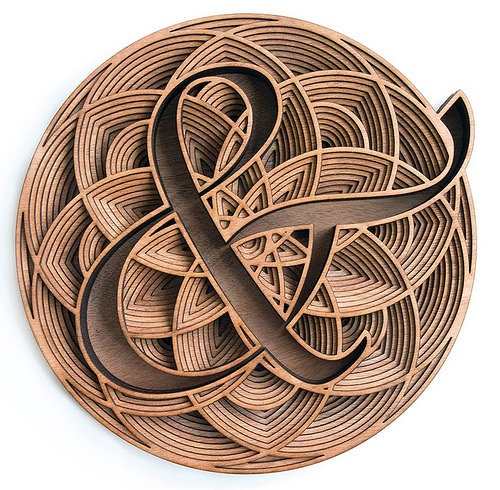
"&" by Gabriel Schama

“&” by Gabriel Schama. Visit Schama’s website and gallery.

REPRISES/RESPONSES/REJOINDERS/RIPOSTES

  • Reader W. feels it would be prudent “to let readers in on your little joke about visiting the ‘Museum of Hoaxes’ in San Diego, which doesn’t actually exist.” — Fair enough. But note I did say readers could ‘try to visit’ the museum…"

  • Reader B. leads the way: “this triggered a memory (this? words without prefixes) … in Felicia Lamport’s Light Metres … she has a section of couplets and a quattrain or two … that turn on this …” — B. included a snippet from Google Books that led me to the original William Safire article including “The Deprefixers”. Scroll down…it’s delightful.


I welcome comments, suggestions, thoughts, feedback and all manner of what-have-you. Just press ‘Reply’ or email to: clippings@katexic.com.

And please feel free to share anything here as far and wide as you want! If you want to give a shout-out, please link to: http://katexic.com/clippings/.

Daily(ish) email overwhelming you? Email chris+weekly@katexic.com to switch to the weekly digest edition.

#191
April 3, 2015
Read more

|k| clippings: 2015-04-01 — rushing in

WORK

“My imagination makes me human and makes me a fool; it gives me all the world and exiles me from it.”

—Ursula K. LeGuin
—from “Winged”

WORD(S)

mooncalf /MOON-kaf/. noun. An unholy fool, a dolt, a simpleton. An ill-conceived enterprise. In older usage a mooncalf might refer to a deformed animal or some misbegotten monster, based on the folk superstition that abortive fetuses (of cows and people) were the product of the moon’s influences. Also, now thankfully obsolete, a uterine mole or tumor.

“The potion works not on the part design’d,
But turns his brain, and stupifies his mind;
The sotted moon-calf gapes”
(Martial, translated by Dryden, from Juvenal’s Satires)

“…a very big man came into the room carrying a can of beer. He had a doughy mooncalf face, a tuft of fuzz on top of an otherwise bald head, a thick brutal neck and chin, and brown pig eyes…” (Raymond Chandler, from “The King in Yellow”)

“ In his pockets, it turned out, puppets were tucked, with strings and bars. A wistful female child, a wolfman with a snarling smile and a fur coat, a strange mooncalf, luminous green with huge eyes.” (A.S. Byatt, from The Children’s Book)

“We recruited fools for the show. We had spots for a number of fools (and in the big all-fool number that occurs immediately after the second act, some specialties). But fools are hard to find. Usually they don’t like to admit it. We settled for gowks, gulls, mooncalfs. A few babies, boobies, sillies, simps. A barmie was engaged, along with certain dum-dums and beefheads. A noodle. When you see them all wandering around, under the colored lights, gibbering and performing miracles, you are surprised.” (Donald Barthelme, from “The Flights of Pigeons from the Palace”)

WEB

  1. “What can we learn by examining only the first and final shot of a film? This video plays the opening and closing shots of 55 films side-by-side.” → First and Final Frames

  2. Via Reader C. comes an interesting story about Jon Bream, his massive music collection, and an interview about his music reviewing career. → “Star Tribune music critic Jon Bream parts with his 25,000-piece record collection”

  3. Cynthia Ozick on generations of writers, their separation and their kinship → “Writers Old and Young: Staring Across the Moat”

  4. “Conservatives, Please Stop Trashing the Liberal Arts” [Use the first Google search result to access the whole article. Stupid paywalls.]

  5. Today is April Fools’ Day. There are various theories about the exact date and origin, but mentions of April Fools’ Day go as far back as Chaucer, in the late 1300s, and detailed stories of pranks and mayhem are documented back to the 1500s. A few classic pranks include ►the 1957 BBC News report on the “spaghetti harvest” that prompted hundreds to write in about how to grow their own spaghetti trees and the Taco Bell buying the Liberty Bell hoax that fooled millions. That last link is one of many great pages to be found on the Museum of Hoaxes website (if you are ever in San Diego you should try to visit). Mark Twain said, “The first of April is the day we remember what we are the other 364 days of the year.”

WATCH/WITNESS


"Ship of Fools" (Hieronymus Bosch) [click for larger]

click for larger
“Ship of Fools” by Hieronymus Bosch. Originally part of a triptych (see a partial reconstruction), Bosch’s painting depicts a ship sailing to nowhere with a variety of carousing fools aboard.

REPRISES/RESPONSES/REJOINDERS/RIPOSTES

  • Reader B. shares one of my favorite uses of the WORD ‘ravel’ (more from Shakespeare on the website…someday): "For ravel, what came to my mind is Macbeth:

Methought I heard a voice cry ‘Sleep no more!
Macbeth does murder sleep’, the innocent sleep,
Sleep that knits up the ravell’d sleeve of care,
The death of each day’s life, sore labour’s bath,
Balm of hurt minds, great nature’s second course,
Chief nourisher in life’s feast,–


I welcome comments, suggestions, thoughts, feedback and all manner of what-have-you. Just press ‘Reply’ or email to: clippings@katexic.com.

And please feel free to share anything here as far and wide as you want! If you want to give a shout-out, please link to: http://katexic.com/clippings/.

Daily(ish) email overwhelming you? Email chris+weekly@katexic.com to switch to the weekly digest edition.

#190
April 1, 2015
Read more

|k| clippings: 2015-03-30 — all up in my head

Today’s WORD is nearly a phantonym, illustrating one of those playful qualities of language that led me to creating these dispatches in the first place.

WORK

Most have trouble with “it’s” and “its,” so I proposed a mnemonic device: “When is it its? When it’s not it is. When is it it’s? When it is it is.”

—Jessica Mitford
—from Poison Penmanship: The Gentle Art of Muckraking

WORD(S)

aprosexia /a-proh-SEX-ee-ə/. noun. Not what it sounds or looks like, aprosexia is the abnormally severe inability to focus one’s attention. We’re talking here about a state well beyond that of the classic absent-minded professor and into the realm of a medical condition sometimes thought to be caused by “adenoid vegetations” (eww). From Greek a (negative) + prosexein (turn attention to) from pros (toward) + echein (to hold).

“In 1887, Guye, of Amsterdam, published a paper on defective nasal respiration, in which be coined the term ‘aprosexia,’ defining it as a lack of power of concentrating the mind, or inability to fix and hold the attention.” (Derrick Vail, from The Cincinatti Lancet-clnic)

“The word aprosexia is not connected with sex; via Greek a (negative) + prosexein (turn, the attention) it is applied to an abnormal inability to concentrate. Fixing persistently on one idea is hyperprosexia; turning constantly to side issues is paraprosexia. Man’s major drives are for security and power; sex is a side issue, to keep him going.” (Joseph Shipley, from The Origins of English Words)

“Aprosexia is the inability to concentrate on anything…some of us call that the Internet.” (from AsapSCIENCE)

WEB

  1. Using 3-D printing, the Prado has created the first fine art exhibition for the blind. See also, the New York Times story. Pairs well with “Blind Painter Uses Touch And Texture To Create Incredibly Colorful Paintings”.

  2. “Thug: A Life of Caravaggio in Sixty-Nine Paragraphs”.

  3. A provocatively titled (and written) essay along with a dozen high-profile responses → “Against Empathy”

  4. Pulp Drunk: Mexican Pulp Art book covers.

  5. Today in 1858, Hymen Lipman patents the first combination pencil and eraser, noting that his invention is “particularly valuable for removing or erasing lines, figures, &c., and not subject to be soiled or rnislaid on the table or desk.” Four years later, Hymen sold his patent for $100,000 (more than 2.5 million in today’s dollars)…and a good thing too: a few years later the purchaser tried to sue the Faber company for infringement and ended up with an invalidated patent when the US Supreme Court ruled that Lipman’s invention was “actually a combination of two already known things with no new use” and that letting such a patent stand would be “as if a patent should be granted for an article … consisting of a stick twelve inches long, on one end of which is an ordinary hammer, and on the other end is a screw-driver … The instruments placed upon the same rod might be more convenient for use than when used separately. Each, however, continues to perform its own duty, and nothing else. No effect is produced, no result follows, from the joint use of the two.”

WATCH/WITNESS

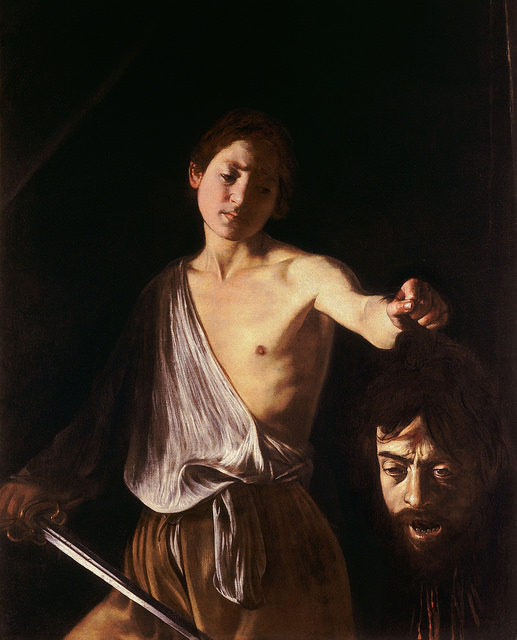
Continuing the theme of decollation…
"David with the Head of Goliath" (Caravaggio)

“David with the Head of Goliath” (Caravaggio) is both a depiction of the myth and a doubled self-portrait in which a young Caravaggio holds the head of the (then current) older Caravaggio. Click the image for larger views.

REPRISES/RESPONSES/REJOINDERS/RIPOSTES

  • Many thanks to the many Readers who had my back when I asked about words which can also mean their opposites (such as ravel), pointing me to contranym and auto-antonym. I think I like the less prosaic antagonym or Janus word even better.

  • Reader C. writes in with two great links: “…do you follow Bobulate? Liz Danzico describes the etymology behind her blog’s name: ¶ ‘Bobulate’ comes from an email exchange Liz had with a friend which tracked lists of words that sounded better without their prefixes and/or suffixes. The original list didn’t live on, but the name did. Standing for ‘intentional organization;’ to be thrown into order, as if against one’s will, if it were a real word, it would mean the opposite of ‘discombobulated.’ ¶ Danzico links to this gem.”

  • Reader K. creates a litmus test: “I forwarded the quote by Richard Feynman to a friend of mine. He replied ‘That makes my head hurt.’ I’m now reevaluating our friendship. ¶ And I would like to forward the Viagra story to a number of friends of mine, but don’t want anyone to take it personally.”


I welcome comments, suggestions, thoughts, feedback and all manner of what-have-you. Just press ‘Reply’ or email to: clippings@katexic.com.

And please feel free to share anything here as far and wide as you want! If you want to give a shout-out, please link to: http://katexic.com/clippings/.

Daily(ish) email overwhelming you? Email chris+weekly@katexic.com to switch to the weekly digest edition.

#189
March 30, 2015
Read more

|k| clippings: 2015-03-27 — a vast (un?)weaving

WORK

“It is a great adventure to contemplate the universe, beyond man, to contemplate what it would be like without man, as it was in a great part of its long history and as it is in a great majority of places. When this objective view is finally attained, and the mystery and majesty of matter are fully appreciated, to then turn the objective eye back on man viewed as matter, to see life as part of this universal mystery of greatest depth, is to sense an experience which is very rare, and very exciting. It usually ends in laughter and a delight in the futility of trying to understand what this atom in the universe is, this thing—atoms with curiosity—that looks at itself and wonders why it wonders.”

#188
March 27, 2015
Read more

|k| clippings: 2015-03-25 — complexification

WORK

“…I believe in the complexity of the human story and that there’s no way you can tell that story in one way and say, . Always there will be someone who can tell it differently depending on where they are standing; the same person telling the story will tell it differently. I think of that masquerade in Igbo festivals that dances in the public arena. The Igbo people say, . The masquerade is moving through this big arena. Dancing. If you’re rooted to a spot, you miss a lot of the grace. So you keep moving…”

#187
March 25, 2015
Read more

|k| clippings: 2015-03-23 — head from toes

WORK

“Embodiment”

how a birch shirks its skins : strange grain of the language of prayer : to disturb words addressed to where God is is what writing is : alphabet alive beneath the alphabet so far into whiteness each mind to itself creation come crawling matter out of nothing : always longing inquiries at the threshold a question unanswered : not skin but the look of skin : what once overheard the talk of God became matter : ask the birch did the soul have a choice :

#186
March 23, 2015
Read more

|k| clippings: 2015-03-20 — a brief retreat

No, your inboxes are not deceiving you: Katexic is on an unexpected--but happy--hiatus until Monday. Have a great weekend. I hope Spring has sprung for all of you.

"It is spring again. The earth is like a child that knows poems by heart."   --Rainer Maria Rilke
#185
March 20, 2015
Read more

|k| clippings: 2015-03-17 — black and gold

WORK

“Stories of imagination tend to upset those without one.”

—Terry Pratchett —from

#184
March 17, 2015
Read more

|k| clippings: 2015-03-13 — cndnsry

WORK

“Poet’s Work”

Grandfather    advised me:       Learn a trade

#183
March 13, 2015
Read more

|k| clippings: 2015-03-11 — can you get there from here?

WORK

“Nothing is original. Steal from anywhere that resonates with inspiration or fuels your imagination. Devour old films, new films, music, books, paintings, photographs, poems, dreams, random conversations, architecture, bridges, street signs, trees, clouds, bodies of water, light and shadows. Select only things to steal from that speak directly to your soul. If you do this, your work (and theft) will be authentic. Authenticity is invaluable; originality is non-existent. And don’t bother concealing your thievery—celebrate it if you feel like it. In any case, always remember what Jean-Luc Godard said: ‘It’s not where you take things from—it’s where you take them to.’”

#182
March 11, 2015
Read more

|k| clippings: 2015-03-09 — what is said in return

WORK

"To consider the world in its length and breadth, its various history, the many races of man, their starts, their fortunes, their mutual alienation, their conflicts; and then their ways, habits, governments, forms of worship; their enterprises, their aimless courses, their random achievements and acquirements, the impotent conclusion of long-standing facts, the tokens so faint and broken of a superintending design, the blind evolution of what turn out to be great powers or truths, the progress of things, as if from unreasoning elements, not towards final causes, the greatness and littleness of man, his far-reaching aims, his short duration, the curtain hung over his futurity, the disappointments of life, the defeat of good, the success of evil, physical pain, mental anguish, the prevalence and intensity of sin, the pervading idolatries, the corruptions, the dreary hopeless irreligion, that condition of the whole race, so fearfully yet exactly described in the Apostle’s words, ‘having no hope and without God in the world,’—all this is a vision to dizzy and appall; and inflicts upon the mind the sense of a profound mystery, which is absolutely beyond human solution.

#181
March 9, 2015
Read more

|k| clippings: 2015-03-06 — it's a little old place

WORK

from “Topics Suitable for Composition”

#180
March 6, 2015
Read more

|k| clippings: 2015-03-04 — it is me; it is you

WORK

How can you answer that boy?

#179
March 4, 2015
Read more

|k| clippings: 2015-03-02 — the opposite of loneliness

A short issue today, buttressed by a long comment I couldn’t bring myself to shorten or synopsize…it’s just too good (and true).

WORK

“The piano ain’t got no wrong notes.”

#178
March 2, 2015
Read more

|k| clippings: 2015-02-27 — logic, the beginning of wisdom

WORK

“All I really want to know is how other people are making it through life---where do they put their body, hour by hour and how do they cope inside of it?”

#177
February 28, 2015
Read more

|k| clippings: 2015-02-25 — creatively absorbed

On Twitter, a reader asks, “Is there a word—or can we create one—for when your muse disturbs your sleep schedule? CreativeGloaming? MuseLag?” Can the Clamor help? I got nothin’.

WORK

#176
February 25, 2015
Read more

|k| clippings: 2015-02-23 — braids and blooms

Today’s work comes from Reader D., who included it with her important comment at the end of this issue.

WORK

#175
February 23, 2015
Read more

|k| clippings: 2015-02-21 — outrageous hope

WORK

The virtue of hope exists only in earthquake and eclipse. […] For practical purposes it is at the hopeless moment that we require the hopeful man, and the virtue either does not exist at all, or begins to exist at that moment. Exactly at the instant when hope ceases to be reasonable it begins to be useful.

#174
February 21, 2015
Read more

|k| clippings: 2015-02-19 — flailing's surreal self

WORK

“I believe in the future resolution of these two states, dream and reality, which are seemingly so contradictory, into a kind of absolute reality, a surreality, if one may so speak. It is in quest of this surreality that I am going, certain not to find it but too unmindful of my death not to calculate to some slight degree the joys of its possession.”

#173
February 19, 2015
Read more

|k| clippings: 2015-02-17 — crossing over

Sad news of poet Philip Levine’s passing a few days ago, so please excuse a slightly longer than usual WORK. Many, many readers will know Levine from his (rightfully) oft-anthologized poems “Animals Are Passing From Our Lives” (featured here before) and “What Work Is”. Levine was, by all accounts of mutual friends, not just a fine poet but an extremely generous reader and teacher—which are often the same thing—as well. RIP.

#172
February 17, 2015
Read more
  Newer archives Older archives  
Powered by Buttondown, the easiest way to start and grow your newsletter.