Lewis, Animals, and the Nativity + New scheduling option for Spring Classes!
Friends,
Happy final days of Advent 2025!
If you are in the Dallas area and looking for a Christmas Eve service: I will be preaching at 2pm and 5pm at Church of the Incarnation in our contemporary services. (“Contemporary” for an Anglo-Catholic parish, which is to say: excellent music and an ancient liturgy in our modern English tongue.)
If you only check your email occasionally and we have now already crossed the threshold into the twelve-day-long Feast of the Nativity of our Lord by the time you read this: Merry Christmas!
Below I share an idea that a reader submitted about the scheduling of my Living Room classes for the Spring. It is a really good idea that makes sense given the way so many of our schedules work. If you find yourself wanting to take a class this semester, but the listed dates don’t work for you: read more below.
But first: Lewis, Animals, and the Nativity
One day, when the children are grown and I have learned to manage my time in a healthier manner, I would like to spend a few years re-reading the fiction of C.S. Lewis in pursuit of understanding what he saw as the telos of the technological developments of his day, particularly through the lens of his portrayal of beasts, talking beasts, and humans. Until that day, I will just daydream about it on occasion.
Today, you get to see a glimpse into that daydreaming. You see, Lewis is a medieval thinker trapped in the middle of the 20th century. (This is why so many of us who are longing for more than what our modern world can offer are so drawn to him.)
And as such, he has a far more robust vision of what nature is and what nature is for than most of his University colleagues.
This leads him to a view of animals that we tend to not hold in our modern world.
Alan Jacobs, a living intellectual hero of mine, recently shared an essay by Francis Young highlighting how early Christian Nativity art also had what we might call an elevated view of the animal kingdom compared to our own.
You can read the full article below, following the excerpt.
One of the earliest surviving depictions of the Nativity in art, in the Byzantine Museum in Athens, depicts Jesus lying in a manger with the ox and ass and omits any other human figures at all (in fact, there are several early depictions of the infant Christ like this). Christ is here the unmediated Lord of animals, who recognise and adore him. It is easy for us, in a culture that takes a very low view of animals, to dismiss the role of the animals in the Nativity story as sentimental pap; but animals in the Bible are repeatedly endowed with agency.... From Balaam’s ass to the penalties for ‘criminal’ animals laid down in Numbers and Leviticus, the ancient Hebrews clearly did not have a view of animals that sharply divided them from humans in the way we are inclined to do.
Biblical, medieval and folkloric views of animals are challenging to us because, under the influence of the mechanical philosophies of the 17th century and the Theory of Evolution in the 19th century we have convinced ourselves that humans and animals are unbridgeably different in kind. People in the more distant past did not see things this way; animals to them were far closer to being persons than they were to being automata. We have travelled so far in the other direction that any treatment of animals as persons, any suggestion that they too might reverence the Creator, takes on the status of sentimental anthropomorphisation in our culture. We see a depiction of animals kneeling at the crib or the repentance of the Wolf of Gubbio, and our minds leap to Disneyesque talking animals and childish fantasies. But people in ancient Israel and medieval Europe took completely seriously the idea that animals could be held responsible for their actions (at least to some extent) and that they had a duty of reverence to their Creator.
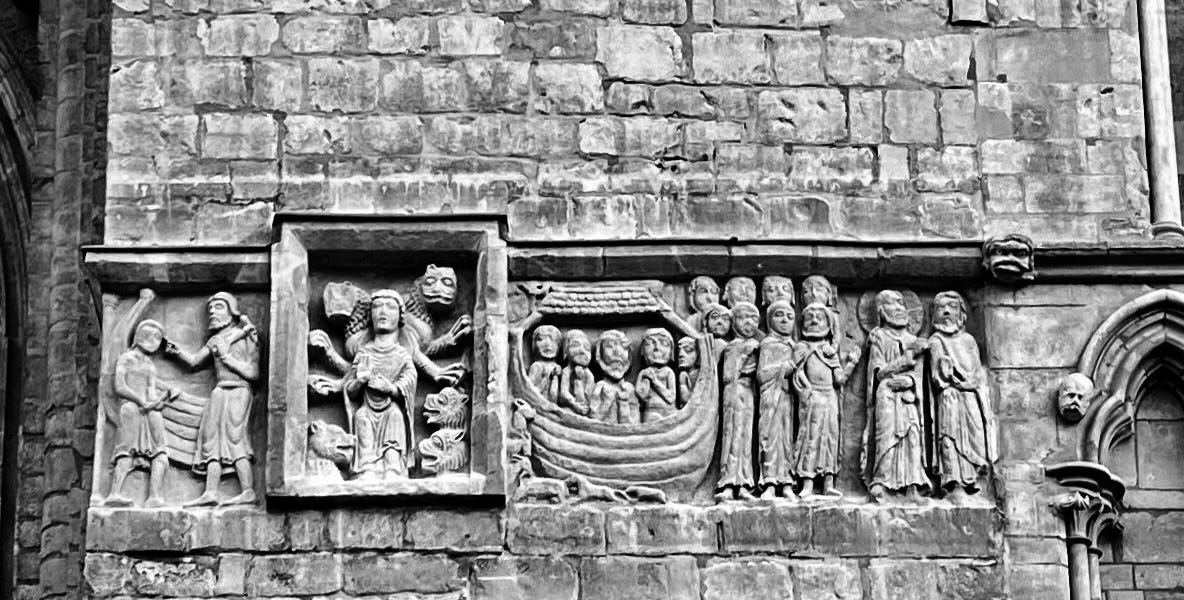
The ox knoweth his owner, and the ass his master’s crib
Christmas of the animals
New Scheduling Option for Spring 2026 Living Room Classes
Are you interested in either Here there Be Dragons or History of Christian Traditions, but the days and times listed on my Class Page don’t work for you?
If you take on the scheduling work, I would love to make something happen!
Gather four or more people who are interested in one of these classes, either in-person or virtually, and send me some meeting options that work for all of you. Both classes can be adapted, as needed, based on schedules. Dragons could be condensed or spread out over the semester. History of Christian Traditions can be made into one long class or two or three shorter classes. In the words of a dear friend of mine: Freedom is open.
Talk to your friends, and then shoot me an email with a proposed schedule. Chances are we can make something happen!