Backrooms - Jender Theory
Let's get liminal.
Internet culture has had a hard time translating to film for many years. Not many social structures of the internet translate easily. The Unfriended movies get a lot right by building the movie around emulating software that visually interests a filmgoer. Before the demon and/or dark web hack attacks, they’re riveting movies about looking at a narrative being told through a specific technological stage.
Internet folklore has had it even worse. I’ve always admired the legacy of the creepypasta, attempts at cultural formation where young writers auditioned their big ideas for the canon of their respective forums. The cultural bleed of creepypastas has spread through different online media cultures, everything from mascot horror to the Backrooms themselves run downstream from the years of cultural formation that gave us concepts like the Slender Man, the first real piece of internet folklore to get a big out-of-touch Hollywood adaptation.
What separates Backrooms from the admirable but redundant juvenility of much of the creepypasta genre is that the visually striking core concept contains a range of narrative potential unlike any provoked by the forum mascots. The liminality of the concept allows the mind to wander and attempt to fill the gaps - it’s a place of trickery where the worst thing you can imagine could very well be around the next corner.
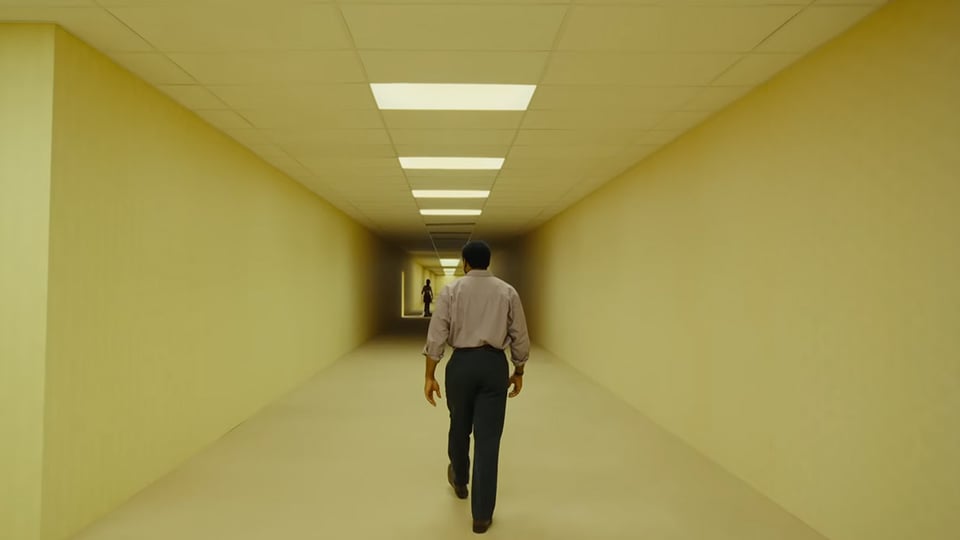
Backrooms is thoughtful psychological horror, where explorations of therapy and the hangups of the subconscious make the physical space something that can withstand projection from the viewer and the characters. Parsons’s approach to production design and shot composition make the space real. Long shots full of negative space where the camera peers around edges and whips to check blind spots. Seeing the space is consistently eerie, the harsh lighting and that signature ugly yellow tint repel the eyes on an instinctual level. The movie’s period setting feels just as alienating to a modern audience. To the smartphone generation, camcorders and 90s computers are just as unreal as the backrooms themselves.
Chiwetel Ejiofor is magnetic as the struggling business owner Clark, who encounters the backrooms just as he hits an emotional low in the process of his divorce. He spends the movie in constant misery, displaced from any conventional space. We never see Clark in a space that isn’t asking him to perform some kind of function: his store, his therapist’s office, or the backrooms themselves. His therapist Mary is just as isolated from places of rest. Agoraphobia perturbs her, even in her bedroom she’s maligned by memories of the walls of her childhood home being destroyed as she watches from inside.
The backrooms is the ultimate hostile space, its lack of definition the bait for the mind to become lost in its meaninglessness. In a meaningless place the mind produces meaning from the traumatized perspective, and the space invites every possible response to trauma. Clark resigns himself to his projected lack of control over his own life. The backrooms is the only place that will not change no matter what kind of frustration he directs at it, a place where he may safely succumb to his darkness without consequence.
Explorations of the characters’ inner trauma extend outward to more directly thematize the backrooms, a risky decision that pays off with the range of possibility still suggested by the key element of memory being woven into the design of the horror. As Clark and Mary struggle to overcome past traumas the backrooms renders the malformed memories of the traumatized mind into physical threats, truly creepy figures with unreal faces and inhuman posture. The movie is at its least interesting when it resigns itself to having its characters running away from scary monsters, but all of the substance draping the plainest stretches and the consistently dense compositions keep things interesting. While I don’t care as much for the raucous stretch of the climax, the somber ending has firmly stuck with me.
