
The Moon

I've been reflecting a bit on my philosophy of learning stuff. How I like to think about things (and maybe how you like to think about things, if you like to read this newsletter).
I make a lot of observations of the form "X is Y" which tend to get understood sometimes as being reductive, and missing important aspects of both concepts. Which is strange to me because I think it seems fairly clear that the intended reading of "X is Y" is "one way, of many, of conceiving of X is that it is an instance of Y." This is actually my favourite kind of insight, when I can draw an explicit line between two things I sort of understand and as a result deepen my understanding of both. Such connections are not intended for everyone; someone without an extant understanding of either topic would probably not be able to get much out of a connection being drawn.
For a long time, I didn't have a good explanation for what I'm doing when I made those kinds of comparisons, and why I think they're valuable, until recently!
I recently read A Swim in a Pond in the Rain, by George Saunders:
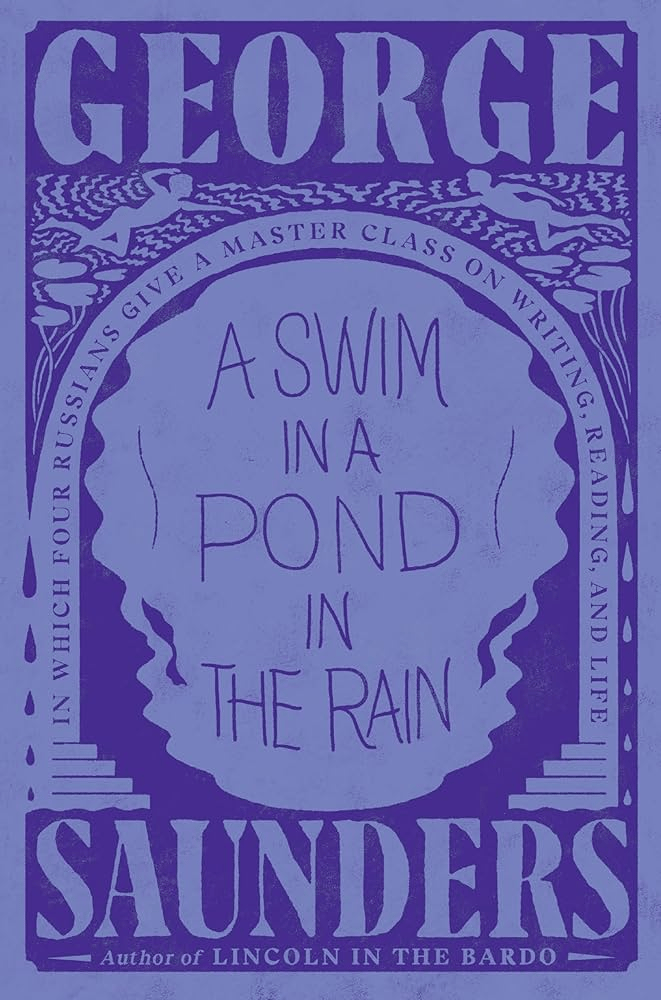
In this book, Saunders goes through a bunch of short stories that he thinks are masterpieces and explains what he likes about them, and what he thinks makes them tick as stories. One passage that particularly spoke to me was near the beginning:
Throughout, I'll be offering some models for thinking about stories. No one of these is "correct" or sufficient. Think of them as rhetorical trial balloons. ("What if we think about a story this way? Is that useful?") If a model appeals to you, use it. If not, discard it. In Buddhism, it's said that a teaching is like "a finger pointing at the moon." The moon (enlightenment) is the essential thing and the pointing finger is trying to direct us to it, but it's important not to confuse finger with moon. For those of us who are writers, who dream of someday writing a story like the ones we've loved, into which we've disappeared pleasurable, and that briefly seemed more real to us than so-called reality, the goal ("the moon") is to attain the state of mind from which we might write such a story. All of the workshop talk and story theory and aphoristic, clever, craft-encouraging slogans are just fingers pointing at that moon, trying to lead us to that state of mind. The criterion by which we accept or reject a given finger: "Is it helping?"
I offer what follows in that spirit.
I think this is a really beautiful perspective on learning and understanding.
Why do I think analogies like "columnar storage is normalization" are valuable? I think partly because in some sense "concepts" are impossible to grasp fully. They're simply too ethereal and abstract to have a single canonical instantiation.
When we teach students a concept in school and then test them on it, we don't say "tell me this concept," we tell them to apply it to problems. Well, when I was younger, I might have said that "the standard of understanding that allows one to apply a concept to a situation is higher than simply regurgitating that concept." That's one reason, for sure. But in perhaps a more fundamental sense, there is no one thing which is, say, the concept of NP-completeness. It's an idea that is a combination of concrete instantiations, implications, vibes, applications, and related ideas. That is to say, we know it exists only because we can see its shadows: what it implies, what it doesn't imply, what problems it lets us solve, or what neighbouring concepts it illuminates for us.
I think many ideas in computer science are like this. You can know how to implement a particular kind of algorithm and get value out of it, but at some point a more satisfying understanding comes from seeing how one algorithm is connected to another algorithm or is implemented in some other style, or how it's a special case of something else. Or seeing how much you can relax the requirements of it and still have it work (this is why I love talking about LSMs in the context of abstract algebra). You have to look at its shadows, the different things it implies and suggests, because you can't entirely pin down the underlying idea.


Add a comment: