Comics reading in Australia
Welcome to my free newsletter. Stay up to date with all my latest writings and ramblings. Wherever curiosity takes me.
This post is fully dedicated to comics. More media analysis and ghosts in the machine next time. Promise.
Reading comics is still seen as alien for a lot of people. Especially, when adults read comics. Yes, comics are hugely popular shops and in libraries the graphic novels sections have been getting bigger but, leaving aside junior comics, I know that some librarians still look at them with some suspicion.
As a lifelong reader of comics, I don’t understand this. My parents, both of them lifelong comics readers too, don’t understand it either. I guess I grew up in an alien household.
I’ve often wondered what the reading habits of Australians are when it comes to comics. We know that a large percentage of adults read comics regularly in some countries, especially in France and Japan, but what about Australians?
It’s never been easy to find data on comics and reading in Australia but I’ve come across the Creative Transformations: Results of National Arts Participation Survey published by Creative Australia, and there’s some interesting information there.
One of the key questions asked with a base population of 15+ years of age was, “excluding for work or study, which of the following did you read in the past 12 months?”
The results are interesting.

The results show that 69% of Australians have engaged in reading. It’s not a surprise that most have engaged with general fiction (novels or short stories) at 46%. What I find really interesting is that 13% have engaged with a comic or graphic novel (and I assume manga(?), although this is not specified anywhere). This is higher than plays and higher than poetry at 6% and 9% respectively.
The percentage of people reading comics and graphic novels has also remained relatively stable, with 14% in 2022 and 15% in 2019. This little drop should not be of concern and, again, I wonder if manga readership is being captured by the survey.
Delving into further details, it is perhaps not surprising that more men read comics (16%) than women read comics (10%), as shown in page 178. This makes sense to me, traditionally men have been bigger readers of comics but I’m sure the gender difference is changing. Globally, there’s a trend of women increasingly reading more comics, particularly manga, webtoons (which are now finding success in print) and graphic novels. There’s no reason to think that Australia will be any different but, unfortunately, I don’t have the numbers on this.
What I found particularly striking and interesting in the report is something that I have perceived instinctively for a long time and the data confirms. In libraries, we cannot just cater to mass majority. We must cater for everyone in the community and that means addressing the diversity in our community head on. I’ve always felt that comics are a huge part of this and a part that often gets overlooked. I’m honestly still haunted by the very experienced librarian who said that if it were up to her the library would not have young adult and adult comics. I was shocked back then, I’m still shocked today.
The breakdown of data in page 178 of the report shows that “almost all gender-diverse respondents read for pleasure (96% compared to 73% of women and 65% of men).” That’s really important, but here’s something that I wish more people realised, “gender-diverse respondents are particularly more likely to read graphic novels or comics (37% compared to 16% of men and 10% of women).”
That’s absolutely huge. 37% of gender diverse people surveyed read comics. It’s important to emphasise that.
Unfortunatley, there’s no data in the report about neurodiverse readers but I would bet my life that a huge percentage of neurodivergent readers regularly read comics, graphic novels and manga and I would venture to say their percentage would be similar to that of gender diverse readers if not higher.
The next interesting bit of data is on culturally and linguistically diverse (CALD) readers. Still on page 178, the reports says that, “CALD respondents are more likely than non-CALD respondents to read for pleasure (76% compared to 68%), especially graphic novels or comics (19% compared to 12%).” So CALD readers reader more than average Australians and they read more graphic novels than average Australians too.
It’s worth looking at the full data on CALD readers in page 182.

In my view, all the data mentioned above makes a very strong case for building comics, graphic novels and manga collections in libraries. The key points being:
Libraries must cater to everyone in the community, this includes comics, graphic novels and manga as multimodal texts that 13% of Australians read.
Gender diverse readers engage in reading comics well above the Australian average (37% of gender diverse readers, compared to 13% average).
Cultural and linguistically diverse readers also favour comics (19% of CALD, compared to 13% average).
Unfortunately, a breakdown of neurodiverse readers is not included in the report but lots of other studies suggest that neurodivergent readers favour multimodal texts like comics well above the average.
And remember, the Creative Transformations report was looking at readers 15 years of age and above. This data is about young adult and adult readers, not children.
I’d love to know of a library in Australia where 13% of their collection (since that’s the all-round average) is graphic novels for young adults and adults.
It’s great to see comics being nominated and receiving awards in the last few years, with Lee Lai’s Cannon being the latest one (kudos to the Stella Prize and the judges who awarded Cannon the big prize). Perhaps its time for the Australian Book Industry Awards and other literary awards to include a category for comics?
It’s great to see Publishers Weekly and the American Library Association’s Booklist magazine covering comics regularly, reviewing comics regularly and, in the case of Booklist, publishing a yearly supplement every July dedicated exclusively to comics, graphic novels and manga. Perhaps it’s time that Australian magazines like Good Reading take note and include reviews of comics, graphic novels and manga regularly?
It’s great to see the increasing popularity of comics, the increasing number of academic interest and work around comics, the rise of comic cons and comics festivals at libraries and the increasing growth of independent comic arts festivals with a focus on comics and comics creators (as opposed to the comic cons and their focus on pop culture in general and cosplay). Perhaps, it’s time to fully embrace comics as the mature storytelling format that they are, with its quirks, its tropes, its complexities and all its virtues, not just for children, but for young adults and adults?
On a different note, it’s interesting to see that the Perth Comic Arts Festival (PCAF) gets a full page of the report (page 174) and highlighted as an excellent showcase of comics, comics creators and fans, the report noting that “attendance to the Festival has steadily increased over the years, from just over 600 people in 2018 to over 3000 across 2024 and around 6000 in 2025.” There’s definitely big interest for comics in the community.
Hopefully, festivals like Adelaide’s Papercuts, Sydney’s SCAMP, Brisbane’s Comicstreet and the upcoming MAKE in Melbourne will make it to the next Creative Transformations report and will continue to build comics community in Australia.
The report also mentions what percentage of the Australian population engage in writing. In page 202 the report says that at 11% “in 2025, more than one in ten Australians wrote creatively (not including those who did so specifically to engage with their own cultural background, language group or community).” What really piqued my interest though, is the breakdown of what format those who engage in writing work on:
5% of Australians write novels or short stories.
4% of Australians write poetry.
3% of Australians write creative non-fiction such as biography or history.
2% of Australians write instructional non-fiction such as guidebooks or cookbooks.
2% of Australians write graphic novels or comics.
2% of Australians write plays.
The data is clear and it’s consistent with data from 2022. 2% of Australians write comics. Perhaps its time to see more of them on literary festivals and literary magazines?
KICKING AROUND THE NET
Reimena Yee is a comics creator, originally from Malaysia, now living in Melbourne who I really admire, not just for her work in comics but also for how proactive she’s in the community. She’s a powerhouse with lots of initiatives, including the Comics Devices website, which is an extraordinary website for comics creators, for educators teaching comics in the classroom and for anyone interested in different visual devices used in comics storytelling. Best of all, the website is totally free. Reimena has also recently published a blog post exploring the issue of how to strengthen the comics community in Australia and why the comics community needs greater policy support and coordination from the Australian government. It’s a fascinating and thought provoking read.
The creator of Maus, Art Spiegelman gave an interesting interview to The Guardian discussing a wide range of issues including Trump, the shadow of 9/11 and the rise of fascism in America. It’s well worth a read.
And if you want to catch up with reading or want to buy graphic novels, here’s a roundup of graphic novels published by Australian creators in the first half of 2026 posted on the ALIA Graphic Novels and Comics group’s website.
PHOTO OF THE WEEK
Since this post is all about comics, I’ll show you one of my favourite photos of my kid reading before he could read words.
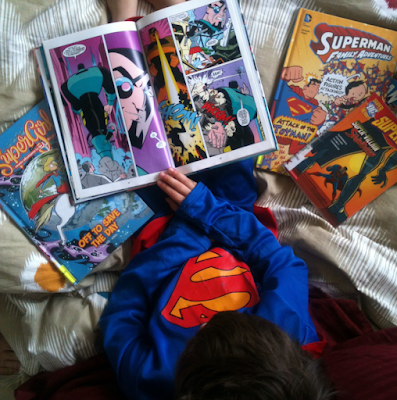
I love this photo because long before my son could read words he was reading comics.
He loved putting on a costume and going through all panels. He read the visual panels carefully and pieced the story together just from the visuals.
Then, of course, I used to sit and read the words to him, but he often read the comics before I had a chance and he would tell me parts of the story he had figured out just looking at the visuals and putting the sequential action together.
This kid is now 15 and continues to read comics as well as novels and non-fiction books. He loves reading and always describes himself as a reader. My job here is done.
That’s it from me for now. Hopefully you found something interesting. Feel free to share with whoever you like. This newsletter is free and will always be free. It’s shared with a Creative Commons BY ND licence which enables reusers to distribute, remix, adapt, and build upon the material in any medium or format for noncommercial purposes only, and only so long as attribution is given to the creator.

