Book Bans and Censorship in Australia Part 1: Cautious Hope
I reflect on Australia's book-banning wave, from Gender Queer onwards, has mostly failed in the open, the risks of creeping soft bans and why I have some hope. Also, the highlight of my year: MAKE, the Melbourne Alternative Comics Expo.
Welcome to my free newsletter. Stay up to date with all my latest writings and ramblings. Wherever curiosity takes me.
I remember ordering Gender Queer for the library soon after it was published. A librarian I trust recommended it on Twitter (back when Twitter was still a thing) and it looked like a really interesting graphic novel. Then the wave of book challenges and book bans started in the U.S. with Gender Queer among the most banned books and I got worried that it would happen in Australia too.
In 2022, I called a couple of favours and organised a special podcast episode with the American Library Association’s Addressing Comic Book Bans & Challenges Committee. It was a fascinating conversation where James and I, both from the ALIA Graphic special interest group, tried to find out what was happening in the U.S., what they had learned in the first few months of the wave of book challenges and how they were getting organised to fight back and defend libraries, librarians and, most importantly, the books.
Then, just a few months later, Gender Queer was referred to the Australian Classification Board and my fears were realised. It was the beginning of a series of book challenges and attacks on libraries in our shores.
My hope that Australia would avoid a new wave of moral panic, culture war and censorship has wavered in the last three years. Sometimes I dared hope, sometimes I grew frustrated and sometimes my fears grew. Here’s the thing there are signs of concern and there are also signs of hope.
This is the first of what I hope will be a series of posts (not fully thought through, but more like a work in progress) where I will look at these issues from a few different angles.
I'll talk about where we're at now, but I also want to go back in time and cast the net much wider, exploring how horror, violence, nudity and sex has been censored in Australia. What did those groups object to and why? And how did libraries and librarians respond to book challenges and censorship? Did they fight back? Did they stand aside or were they supportive and complicit in censorship?
The dictionary definition of censorship is a process exercised by a group of people who ban or modify a text, consequently curtailing the chance for another group of people to see, hear, or read it in its original form.
It's a limited definition that, in my view, doesn't include some of the more insidious forms of censorship like soft bans (for example, when books are re-catalogued and re-shelved as adult when the target audience is, clearly, for teenagers or when books are not removed but hidden away) and self-censorship in order to conform to the norm and not attract any attention/trouble (for example, not buying a book because you don’t approve on moral grounds or because you think it may attract some complaints from certain members of the community).
We have to be honest, whilst the most commonly identified censorship is that of totalitarian regimes and their blatant ban of texts that do not follow their agenda, censorship is ever prevalent in free societies in subtle but powerful forms. Aldous Huxley warned in the 1930s that transparent censorship was to become the most powerful form.
He was right. Most censorship these days is not blatantly coming from the top.
With moral censorship, which is what we're seeing these days, pressure groups and the media exercise a strong influence over governing bodies advocating for protection for certain individuals from allegedly corruptive and dangerous media. To protect children from what they deem offensive, they demand that content and information is banned for everyone.
What we're seeing right now with attacks to LGBTQIA+, sex education books and books with visual elements such as picture books, comics, graphic novels, manga, and illustrated non-fiction books, is moral censorship of the worst kind.
It would be easy for them to simply not borrow or buy those books. Just leave them on the shelf, move on and grab something else. But that’s not how they think. If they object to it then they demand that it must be banned for everyone, removed from circulation and the problem is that their morals start to infect everything else...
When conservative and religious groups and individuals continue to harass librarians and educators, objecting to books they deem inappropriate and referring those books to local government councillors, school principals, the eSafety Commissioner and the Australian Classification Board, well meaning librarians, teachers and parents start to watch themselves and soft banning slowly grows.
Then financial censorship starts to be exercised by publishers who, even when they're well meaning, give little suggestions to creators to make amendments to their books in order to avoid any trouble or who decide not to publish something because 'we better avoid entering into that for now’.
Then, educators don't invite an author to school because they posted something online, or they took a political stance on something, or they ask the author to skip over their LGBTQIA+ identity and themes.
Teachers then take some books out of the classroom library and classwork preemptively, just in case, because they don't want parents complaining and teacher librarians start hiding some books, taking them out of the shelves, re-cataloguing them for an older audience even though they're written for children or teens, or simply stop buying them, because they don't want complaints from patrons.
Political censorship emerges then with councillors and politicians demanding that some books have to be removed because one person finds them offensive or uncomfortable.
At its worst, all this happens quietly. As teachers don't choose a certain text just to avoid any trouble with parents, as librarians don't place some books or graphic novels on display for fear of patrons making a complaint. Then it goes up the tree and management level staff start to say that 'adult graphic novels are not worth the trouble.' They also cancel plans for a Rainbow Family Story Time because they don't want protesters at their door. Etc.
It happens quietly and most people don’t notice because it’s not out in the open. It’s not obvious, it’s not blatant, until suddenly, somehow, it’s all out in the open. Because these things can’t be hidden forever.
It's incredbly frustrating and disheartening when people instigating this type of culture war, despite their little tiny-weeny number, can have a ripple effect that can grow into a terrifying and soul destroying wave.
It's not all doom and gloom though. Despite Australia's history of censorship (and it's quite a history: here's an article discussing Australian censorship in films and here's an article discussing Australian censorship of books throughout the 20th century and here’s an article looking at censorship of Australian books and comics in Queensland, there are some positive signs.
Thankfully, there doesn't seem to be much appetite for political censorship of books and libraries in Australia. Some politicians from One Nation and LNP have tried to sow discord and fear but they're very few and on the far-right side of the spectrum.
They didn’t succeed in Queensland, nor Albany (Western Australia). They tried but failed because the community trusts libraries and ALIA has responded calmly and strongly to defend the freedom to read, libraries have organised themselves and those seeking to employ the same tactics as in the U.S. are not gaining much traction.
They didn’t succeed with Gender Queer. The case dragged on for two years but the Australian Classification’s Board’s final decision was the same as their original decision. Gender Queer is rated Unrestricted M, which means that anyone can read it, though it is not recommended for readers under 15. A sensible decision.
But, even when they lose, their actions can have serious consequences, including serious harm to marginalised members of the community. So we must be cautious, aware, well informed and ready for action.
We have stronger public institutions in Australia, we have protections (despite some personal frustrations) with the Australian Classification Board and, so far, teachers, librarians and institutions in Australia have very strongly repudiated these kind of attacks.
Let's hope it lasts. Let’s hope we don’t fall into soft banning and self censorship. And let's hope we don't give an inch.
KICKING AROUND THE NET
Lizzie O’Shea and the Digital Rights Watch team are doing an excellent job of tracking issues around digital rights, privacy and security and fighting back against the big tech companies in Australia. I may be posting less about these issues in the future but if anyone’s interested I highly recommend they follow Digital Rights Watch, support their calls for action and subscribe to their newsletter.
It’s interesting to see what big tech executives say behind closed doors when they think that no one’s listening. The thing is that the AI Con is too big to hide and the truth eventually comes out, one way or another. Some documents have surfaced from the NYT vs Microsoft and Open AI court case and there are some great quotes from the tech executives including admitting that AI scraping is the biggest theft of labour in human history and that they know this may cause a ‘doom loop’ that could destroy news media and the internet as we know it.
Jane Cowell has written a great post on Medium with some thoughts on AI in libraries. She highlights the importance of AI literacy but, critically, she also mentions that knowing how to use it and getting people to use it has to also be complimented with a critical perspective and choice. For example, workshops in libraries in the U.S. teaching how to disable and avoid AI features from phones and web browsers, and how to make safer and more privacy conscious choices, have been incredibly popular.
There have been lots of reports that show the positive impact libraries have in the community and economy. Cory Greenwood published a recent blog post about a new report. More importantly, he highlights how important and beneficial it would be to have some national standards, stats and reporting in order to increase their policy influence.
PHOTOS OF THE DAY
Yes, today I share more than one photo and I’ll probably write more about this soon but this year my big bucket filler and absolute highlight of the year has been working in the committee for MAKE, the Melbourne Alternative Comics Expo. This is a brand new and totally independent comics festival that was just a dream and a bunch of ideas back in February.
It has been an extraordinary weekend that included:
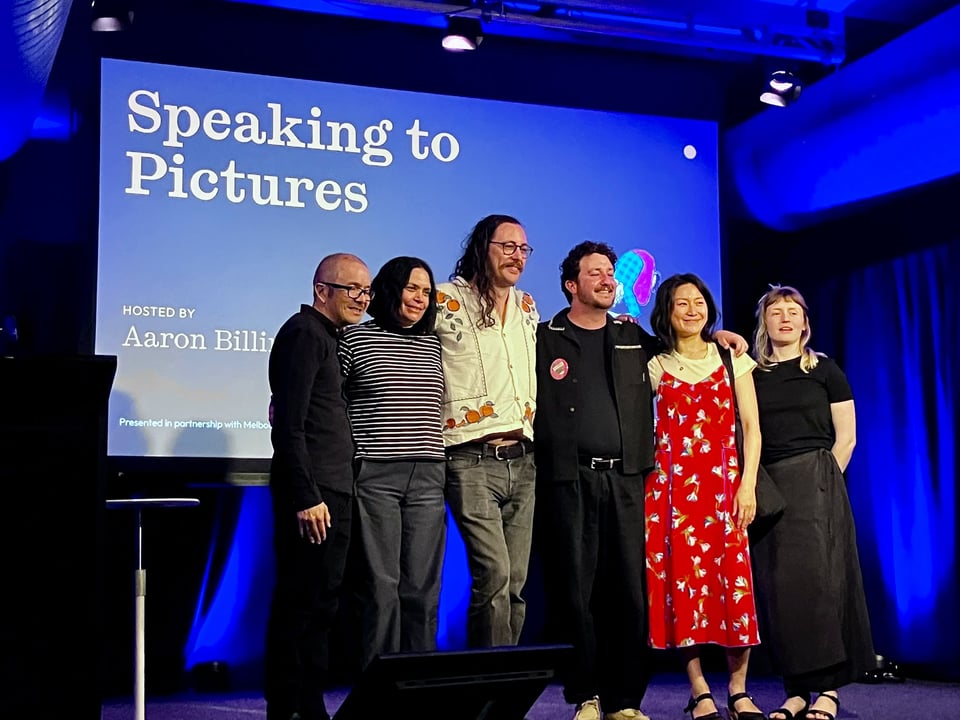
DAY 1 Speaking to Pictures opening gala: A live comics reading presentation at the Wheeler Centre, with an outstanding set of creators reading and acting out their work that included: Shaun Tan, Mandy Ord, Joshua Santospirito, Aaron Billings, Rachel Ang, Bailey Sharp
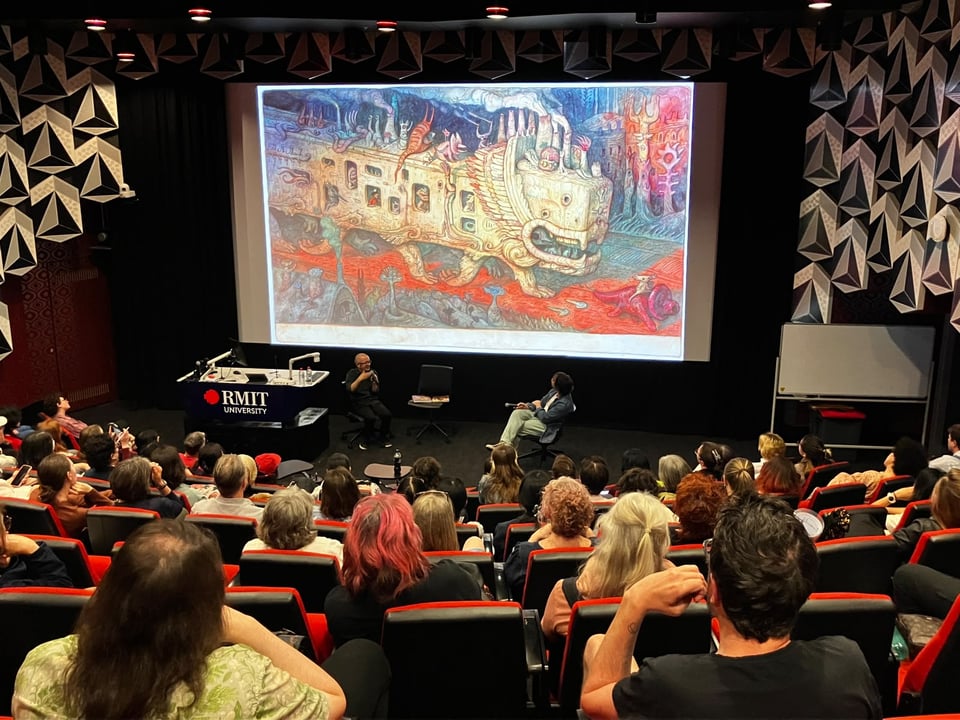
DAY 2 Community Day: a full day program of panels and presentations that included comics creators, literary agents who represent comics creators, comics editors and publishers at RMIT University. The day concluded with Campbell Whyte and Shaun Tan, two extraordinary and imaginative creators in discussion when Home Time met Hometown.
Day 3 Market Day: a market hall filled with 119 comics creators from all over Australia selling and sharing their comics, an exhibition showcasing the different process comics creators use to create their comics and a series of workshops all throughout the day, including: the perfect three panels to start a comic, how to research and use that research for comics, drawing nature in your community, how to transform characters, writing autobiographical comics, and a fun drawing party with ‘Ghosts and Ghouls’.
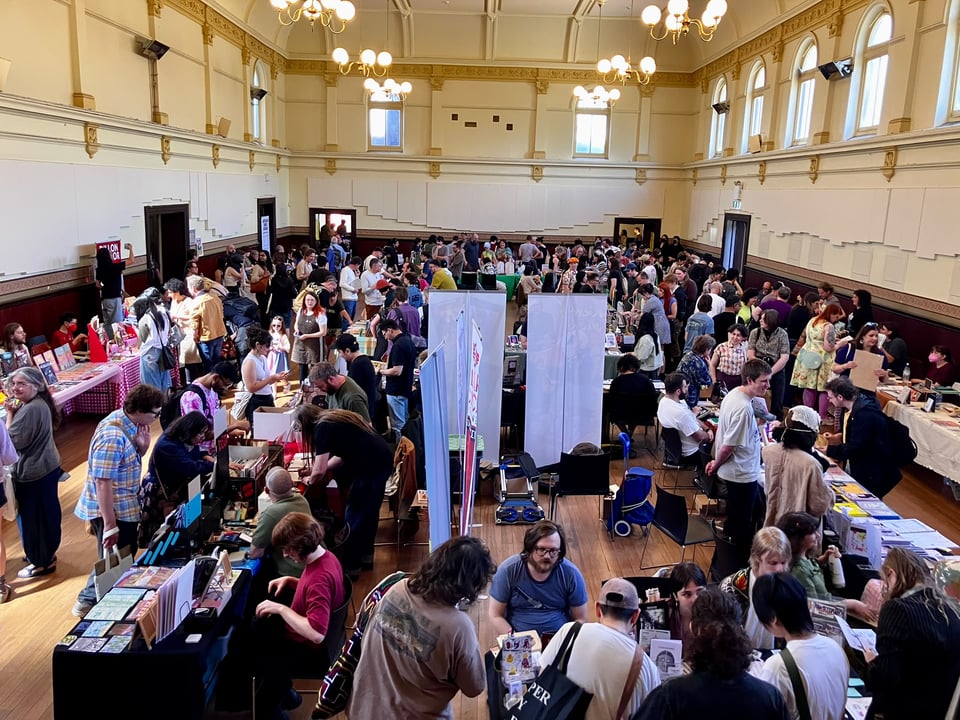
The energy and vibe of the whole weekend was incredible. Truly incredible. I’m still high in cloud nine and I’ve also had the best night of sleep since… I can’t really remember but probably since my teen days.
It’s amazing what can happen when a group of dreamers unite with a single purpose, work together as team to put MAKE something for the community and the community responds: both the comics creators and those in the community who attended the event, because without them, there’s no festival.
Now… Let’s see if I can come back down to earth and touch ground before we start thinking MAKE 2027.
That’s it from me for now. Hopefully you found something interesting. Feel free to share with whoever you like. This newsletter is free and will always be free. It’s shared with a Creative Commons BY ND licence which enables reusers to distribute, remix, adapt, and build upon the material in any medium or format for noncommercial purposes only, and only so long as attribution is given to the creator.


Add a comment: