#5: new voice, same me?
on listening for your old self
Hi and welcome to Other Kinds of Intimacy.
When you’re in a period of significant change, what’s your relationship with your old self? Do you try to hold on to who you used to be or do you turn away from it? And how do the people who know you best figure into this calculus?
This week I’m sharing a conversation I had with meg, who at the time had been on testosterone for four months. The most significant change, they told me, had been their voice. What was once high-pitched and cute, beloved for its seeming contradiction to meg’s masc appearance, was now deeper, a touch gravelly. OK, sexy voice, a friend commented upon hearing it.
meg and I met last summer in West Philly through a friend. They’re 30 and grew up in the Midwest, bald, carry their keys on a gold snake carabiner clipped to their belt loop. That summer, in between seeing psychotherapy clients, teaching, and working on their dissertation, they acted as handyman to my friend and me: snaking the drain in our shower, fixing the interminable beeping of the carbon monoxide alarms.
One night, after karaoke (during which they did not sing), they told me, with what I read as thrill, you’re the first person who’s met me with my new voice. As in, this version of meg—sexy voice meg—was the only one I knew.
It got me thinking about how unsettling and awkward it can be to change in front of people who know you well, how strange it is to be able to demarcate a new self. I wanted to talk to meg about something I’ve been wondering: Is it possible to remain intimate with our past selves?
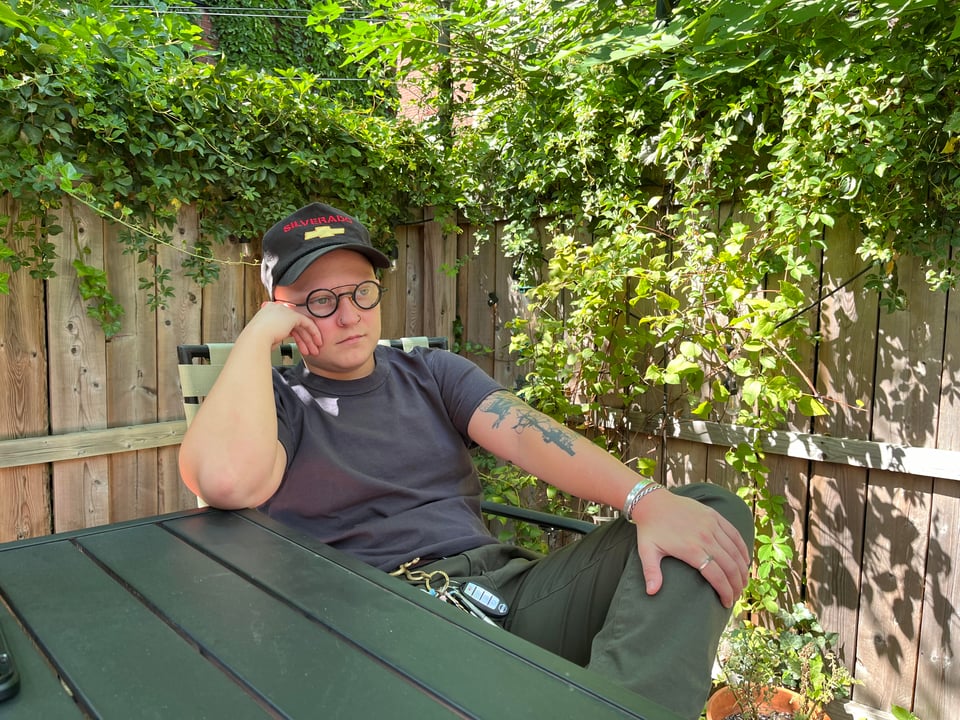
Some of what we ended up talking about: helium voice, holding parental grief, the last gasp of visible femininity, Jodeci, that friend who can get you to do anything to make them happy, and all the complicated feelings that arise when you don’t sound like yourself.
Excerpts of our convo are below.
‘I miss your sweet little voice’
People were very complimentary of my voice. They liked it. They thought it was really sweet, and they liked the shock of it.
Even [my partner] now will be like, I miss your sweet little voice. And then I’m like well, you like it now right? Because I am nervous about that because I did like the feedback that I got about my original voice.
I've been on testosterone for four months, four and a half months now, and [my voice] changed very quickly. Like within two weeks I started sounding different.
And then because of how high it was and where it's at now, it's way different to the point where my parents—I didn't tell them I started testosterone—my mom literally thought I was someone else.
When you called her?
Yeah, and I was like, “No, it's me, Mom.” And she's like, “No, it's not. I know my Megan”—she still calls me Megan—“and this is not her.” She/her-d her. And I was like, “No Mom, I swear to God it’s me.”
And so I’m slightly unrecognizable to my family and that’s a complicated thing. I didn't really have a plan about talking about testosterone with them. And I think that my voice change has been the most significant change that’s visible.
Oh, really, because the way you look didn’t change?
I look the same. I have kind of a peach fuzz ‘stache, right? But beyond that, I really look the same. Maybe my shoulders are slightly broader, but for the most part, I do look the same. And so I figured I would have more visual, physical changes. But that wasn't the thing, it was the voice. And it was a fear of mine actually, the voice.
I didn’t want to have a super high pitched trans voice where it sounds like you're kind of a teenage boy and stuck in transition mode there, you know? I forget what they call it, I think they call it helium voice.
Why didn’t you want that?
To be honest, sometimes I find the sound annoying, and I didn't want to find my own sound annoying.
‘She’s really tied to me being a girl’
Other people in my life have asked me, like, am I sick? And then I decide what to say, based on who it is. Sometimes I'll say, yeah, because I'm not ready to face the music.
What do you mean by that?
I think it's really tied to my parents. I want to have a relationship with them. I don't think that they would end the relationship with me, but I do think it would be a very painful experience for me and for them, specifically my mom, and I don't really care to hear her tears.
Are you talking specifically about being trans or being on testosterone, or all of it?
All of it. My mom doesn’t really understand that stuff. That stuff meaning trans people.
When I was 16, she walked in on me having sex with my first girlfriend, and I thought she was sleepwalking because she did that. So I was like, it's fine, like, she's probably sleepwalking. And then in the morning, she goes [yelling] Megan! And I'm like, oh, fuck, she was awake. So then, she was like, Are you gay? And I go, totally.
[cackling] No, you didn’t. You said, totally?
Well, I probably said, yes, Mom, I am. And then she started freaking out. And then I said something like, but you like Ellen DeGeneres so you can't hate me. And she was like, but Ellen's not my daughter! But she's really tied to me being a girl.
Versus you being straight?
Yeah, she eventually got over the gay stuff. It took like, two years of hell, but she got over it. Now she's like, you know, gay ally all the way. Weird. But, you know, one of the things she also said, it was like, you're not going to try to be a boy, right?
And at that point, were you not as masc? Or did she just not see?
I think it's selective, like she's choosing not to see. I'm sure I wasn't as masc as I am now, but I still very much so was, like I always wore boys clothes and what have you.
But it is very tied to the voice, because my high pitched voice was a representation of femininity, like a piece of femininity that was observable. And now I think my voice has become more ambiguous.
Wow, so in a way, it’s this last piece of femininity or something,
Especially because, again, I have alopecia, so it's all sort of connected to my physical appearance. And then the voice is the reminder that I am still a girl in her eyes. Or I am non-binary to the rest of the world.
‘My voice was something that kept me safe’
Even when I get misgendered, like he/him—I get he/him-ed by random strangers, with my old voice, when I would talk, they would say, oh, sorry. But now it's it's he/him, and then I talk and it’s no apology.
You know, in some ways, my voice was something that I felt kept me safe—r when using the bathroom, specifically public, and I didn't realize that until my voice changed.
But the thing about the voice change is that it will never go back.
And safety is whatever. At least it kept people from saying shit to me, I think. And I would intentionally start talking when I was entering a bathroom so people weren't really jarred by my physical appearance, even if I was talking to myself. Like coughing or making a sound.
But now I slither in and slither out quietly because I'm like, I don't know where to go, and I don't really use my voice now to enter. It’s not a tool. And so in some ways, it does make me feel a bit uncomfortable.
‘Can I still tell that it's me?’
I’ve avoided listening to my voice often. I guess I fear that if I'm aware of a significant change and it freaks me out, that I’ll stop [testosterone] but it doesn't really make that much sense because I really wasn't attached to my voice before. I was just so used to it for so long. But I do listen to it like, every two weeks.
What are you listening for?
I guess just to see where I'm at, like, if I can still be recognizable to myself. If it feels like something that feels OK for me.
But the thing about the voice change is that it will never go back. It’s a permanent change. If I stop testosterone completely, they say the voice is one thing that will not return, it's just because of the thickening [of the vocal cords], I guess it's hard to reverse.
I’m slightly unrecognizable to my family and that’s a complicated thing.
So obviously, I could do voice coaching or whatever, but I have kind of taken that to heart, like, this is something that's a more permanent change that I'm willing to accept.
Are you listening for a little bit of the old you?
Yeah. Like can I still tell that it's me through my voice? And in some moments, no.
What’s that like?
I think there is some grief related to the voice change, and I have a hard time distinguishing, is that mine or is that my mom's?
I'm grieving for her in some ways, the loss of this one last thing that she could hold on to. And I'm also grieving for me in the same or similar way because I wish that that weren't the dynamic, and I wish that I could be transparent with her without it being a whole emotionally draining thing for me and a devastating thing for her.
And the recognizable piece is like, can I still access the old voice? Like if I can hear part of my old self in my current voice, then I can possibly talk that way, or closer to that way, specifically when I'm addressing my parents, and I have tried to do that, and it's not that effective.
Like it’s hard?
It’s hard as fuck.
And then there’s singing. I love to sing. In my car, with friends. Not for karaoke because I’m terrified.
But now it’s physically hard to sing. The sound doesn’t come out. You know? It's like, R&B, like 2000s, late 90s. It's like, can't really get it. Jodeci? Can’t really do it.
But then, you know, I'm singing deep, deep, deep country songs now, and that's kind of fun. Actually, I did karaoke for the first time ever.
Wait, when?
At [my friend’s] bachelorette party. And that’s because she can convince me to pretty much do anything to make her happy. And she was like, Meg, I want you to be singing, and I was like, you know what, girly? Totally. I love you.
What did you sing?
Your Man, Josh Turner. A country song. I was so shy at first, but then I really embraced the deep voice. Because they were all a bunch of girlies for the most part. And I, you know, put on a show as a country dude and pointed at them, like, [singing] be your man. They loved it.
Do you think deciding to do karaoke had anything to do with you new voice?
I think perhaps I wanted to see if my voice could be received or appreciated in a way. Like none of them actually knew my voice before, except for my friend and her one friend. But that's it. So it was a new audience. It was a test to see if I could do it. And shrooms helped.
‘Wait, what? That’s me?’
My doctor said you can't build a bear before he started me on testosterone. He’s a trans guy too. He’s like, you get what you get. It's kind of a roller coaster.
Yeah, I can see that being really scary. It's like, who knows what’s gonna happen.
It's kind of jumping into deep water, not really knowing how to swim, and just seeing what happens, and accepting. It's like a continual acceptance of what is happening.
I've talked about a lot of things that can be perceived as negative, but I do think it's a fun surprise. This whole idea of like, wait, what? That's me? No way.
Like learning a new version of yourself, meeting a new you.
Yeah, like, holy shit. That's me. Rolling with the punches. Gambling. So it is kind of like a joy ride, a thrill for me, coming into something that I don't know what I'm coming into.
Thanks for reading.
Till Sunday again,
Juliana

Add a comment: