
Book review: Stylish Academic Writing (Sword, 2012)
Don't take this the wrong way, but y'all need this book. I guess w'all need this book. Helen Sword's Stylish Academic Writing, reviewed.
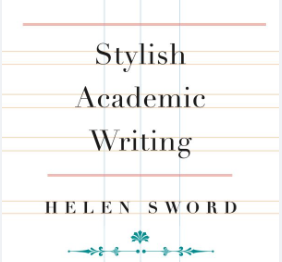
Design: Jill Breitbarth -- Credit: Harvard University Press
The University's library has got two seasonal displays, where they showcase selections of books, which change regularly. It's mostly the seasons of the university, although a couple of holidays get a nod. There's all your this history months, and that celebration weeks; we have a lot of placement based, 'clinical' programmes (teaching, nursing, physical and mental therapies), which start staggered before the hoi poloi Fresher's Week, so they each get their week in September. Art therapists week turned me on Joan Chodorow's edited Jung on Active Imagination (1997), which was, as anticipated, a trip.
There's a display at the bottom of the stairs, then one across from them when they reach the first floor. Interestingly, the former is just an open, tiered stand, so I was able to flick through the Jung and Chodorow (1997) before going to find a copy to borrow; the latter, however, is behind glass. I guess it isn't in the line of sight of the library advisor's station, and students are animals, but then again that station hasn't been staffed by default for a good couple of years.
The glassed display is, I think, changed less often, and its content less casual. The kind of text where an interested student will be willing to go find a copy in the stacks if they're interested. So there's a lot of study skills. Which means two floors up and the back of the building just for a flick-through.
But when I saw the cover of Helen Sword's Stylish Academic Writing (2012) - an elegant design by Jill Breitbarth (Jailbroken), I immediately went up the two floors to borrow a copy. Not that my academic writing lacks style, in fact, I'd humblebrag I have the opposite problem. So I was up for a little precis of the Elements, for the 21st century.
I was not disappointed.
By the time I'd borrowed it, I knew already the book was gravid with examples of bad writing from the published literature, which I think is what sold me on the text. I was expecting to have a good time because, in many a domain, a rarely acknowledged joy of any practice is to throw shade on bad practice. Often, more cruelly, on bad practitioners. But I wasn't expecting to be outright impressed.
When I picked up the book for what I thought was a scan, I'd quickly worked my way through two and a half chapters before realising Sword had worked on me the exact magic she preaches: that of making reading easy and enjoyable for the reader, through style.
The introduction makes the powerful point that it is a moral duty to the readership of academic literature to make the prose as enjoyable to read as possible, and from the beginning there is a sprinkle of tragically hilarious examples of very unstylish academic writing. Interestingly, it start with three back to back, and I thought the last one was the counter example... But it wasn't, it just made sense to me, cause it was clearly paragraph about Higher Education. Oof. From this point on I'm reading thinking maybe my writing is not as stylish as I presume, I just use words like "constructive alignment".
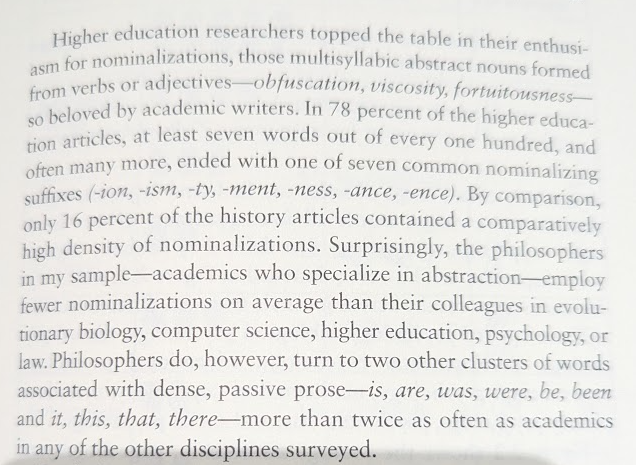
Then there are two chapters of empirical work. In the first, she has sampled literature from respectable journals across an array of fields (although not always an array of journals in the field), then did some pretty nifty bibliometrics re: author count, word count, references count, instances of the passive voice, first person (singular and plural), sentence length, action verbs, concrete nouns, etc... It's better in some fields than others, and Higher Education is the absolute worst by a country Kilometer sixty. Not any/all Education, specifically Higher Education, and actually, as above, from a single journal, so there's hope. Still. Not a vote of confidence.
The second chapter looks at published style guides, again with transparent, solid method, indexing points on which they all agree, those of dissent, etc. She boils it down to a set of bullet points, most of which I was relieved to find I tick:
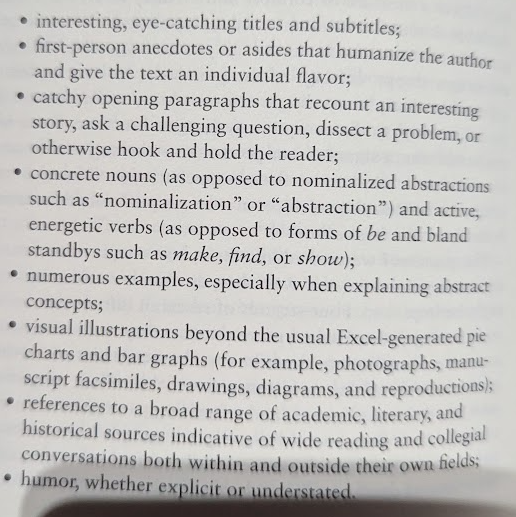
I am missing some important ones: I am an absolute sucker for nominalisation, so clearly I am cut out for the field of HE Studies. And I guess I think one example enough to illustrate my loathsome nominalised abstractions. 'Constructive alignment' is when you teach to the test, but somehow manage to spin this not only as right, but necessary, the only correct thing to do. Is that anything? I feel I'm not selling it? Put like that, I guess I see why Higher Education research probably stays away from examples.
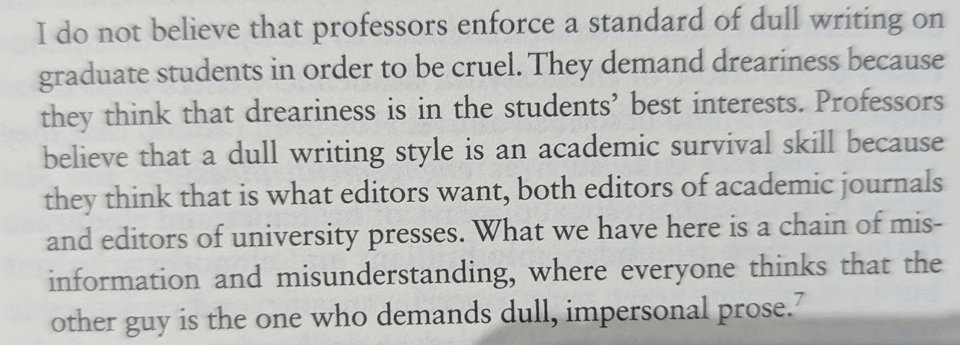
The first piece of work I handed in at Roe, my first time there, got 87/100, which prompted me to immediately recalibrate my effort gauge and increasingly lowball the rest of the PGCE, as the teaching load was growing. Miles Berry, who graded it, is forever warning me he enjoys my writing, but that maybe not everyone would. I hope he was referring to too much explicit humour rather than the first three items of the above. But then all subsequent work, graded by 3 different academics, also scored above 82. I'm not flexing, I hold this up as evidence the system is broken, but I've moved from impostor syndrome to charlatan syndrome and I'm willing to exploit it. But I'm sure these other graders may share Miles's reservations. Because, as per Patricia Limerick's 1993 NYT essay (jailbroken):
The rest of the book is a style guide, going over the bullet points in chapters, with examples of good, as well as bad. I've yet to come across an effort to rephrase the bad so they're good, then likely in most cases one would need disciplinary knowledge, and it's not Sword's job. It's all beautifully tied together: the chapter on opening hooks opens with the incipit of Hunter S. Thompson's Fear and Loathing in Las Vegas, which she compares to the introduction of a neuroscience paper on these two emotions, slightly adapted from an actual one on fear and anger: the aforementioned broad range of academic and literary sources. It's this kind of thing, all the way through, I cannot recommend it enough, although here, 1500 words (incl. quotes) probably is enough.
Go be stylish, my other guy.
References
Jung, C. G. (1997). Jung on Active Imagination (J. Chodorow, Ed.). Princeton University Press. https://doi.org/10.2307/j.ctv3f8rg4
Sword, Helen. Stylish Academic Writing. Harvard University Press, 2012. http://www.jstor.org/stable/j.ctt2jbw8b