
First of all and most importantly, have you seen the video of the cat who joined the final scene of a ballet performance of Romeo and Juliet?
The cat has nothing to do with the subject I want to talk about today, but it brought me joy.
Another staging of the story has made me scratch my head a little. A current Shakespeare in the Park production puts immigrants on one side of the feud and anti-immigrant state violence on the other; I have not seen the production and perhaps it’s great, but I am wary of the approach. I have no problem with political readings of R&J, and in fact I think it’s difficult to read the play as anything but political (I will get to that in a minute), but stagings that randomly assign the Montagues and Capulets to sides in real modern conflicts (or worse, genocides) that are not rich-family feuds often end up incoherent or worse. The rich-family feud part is important! Shakespeare’s play deliberately does not care about the reasons for the feud and goes out of its way to show that the two sides are equal in power and wealth. Nobody thinks “if only border agents and immigrants would bury the hatchet, I mean, who even remembers what they were arguing about.” That would be grotesque, frankly.1
While I was reading about this production, I happened on a lot of comments online to the effect that Romeo and Juliet is “not political” because it is, instead, “a love story”, as if those two things were opposed. Sometimes people tell me R&J is their least favourite play because it’s “just a romance” and an unrealistic, melodramatic one at that.
It isn’t my intention here to dunk on this opinion, which is a common one. I can see where it comes from, and I firmly believe that Shakespeare’s work is big enough and resilient enough to admit many interpretations and approaches. But I do not see Romeo and Juliet that way at all, so I thought I’d dig into that in this week’s newsletter.
What could be more political than a love story?
I’ve been living very closely with R&J for the last few years as I was working on my novel Mercutio — and not only with R&J itself, but with Shakespeare’s sources and the historical context.
The play was written in the early 1590s, and became very popular during Shakespeare’s lifetime. I’m not reading in any allegories, but it’s worth remembering that it was written at the height of the wars of religion across much of Europe, and cities such as Paris were repeatedly torn apart by sectarian, internecine conflict, neighbour against neighbour, spurred on by the ambitions and rivalries of the powerful. City-street factional violence involving and affecting different classes in different ways was, to a large extent, the matter of “politics”, if we can put it that way, in the 1590s.
The story itself comes from earlier sources. Dante refers to the Montagues and Capulets in the Divine Comedy, which was written in the early 1300s, so nearly three centuries before Shakespeare. Dante himself spent time in Verona, probably twice, and the first period was likely during the tenure of Bartolomeo della Scala, the lord of Verona in the early years of the 14th century.
This puts Dante in Verona during the time when we traditionally suppose Romeo and Juliet to have lived. (This is why my novel takes place around 1300 with Dante as a central character, a choice that has confused some readers who were expecting Elizabethan vibes. Sorry!)
Bartolomeo della Scala, or possibly another member of his dynasty, is probably the “Prince Escalus” of Romeo and Juliet. Like the Prince, Bartolomeo was very occupied with trying to keep the peace in Verona between feuding factions. The great conflict of Dante’s age was between the Guelphs and Ghibellines, a feud led by powerful families that started as a very specific political dispute but took root and grew into something more complex, taking on a different (but always violent) character in different cities and regions, as generations passed and lost touch with the original reason for the fight.
In Dante’s Florence, the civic authorities (basically the artisan and merchant class, although I am oversimplifying) were constantly in conflict with rich and powerful families who were notorious for bringing their petty but bloody rivalries into the city streets (between Guelph and Ghibelline, and then between different factions of Guelph, which is what got Dante exiled). The story of politics in Florence and other Italian city-states during the time of the Montagues and Capulets is a story of the people trying to protect themselves (often literally) from the violent feuds fomented by wealthy families.
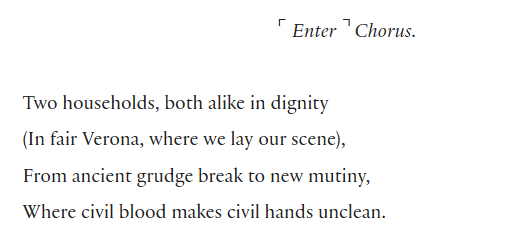
Shakespeare used the word “civil” at different times to mean “cultured and refined”, “pertaining to civil conflict” and/or “pertaining to civic matters and cities”, so the phrase “civil blood makes civil hands unclean” is using all three meanings to play on the fact that it’s the fancy folks who are doing the violence in, and to, the city.2 He goes out of his way right in the prologue to tell us that the problem is the behaviour of certain wealthy families the law can’t constrain, and then he tells us that over and over again. This is his explicit theme! (One of them, anyway.)
The play is not interested in the nature of the conflict between the Montagues and Capulets, which is left unexplained beyond an “ancient grudge.” At several points, the play reminds us that both sides are equally guilty. There is no good guy and bad guy to choose from between them.
The central and much more interesting conflict of the play is actually between the Montagues and Capulets and everyone else, who are both drawn into the violence on one side or the other, and continually damaged by it.
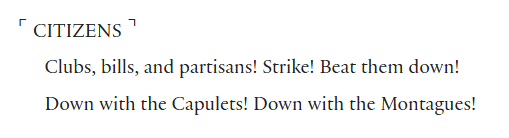
The law (represented by the Prince), over and over and with increasing frustration, forbids the two households from acting as if they can do whatever they want in the city streets, but the two households are too rich to care and have assembled gangs of young men who have been told, implicitly or otherwise, that the law does not apply to them.
There is a structural power dynamic at play, not between the two houses who are “alike in dignity”, but between the patriarchs and those under their control, who have been drawn into the conflict not because they share any part in the “ancient grudge” but because it’s basically their job.

The Montague/Capulet feud recruits young men into violence and uses them up like cannon fodder. Mercutio’s curse at the moment of his death is an epiphany for him and a lesson for the audience:
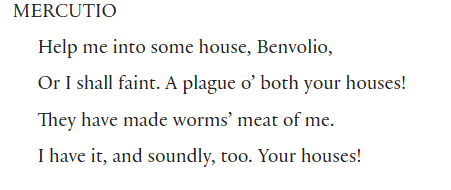
What makes it brilliant is that Mercutio himself picked the fight, which is one of the most nuanced and interesting political aspects of the play: the light it shines on youth, the impulsive energy of which can be harnessed by the establishment, but which can quickly turn against it and threaten power structures.
Franco Zefferelli’s Romeo & Juliet came out in 1968, the year in which a counterculture youth movement swept across much of the world, largely in protest of conflicts created by the powerful in which young people were being sent to die. Again, I don’t want to press the parallel too much or ask too much of Zefferelli’s politics, but it would be very strange if a movie about young people defying their parents’ violent power struggles in 1968 didn’t carry certain resonances for its audience.
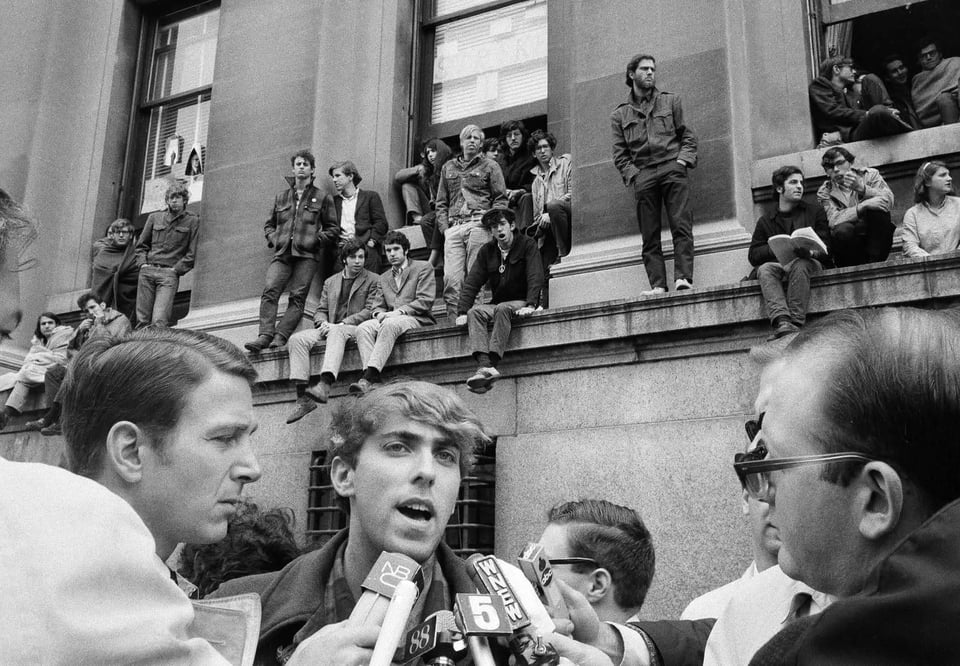
Zefferelli’s film has several amazing street scenes showing the young men on both sides of the feud strutting around or lounging on walls and stairs, establishing ownership over their territory, and making their elders feel uncomfortable. Mercutio relishes this power more than any of them — possibly because he’s not quite as young as his friends, at least in this film and in the 1996 Baz Luhrmann film (which I think was a good casting choice in both cases). He’s old enough to recognize the power of youth and feel it slipping away from him, feel himself becoming not quite appropriate for his age, as he is not quite appropriate in so many ways. Maybe he’s deluding himself about the fact that he’s entering his own establishment years.
I don’t think Romeo and Juliet is an indictment of the follies of youth, although I’ve seen that opinion many times. The young people — whether it’s Mercutio with his wit, or Romeo and Juliet with their innocence — shame the older generations into finally making peace. Young people have been trying to shame their elders into not being merchants of death for a very long time, and they are doing so today on university campuses. As the bard said:
Come mothers and fathers
Throughout the land
And don’t criticize
What you can’t understand
Your sons and your daughters
Are beyond your command
Your old road is rapidly agin’
For me, it’s the love story that’s always been somewhat, well, secondary to what I find interesting in the play. I don’t mean to denigrate any love story, least of all one that has so much cultural weight that the “Darmok’ episode of Star Trek: The Next Generation uses “Juliet, on her balcony” as a unit of language. It is the love story, and the question of who is allowed to love, that drives the play. But what interests me is how that love story allows Shakespeare to ask “what would it take to force the powerful to stop feeding on violence?”
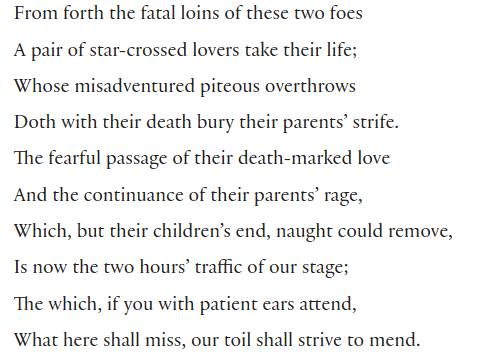
That’s why it doesn’t really matter that Juliet could have just snuck away with Romeo, or that the whole plot hinges on a delayed letter, or that Friar Lawrence makes infuriating choices, or any of the other things that bother people about the play. It’s not about whether these two crazy kids will make it (Shakespeare tells us in the prologue that they’re not going to.) It’s about how their tragedy puts an end to the bloodshed:
A few newsletters ago, I wrote about why I like to go back to a story’s origins when I write retellings. While I don’t think this is the only way to do things, it’s a way that I personally find productive. I don’t think you have to be thinking about the historical context of Italian city-state politics in the 13th and 14th centuries to appreciate or judge Romeo and Juliet. I certainly don’t think it’s useful to do a little box-ticking exercise trying to create a canonical checklist about what a play “means.” But I find that thinking about the history in historical fiction (remember Romeo and Juliet was a retelling of older stories) can help us ask more interesting questions, to move beyond “it’s bad when people don’t get along” or “I don’t like the instalove trope” (I actually came across that as a dismissive criticism of Romeo and Juliet on this here internet once, and you know what? Fair! Dislike what you want to dislike for whatever reasons you want to dislike it.)
I think R&J is a fascinating play, and stands among Shakespeare’s best. Spending many, many hours with it over the last few years has not dimmed my enthusiasm for it in the slightest. And yeah, it’s chock full of politics. (And I didn’t even get into the politics of gender, marriage and sexuality in R&J here, or the politics of destiny and free will…)
If you’re interested in this area of Shakespeare interpretation, the Bard in the Borderlands anthology examines how the play can be interpreted within current US border politics, and the potential pitfalls of doing so. ↩
See Shakespeare’s Words, by David Crystal and Ben Crystal. ↩
You just read issue #63 of Kate Heartfield's Newsletter. You can also browse the full archives of this newsletter.