
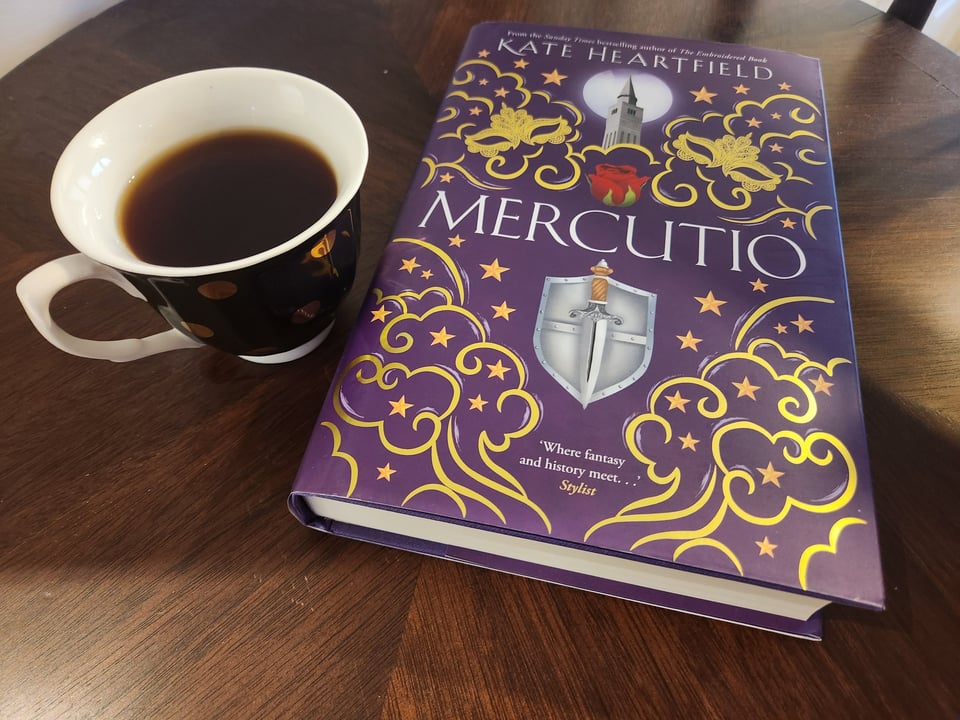
He’s arrived! Mercutio is on bookstore shelves in the UK as of yesterday. The audiobook narrated by Maxim Reston is also out worldwide, and the ebook is also available in some parts of the world, including the U.S. Here in Canada, Mercutio will be in bookstores in August, but you can pre-order from your favourite bookstore now. I have a page on my website with more info about the book, including its back-cover copy and very kind endorsements.
I know it’s frustrating that it doesn’t release to all territories at once, but I do have a small compensation: I’ve got some author copies to give away! If you’d like a signed copy mailed to you anywhere in the world (my treat), just enter your name and email on this form. I’ll use a random number generator to select a few winners on Sunday, May 10 at noon ET, and I’ll let you know by email if you’re among them and I’ll get your mailing address and personalization requests at that point. Anywhere in the world is fine.
This novel takes an approach to retelling that seems to be a favourite mode of mine (and which I have learned is slightly risky, because it does not necessarily recreate the familiar vibes of the best known version). I look at all the extant versions of a story, and then I speculate into existence one possible now-lost "original" that would explain how the elements of all versions (even the contradictory elements) came to be.
For example, in Mercutio, we learn why our man has perpetually cold hands. Shakespeare never said Mercutio had cold hands, but Luigi Da Porto did, in his Giulietta e Romeo, about a half century before Shakespeare. This is also why my Mercutio is medieval – the story was already historical fiction in Shakespeare's day.
I also did this in The Valkyrie, coming up with an early version of Brynhild's story that I could imagine leading to all the others, in a centuries-long game of telephone. The story under the story, so to speak.
One reason this is slightly risky is that most people who do know a story don't know all versions of that story, of course – why would they? So most readers are not going to catch all or even most of the little “ah-ha” moments in Mercutio or The Valkyrie, and the books have to work well on their own. Some readers might go in expecting a remix or continuation of the version they know best, and maybe they’ll enjoy being surprised by what I’m doing instead, and maybe they won’t.
But I like gathering the threads of a story tradition and weaving them all into something new. It feels to me like honouring the past tellers by keeping all their versions in active conversation, and like a kind of archaeology, going down through all the layers.
The usual reason I am drawn to retell a story in the first place is that there is some mystery or gap, something that tells me "that can't be the whole story — there must be something that we’ve lost."
I have always felt that shiver when I read stories of Rumpelstiltskin — or Tom-Tit-Tot, the version retold wonderfully by Susanna Clarke in her story “On Lickerish Hill”, which is in Ladies of Grace Adieu and Other Stories. My own Rumpelstiltskin story is “I Know All of His Names”, which, although one of my favourites among my stories, still hasn’t totally scratched that itch for me. Another one that has been under my skin since I was a kid is the Pied Piper of Hamelin, and maybe one day I’ll do a Pied Piper story or book. (If you watch very closely in Mercutio, you might spot a version of him…)
So going back through the antecedents is part of me trying to figure out why a story got under my skin — by which I mean it spooked me a bit, made me half-see forgotten stories in the shadows. I rummage through the story’s history like an old trunk in the attic, and every time I find something that gives me that same shiver, I put it into my pocket, and by the end I have a little collection of things that I can imagine a lost story about.
This is of course not the only way to do a retelling. I love many retellings that pull themes out of a work and apply them in new “what-ifs”, speculating from a different direction (such as, to take one example, Hamlet, Prince of Robots by my friend M. Darusha Wehm). But this digging in the roots is something I feel compelled to do, and while it’s not for everyone, some readers like that it "feels real", like they can almost believe this secret lost story happened. (I took a similar "what if this secret history could explain everything?" approach to retelling the true-ish histories of Marie Antoinette in The Embroidered Book — just as “I Know All of His Names” retells not only the Rumpelstiltskin story but also the half-legendary history of a bad woman.)
Like every nose-in-a-book kid, I always hoped I’d find a dusty tome in the back of a bookshop that would take me on an adventure, like Pidge in The Hounds of the Morrigan or Bastian in The Neverending Story. I suppose one reason I write retellings the way that I do is that I’m creating that book for the kid that I was — creating the secret volume that tells the forgotten story.
I get that kind of shiver of finding a true lost story from Gregory Maguire's work, which had a big influence on how I approach my own retellings. I don’t think Maguire is necessarily as concerned as I am with excavating the oldest versions of things, but Wicked, for example, is not a remix of The Wizard of Oz so much as it is a building up and underneath and around it, in a way that allows both book and movie (the Wizard of Oz ones, I mean) to be plausible offshoot tales about what really happened, or at least, that’s the way I read it.
A bit of news to close off with: I’ll be a guest at the Stratford Festival in Ontario in September, talking with Chester Scoville about fairies. (It is difficult to think of many things that could bring me more pleasure than talking on stage about fairies at the Stratford Festival. This is very much one of the things that I would like to go back and tell 12-year-old Kate about.) If you’ve never been to the Stratford Festival, I highly recommend making the trip, and if you can do it Sept. 24, I’ll see you there.
In the meantime, I hope you enjoy Mercutio if you have a copy, and don’t forget to enter the draw for the giveaway, and request the book from your library when you can, and if you do read it and like it, please tell a friend and/or leave a review. I also love to see photos of the book on shelves, and I’d love to know what people think of the audiobook!
You just read issue #60 of Kate Heartfield's Newsletter. You can also browse the full archives of this newsletter.