The drought that killed nobody
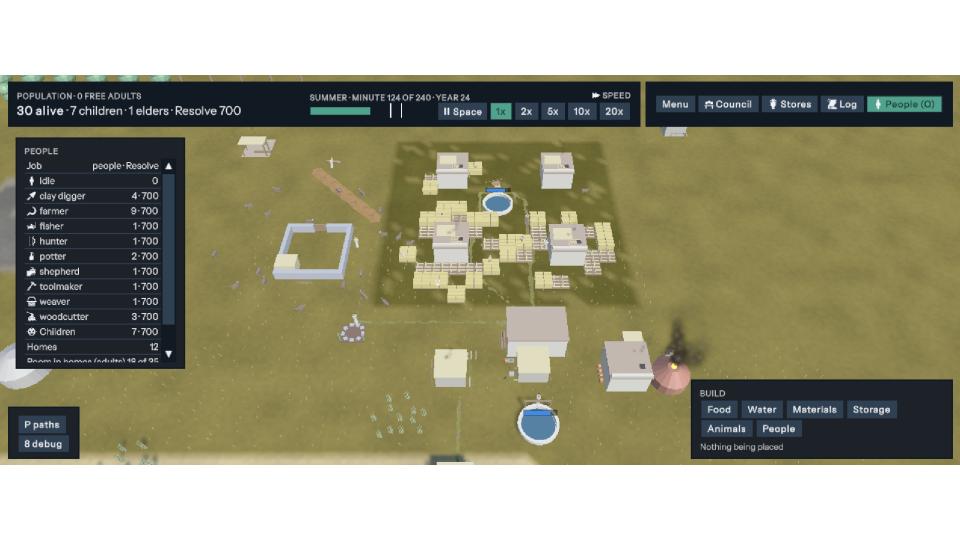
This is Collapse: The Aegean Expanse, a city-builder / disaster survivor set in Bronze Age Crete, in the centuries before the palace world fell apart around 1177 BC. It’s still a grey box: plain shapes, but every one at true scale, and nothing teleports. Every jug of water is carried by someone, on foot.
The game has three arcs:
1. The Founding,
2. Peak Civilization and
3. The Collapse. Each carries a different focus.
Last week I played the first version with all three arcs, about four hours long in total now: four settlers and a spring at the start, a village of thirty-odd people by the end, and a drought in the last hour. I built four farmhouses in a ring round one cistern, everything within fifteen metres of it. No well at all.
It worked far too well. Thirty-four people were alive at the end, and the drought took nobody. The idea is that this should be really hard. So changes are needed.
The reason was a mistake in scale. In the game a year passes in five minutes, so everything people use is squeezed to fit, but the rain wasn’t: a cistern caught a real winter’s rain. One normal winter put more than two hundred years of the village’s drinking water into it. No drought could touch that.
Fixing the number was easy. The harder question was what a drought should feel like, and what the people who actually lived there did about it. So I went back to the archaeological records.
The Minoans didn’t only store rain. In the hills near Zakros, in eastern Crete, they built low stone walls across dry stream beds: check dams. One at Choiromandres is 27 metres long. In winter the floods slowed behind the walls, dropped their soil and soaked into the ground. They kept the terraces moist, they fed the springs and wells below, and the small ponds behind them watered the animals. It’s a way of fighting drought with the whole landscape rather than one cistern.
So that’s what the game has now:
Two dry streams run from the hills past the village to the sea. They’re slow to cross.
You can build check dams across them. A dam holds a pond for the animals, keeps the wells below it alive when the rain fails (which it will, many times), turns the strip beside the stream into moist farmland, and its top is the easy way across.
A failing well can be dug deeper.
Crops now follow the rain: a failed winter costs about a third of the harvest.Every ten years a trading ship calls, and it sells donkeys. A donkey with four jugs saves a lot of walking, and it’s drought tolerant.
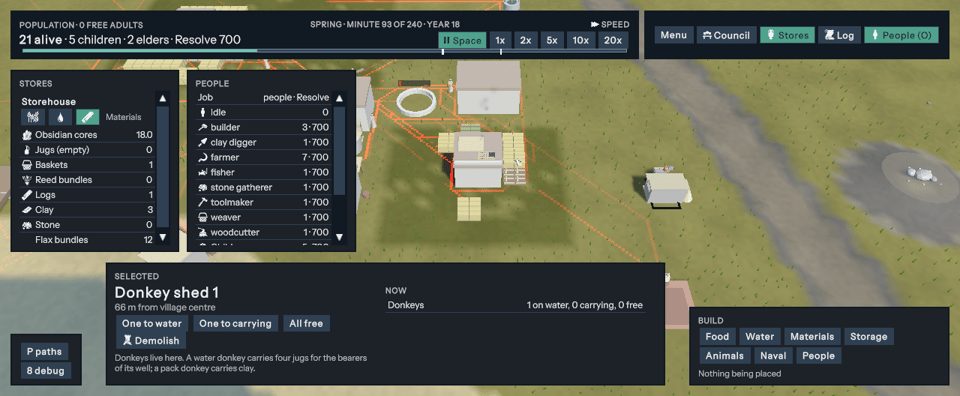
Next: two droughts instead of one, each two years long, five years apart, so a village that just scrapes through the first has to rebuild before the second. Gutters on the roofs and stone channels that you draw yourself.
Right now I’m working on balancing different ways of handling water and testing different water management strategies: wells only, deepened wells, donkeys, cisterns and channels, dams, and a mix. I’m waiting to see which ones carry a village through both droughts. My guess is that none of them does it alone, since I have now upped the drought significantly. Will I survive the collapse this time? Only time will tell.
If you’d like to follow along, sign up at hardpangames.com. I’ll write when there’s something real to show, and nothing else.
Kris, Hardpan Games