![[Indistinct Chatter] logo](https://assets.buttondown.email/images/6151609f-9740-4849-8e12-fa40bef93ca6.JPG)
[IC]#4 / The Horses, They Understand

Long Take,
I would like to start with an apology to my colleague Carl, for it is he who recommended the Weatherdrive [IC#2] to me. Sorry Carl. It was my colleague Andy who corrected me after he read last month’s newsletter where I waxed lyrical about Andy’s recommendation of the band Westside Cowboy [IC#3]. Carl had also recommended the Weatherdrive to him. That out of the way let’s get into this month’s nonsense, whose title comes from a quote in a book I started late Feb on my London trip, and finished this month, Anne McKnight’s translation of Long Take, a collection of essays by Akira Kurosawa, and his daughter, and a collection of interviews with the Japanese filmmaker. To note; the quote, that gives this month’s newsletter its title is not an AK quote, but from the writer Inoue Hisashi talking about Seven Samurai (1954) in one of the book’s splendid conversations.
I wanted to read the book because Kurosawa’s daughter Kazuko collected her Father’s thoughts on 100 films. What was particularly enlightening for me was how those thoughts were on films that ranged across a wide span of time, from D.W. Griffith’s Broken Blossoms (1919) to Kitano Takeshi’s Hana-Bi (1997), released not long before Kurosawa’s death. I realised I had presumed, ignorantly, that the films that mattered to the filmmaker, the ones he would have focused on when discussing cinema, would be from his formative period and confined to the ‘classics’ and the ‘canon’ that emerged before and during his celebrated 1940s to 1950s peak, at least in terms of Global cinema. I was delighted to be proved wrong, and to learn he was a cinephile like myself, always looking for the great in the now, never confined to suffocating ideas that all the best stuff is behind us.

Who You Go With: a List in Response,
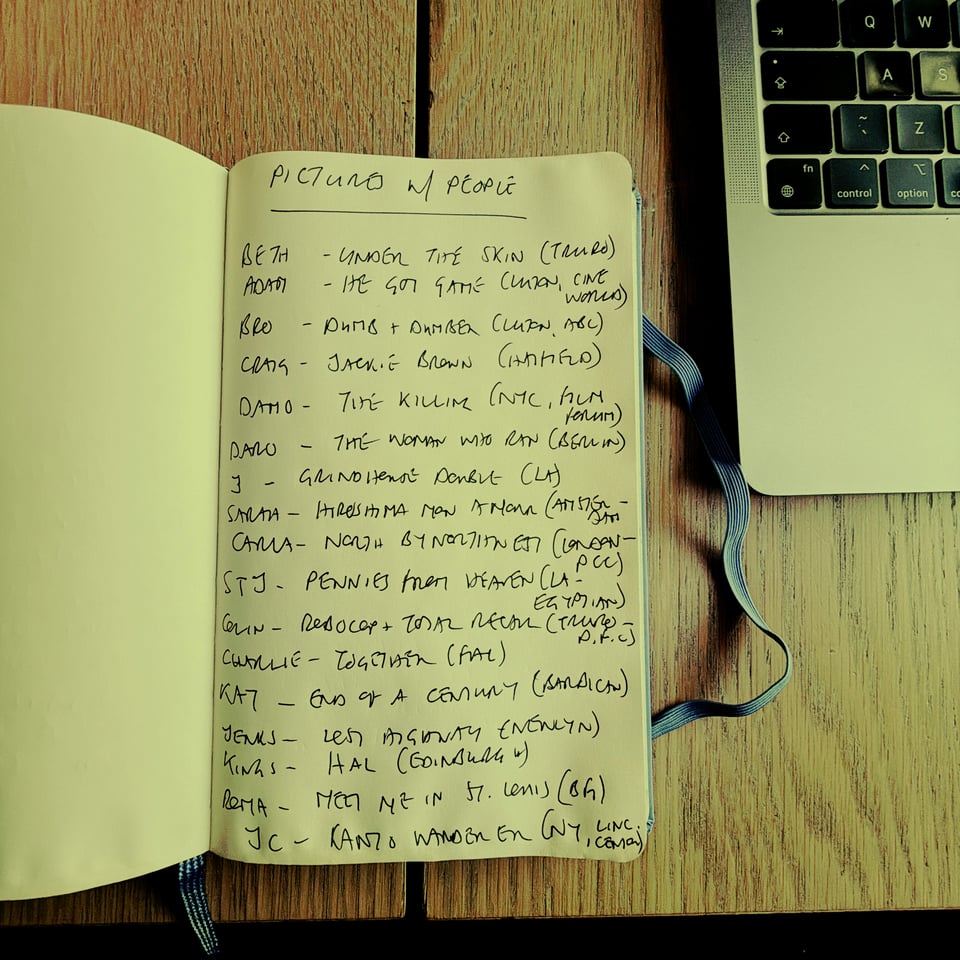
I thoroughly enjoyed Dario’s two-parter [Part 1, Part 2] over on his Substack, looking at the cinematic experience through the lens of choosing where to sit in an auditorium. I read part two early in March and it led me to reflect on my own choices on where to sit in different auditoriums I frequent and also what governs my choice in an unfamiliar space [and also how early I get somewhere I don’t know that has unreserved seating]. Among the things I reflected on that Dario didn’t touch on too deeply was the experience of seeing films with different people you know. Whenever I think of each of these films I think of these people, and the cinemas I saw the film in. Who you watch with has an impact I think, for me at least. I had a lovely time letting memories of specific films in specific cinemas with specific people drift into my mind. While for many of the people listed above, there are many memorable cinematic experiences to savour, I decided to pick the first film that came to mind when allowing these thoughts to rise up. It’s not exhaustive and is limited in nearly all cases to films watched in a pair, as opposed to groups. I also may have cheated a bit so that most cinemas are only mentioned once [save Truro Plaza].
BBC Sounds: 6Music Artist in Residence - Kelly Lee Owens

I often panic when I check BBC Sounds for shows/series I like. I was thrilled to see that Kelly Lee Owens, an electronic musician who is one of my favourite artists to emerge in the last decade, had curated a set of shows for 6music. This thrill turned to anxiety, a common shift for me, when I saw that the oldest show of the 4 had only 20 days listening left! Argh! How will I fit 4 hours of listening in the next 20 days to make sure I get through all the shows while they are still available? I know. A completely irrational fear. And fear may be too strong a word. It undeniably is. Even so, I screen-shotted all the track-listings in case. So I could listen later to what Kelly had picked, if I needed to. I did not need to.
Unfamiliar Sounds: Craven Faults
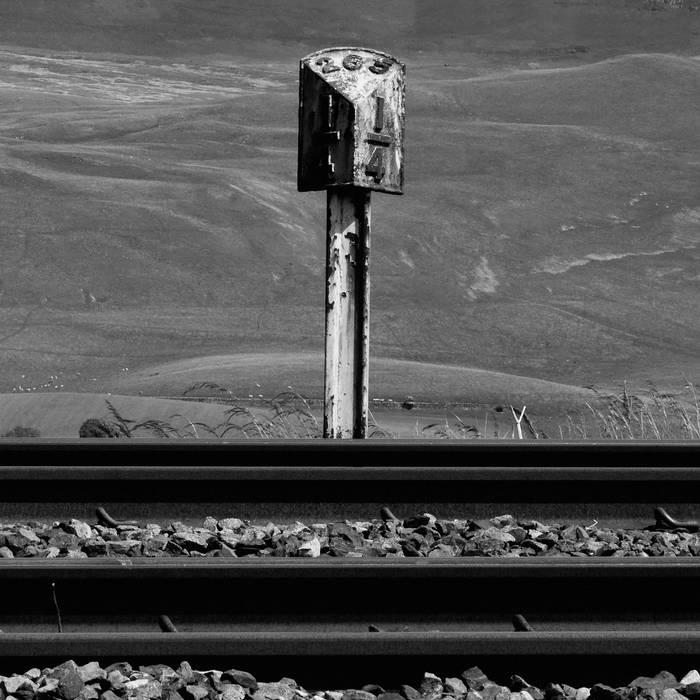
I tried, I really did, to like February’s Kosmos Klub offering, the compilation Elders of the Begena: The Harp of David in Ethiopia. I think I found a limit on my curiosity and experimental taste. This month normal service was well and truly resumed. This month’s album is a 2026 release so it’s become one of my favourite records of the year so far [see also Dry Cleaning, Bill Callahan, The Orielles and in first place Joshua Idehen].
This record is stunning though. There’s an epic scope in the way it moves forward consistently in the ways that all good Kosmiche/Krautrock that I like does. But there’s a tenderness and a sensuality to it that surprised me. A tactility and texture and other T words that has drawn me back and back to it already. There’s a comfort for me in inhabiting the space the music provides. The songs are long, and repetitive, but also nuanced in the way elements dance around central rhythms. It’s been a solace and a source of centering a lot for me this month.
Unfamiliar Images: Wo ai chu fang (Kitchen)

This month’s completely unfamiliar watch [unfamiliar title and filmmaker] came courtesy of my friend Stephanie [thanks Stephanie!] through who, via conversations about this film, I discovered the website RareFilmm where a copy of this film resides. [Weirdly, the day after discovering this site my friend Kat linked me to an Elio Petri film on the very same site, which I write about below]. I am not sure of the provenance of the films on the site, but as far as I can tell they are unable to stream anywhere that’s not a Russian YouTube channel, so I have no compunction watching it here given I can’t stream it via a paid means.
The film is fuzzy, with soft contours that matches its mostly gentle tone. The fact that the version I saw was clearly uploaded from DVD helped this feeling. It feels very 90s, and very much in thrall to one of the leading figures of Hong Kong cinema [did I sat the film was from HK yet?], Wong Kar-wai [as well as in a moment or two, Tarantino]. As in, it lacks a visual style that feels like it is its own. It’s enjoyable, and I am grateful to know of it and have seen it, but it didn’t blow me away. This was true of most of my film watching this month. With a lot of my viewing I was drifting off to think of other films. I rarely mind that.
I love it when the film I’m watching feels in intentional [if not conscious] dialogue with other films. And, particularly at home, the drifting off to other movies can often be pleasurable. A long-standing and less morally dubious version of second-screening? I rarely resent the film I’m watching for that experience, unless it feels like it’s telling me, shouting at me, of its uniqueness. Wo ai chu fang isn’t like that. This film doesn’t shout. Even its moments of darkness, and occasional flourishes of expressionism, are dealt with carefully. And all in an uber 90s blue hue.
Familiar//Unfamiliar
An interesting feature of this month was some viewing that sat in a fascinating juncture between familiar and unfamiliar, in that I discovered and watched films I was unfamiliar with, by filmmakers I was. In quick succession, via the JustWatch app, I learned of films I was unaware of previously directed by Basil Dearden, Jules Dassin and Claude Chabrol that had just landed on Amazon Prime. In addition there was the aforementioned recommendation by Kat, an Elio Petri film, and I also added in a Mario Bava flick (Prime), because why not. All bar the Petri I learned of via Just Watch. Most of them had eerie thematic connections, and two delightfully starred Anthony Perkins, a favourite of mine.
The first three I watched, the three I learned about in quickest succession, were the Chabrol, the Dearden and the Dassin. All three were murky, Gothic family mysteries. All had some morally dubious and/or scuzzy relational dynamics that were at the heart of the dramas. In Woman of Straw (Dearden, 1964) Sean Connery plays the nephew of a supremely racist and nasty Ralph Richardson, who he is trying to swindle out of his money by bumping him off with the help of Richardson’s beautiful nurse, played by Gina Lollobrigida. I wondered why this film has been forgotten or neglected because it’s a rollicking pot boiler. Dearden is a fantastic filmmaker.
I imagine though it’s the racism that is the factor. Which is interesting if so, because I think Dearden is a brilliant chronicler of race issues. His 1951 film Pool of London with Earl Cameron and Sapphire (1959) are testament to that. And he always handled social issues adeptly, including homophobia and hate crime in my favourite film of his, and one of my favourite British films of all time, Victim (1961) starring Dirk Bogarde. I wonder if it’s because of how caustic the character of Richardson is. He’s a truly deplorable colonialist and racist, but the film makes racial politics part of the thematic drive of the film, with Connery undone by a quieter but no less poisonous form of racism compared to Richardson’s boorish, privileged exaltations, used to justify his demise, but also to shine light on Connery’s character’s nefarious side.
The Chabrol, 1971’s Ten Days Wonder, is a family drama rife with religiosity, again about wealth, power and indignation, this time starring Orson Welles as a grizzly patriarch, overseeing the life of his adopted son, played by Perkins. Welles hires Michel Piccoli to figure out what is ‘wrong’ with Perkins, only for it to be revealed (unsurprisingly) that his adopted son is in love with Welles’s new hot young wife. Welles is worried because Perkins keeps waking up in strange places covered in blood and with no memory of how it happened. The film, and the transfer on Amazon Prime, have fuzzy contours and it’s a hoot.
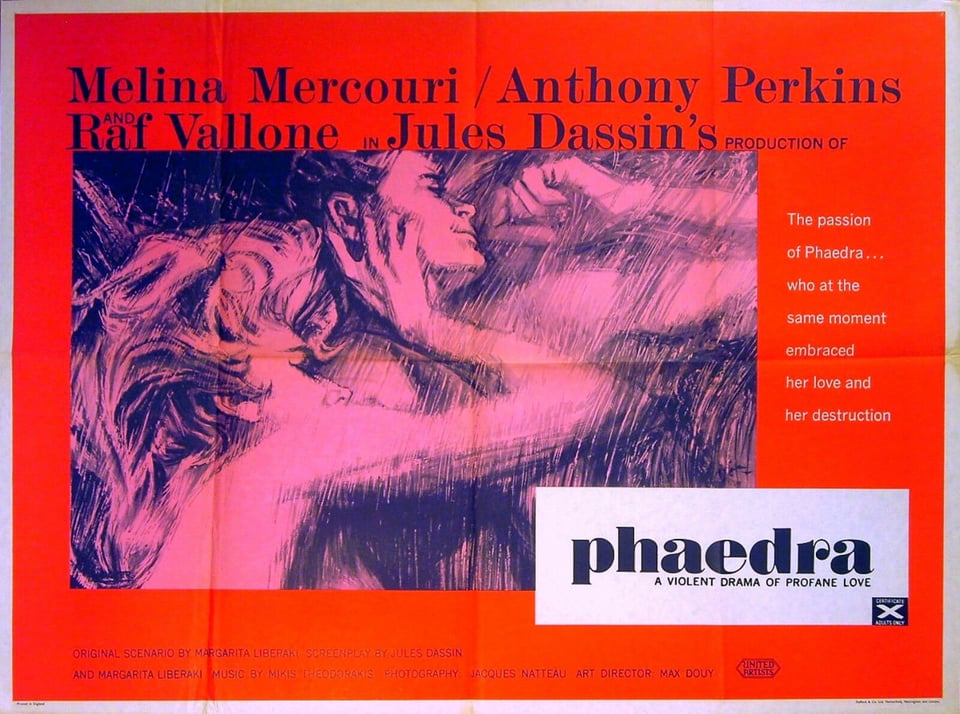
Perkins popped up again in my favourite discovery of this bunch, which was Jules Dassin’s version of the Greek myth Phaedra (1962). It is a gorgeous looking film and again, Perkins plays a philandering son - this time the legitimate son of a Greek shipping magnate - studying art in London who falls for his Father’s new wife, Phaedra. Their love affair is tumultuous and damaging to both of them, individually, collectively, and ultimately to everyone and Dassin manages the intimate explosion beautifully, delivering it in sync with an external tragedy that engulfs the magnate simultaneously. There is also a beautiful sex scene, shot and edited exquisitely, and early 60s London looks resplendent.
Slightly at a tangent to these viewings was Mario Bava’s über literally titled Hatchet for the Honeymoon (1970). Tangentially because Bava is a filmmaker I am familiar but who I haven’t spent much time with, certainly not as much as the others I mention above. So it feels a bit like cheating [but I’m only cheating myself]. The film is also tangentially connected to the others in terms of familial tension at the core. The style feels similar in that all films lean into the operatic and baroque to varying degrees, but here we have a proto Bateman in the form of a protagonist who we know from jump is the titular Hatchet wielder.
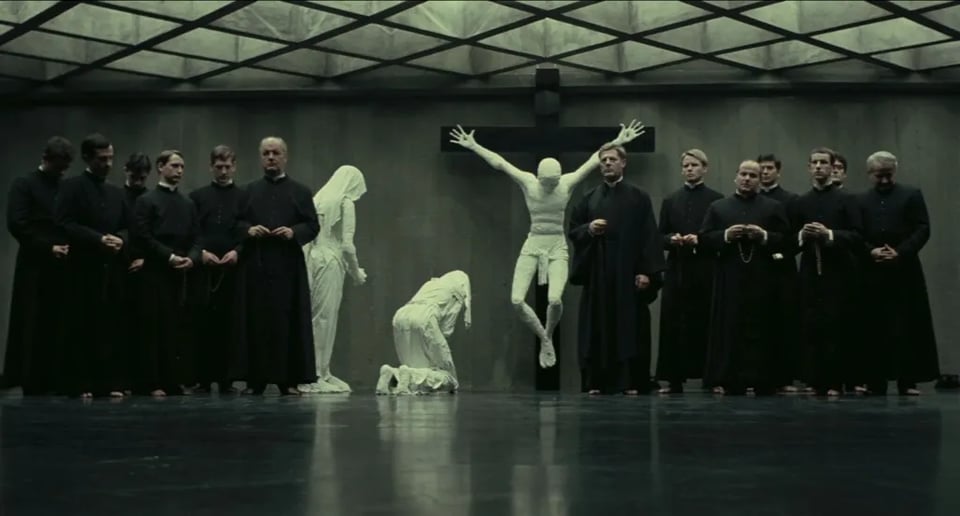
Lastly but absolutely not leastly, it’s Elio Petri’s divine One Way or Another (1976). The use of that adjective is more literal than hyperbolic as it deals with a spiritual summit convened by the Catholic Church to explore and seek to absolve the sins of the [corrupt] Italian government and private [corrupt] interests. The proceedings are led by an imperious Marcello Mastroianni, but the focus is diverted by an incredible Gian Maria Volontè performance. Both actors had worked with Petri and it’s clear that he trusted them to guide this intense and murky saga. It’s late stage Petri and his recent interests at the time, particularly in the role of the media in society, evident as early as The Tenth Victim from a decade earlier in 1965, also starring Mastroianni.
One Way, however, is a different beast. Rawer, snarling. It’s a brutal exhumation (exorcism?) of Catholic State power in Italy. In addition to its baroqueness there’s a balletic quality to the staging and cinematography as the entirety of the summit takes place in an underground bunker while an epidemic rages above ground. Prescient sci-fi. It merges and predates The Da Vinci Code (Howard, 2006) and Conclave (Berger, 2024) and captures something of Bunuel’s fixation on Catholicism’s strangeness at a national level as well as the surreal power of The Exterminating Angel (1962) and its story of psychic entrapment.
A final note of lovely serendipity. I read this month’s Sight and Sound and enjoyed the recommendations of performances and actors, from actors. Josh O’Connor recommended the Italian actor Franco Citti, who played Accattone for Pier Paolo Pasolini in the mesmerising film of the same name. Citti is here in One Way, in a pivotal role that I won’t spoil. But I enjoyed that connection in a month of intriguing and satisfying connections.
The Art of Nostalgia: Wes Anderson’s History Films by Andrew Eckholm
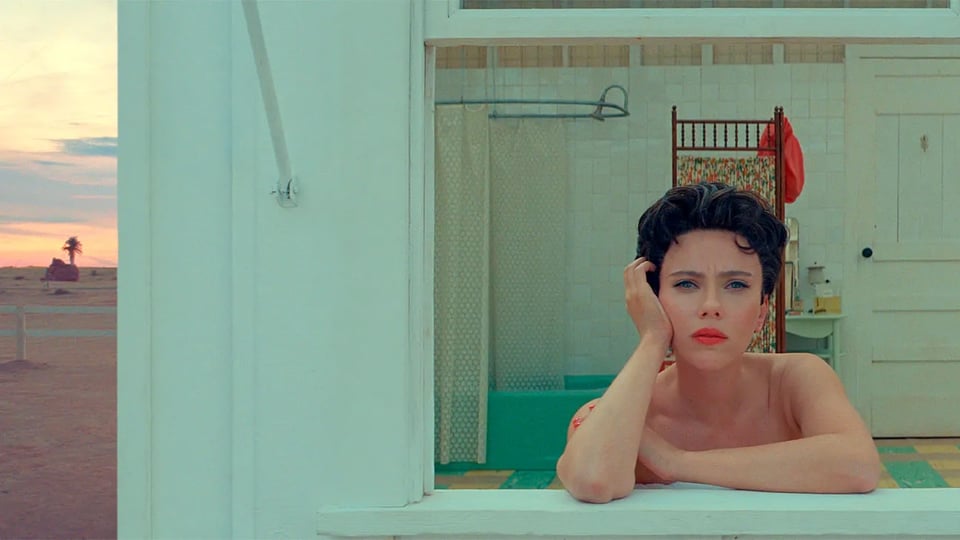
This article is one of the best things I’ve ever read about Wes Anderson and what he’s doing in his films. It’s also one of the best pieces about nostalgia and artistic engagement in and with nostalgia. I loved this segment -
“The sense that there’s a better world that’s somehow been misplaced is not one that can be addressed through art, or at all. But that impossibility, that gap between real and ideal, is the generative force that drives people to do crazy things like put on a play, make a movie or launch a revolution.”
Gig - The Style Councillors

Links to Stuff I’ve read online, and podcasts I’ve listened to, this month and enjoyed - Godardorama [New Left Review] What’s so funny about Infinite Jest? [Paris Review] 15 Questions with Dario Llinares [11am Saturday, Substack] The Action Scene: Haywire [MUBI Notebook] Inside Steven Soderbergh’s Nitehawk Takeover [BK Mag] Winning Isn’t Everything [Flaming Hydra] Infrastructures of Escape [Film Quarterly] Berlinale Filmmaker Survey: Just One Moment [MUBI Notebook] My Mother’s Prison [LRB] Moving Places: Against Targeting [Chicago Reader] Why Have We Forgotten Robert Vas? [Prospect] The Surprising Folklore of Analog Horror [Film Quarterly] We should treat love as something to be built rather than found [mixtapes by Igor] Futures and Pasts: Running on Empty [Metrograph] The Holy Girl [Metrograph] Pixel Visions: Dogme 95 and the Emergence of Digital Cinema [Criterion] Kelly Reichardt [Novembermag] Bearing the Consequences: Kelly Reichardt’s The Mastermind [Sabzian] Elucid & Sebb Bash [4Columns] Fantastic Football: A Conversation Between Christian Petzold and Alexandre Koberidze [Screen Slate] John Smith on Being John Smith [e-flux] Mr Smith goes to Dalston: John Smith on The Girl Chewing Gum at 50 [the Quietus] Planet of the Tapes: A Conversation with Alex Ross Perry [Criterion]The Maiku Hama Trilogy [Metrograph] What the Oscars Got Right [Cannonball Podcast]
Events, Gigs & Travel in April
April 10-11, Falmouth, Kernow - Wanderfal
April 15, Exeter Phoenix - Joshua Idehen
April 25, Princess Pavilion, Falmouth, Kernow - Dr John Cooper Clarke
April 28, Verdant Taproom, Penryn - Sound/Image Cinema Lab x Brewing Folk Presents: Nos Fylm / Film Night
Events & Travels Further Afield in Time & Space
London - May 21-24 (Exact Dates TBC)
Sydney - June 4-14
New York, Los Angeles - June [TBC]
Falmouth - British Popular Culture(s) Conference - July 9-11
Berlin - November [Dates TBC]