Gnamma

Archives
Subscribe

Gnamma

Archive

Gnamma #85 - Aquifer Warfare

Gnamma #85 - Aquifer Warfare

(NOTE, this newsletter was originally sent on February 10th 2024, via a brief stint using the Mailerlite software which I ended up hating. It is being reposted for completeness of the Gnamma archive.)

Newsletter title nomenclature credit goes to my friend N.Z.

Amidst the ongoing death and desecration in Gaza, it's a hydrologist's nightmare to learn that Israel is flooding subterannean tunnels with seawater, ostensibly in attempt to flush Hamas out of them. Introduction of salt into the subsurface soils and waters will lead to decades, if not centuries, of difficulty soil health and the use of subsurface water (aquifer water) for drinking or agriculture.

#89
August 12, 2024
Read more

Gnamma #87 - Riding The Wetland Rodeo

I was in Los Angeles last week (one of the upsides of working remotely in my postdoc thus far!), so Elena and I snuck in a visit to one of my all-time favorite little institutions, the Center for Land Use Interpretation. The Center was immediately on my radar when I moved to Los Angeles in Fall 2018, I think via a recommendation by a friend-of-a-friend who loved its quirky nature and its both real and performative institutionality. This manifests as an layer of bureaucratic aesthetics over what is really a passionate and artistic dive into critical geographic and (landscape) architectural theory.

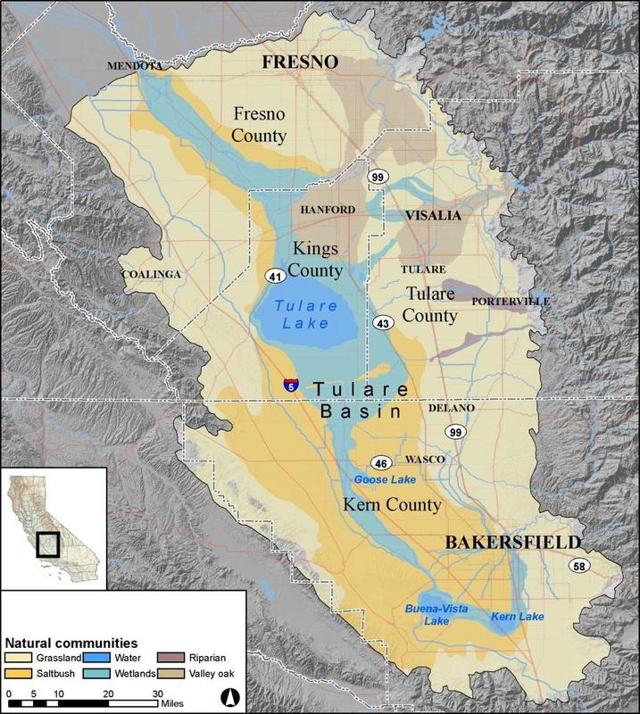
Map of Tulare Basin in the Central Valley of California

The show on display at CLUI right now is Tulare, a series of photos, videos, maps, and words on Lake Tulare. To say whether Lake Tulare "exists" or not today depends on what exactly you're waiting for, but the lake loudly announced its re-arrival in the extremely-wet 2023 at the southern end of California's Central Valley, causing widespread flooding. The lake has since retreated, divvied up into evaporation, groundwater percolation, and surface water diversions (i.e. canals and streams). These diversions are part of how the region has now been lasso'd into agricultural use across in the former freshwater lake and wetlands. Intermittent lakes and rivers, with these large seasonal or multi-year swings in their hydrologies, are somewhat common in arid landscapes around the world. Tulare is just particularly huge (> 1000 square km) and intertwined with California water infrastructure and politics. The fertile and, most-of-the-time dried out lakebed is now the terranean jewel of the J.G. Boswell Company, the "biggest farmer in America" (thx Elena!), whose lobbying has had outsize impact on dam and levee and canal construction in the region. Ultimately, this same construction now mostly prevents Lake Tulare from swelling during wet seasons as it has done for millennia.

The dogged persistence of bodies of water is one of their attributes I most admire. Despite all the bulldozers in the world, it's just pretty tough to move enough dirt and rocks to meaningfully change how the earth's landscape is shaped, and water still flows and collects downhill. A lake drained out of existence by pumps and dikes exists as the potential to re-emerge, with enough melting snow pointed towards a shallow bowl-shaped geography, as happened last spring in Tulare. All of the earth's surface is always changing, but rivers, lakes, and wetlands (both freshwater and salty) are particularly dynamic; while water is inherently geographical, it is less fixed-in-place than many other physical landscape entities; plus its heft, cyclicality, and slipperiness make it difficult to engineer around. These dynamics challenge imposed management regimes or expectations for our environments to behave to our desires in many ways, some of which I've written about previously in this newsletter. Particularly, the ebbs-and-flows and murky edges of wetlands–including the tule reed landscapes of Tulare–contribute to their particular positioning as difficult landscapes, of sorts, to manage.

#88
May 20, 2024
Read more

Gnamma #86 - Surfing and Books and...

Gnamma #86 - Surfing and Books and...

On Wednesday I woke up at 6 am in San José del Cabo, Mexico; ate a breakfast of shrinkwrapped corn muffins, half a can of tuna, plus a gatorade; and proceeded to have perhaps the best surf session of my life.

I then napped, did groceries (the store was closed by the time I arrived the night before, hence the convenience-store diet), and plowed through Nat Young's book Church of the Open Sky, which is a memoir-of-vignettes about surfing. (Note, the author is the old Australian Nat Young, not the young American Nat Young--popular name for surfers?)

It's a fun, quick read, perfect morsels for light vacation reading between surf sessions. However, other than some touching spiritual notes at the beginning of the book, there is little depth in its pages. Young himself defers to William Finnegan's Barbarian Days as the titular example of exemplary surf writing. I told my girlfriend Elena that I found Young's book akin to an old guy's unprompted rambling stories of his youth, and she said that's somewhat how she found Finnegan's book, too. Maybe it's just how these words land differently to a surfer or not, but to me the main message is that damn, there's really very little good writing about surfing. But maybe I'm just overdue to subscribe to The Surfer's Journal.

#86
March 23, 2024
Read more

Gnamma #84 - Shifting Sands of Silicon

This edition of Gnamma is a reaction to the newsletter service I've been using, Tinyletter, announcing their shutdown. Tinyletter is owned by the larger email platform Mailchimp, and I've always appreciated that they've had a smaller and simpler tool for sending out little newsletters. No longer! Tinyletter closes at the end of February 2024; if you want to unsubscribe, do so now (no guilt/shame!): in early February I will transfer all subscribers over to some replacement service. As of now I am leaning towards mailerlite, as I am not quite ready to start paying for something like buttondown unless I start monetizing this newsletter somehow. 

Leaving Tinyletter adds just one more layer to the long list of internet services I have migrated to and from. While it still generally feels like what goes on the internet stays on the internet, I think this is mostly the result of the compostability of online content: photos and text and now video rapidly proliferate by web scrapers and compilations and reposts etc, gaining longevity via redundancy rather than by any particular platform providing stability. All of these services are mutable entities, subject to changing hardware and software and financing and personal or corporate priorities and cultural norms. I would love to see the day when Facebook (Meta) goes bankrupt and dissolved all their data, but I suspect they'll have my college-age selfies for a few more decades still, taking up a little bit of memory in enormous server complexes wherever the energy bills are cheap and privacy regulation loose. And after that, honestly, I bet all the data will be harvested by other layers in the corporate/state stack. 

Some of my first internet accounts were early LEGO forums: Classic Space, Classic Castle, Saber-Scorpion, and some services that supported them. I truly cannot believe Brickshelf (LEGO image hosting) still functions, and my accounts are still there. Even the web design is the same. It takes so much work to maintain a web-based platform: keeping up the domains, keeping up with browser development, the ballooning of web dev tooling, maintaining anti-spam and security measures, paying server fees and migrating between providers, user management: I am generally in awe whenever small sites with even medium-sized user bases make it more than a few years. I don't use Pinboard any more, but I still enjoy checking in on it because its creator is vocal about many of the details of keeping the whole machine running. 

While PHPbb forums were my first real "social media" accounts, they were pretty one-off. The genuine platforms started emerging circa 2006: the LEGO community moved to flickr, I became a tumblr boy in high school through the middle of college, I lugged around a facebook profile for a while, I spent my later college years and some thereafter in the twitter-sphere, I was in a bunch of Slack groups in the twenty-teens. I've essentially permanently logged off of each of these now, too. I do still use Instagram, although with an air of hatred. It feels like an absolute algorithmic brain-nuke every time I log on. I guess I keep going back because Instagram remains a way to learn about events happening that are of interest to me; interestingly, the long tail of event details was the same reason I stayed on facebook longer than I should have. There are also some unique folks playing with and posting on Instagram that keep me attached, like David Horvitz. When I finally log off, I will miss some things like that. 

Of course, the online service I still use the most is Are.na. I feel pretty indebted to the Are.na team for maintaining an incredible crucible of value against the maelstrom of cultural change online in the past decade; for seeking transparency in how the whole operation is maintained; and for simply keeping it working and interesting. I hope Are.na (and the values it represents) is around for a lot longer than all of these other tools. My friend Bryan recently wrote a piece called What Happened to the New Internet? which chronicles an online social scene from the late twenty-teens I was/am deeply intertwined with, broadly part of the Learning Gardens network. The article then chronicles crypto, which was a trajectory that I was not really involved with, although one that was inescapably present for anyone optimistic about the direction of the "new internet." The essay also ends on a note of optimism about tools like Are.na.

Communities inevitably come and go as their constituent people ebb and flow, or maybe their reasons-to-be cease to exist, or maybe, as in the case of many online spaces, the tools that host the communication degrade. Bryan touches just a bit on how the culture that was substrate to and grew intertwined with a specific group of people outlasts any specific "community" entity. It evolves into either a more loosely woven social network or persists as shockwaves of cultural production that reverberate out from a scene in a particular moment. To dive into ideas about cultural longevity more deeply, I think I'd need to read some anthropology...

At a personal level, I am increasingly thankful that I have quite low professional benefits to "be online" any longer. (I'm trying to be a coastal engineer or academic.) In this age of enormous normative platforms and dense advertising, it's a relief to not be forcibly attached to these social platforms for the sake of making money. 20 years of being super logged-on was more than enough to cause permanent brain damage. It's an extremely difficult extrication from my decades of online persona(s), which Kyle Chayka helps describe in his recent New Yorker piece. When I am not pushing stuff online or consuming I feel I have a bit of a phantom limb, despite now having good social networks that I primarily interact with in-person (is that why events are so "sticky" in their online feed value?), or via pretty lightweight tools like group chats. Emphasizing this feels correct to me at this moment in time, but perhaps in the future I will find my people online once more... we'll see where life goes! I am overdue for a major refactorization of my online consumption: brooding tools like CycleMarks or old tools like RSS may be useful in further de-centering of data-harvesting firehose content platforms like Instagram. 

I've never felt like my email newsletter is a "community": it is too one-directional, from one-to-many. But I have really valued friends and strangers alike reading my words and bouncing ideas around, and it helps me scratch the itch to publish something online, so I'll keep writing. Email is so strangely resilient as a tool, likely because of how decentralized and platform-agnostic it can be: I hope you'll stick with me as we migrate once more. 

Deplatforming,
Lukas

p.s. I finished my PhD in December and am now between jobs! Woohoo! I'll be surfing and reading and trying to un-fuck my brain for the next two months. 
 
#85
January 18, 2024
Read more

Gnamma #83 - Lukey's Mid-Semester Update

It's been a couple months since I last wrote: life is overwhelmingly full! I can think of two people who have told me that the end of their PhD was the most intense work period of their life, and it is shaping up similarly for me. 

I'm in my final semester of the PhD now, a long cry from when I first committed. Most of my time is spent trying to push research along, but I am also the TA for an undergraduate hydrology course, with Dr Cynthia Gerlein-Safdi as lead instructor, getting to revisit lots of basic hydrology concepts I'd forgotten about. Solar radiation fluxes. Soil infiltration. Snowpack measurements. Etc. 

Teaching is a joy for me, and despite all of the dysfunction of the modern-day university, I'm curious what's still possible. In this vein, I've accepted a short (1.5 year... or more?) postdoc position with a large teaching component at a teaching-focused university, Cal Poly San Luis Obispo ("SLO"). 

Thanks to an aunt who moved to San Luis Obispo decades ago, I have a long-standing relationship with California's Central Coast and I am excited to deepen it. Growing up and visiting her (and my cousins) gave me my first sense of what California "is..." The Central Coast is a little bit mystical to me, a place I feel both bewildered by and comfortable in; the surf can be both fantastic and fickle. My arrangement will allow me to keep dipping my toes into the Bay Area, Los Angeles, and elsewhere in this big weird state. I'll move to SLO sometime in the middle third of 2024; please come visit. I really want to get a cat. 

The postdoc is a bit of a stepping stone. The research project within it is extremely applied—I will essentially be working as an engineer. This appealed to me as I am trying to figure out how to scaffold the next moves in my career. Part of me wants to get a jobby job (likely as an engineer in the public sector), granting some financial stability to life and hopefully capacity to spend my extra time watering the garden of ideas I've neglected for years (environmental philosophy, degrowth organizing, and other new hobbies). Part of me wants to stay in academia, for the teaching opportunities and conflagration of work and intellectual pleasure (or at least more time on ocean-going research vessels?). We shall see what opportunities bubble up in the near future, I'm trying to embrace one step at a time. 

My first paper/chapter was published in late 2022; my second paper/chapter was just submitted to a journal. (It's about seasonality of marsh-edge erosion in San Francisco Bay!) In the next two months I need to squeeze out a third chapter: I'll have to submit it to a journal, too, but that will come later. I'm proud of my papers, but scientific publishing is such a small, weird form of a publication practice. If you are in the Bay Area and want to hear my PhD Exit Talk—where I'll actually talk about the ideas that motivate my research around restoration and environmental science and exploration of myself—please come to UC Berkeley campus on Friday, November 17th. (Text me for the exact details!) 

In the meantime, I've been swimming a lot, and in about a week and a half I'll be swimming from Alcatraz Island to San Francisco as a group swim, with friends, to raise money for gastric cancer research. It's a Bay Area bucket list item, I suppose. If you can, please consider donating to fuel me across the cold, shark-infested waters of SF Bay!!! 

Getting in the water has been a great respite during a punishingly busy period of work, as always. I have been missing more reading and writing time and am really excited for some months to refill my head after I wrap up in December. 

Off till then,
Lukas
 
#84
October 10, 2023
Read more

Gnamma #82 - Degrowth Environmental Science

I'm increasingly interested in degrowth-oriented politics as well as a career as an environmental scientist, so when I saw an article in Nature (a well-known science journal) titled "Degrowth can work—here's how science can help," I was excited to read it. It wasn't the first time a major science outlet has gone here: the IPCC Sixth Assessment explicitly discussed degrowth, too!

While the Nature article certainly introduces some concepts of degrowth well, I found that with regards to specific actions it fell into a realm that I generally think anyone can do, not just scientists or those who work in science. The core ideas of the article are the following: Remove Dependencies on Growth; Fund Public Services; Manage Working-Time Reductions; Reshape Provisioning Systems; and then, in my words, Make It Politically Feasible. These are all good goals and there can be science in support of these, but I wouldn't call "Manage Working-Time Reduction" and act of doing environmental science. "Doing Environmental Science" today is the work of getting to know particular places/systems, stitching together data-rich and data poor landscapes and processes, marrying correlation with mechanism to describe causation of physical processes, navigating peer review & publishing & outreach. But the the list from the article felt like a list that anyone could implement in the quotidian managerial, communicative, and political actions that we perform every day of our lives.

So I've been thinking about what environmental science work towards degrowth might look and feel like. I find degrowth mindsets relatively common amongst my peer scientists, who have often become interested in sciences out of a desire to live better with nature, more sustainably, and to study it more closely. I would love to hear your ideas, too, or responses to these thoughts. 

1. Publish and celebrate publishing negative or neutral results. Studying nature means we are always studying open systems, with many potential unknowns and messy intertwined influences. While I believe every individual scientist knows that some results lead nowhere or may not pass various checks of significance, it is often discouraged or impossible to publish these investigations in peer-reviewed ways. This limits the extent of knowledge sharing between scientists, teams, and institutions (what was tried? what didn't work?), leading to unnecessary repetition. Additionally, the bias of primarily publishing positive results creates a tone in science of a false sense of control and wisdom. This false confidence in the understanding and precise quantification of natural phenomena has fueled hubris in environmental engineering and management, twisting the knot of environmental systems tighter and straining our resources. The negotiations of the Colorado River Compact are a prime example. 

2. Develop science of the local. Much of the natural sciences rests on an epistemological stance that the laws of the universe are universal: that a behavior observed here is should be replicable there. (I'm not a great philosopher of science and could use to learn more about how to explain this!) While I agree with this in principle, when this expectation is applied to the environment (as opposed to, say, laboratory chemistry) it can get a bit awkward. I collaborate with environmental scientists who work hard to abstract their results beyond the particular place they are studying in order to get it published, or to get better employment; it is seen as less prestigious to share results that are unique to a place. Abstracted science does not need to die, but I believe that we need to work to celebrate equally the work that fights against the environmental damage that abstraction permits. Environmental impacts are not abstract: they are essential elements of the history of place, and we need to support people doing the work to understand the particular dynamics of particular places in order to build sustainability into the future. 

3. Write and refine life-cycle analyses. I have mentioned life-cycle analysis (LCA) in a few newsletters now: it's the act of determining the (typically environmental) impacts of all of the stages of an industrial process. For instance, the carbon LCA of some asparagus on your dinner plate could include the carbon the asparagus sequesters as it grows; the carbon emitted during production of the fertilizer used on the field; the emissions that resulted from the irrigation the plant required; the vehicles used to transport the asparagus to processing facilities, the grocery store, and then, ultimately, your plate. There are varying degrees of what gets included in LCA, and the broader the inclusion, the more difficult the analysis, generally. (Should we include the carbon emitted to pump the water used to flush your toilet after you've excreted the remains of the asparagus? I'm not sure, but you could.) LCA is a very messy but technical business, but there is hard work being done to standardize elements of it. It helps us grapple with the scale of impact of various decisions we make as consumers, and it is work that environmental scientists and engineers are well-equipped to handle. 

Those are my first three ideas to orient environmental science work more towards degrowth. Of course different choices will be relevant to other kinds of scientists, from nuclear physicists to psychologists. If you're an economist, incorporating a pro-degrowth orientation into your work should be more self-evident. 

Assessing the carbon footprint of this email,
Lukas

p.s. Thanks to everyone who helped me raise money for City Surf Project; International Surfing Day was really fun, and together we met our fundraising goals! 
#83
June 27, 2023
Read more

Gnamma #81 - Recycling Geology

Hi Everyone! Like last year, I am raising money for the SF-based nonprofit City Surf Project. With some friends, we're trying to raise $1500 for the June 17th deadline, which is the annual SURF-A-THON! 

City Surf Project is simply a wonderful nonprofit, doing the work to connect the next generation to the ocean. The mission is close to my heart, as getting into surfing was one of the major ways I became an environmental scientists, or environmentalist at all. I'm working with them now to develop some little science lessons to sprinkle in, especially on days when the ocean conditions make it tough to be in the water. 

If you can spare something—even $10 helps—please consider donating here! Now, on to the post. 

When I think of recycling, I first think of the paper, cardboard, glass, metal, and plastic that I put into a bin every week on the curb here in Oakland California. Over the years though, I've become increasingly aware and pessimistic of where this stuff ends up. I'm not actually sure where it goes, in my city (embarrassing!), but at the scale of the USA, the results are pretty dismal, especially for plastic. Most things put in recycling just end up in a landfill somewhere stateside, or have historically been sold to east Asia (mostly China, though no longer) to be "recycled" though ultimately just  getting dumped into the ocean. Yay! 

(n.b. steel & aluminum are some of the easiest materials to recycle, consider swapping those for plastics whenever possible, and glass thereafter!)

Without recycling, stuff accumulates. Some of the magic of sustainable ecosystems is how materials get broken down, moved around, and re-used—at the levels of compounds or elements! These cycling processes prevent buildup. There are many initiatives to figure out how to recycle anthropogenic mixtures on short-term timescales, which is essentially the basis of the "circular economy" concept. This is important, and valuable, but my focus here is on the cycles performed by nature already. You have probably heard of some of the big biogeochemical cycles—the water cycle, the carbon cycle, maybe the phosphorous cycle. While one can imagine a "cycle" for virtually any substance, some of them depend on very specific conditions or long amounts of time, making the cycle more difficult to conceptualize. For example, the rate of coal production now is quite low, because of fungal activity that now decomposes woody lignin. Before that, wood did not decompose and just got buried and transformed into coal. Because buried carboniferous wood isn't being replaced now, when we mine coal in contemporary times, it's pretty much a one-way process. I have not seen anyone do the life-cycle analysis to calculate if we're burying wood at a sufficient rate to make coal in the future. 

Lola wrote a great piece on lithium mining & its discontents in her newsletter, and the "lithium cycle" is another great case of "geologic recycling." The work of lithium mining is a complex process that depends on water and big trucks and jobs for the people doing it, but at a geologic level, lithium is largely found in pegmatite. Pegmatite is a not-uncommon kind of rock, but it remains a bit mysterious, as "no one universally accepted model of pegmatite genesis has yet emerged that satisfactorily explains all the diverse features of granitic pegmatites" (ref). As lithium mining continues to ramp up for the battery boom, I wonder if we know how quickly it's being placed "back"  into the environment, albeit kilometers under the surface we walk on, via tectonic processes. 


I wrote, over four (!) years ago now, about "Geologic Objects," the idea that the extractivism behind various materials fuels many of the things we touch daily—in architecture, infrastructure, and consumer products. You're likely reading this message on a device that contains lithium, cobalt, and tantalum, plus many many other somewhat more banal but perhaps more difficult-to-recycle materials. And it almost certainly used coal or oil somewhere in its supply chain, linking you to carbon cycle processes from millennia ago. As per the silly meme above, everything can be recycled, so long as you're patient enough for tectonics to pull your iPhone, plastic case and all, case into a subduction zone. In any substance you touch that's dependent on mining, try to remember the geologic timescales at play for their cycles. As seems to be a refrain for this entire newsletter series, we would benefit from figuring out how to live with a pace of extraction that can match the pace of geologic recycling*. 

I recently finished reading John McPhee's Assembling California and oh man, it makes me want to get another PhD, this time in geology! I particularly enjoyed a section where McPhee and the ostensible protagonist of the book, Eldridge Moores, go winetasting in California wine country. The passages weave together geologic details of far-off countries with those immediately evident in California—with Moores excited to see volcanic limestone used to build the roadhouse in which they were sitting. It then brings in details of the local wines, thusly described as "volcanic." I realized that the language of terroir, the connection of the grape's flavor to the place where it grew, the soil a byproduct of the country rock geology, makes wine a geologic object too. Hell of a lot more delicious than petroleum. 

Reduce, reuse, recycle,
Lukas

* This, to me, is the foundation of support for the degrowth movement. More on that some other time. 
#82
June 4, 2023
Read more

Gnamma #80 - A Step Towards A Conservation Ethic? A Perspective on Wetland Mitigation Banking

As I discussed in my previous newsletter, the process of developing markets tied to ecosystem services is tough. It's nuanced environmental science with tricky life-cycle assessment, then coupled with increasingly sophisticated financial services. If you couldn't already tell from the tone of the last piece, I'm unsure of the accuracy and precision of the quantification of environmental services. I believe that we may press up against epistemic limits (in the words of Morgan Robertson) of the knowability of some environmental parameters, especially coarse, clunky ones like "biodiversity." We are also likely to run over thresholds of diminishing returns when it comes to the technical effort required to accurately calculate various metrics. Within the same logic, increasingly sophisticated remote sensing technologies allow us to grasp more and more of how a landscape works with less field work (which is more labor intensive), but remote sensing still requires field validation; I believe really in-depth environmental metrics assessment might be better left to scientists who are not motivated by making their money back. The problem with uncertainty in environmental metrics for ecosystem service markets arises because of the linkage between the metrics and financial instruments. If the metrics are too loose, the financial instruments are effectively decoupled from environmental processes and no longer help; if they're too tight, the natural heterogeneity and variation in environmental systems may appear too volatile or low-ROI (after lots of expensive field work) in the eyes of financial investors. 

So in the context of the marketplace, even contemporary higher standards for offsets struggle to compete against the deluge of low-cost junk offsets in a softly-regulated world. As you can read about in any publication that believes climate change is real, the most high-certainty way to reduce atmospheric greenhouse gases is not pull the carbon out of the ground in the first place. How do you make a market for that? And how can it rely on good-enough quantification techniques? 

Optimistically, there is an opportunity for markets to do the work of coordinating people to incentivize environmental protection by finding something close to "true value" (whatever that means) of quantified ecosystem services off the landscape, and then holding people to paying that cost. Unfortunately, I'm pessimistic over the potential for markets to do coordination that serves society well, especially outside of well-enforced, responsive, and trustworthy regulatory environments.  Sure, markets allow for vast amounts of coordination without much communication, but because of the dollar-value tunnel vision, they optimize and coordinate towards monetary value rather than the meaningful externalities. There is plenty of critique to be leveled against Scott Alexander's well-known Meditations on Moloch essay, but I think the core nugget stands: that mass-level individual-actor miscoordination can lead to bad (Molochian) outcomes in a civilizational prisoner's dilemma. Microplastics in our drinking water, gasoline-dependent lifestyles, and of course global ecological collapse follow from us all proceeding as-normal, avoiding difficulty of organizing and changing collectively. Instead, most things pursue cash.  

I would like for carbon credits, payments for ecosystem services, natural asset registries, cap-and-trade systems, environmental taxes, etc—all of these schemes!—to lead to more of a conservation ethic, where the rich world finds ways to enjoy life without expansion of damage-causing consumptive patterns. I'm my mother's son, and she is a geographer, so I believe that the essential element to return to is land. Land is the ur-asset, both environmentally and financially. We have a finite amount of square footage on earth and we should prioritize stewarding it well. (I include the ocean when I use "land" here, really—any unit of area on the earth surface.) You can't destroy square footage, but you can effectively destroy its ecosystem function by, for example, paving over it, one of the purest ways of disconnecting an ecosystem from its context. And disconnection is death. I'm interested in ways to incentivize people to do this less: the development of a wider-scale land conservation ethic. 

There is one marketesque tool that touches this: enter Wetland Mitigation Banking. WMB is a legal mechanism in the United States that builds a market on which to exchange wetlands. It is not really a true market, acting more like a highly regulated and procedural exchange between a small number of players (around 400 wetland mitigation banks in the USA as of 2017) and land developers. The “market” for wetland bank credits is purely a construct of federal and state regulatory programs that restrict development in wetlands and mandate compensation in exchange for development. It is enforced by the EPA and US Army Corps of Engineers. The essence of WMB now is that wherever wetlands are destroyed, they must be created (or restored), working towards "no net loss" of wetlands, a mantra established in 1989 after the policy's inception—it was a product of the 1972 Clean Water Act. 

WMB has evolved over time to require "no net loss" not only represent total area, but also function of wetland (evaluated in a few ways), and that the destroyed/developed wetland and created/restored wetland be geographically proximate. Originally, exchanged wetlands were required to be in the same watershed; now, they can be further separated. A mitigation ratio is set in the exchange however, and it generally increases the required area of wetland to be created/restored if the "new" wetland is off the same site, outside of the watershed, or even further away. (i.e., you might be approved to destroy/develop 2 square kilometers of marsh if you restore/create 5 square kilometers of marsh 20km away.) This mitigation ratio can be cranked up to account in response to anticipated "losses due to lags" in restoration (BenDor 2009) or otherwise used as a kludge to help offset damages or adjust for different wetland functions. In WMB today, the parties controlling the developed/destroyed and created/restored wetlands are allowed to be different. A wetland mitigation "bank" is an entity that creates an array of wetland credits through marsh creation, restoration, and navigation of the legal procedures (including a broad inter-agency review team, IRT) required by WMB policy. The process typically takes 10-20 years which, as a wetland restoration researcher, I can say is a decent timeline to restore marshland in some functional capacity. Once the bank has these "mitigation credits" in-hand, they can be sold to developers, who need the credits to get approval by the U.S. Army Corps of Engineers to destroy/develop the wetlands. The wetlands are given million-dollar trusts as part of the arrangement, to, hopefully, pay for stewardship in perpetuity (Kirk Elliott, personal communication). 

More intricacies of the WMB system, from BenDor et al. 2009

Any time wetland credits are exchanged, some kind of equivalence is invoked. Claiming that "wetland X here is exchangeable with wetland Z there" is a bundle of interlinked assumptions and willful ignorance. Equivalently effective bird habitat? Equivalent above-ground shrub biomass and trajectory? Nitrogen fixation? Heavy metal burial rates? Accessibility for recreation? Hydrologic connection with the rest of the watershed? It's near-impossible to speak about any kind of precise equivalence of any two specific places on planet earth, despite all our tools for abstraction. We continue to treat things as fungible regardless, as that's what is required to make a market exchange happen. Some work by Cardozo & Kelty at UCLA helps explain how cultural history of a site, indigenous and not, further renders land unfungible because of its in-place cultural value. They explain some particular conditions where an oil company has pursued swapping wetland that they own (and degraded, seemingly) in exchange for nearby protected wetland where there is untapped oil, something akin to WMB but where the restoration has not yet happened. (This is actually another type of wetland mitigation, of which there are three—WMB, In-Lieu Fee, and Permittee Responsible Mitigation, but research supports WMB, where the restoration must be done prior to exchange, as the most ecologically successful.) The project is in Metro Los Angeles where oil drilling and wetland and sacred Tongva & Acjachemen lands comingle, and drilling is being circularly permitted in a "land swap":
" ... the oil company could simply profit from expanded oil drilling, where allowed, and not invest any money in ecological restoration of the wetlands they have already degraded–i.e. just move on and let them be. But a restoration project [...] provides an added incentive because [the oil company] can now take advantage of the [land swap and] mitigation system to generate revenue for restoration in the future. That is, under no existing legal regime could [the oil company], or its predecessors, be fined for the damage already done, nor expected to pay for what the damage caused by them or their predecessors. Rather [the oil company] can generate revenue and good will by using the mitigation system to support further drilling in exchange for fixing what they have already degraded. This is, not to put too fine a point on it, a kind of temporal pyramid scheme which designers of mitigation schemes probably did not intend. But it is a clear outcome of the fact that mitigation schemes are inherently future focused, not backwards looking: they privilege constraints on future action, not accountability for past actions. There are good reasons for this, to be sure, but as this story illustrates, there are also bad outcomes." 
#81
April 17, 2023
Read more

Gnamma #79 - The Case Of The Disappearing Marsh

Conservation is rife with sob stories over the tragedies of losing unique landscapes or the things they contain. The arguments for protection or conservation may be purely emotional, ethically-motivated, tools for social equity, or even utilitarian in some long-winded logic about how biodiversity benefits us all through the gaia mechanisms. Landscapes that have been instrumentalized into production of some way pit the macroeconomic-utilitarian versus the conservationist. I'm generalizing here, but I think you know the  prototypical story: birders write nasty letters against a plot of land turning into agricultural fields, rare plant enthusiasts protest the opening of a new mine, John Muir fighting US Congress' decision of "[water] management over aesthetics" in Yosemite's Hetch-Hetchy valley. 

As awareness, theory, and technical capability have grown for "nature-based solutions" to climate change, the prospect grows for overlap and collaboration between these two "factions"—the utilitarians and conservationists—working in harmony at site-based scales. One of the arguments to promote the creation and use of carbon and ecosystem credits is that they're a method to produce market-based financial assets out of conserved land and conservation-minded management, making money off the land without needing to raze it. I've become interested in this particularly through an example of tidal marshland that I'm familiar with inside San Francisco BayI'd like to dive into an example of a coastal marshland that I'm familiar with in San Francisco Bay, Whale's Tail Marsh. 

Your author, "out on the marsh" at Whale's Tail, SF Bay and Mountain View in the background. 

Long seen as "junk" landscapes, marshes around San Francisco Bay were initially used as dumps or places for low-grade or dangerous work (read: explosives) under colonization, and that's before they were filled-in with dredged sediment to pave them over and build the office parks of Silicon Valley. Originally viewed of as nearly free for "land reclamation," the financial value per square meter of former marshlands has increased as offices, shops, and apartments have appeared over them, tempered a bit by their remoteness, and increasing awareness of the geotechnical difficulty of building over flood-prone soil that easily liquefies under the frequent Bay Area earthquakes. Historically, many marshes in South San Francisco Bay were turned into shallow ponds for harvesting salt, a practice that went comparatively insolvent decades ago, yet the odd-colored brine ponds persist and are still visible as you land at SFO by plane. Thanks to purchases by the state and easements, many of those salt ponds are now slated to be restored back into marshlands through fairly typical conservation mechanisms. Whale's Tail Marsh was never entirely turned into salt ponds or agricultural land, making it one of few "historic" marshes around SF Bay. This is important because quality research has shown that thus-unmodified land should be kept as-is with priority, as pre-established landscapes tend to perform better than restoration zones. Their long-established ecologies and soils have much more certainty in them, w.r.t. ecosystem services, than restoration projects and thus should be prioritized. (Reminder that the contemporary conception of environmental "restoration" is only a few decades old!) 

The conservationist increasingly has tools to give economic value to the remaining slivers of marshland in SF Bay by way of selling their ecosystem services. California—or private owners—may want this money to invest in marsh protection, infrastructure, or monitoring, in addition to covering the construction costs needed to continue the process of turning salt ponds back into marshlands. Marshes are excellent landscapes for rapid carbon removal as they receive lots of sediment from upland and bury vegetation under sediment and water, effectively sequestering the carbon therein. Marshes clean water and are hotspots for nutrient cycling, thereby supporting populations of lots of animals, including fish and bird populations that interplay with regional and ocean-wide food chains. Marshes can also act as buffers against coastal flooding, and can help accommodate extra stormwater during rain events (although this particular facet is less relevant, or at least less-studied, in California). Through the lens of carbon and ecosystem service credits, all of these functions can be assigned financial values. 

All credits I've seen require a property called "additionality". This requires that the intended function and change in the system would not happen were it not for the intervention that issues the credit and the sale of that credit. In other words: you can't just get carbon credits for having a marsh sitting around and doing its thing; you have to have implemented some change (either as a specific project or management shift) that promotes an ecosystem service and then sell the credit that is pegged to the marginal change in the service. The sale of the credit needs to have incentivized the increase in the service. 

This is an excellent requirement (though often very difficult to demonstrate causally) in the logic of carbon offsets, where a company purchases a credit to "offset" the new production of something. Their new production gets "balanced out" with some additional ecosystem service, via the market exchange of the two. Exchange in this way would work easily if, say, carbon sequestration was done as a cube you could pop out of a machine—or something close to it—but when actually done by landscape systems,  which typically operate slowly and in patches, the accounting gets to be more complicated. 

The essence of additionality puts primacy on the "intervention" and what follows from it rather than the ecosystem services of the yet-modified landscape. The need to change and modify the landscape in order to generate a token of financial value carries, to me, a "do-more" pro-growth affect in a world that needs more badly a degrowth mindset (or maybe do-nothing technique). And to the degree that we understand the physical science of these systems, a degrowth/non-interventionist approach keeps us more in the realm of the "known unknown" of how holistic landscapes and ecologies function, conservatively distanced from the "unknown unknown" of how "restored" landscapes behave. I'm not anti-additionality as a principle, but I am ideologically against depending on systems that hold landscapes accountable to economics-based expectations of how they should function, as they are complex systems that tend to exist as assemblages across many spatiotemporal scales and entities, intertwined with the world beyond just the "landscape unit" of the owned parcel. Here's a Fukuoka quote found by my friend Nate to tie off this epistemological thought: 
Discrimination, a fragmented and incomplete understanding, always forms the starting point of human knowledge. Unable to know the whole of nature, people can do no better than to construct an incomplete model of it and then delude themselves into thinking that they have created something natural. 
#80
February 17, 2023
Read more

Gnamma #78 - Acequia Thinking

Announcement before I jump in: my friend Bryan and I have been working on a new season of short stories about near-future speculative fiction about climate activism. The stories, which I helped edit, and new site are now online HERE! Please give a read. 

I wrote a little bit about acequia systems over a year ago. As a reminder, they are community-owned irrigation ditch systems, typically in New Mexico & Colorado in the United States, but with similar sociotechnical constructions around the world. 

Since then, I've read two books (Mayordomo and Acequia Culture) about acequias in particular, and one about water, place, and equity. What interests me most about these systems is how much they embody some different ethics than what I see in my daily life around land and water. 

At the same time, I'm still trying to find a new apartment after my time in Chile. You likely already know that affordable housing in California is impossible to find, yet alone on paltry grad student stipend. The big UC Strike has officially ended with an agreement ratified last night. Unfortunately, while wages will go up, they're nowhere close to keeping up with housing costs or inflation. (I'm close enough to the end of my PhD that I don't really think about dropping out any more, but every time I open craigslist to try to find an apartment, I consider leaving again—it was definitely a horrible financial decision to stay at Berkeley for my PhD, and that has damaged other aspects of my life.) UC is, in effect, choosing only to graduate the wealthy students who already have means to stay, and making many students enter a bit of an extractive mode: come to California, get a PhD, and get out as soon as possible. UC's credibility wanes in its ability to serve its mission of giving Californians new opportunities, and supporting people to stay in the state; it's behaving more like a private university, without any of the benefits (or endowment). 

I digress. What does this have to do with acequias? It's about land and housing markets. UC, by some actions as well as its inaction, has furthered the Californian housing market to prioritize the landlord and anti-density development, basically protecting the investments of previous generations while amputating the future ones. In the same way that you can use water in a sustainable and cyclical way or you can use water akin to extractive mining, sustainable/adaptive development is possible, or it can be conceptualized as a one-way path to sprawl and rising property values. Sadly, California is a state built on a first-come-first-serve land grab of exclusion and disenfranchisement. 

Given this context, what's most interested me in acequias is a logic other than the first-come-first-served, "prior appropriation" logic—something ubiquitous in the waters of the American West. Instead of a system built for those who were there "first", riparian rights (and other forms or mutations of common law norms) consider a system that tries to make space for the newcomers, too. ("First" in quotes because discussion on white settlement is not included here—I don't think I could do the atrocities justice now!)

For acequias, the ability to resolve effective change is partly possible because of their small scale, a few dozen to a few hundred people. As narrated in Mayordomo, much of the maintenance and expansion of the whole system is about basic conflict resolution between specific people. Additionally, the acequia functions as a social unit, able to exert social pressure and mutually-enforceable penalties against use that does not align with the cultivated sense of stewardship. Acequia Culture includes a portion around how, as New Mexico real estate prices have gone up, extractive tendencies have, too: possibilities to "get rich and go" have increased, with no sense of long-term care. Navigating equity is tough at the acequia scale; a shared culture of willingness to sacrifice individual gain for the communal good is even more difficult to maintain at, say, the size of the entire state of California. Acequia Culture has much more to say on these topics, carefully explaining how acequia systems for water distribution are resilient and trusted because they are adaptive, with centuries of histories of expansion and contraction when conditions permit or inhibit. It's easier to steer a small institution and culture than to rapidly change large ones. 

I don't mean to needlessly glamorize acequias—I don't expect society to return to family-scale farming as the way forward—but acequias have lessons within them nevertheless. They celebrate a re-localization of governance and the social need for emphasis on procedural equity (sometimes to the detriment of material efficiency), while providing thriving examples of socioeconomic systems not based on prior appropriation. I would love to see more like this applied to larger scales, and to real estate systems. 

Back on craigslist,
Lukas

p.s. Both Mayordomo and Water, Place, and Equity discuss how difficult it is for typical economic theories to grapple with water as an economic good, because of its cyclical nature. No surprise: typical economics hardly encourages cyclical systems. I have more to say about this, maybe next Gnamma... 

p.p.s. Happy holidays!!!
 
#79
December 24, 2022
Read more

Gnamma #77 - Every Day A New Crisis

If you did not know, I am currently a PhD student at the University of California. Exactly what a PhD "is" can be murky, and it is subject to wide variation. For some people, a PhD is effectively a 5+-year apprenticeship with a specific person, building skills to carry on a lineage of work. For others, it's the intellectual equivalent of crossing the Pacific Ocean alone in a sailboat: the experience has been done before, but gosh is it lonely. For some, they become a cog in a multi-human machine for turning out research progress. My experience has been light on mentorship but strong on emotional support and material opportunities, and I've benefitted from secure funding and a scholarly community throughout, thanks to a coop program with the U.S. Geological Survey. 

Anyway, all PhDs all work a little bit different, often tailored to the person and money available to pay them at the time. The difficulty in how this all becomes standardized is rearing its head in a big way during enormous and ongoing strikes that I am joining in, albeit remotely from Chile. To be clear, there are three unions: one for student instructors, one for academic researchers/postdocs, and (new) one for student researchers. I am in the latter category. We are striking in unison specifically over unlawful bargaining practices, but generally towards a fair contract. The current sentiment is that, as workers, we are underpaid and undersupported, given how much we drive the momentum of the University. To my understanding, universities essentially argue that some invisible elements—the mentorship we (might) receive in a PhD, the classes we (might) take (if we have enough time after research and the other jobs we have to pay the bills), the professional prospects we (might) get with our degrees—are coming out of our paychecks, and that we should expect to live a penny-pinching life during the years in graduate school in exchange for the honor and opportunities. 

All of the implicit and explicit expectations around graduate school are kind of a mess, they vary by discipline, and one can argue that the messes and murkiness I've described allow universities to cleverly underpay their employees. California additionally, but not uniquely, suffers from extremely high cost-of-living, so even if the University of California can pay similar paychecks to similar jobs in similar universities, the differences in what those paychecks get you is vast. Graduate schools is, with a couple exceptions, a luxury for knowledge-workers' career advancement, but the fight for better wages (and more) opens up a conversation about how much it can, or should, be an open supportive opportunity for everyone. Is life fair? No, of course not, but that doesn't mean we can't try to make it more so, and especially in education. I would love the University of California genuinely support the people who do the teaching and the research at the university (honestly, including professors), regardless of if they have health conditions, families to support, or, on the flipside, deep money to support themselves through graduate school, and that's why I'm on strike. 

Of course, it's not like the University is in charge of everything that has lead to this. It's been decades, if not centuries (!) of poor development planning for affordable and sustainable housing markets in California and underfunding of higher education by the state. (The calculus of all this is a bit different at private universities). There are also elements that have come out of changing perception of what universities are for, at  both undergraduate and graduate levels, leading to widespread accretion of various university expenses (middle management, centers for this-and-that, university-included health services and gyms and clubs and ______) , as well as lack of leadership (i.e. clarity) against the "PhD employment crisis." 

What is the UC to do? Sell off its campuses to the highest-bidding property developer and build new campuses in less expensive real estate? Pay its employees livable wages via a massive restructuring of financial assets and doubling the price of undergraduate tuition? (UC's budget reports are interesting!) Throw its weight behind lobbying the state of California to adopt equity-focused land-value-taxation and subsidize large zoning & housing projects? Go fully for-profit and laissez-faire, supporting whatever programs the students want to pay top dollar for? Use the time machine hidden under Lawrence Berkeley Lab and send a brave postdoc back in time to kill baby Ronald Reagan? All of the above? Some of the above?

The only completely wrong answer is "none of the above." None of the problems of today are new or unique, and the UC should have been better-prepared and more forward-thinking, but still, there are elements of this gordian knot outside the University's control. 

I recently learned the word "polycrisis" from this newsletter called Polycrisis Thinking, and suddenly I'm seeing it everywhere. It might be a new word for an old thing, but it's an apt one to describe the layered, multi-scale, and intertwined problems. The University of California may be undergoing a polycrisis, which is nested inside a polycrisis of academia as a whole, or, nested inside a polycrisis that is the state of California. And those are nested in this big polycrisis thing we call "21st-century Planet Earth" (or however else you'd like to decompose the problems). It's dizzying, and I'm thankful for the union leadership and conversations with people to make sense of where to start. It's also about picking your battles, sadly. 

I turned 30 last week, and when I blew out the candles on a cake (thanks to my landlady, Rosa) I found myself wishing I could have a conversation with the recently-passed Mike Davis. RIP. He was hugely influential to me in awakening more class-consciousness and establishing my enduring love for Southern California. I think he could help me make sense of the situation with UC with his cutting and pragmatic words around labor, land, and power. Of course I know which side of the picket line he'd be sitting on, but I'm still curious to see what landscape of forces and players and choices he can see from up there by the pearly gates. Across a few cases, Mike Davis was adept at setting up the mental scaffolding to climb inside the messiness of the big problems in the world and see through to the outside. Of course he never got a PhD. 

My neck, my back, I want a fair contract,
Lukas

p.s. I have been shocked to learn that I cannot find any of Mike Davis' work translated into Spanish. If anybody knows any good, friendly, or interested English-to-Spanish translators or would be interested in helping me pay for such, I would really love to get The Case for Letting Malibu Burn translated. Or, if the strike is fully successful, maybe I'll be able to afford it myself. 

p.p.s. If anyone knows about apartments less than $1000/mo in the Bay Area (or, hell, I guess I could do a month in LA) starting February 1st, 2023, I am now looking for my return to the USA. 
#78
November 27, 2022
Read more

Gnamma #76 - Desert Power

The title is a line and mantra from Dune, and I interpret the phase to as a call to build capacity for society in the desert, or a call to harness the unique power of the desert environment. If you haven't read Dune (or seen a movie version)—and I'm only speaking about the first book here, as that's all I've read—, it revolves around the politics of a planet mostly covered in sand dunes, BUT the planet has a hyper-valuable export called spice which causes it to be the nexus of geopolitical conflict. 


The "but" is crucial as generally sand dunes and deserts are seen as empty, barren, useless environments. Implicit in the politics of Dune (and there's plenty of orientalism to unpack here) is that the desert is not valuable unless it has a commodity to produce. In our world on Earth, this has largely been true, with the obvious exceptions of oil reserves in the Middle East and minerals in the American Cordillera (and more that I'm not including—send me your best please). Still, desert landscapes are neglected, perceived as empty, useless, and difficult. A tropical rainforest is "difficult" too, to traverse and turn into market resources, but that's due in-part to over-abundance of plants. In contrast, a desert is difficult due to its lack of plants—making it hard to find water and gain protection from the elements. In the board game Settlers of Catan, the "desert" is a region of the game map that uniquely produces no resources. It's also where the robber hangs out. (Is this another instance of clumsy orientalism—associating the thief with the desert? I wonder this with the "thief" Gerudos in the Zelda franchise, too. More on that some other time...) 

Did you know that about half of San Francisco was a dune field when the Spanish arrived? It's one of my favorite factoids about the city. You see elements of it everywhere: the soil underneath the concrete the Sunset District is mostly sand, and the city often has to close the west-side highway because the sand dunes of the beach "eat" it up. I've read that the first three years of Golden Gate Park in SF were spent trying to generate enough soil over the sand dunes to get plants and trees to grow in the sand-whipped city—"Sand Francisco." This Found SF page writes, "sand has been a symbol for desolate and impermanent landscapes since biblical times, when the apostle Matthew upbraided the 'foolish man, who built his house upon the sand.'" 


My point is that the perception of deserts as difficult and "resourceless" are embedded everywhere. What follows are questions to the contrary: what are the economic/extractive values found in desert landscapes? How are they instrumentalized, given their challenges relative to more humid places? 

Sand dunes in particular—which can occur in deserts—are very challenging to build on and engineer around, as they are hyper-dynamic landforms that refuse to obey fixed boundaries. My friend Ian has a forthcoming essay in Noia mag about the Guadalupe-Nipomo dune field, one of the more intact coastal dune fields on the planet and the site of some very interesting attempts to render the "inherently unstable territory both bureaucratically legible and economically productive." This has led to an enormous oil spill, an abandoned film set, and suppression of Chumash interests. (I'll share a link once the essay's published!) Despite the difficulty to instrumentalize dunes, they can be nonetheless caught up in battles of territory, perception, and development.  

The Center for Land Use Interpretation ran a program in 2005 called "Tour of the Monuments of the Great American Void," the "void" referring to the region around the Great Salt Lake, a jewel of the vast deserts of the Western US. 

I love, of course, the humor behind a bus tour of a void, speaking exactly to the fact that this dry and sparse landscape is anything but vacant. CLUI's project tells us that the desert has attracted some industries precisely because it is perceived as "empty." This had made them attractive for things that people might not want closer to humankind—either as an aestheticized remoteness (in the case of the 20th century land artists), as a perfect place for dirty extractive industries, or as a place to dump wastes. Desert landscapes in the American West are accumulating trash, nuclear refuse, and mining tailings. (This is not unique to the USA.) For this they are valued, in a sense, but this does not mean they are treated well or stewarded: the "value production" is actually tied to the destruction of the landscape. Look up synonyms for desert, and the word "wasteland" will often come up, reflecting sadly on the inability to see the desert as beautiful or useful. (See peladero in Spanish.) Deserts are often relegated to "national sacrifice areas" as I wrote about in part of Gnamma #74 a tool for the displacement of harm, pushing "the bad stuff" out of sight and out of mind. I'm dizzied by the way the void becomes valuable because of the (perceived) lack of anything there. 

Can you tell my bias? I see deserts as unique and full of incredible things happening. I've grown to love the desert over my years in California, but it took convincing and learning to see new things after my upbringing in the humid midwest (thanks, Toma, Nisha, Lola, Kevin, and more). The guys at Cactus Store, too, helped me during my internship in 2017, slowly getting me excited about the strange people and mind-bending plants that have built home in the desert. I'm also a fan of deserts because I'm a fan of the underdog, and the landscapes of my research tend to be under-valued, too. 

Appreciation of desert beauty requires slowing down and paying attention to small patterns amidst huge spatial scales. Campaign's like "don't bust the crust" struggle to make people aware of the ecosystem dynamics of xeric landscapes because they're quiet and almost geologic. Two recurring questions of this newsletter now unite... how can civilization move at timescales that reflect natural processes, and where "should" we put things, geographically, as a society? 

Deserts change slowly. It's the only way to endure xeric conditions and make it out alive. If we need a place to put something that will take a very long time—nuclear waste, for instance—is there a better place on earth than deep beneath a rocky, slow-moving landscape? 

We colloquially call energy from petroleum and coal "non-renewable" because their timescale of extraction is much, much faster than their timescale of replenishment, which ranges from geologic to planetary timescales. In other words, more years than are conceivable to civilizational organization that we've yet seen. The same is true for metals mining: it's non-renewable only because we're impatient. If we wait long enough, we'll get more copper along our tectonic boundaries, and more petroleum from our shallow seas. The existential questions for extractive humans if we can wait a few million years, and what to do in the meantime! The same is true on the other end of use for nuclear power: it is only a "renewable" in a sense if we can neutralize the waste at the rate it is produced, and this requires keeping a large stock of nuclear waste around on earth. This doesn't sound great for people. Other "sustainable energy" assets also often require materials with geological rates of replenishment. It's obviously not just humans that have to bear the burden of the ongoing, geologic-time impacts: all flora and fauna are forced to re-adapt. 


I recently finished José A. Rivera's Acequia Culture, and I'll need to dedicate another newsletter to acequia-focused topics. For now, one element of the book that stuck out is the replacement of the term "groundwater pumping"—which means the pumping of water reserves from underground aquifers up to the surface to drink and irrigate—with "groundwater mining." He used "groundwater mining" in the case where the rate of water extraction exceeds rate of replenishment from rains and snowmelt. It's a great choice of language swap, immediately conveying the extractive nature of aggressive aquifer pumping, and I'm keen to start using this phrase "water mining" in contexts where it makes sense, like here. 

Lola, one of the friends who has, over the years, helped me cultivate a love for the desert, wrote in her newsletter recently (which you should read if you like the American West and the desert) about the Salton Sea and lithium mining in the Southern Californian deserts, thereby motivating much of this newsletter. The subtitle is "On letting ancient geologic forces set the pace of life"—which I love. An aspect of extraction that she points out acutely is that not only are "water mining" in the Salton Sea basin and lithium mining nearby non-renewable in the classical, large-scale sensibility of my previous paragraphs, but they also don't really support communities during their active periods. Mining has a tendency to produce boom towns and then ghost towns when the resources run out, rather than building the capacity to support generations of people smoothly.  It seems that most ways our deserts are valued, engineered, and abused do not support people. Nor do they play at the natural timescale of these landscapes. Most of what I can find is about one-way extraction before abandon: where's the desert power in that? 

Sand-whipped,
Lukas
#77
October 30, 2022
Read more

Gnamma #75 - El Chupe del Sur

Our arrival in Melimoyu began hazily, with an iPhone alarm sounding over snores through a greasy, faux-leather, fluorescent-lit cabin following a 9-hour overnight on a ferry. The boat had been heaving through the darkness of night—soothing, I thought, even between attempts of sleep—as we traversed the tumultuous Gulf of Corcovado. I read snippets of Roberto Bolaño's satirical and dark novella, Nocturno de Chile ("By Night in Chile" translated title), between naps, and the dark rantings about the nature of the long skinny country and its literary world seemed both close at-hand and far-away as I folded myself into a remote but undeniably Chilean corner of the place. The dock in front of us, we gathered our bags, tucked into our jackets the last warmth of sleep, and stepped outside into the cold, dark, and wet. 

A dock leads into water in a bay, with grey clouds overhead.
Both Nocturno de Chile and Travels in a Thin Country (which I mentioned in #74) address Chile's relationship with itself. Despite being very different in content and author, they share the sentiment that Chile has a strained relationship with itself culturally. It is an isolated country, itself somewhat difficult to traverse; its biggest neighbor, Argentina, seems to incite an ongoing inferiority complex of cosmopolitanism. And to enter the realm of Chile's most famous cultural world of the 20th century (authors/poets Mistral, Neruda, Donoso, Allende, Bolaño himself), it seems like a stint abroad was necessary for fame or, in Mistral's case, a byproduct of her success. The protagonist in Nocturno de Chile writes essays about the Chilean authors of his time but describes it as "embryonic" cultural scene, while he and his circle of literary friends focus more on European references. Perhaps the literature was just (is still?) young, and the world of Chilean writers too small and separated to do anything but look elsewhere in the world for context. 

I felt embryonic too: exiting the ferry boat and entering the fjord was a sort of primordial fever dream. It was barely dawn, and the low, metallic sky was squeezing out something between rain and fog. In any direction we could feel the looming presence of the mountains and volcanoes, but their contours were shades of black too obscure to differentiate. The hollowness of cold and poor sleep blended with the vacuous nature of awe and we piled our bags into a boat. We had been greeted by a frank, chipper man named Alex whose garb suggested he was prepared for this dampness every day, and he quickly piloted our boat across the fjord to a lodge where we would spend the next few days. More sunlight made its way diffusely through the cloud layer as we moved along the surface of the water, and suddenly it felt like we had crossed the ethereal threshold between night and daybreak. A tractor waded into the waves to help bring us to shore dry, and we stumbled, weary but now awake, into the bright, clean, and dry wooden lodge. Regardless of any descriptions I've read about Chile's backwoods, few things speak stronger to a sense of civilization than food and hospitality at the end of the earth. 

A fjord is a type of estuary (where a river meets the sea), and we were there to study a phenomenon that mostly occurs in estuaries: internal waves. Just as "surface waves" (like what surfers ride) are at an interface of two fluids of different density—water and air—there can be be "internal waves" at the interface of two different masses of water. The waters in fjords often exhibit strong stratification, with less-dense freshwater from local rivers floating atop a more-dense layer of saltwater. Where these two different layers meet, waves can occur. My colleagues had investigated this system as the internal waves were visible from aerial imagery (they show up as broad bands of smooth and choppy water, as the internal waves heave water to the surface and smooth out the texture).

The bodily reality of environmental fluids field work (wet, labor-intensive, geographical in nature) has attracted me as someone with a strong predisposition to living in my head. My role on the trip was mostly support, however (tie some knots, look at some data, help guide some decisions) so I had time to think and stare off into space. Nocturno de Chile was sticking with me, reminding me of my humanities side. Simultaneously, it plainly probes the role of the intelligentsia in the world: it is an ouroboric critique of the insular literati in Chile as well as the value the church, with the protagonist's ostensible profession (priesthood) yielding little benefit for anyone and his greatest achievement (teaching Marxism to Pinochet) a dead-end that nobody notices. Bolaño's belief systems (leftist revolutionary and atheist) and feelings towards his motherland (distaste) are on plain view, the protagonist a metaphor for Chile itself. 

While in the fjord, I was in a beautiful place, eating fresh seafood and bread every day, enjoying jokes about technical questions with friends. I'm having a better time in Chile than Bolaño did, perhaps, the product of being a privileged visitor and 22 more years of change. (The book is from 2000.) I couldn't help but think about the role of the critic, and the uphill battle to argue for the value of criticism against a sea of problems at lower rungs on Maslow's pyramid. I'd love your suggestions and conversation on the topic. But I see a void of writing (criticism?) around environmental relations that genuinely builds new language, standards, and narratives for the 21st century. To me, lots seems too quippish, sappy, or built upon an outdated assumption of human-nature dualism that is tough to shake.

One of the great joys of the flavor of environmental science I do is the assembly of the analysis. My team has baked-in expectations of the behavior of the system into how our sensors work, how our models run, and what we expect to see with our own eyes. This constrains us, applying blinders to what we can sense in the environment, but also allows us to participate in our understanding of the world. We get the gratification of either being correct or being surprised, both of which are interwoven with our self-awareness of our own knowledge. (That's a lie—there is often frustration when something goes awry, but of course it usually offers a lesson, too.) Chile has a great opportunity to be a leader in this kind of science, given its strong universities and pride for its incredible geography: this it should own without self-consciousness. 

Early in Nocturno de Chile there is a metaphor about an estuary and the literary community of the protagonist's host and friend: 
It occurred to me that my host was, without a doubt, the estuary in which all of our land's literary craft, from dinghies to freighters, from odoriferous fishing boats to extravagant battleships, had, for brief of extensive periods, taken shelter. [...] But in fact, I reflected, [his] house was a port.

An estuary is, virtually by definition, a place where all of the runoff of the land accumulates. And, in Bolaño's metaphor (and often in reality), it is also a port. A place of collection, a place of accumulation, but also a place of voyage and exchange and possibility. For all Bolaño's bitterness, I think an estuary like this is worthwhile. I hope you're finding your estuary. This trip, and the book, gave me reminder of mine. 

By night, in Chile,
Lukas
#76
September 27, 2022
Read more

Gnamma #74 - California Upside-Down

There are periods of life that have a crystalline nature, that stand out among the grubbier or more mundane chapters for their clarity and density. Love, grief, stress, or just poignancy (travel, for me now). I think of this mostly as a product of rapid and rich stimulation, the brain working its hardest to compress and organize its memories. Sara Wheeler, in Travels in a Thin Country, describes how poetry can be a "compress[ion of] the meaning of language until it vibrates" and I feel that the metaphor works for when life experiences lead to this kind of hard-edge scribe of memory. (Also a reason I love poetry!)

I'm in a period that feels like this now, and it's also the reason I'm reading Wheeler's 1994 book: I am spending a semester  as an Investigador Visitante at Universidad Técnica Federico Santa Maria in Valparaíso, Chile. I showed up in the thin country with only some gringo basics in spanish, a big pile of work, and persistent sleep deprivation. Despite that, things are smooth so far. I'm finding some speaking partners for spanish (my landlady—who speaks no english—is very patient with me) and crawling my way through all of the chileñismos in day-to-day life. My goals is by the end of the semester, to be able to make some normal chit-chat with my landlady and colleagues at the university. 

As I wrote in a previous edition, it is also a rich experience to simply set up life anew somewhere else, where some of the basic assumptions of lifestyle can be reconsidered. I am focusing on simplicity. I don't have a bicycle here, nor a car, so I've been walking a lot, and will probably do more ocean swimming than surfing. (My first morning here was a bracing swim with an 84-year-old named Virgilio out to a buoy, with sea lions nearby—"mi bautismo," he called it.) The end of my PhD is on the horizon and I can hear the roaring suction of the great funnel of work to get everything done. Mix one part wide-ranging curiosity and one part unmoderated internet access since age 12 and it's obvious why I have a hard time focusing on anything for a long time; the next year is going to be an excellent challenge. 

I am here partly because the landscapes and rivers of Chile and California have much in common, but I am also here just because I wanted to come. Chile is a fascinating country across many facets, and now is a curious time, where the waves generated by the 2019 social unrest are still sloshing around, if not on an upswing due to Boric's new progressive government and relatively recent lifting of strict shelter-in-place orders. I am enjoying reading this history and context through my lens of water and all of the things it touches. I found Linda Schilling Cuellar's The Avocado Toast a juicy little portrait into some Chilean patterns (or at least the palta/avocado-producing regions), especially on water infrastructure. It's a portrait of the interesting intertwined technological and social developments that leads to your pan con palta, touching on neoliberalism's logics of prioritizing global avocado supply chains over equitable drinking water access, a case study that reflects individualized yet global demands over local needs and resources. 

This exchange is nothing new, just another case of what I call "global backyards," where combinations of (often colonial) coercion, financial imperatives, and information gaps allow for the refuse or strife of the world's industrial processes to collect out of sight to those who consume its fruit. Of course this happens domestically, too, and here are two examples, though both a bit old now. Hooks and Smith call these "National Sacrifice Areas," which, in comparison to "global backyards" (which harkens an overgrown zone of forgetfulness), helps remind us how these places can be highly intentionally designated, where the sacrifices have been deemed worthwhile by some kinds of entities and processes. One of my favorite Californian conversations: "Is Los Angeles Worth It?" The city's growth and possibility has hinged on water pulled from an enormous area, and famously, sucking dry the Owens Valley region of the Eastern Sierras. Am I sad for the loss of most of the Owens Valley ecosystem? Of course. Am I glad Los Angeles exists? Also yes. No reason not to continue to encourage efficient water use, the abolition of lawns in Southern California, and mobilization of overhaul in priority of water in draught-prone climates—there is plenty of ecosystem left to fight for. But let's bring it back to Chile: is year-round avocado toast worth Río Petorca running dry? I feel closer to a "no" on that one, but I'm pickier about cities than I am about food, and am much less sure how to consider the good and the bad effects of the economies hinging on palta production. For me this all points to another reason why civil engineers—of which Chile has a strong culture, given their earthquake- and draught-prone country—need more conversations on environmental ethics. Maybe I've gotten lucky, but my conversations with engineers here thus far have been wide-ranging and critical when reflecting on the social context of the work. It's got to be so: there's too much in this reservoir of socio-techno-economic systems not to dive in deep enough to try to see the bottom. 

Nos Vemos,
Lukas
#75
September 10, 2022
Read more

Gnamma #73 - Shallow Water Sensors

Firstly! A reminder that I am fundraising for City Surf Project as part of a group of friends around San Francisco to surf this upcoming Saturday, June 18th, which is International Surfing Day. Please donate! We have less than a week to meet our $1000 goal! 

Your author sweating on a rare sunny San Francisco day with the quiver

Secondly... I don't write about my "work" (in the bill-paying sense) as much here as I could. If I'm grumbling about cleaning up data and trying to pull some signal out of the noise, this post is seeking to articulate some of why. 

A large part of my work involves deploying sensors at field sites, which record various things about the landscape system. My dissertation research revolves around coastal hydrodynamics and sediment transported by the water, so some of the things I'm interested in measuring with sensors are:
  • depth of water over time (so I can see the tides go up and down, for instance)
  • suspended sediment concentration ("SSC")
  • various wave properties (e.g. mean wave height, peak wave period—ask me about how these get calculated, it's cool)
  • fluid velocity (very rad sensors let you see this in 3D)
#74
June 13, 2022
Read more

Gnamma #72 - Long Career, Quiet Now

Writing to you from San Francisco. I moved to San Francisco from the East Bay so that I can more easily go surfing without having to use a car and to enjoy the urban density of "the city." Plus it serves as a pleasant mini "blank slate" of new habits in a new place. And this apartment is a bunch cheaper (????) than my old place. 

The blank slate is mostly appreciated as I've been recently wrestling with a lot of work-related stress and some social overload. But I'm also beginning my fifth (and final?) year of graduate school, managing projects new and old, lots of travel, some side projects. As such, I'm working hard to orbit back to feeling centered, with my best habits in place. And to remind myself of the good in my current trajectory rather than being avoidant and looking elsewhere. The PhD for me has been as much about getting some specified work done as grappling with how to align my time with my priorities and feel a sense of clarity on what is ahead. Just moving through my late 20s in personal development. Healthy strategies for managing my emotions; effective time management; trust in myself to know what I can do; setting up a professional path for myself—that kind of stuff. (Of course, many days don't necessarily move anything forward—there's always shit to shovel.)

I've been feeling all the more thankful that I've chosen a professional realm where my niche can mature over decades, with lots of room for expansion or specialization. I want to run a community science organization; I want to teach about hydrodynamics; I want to consult for green infrastructure; I want to write about the different ways people build social relationships with water. I think all of these can come to fruition (not all at the same time, thank goodness!) and I'm planting the seeds now. With things growing slowly and subtly, the necessity of clarity of mind is utmost. (One of my favorite pieces at the RISD Museum, when I was a docent there, was this plaque by Jenny Holzer. It felt like finding a hidden message, tucked away in the assemblage of buildings and larger, louder displays. Its message rings true to me today. And obviously, I like the submersion metaphor.)

A search for whatever my sense of quietness requires, that's where my focus is now. Nate has been calling it something like "voluntary simplicity." This requires a lot more saying no than I'm used to, but I'm working on it. There's a material side too (less car, yay!) which runs high risk of running into the obnoxious elitism of a minimalistic lifestyle. I'm hopeful for something much more grounded, but still with that sense of spaciousness and play. (And cheap!)


IN OTHER NEWS... with some friends I am raising money for City Surf Project, an awesome SF-based nonprofit that does youth programming and leadership training via surfing. I've volunteered with them a couple times and the people are a total joy. This fundraising is building towards International Surfing Day (June 18). I'll be surfing then, and hope YOU CAN DONATE what you can ($5? $50? both great!) towards our goal! Your donation will help City Surf Project maintain their long-standing relationships with schools and keep the lights on.  

Sitting at my new desk,
Lukas
 
#73
May 31, 2022
Read more

Gnamma #71 - Field Sensing

As I foreshadowed in an earlier edition of Gnamma, I taught a class this just-recently-ended Spring Semester called "Field Sensing in Environmental Engineering." 

Details first: I co-taught the class with my friend James Butler, also a student researcher in my department, who focuses, in research at least, on chemistry and air quality (whereas I think about physics and water: we're at different ends of the discipline of environmental engineering). We had six civil & environmental engineering students fit this never-before-made class into their schedules (five undergraduates, one masters student). 

I was inspired to develop the class out of my learn-as-you-fail experiences using electronic sensors for a variety of research projects. I felt like there was a need for students to have some exposure to various sensors at a tangible level and exposure to how we can think about their utility—all stuff that I wish I had received! Using electronic sensors in the field is also an excellent professional skill, in a world where precision agriculture, environmental clean-ups, and regulatory monitoring are all on the rise. 

Playing with pedagogical norms, especially in STEM, is also a lifelong interest of mine. I found the topic of field sensing a perfect opportunity to bring broader conversations about social impact and data sovereignty into an engineering classroom. Field sensing also meant I could take students who are under the engineering undergraduate pressure-cooker books-and-formulas curriculum out to some weird muddy place in San Francisco Bay, and do field work with tangible stakes and output. 


If I were to run the class again, I would jump into planning our pinnacle event of the semester (an actual field deployment of some oceanography sensors near the mouth of Pinole Creek) sooner than we did... unfortunately, the end of the semester ended up quite rushed. Despite this, we were able to make a class that embodies many principles I hold dear of good class design. This meant lots of student agency: they chose their project topics, techniques, and site. All of these choices were channeled through a nearly-completely project-based course structure (barring a couple early-semester "theory" readings and a couple homeworks that we think served as real practice for their analysis). James and I mostly just helped guide and scope the students' natural interests, while also connecting them with resources. We, the instructors, have been regularly impressed with how engaged our students were, in different ways. Some were willing to ask broad questions and laugh loudly in an engineering classroom, some dove deep into the history of the site we chose, some jumped at opportunities to chip away at a poorly-structured project despite other demands on their time. I'm so thankful for them taking the risk to enroll and participate. Every teacher knows that engaged students are one of the highest rewards. 

Teaching should also stretch the teacher. I learned that I could benefit from practice to help guide open-ended humanistic conversations. I was routinely reminded to try to communicate more and more clearly with the students, especially around concrete expectations for assignments. And I also grappled with how complicated field deployments can actually be.  It was challenging to lay the groundwork, make decisions, plan, enact, and analyze all within a 15-week semester! 

I recently wrapped up all my data collection for my dissertation and am beginning to shift into a mode of just analysis and writing... as I enter my last year (???) of being a student researcher, I've been reflecting on the experience so far. I'm paraphrasing some tweet I saw years ago here (iirc), but it's easy to look at life like tetris and feel like successes disappear and failures pile up. I had some glamorous notions of what I could accomplish in graduate school, many of which were laughable in the face of the lurching, patchwork reality of it (in COVID, no less). Going forward, my opportunities to contribute to and benefit from this huge institution of resources are starting to wane. But over just a couple years I have learned so much, mostly through my work with the U.S. Geological Survey, about how to make field deployments with electronic environmental sensors *work*. And through this class, I was able to synthesize this, condense it into a syrup of a syllabus, and see how some eager students could drink it up. The whole process helped me recognize that in all the stressful ambiguous mess of graduate school, I have learned some shit! And the process of development, refinement, teaching, and mentoring will go down as one of my proudest, shining, efforts at Berkeley. 

In the classroom, in the field,
Lukas
#72
May 10, 2022
Read more

Gnamma #70 - In Water

I'm a bit overwhelmed with work right now. Inundated with my commitments. Thankfully I've done this before, know how to handle it. One of the biggest hurdles when juggling things is simple focus. I like my work when I feel undistracted. When the task is immersive and I feel "clear". This is also how I like anything, really. 

So I was charmed to find this portion of Laurel's notebook, On immersion. I appreciated, especially, Laurel's words on immersion as responsive to direct needs. I am going backpacking for one short night this weekend, and the joy in backpacking, to me, is that you just respond to the very direct stimuli (safety, food, cool findings). I loved full-time teaching because I had to be "on" all day, responding to the conditions of the classroom, supporting the people in front of me. Essentially the only times I feel immersed in my current work is when I am out in the field (responding to conditions!) or I am listening to fast electronic music and programming or reading late at night (lol). 

The most salient immersion in my life, though, is literal. Amidst the busy nature of even just this week, it has felt spacious, and I credit this largely to the time distention associated with getting into water. On Saturday, Nate and I went for a bracingly cold swim at China Beach, in San Francisco. He has been doing a lot of breathwork and I admire his love for and practice around cold water. Yesterday morning I managed to sneak out for an hour of surfing before morning meetings. And today I swam laps in a pool (outdoor!) for the first time since the pandemic. I know that being outdoors and these immersive moments are worth it even when I'm busy. I've enjoyed swimming for years, partly due to its forced immersion: very little stimulus, nothing to do but spin your arms and kick and breathe. 

In our conversation, Nate and I chuckled about the question, what do you think about when you swim? Swimming is a very protected, very isolated headspace, especially in the monotony of swimming laps. I often do some arithmetic, or rehash conversations that went poorly, or I just zone out and focus on my lungs. Immersion of this kind feels like blissful disconnection from the frantic demands of the rest of the world.  I always look forward to the well-scrubbed brain I can carry out of the water with me after a swim, the kind of thing I need more than ever right now. 

My piece of writing for the 2022 Are.na Annual is now online, which speaks directly to surfing as disconnection practice. I like surfing because during an intense session it requires so much of my body and brain that distraction is not an option. Full immersion like that is hard to find. Honestly, the only other thing that even gets close to this, for me, is is driving in San Francisco in a stickshift car (also lol). Maybe an intense team sport would also do it, but I haven't done those in many years. These are activities driven by urgency, however... the immersive potential of gentler & slower activities is equally rich, but sometimes I think I need the urgency, to help me step into that headspace. Laurel's post points to surfing as a model activity for the cyclic experience of immersion, as you structurally can't live in it all the time. At some point you have to step out of the water—maybe so that you can step back in again. 

That's all for now. I hope you can take a bath, or go to a sauna, or, best of all, hop into the ocean, 

Submerged,
Lukas
#71
March 10, 2022
Read more

Gnamma #69 - Drilling the Marsh

Nice. There's something interesting going on concerning the (non-)fungibility of landscape and climate futures around marshes. I'm writing this partly just to help me think it through. 

I find it helpful to frame most landscape change in a geologic context, so I'll start there. Fossil fuels are created when organic material gets buried and forced into the underground pressure-cooker. This process of organic material burial works best under anoxic conditions (i.e. not in the air but underwater) and when the burial happens rapidly, giving the material not enough time to decay heavily, which would mean shedding its carbon to its surroundings. Tidal marshlands are primed for this process, given that they combine high net primary productivity (i.e. plant growth), aquatic conditions, and rapid import of mud. If you add geologic-scale action that push marshes under the earth—subsidence, subduction, or sea level rise—you have a great recipe for the creation of fossil fuels.  


So, why is there oil where there is oil in the world? It's wherever this combination of factors aligns, where shallow seas sloshed with sediment and lots of plant and plankton life got buried. For North America, the Western Interior Seaway followed by sea levels dropping, orogeny, and subsidence gave us most of our oil. By these processes, marshlands and fossil fuels become intimately related. This is curious because marshes (or other wetlands in general) are also central to many carbon sequestration strategies due to their outsize capabilities at sequestering and storing atmospheric carbon. Primary production and carbon burial capabilities—the same things that produce fossil fuels (with time and pressure)—prioritize wetlands to rapidly pull atmospheric carbon. 

In short: marshes are skilled, on geologic time, at creating fossil fuels. Marshes are skilled, on a day-to-day scale, at burying atmospheric carbon back into the earth. When we drill, we're reaching back into deep time for oil that meets some present-day market demand, and the emissions therein may be seen as robbing from the future. The timescales become intertwined, with valuation of the past and present colliding in the present-day. 

At this point, I feel the need to put myself in a specific place, where things actually matter. What do things look like as this marshy (extracted) value manifests? 

There are options. I could explore the inland landscape of fracking and oil sands, or other material histories of "unconventional petroleum deposits." But I don't know about these technologies or their landscapes or people. I could dive into the petrochemical "cancer alley," one of the United States' most concentrated regions of oil refining, built out of the riverine and tidal marshes which have collected carbons for centuries in the lower Mississippi. This, too, is a place I know less about though. I would ask RC Clarke instead. What I can speak to are the oil platforms visible from the surf in Orange County, and my adventures in the small marshy margins of California. These marshes are far from the interior seaway and sediment conveyer belt that is the Mississippi river; they are built on a narrow & steep subducting tectonic plate boundary between the mountains and the Pacific Ocean.


Before I had ever walked around California marshes, I had personally encountered some of their oil: my first apartment in Los Angeles was within a few blocks from some pumpjacks in the LA cityscape. If you look at this map, the role of geology in these oil wells across Los Angeles becomes immediately clear: the oil fields are in coherent structures along the major tectonic axis of the region. Few things scream "Municipal Geology" (what I would like to name my future consulting firm...) more than this, "the most urbanized oil field in the nation," where the long processes of marsh systems and fossil fuels ram up against the urgency of the city and its industries. 

Now economics set in. Oil reserves are valuable. Green spaces such as marshlands are valuable. But, in an off-the-cuff way, they are ontologically different value sets. This is the whole reason ecological economics exists as a field, and why we often gravitate towards instrumentalizing these landscapes to interplay with typical forms of capital. But where the value systems run into each other is still messy: what happens when the marshes get paved over to install new oil pumps? What happens when an oil field transforms back into marshland? 

I need to credit my friend Caylee with introducing this bizarre "oil-wetlands land swap" in Southern California to me. (She is thinking more deeply about the interrelationships between this stuff and real estate development / corporate bankruptcy, too.) Synergy Oil is looking to do new drilling in some wetlands (Puvungna / Los Cerritos), and will "swap" this territory for a larger (in acres) site of historic degredation and drilling. The larger site would undergo a marsh restoration process. Whether or not this is an equivalent trade, even only on financial grounds, is complicated, rooted in the modeled oil reserve outputs, murky assessments of financial evaluations of social and environmental services, and timelines of extraction and restoration. I'm sure Synergy Oil—who will likely not have to face much of the negative externality costs—has done the math to see if it's a worthwhile investment. But that doesn't mean the activists fighting the swap think it's a good idea, on the grounds of totally different priorities of value. 

One of my favorite parts of my math education was sitting with and exploring different flavors of equivalence. When you use an equals sign (=) in typical context, it's only for numbers. Five here is five there, playing into the abstraction of the concept of "five"—the sign denotes that the things on either side represent the same mathematical object. But equivalence can be tighter and looser, depending on what you need. Are 10 acres of historic marsh equivalent to 10 acres of restored marsh? (No, says I, but it's an equivalence relationship that happens a lot.) But maybe the sites are geographically and geometrically isomorphic, in most ways. Our moral and social values, or how we value different entities, get embedded in the choices we make around what is equivalent to what, and our perceptions of balance. I love the marsh and what to see them protected, but to what end? on what timescale? In exchange for what? 

Drilling the marsh, where the past, present, and future of both geologic-time sedimentation processes meet the economic-time mishmash of land use change, lived experiences, and discount rates... I find this all a fascinating case of values getting articulated in the weird little dusty marshlands of Southern California. 

Smells like oil, smells like mud,
Lukas

note, some similar dynamics are happening in Northern California, too! 
#70
March 6, 2022
Read more

Gnamma #68 - Doing Our Own Research

I've always admired independent science organizations, the kinds of places doing high-quality research that aren't state-supported agencies or universities. I'm sure there are more than I know about (I only know stuff in North America), but what come to mind are Perimeter, Santa Fe, Salk, Woods Hole Oceanographic, Schmidt Ocean, Hakai, and the like (send me more!). While I've never worked at one (although Hakai especially would be up my alley!), I'd like to believe that they can move a little more nimbly than other research bodies and beholden to a bit less institutional inertia. While they may benefit from more freedom from teaching commitments (at universities) or state/federal priorities (at public agencies), they can also fall prey to private interest bias depending on their funding source (which tend to be big foundations or donors or some private consulting/contracting work or a mixture). 

What exactly "high-quality" research is can be debated. Truth-seeking, unbiased, replicable, useful? I picked up A Vast Machine by Paul Edwards and am in the early chapters, but I'm excited by its premise and readability. Edwards was the lead author of the 6th IPCC Report, and the book is about the "knowledge infrastructures" that fuel the science behind the IPCC. He speaks directly to how no single data stream or product is "true"—but that the machinery of combining data, cleaning, interpreting, rattling results around a variety of verification and review mechanisms, and then disseminating everything is the "truth" of it, an articulation around the unreachable truth. It's the machinery, the process of truth-making, that makes for good science. And I believe this. But I also worry that, going forward, it is a bit of a "too big to fail"-style argument. While the IPCC seems to have stayed somewhat lean, the institutions that comprise the bulk of (para-)academia run the risk of ossification by arguing that it is their bureaucracy that supports truth-making. 

I also just finished reading The Ministry for the Future after a few recommendations. I'll extend the recommendation to anyone who frets about climate change-driven destruction: while the author writes (I think) accurately about climate disasters, he avoids an apocalyptic tone, and I found myself crying a few times at the book's optimism, which can feel hard to grasp at a day-to-day level. One of the main premises (and a key narrative feature) of the book is an "everything all at once" approach to climate activism; that it isn't one single tactic or deus ex machina that will reverse dangerous climate change, but a vast distributed set of initiatives, each moving the needle in their own little realm. I realized that this philosophy of distributed activism is another reason I celebrate independent research organizations: because I think the ability for smaller, self-organized groups to do good science is actually going to be a critical component of environmental work in the 21st century. 

In the scope of environmental science, then, I want not-quite-institution-scale groups or organizations to be able to do "good science." Really, maybe my question shakes out to this: is "independent science" a contradiction? If truth-building is about exchange and verifiability that requires some scale, how feasible is it for, say, a 5-person team with no network to do "good science?" I think it is possible, and that the details boil down to how the body of work can be verified by a social trust system (e.g. peer review, if you believe in it), and how it can be disseminated in a way that people will believe. This will likely require a social shift away from only seeing the big institutions of the world as the generators of truth (something that's happening anyway), and a re-building of confidence in the ability of groups with few affiliations to do good work (how to do this, I don't really know). Hopefully not under the intent of "doing your own research," but out of showing that we don't need the over-accreted 20th-century institutions to pull apart complex topics. 

More Sci-hub, more preprint servers, more open peer review—these are all things I see happening, and they are to be celebrated. We also need more open data publication standards, more low-cost/DIY technology (e.g. sensors), and more support for long-standing monitoring programs that can serve as the backbones of smaller-scale projects. But more mechanisms to support science by "small fish" organizations, money in rapid grants, and trust-building for outsider scientists—that's what I'd like to see more of, because I think that's where the future is headed. 

Under peer-review,
Lukas

P.S. OK, maybe there's no need for DIY nuclear reactors, but again I'm focusing on environmental science here. Also, fuck Elsevier. 
#69
January 6, 2022
Read more
  Newer archives Older archives  
Powered by Buttondown, the easiest way to start and grow your newsletter.