Gnamma

Archives
Subscribe

Gnamma

Archive

Gnamma #100 - Liquid Computer

Much as I’ve heard over years about water memory, I’ve also heard whispers about “water computers.”

Before computers as we know them today went electronic, there were machines doing computation in a variety of analog ways. Analog computing just means some mechanical activity to do the computing: doing addition with pencil on paper is analog computing. We can make machines that automate this process, ranging from an abacus (still analog) to GPUs (if we go electronic). The Inca did it with quipu. What exactly “computation” means is honestly up for debate: transforming states/values in structured ways? Data getting reworked? But let’s sidestep that for now. Information goes in (two and three), computation happens (plus), information comes out (five).

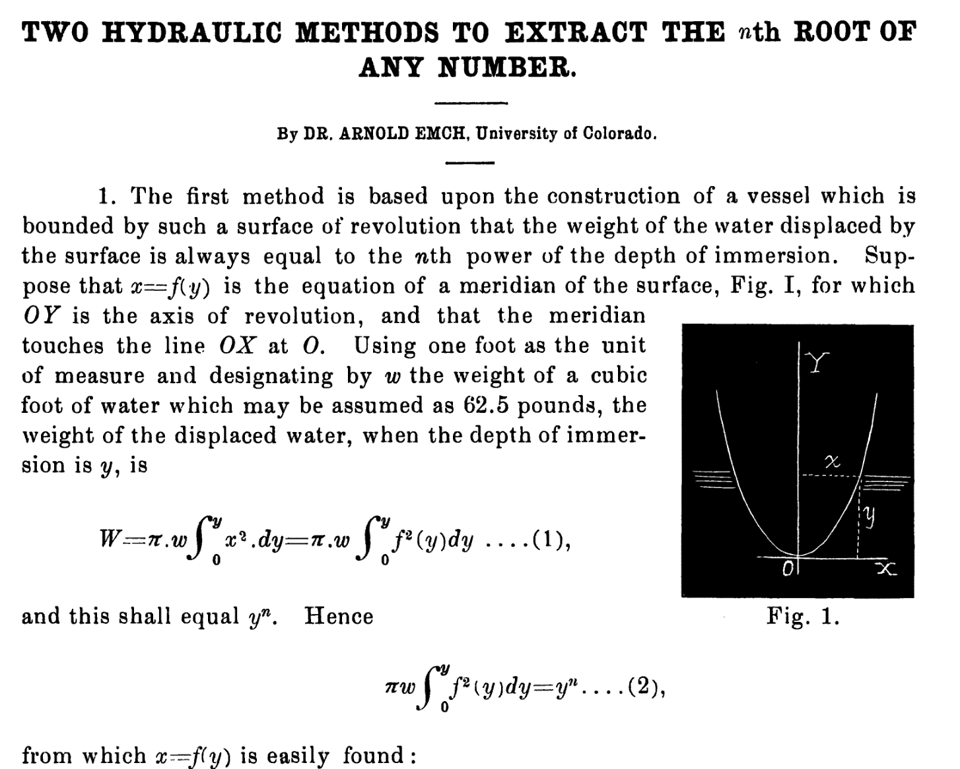
As I learned in this great history of liquid computing (2019) by Andrew Adamatzky, a nifty technique for factoring was published in 1901:

Screenshot 2025-11-17 at 23.26.56.png

Free post
#100
November 19, 2025
Read more

Gnamma #99 - Sandbox Earth

If you like Gnamma, please consider paying for a subscription! You can modify your subscription on the signup page.

One of the biggest perceptual changes I’ve had in my journey to become a landscape scientist is seeing the surface of the earth as a process of continuous change. Some landscapes change quickly, and some move slowly—it depends on what they are made of and the forces exerted on them, like rain and wind (and plants and bulldozers).

I like to think of the earth surface as two dynamic layers between the earth’s interior and the atmosphere: bedrock and soil. This is a big linguistic simplification that would invoke ire by both soil scientists and geologists, probably, but let’s keep it straightforward. “Bedrock” is hard rock, part of the geologic cycle, determined usually by large-scale geologic processes like volcanoes and tectonics. Bedrock can be eroded into particles, which then move around and mingle with particles made by plants (and corals and stuff) and other little solids, and this mixture we can call soil.

Free post
#99
November 2, 2025
Read more

Gnamma #98 - Water Memory

There is an idea that floats around homeopathy called “water memory:” that water can “remember” substances dissolved in it (or antibodies) even after extreme dilution. Put another way, it’s the idea that minuscule aspects of something in the water are carried by the entire body of water sufficiently to matter for medicinal purposes.

The concept was published in a reputable scientific journal in 1988 and then debunked over following decades. However, due to the publishing whiplash and the great marketing ideas that use it to justify various products, it has persisted. (There is a decent history of it here.) But don’t forget: you can just dilute something out of meaningful existence.

In my last semester of grad school (two years ago! yikes!), I took a seminar on stable isotope techniques (taught by Todd Dawson of the Center for Stable Isotope Biogeochemistry), and I share this because stable isotopes in hydrology felt as close as you can scientifically get to the idea of water memory. It felt like magical science. So let me explain!

Let’s start with what an isotope is. All of the elements in the periodic table have default atomic mass values. Those are the little numbers in the bottom right corners of each element in this graphic:

Free post
#98
October 18, 2025
Read more

Gnamma #97 - Clothes for Earth

I love clothing! I've always been very picky about what I wear, and in high school I got the "self-edge" denim bug while attending a fairly formal prep school, the combination of which made me care a lot about what I wear. Even now, I probably spend a couple hours a week looking at clothes online, though often just eBay resellers at this point.

But clothing and fashion are weird and concerning. Fashion gets pretty navel-gazing, so is it worth thinking about at all? See this Blackbird Spyplane response on that. And the clothing industry, particularly in fast fashion, is insanely wasteful. Seriously, bonkers-level wasteful. There's waste in manufacturing, slop between the manufacturers and retailers, heaps of clothes that go unpurchased, massive throw-out culture by consumers, and weird global supply chains leading to dumps of clothes and fabric scraps all over the place. These patterns have big environmental impacts.

image.png Image from Al-Jazeera in the Atacama Desert, Chile. Martin Bernetti/AFP.

Beyond just a waste of resources, lots of clothes have "forever chemical" (PFAS/PFOA) in them, affecting people directly and by entering our waterways. Clothes leave other remnants in the environments in the form of microfibers: clothing degrades slowly as you wear them (or when they're in a landfill), turning into microfibers or microplastics, which can be quite mobile and affect ecosystem health, including us.

Free post
#97
October 5, 2025
Read more

Gnamma #96 - Uh, What Are Tides?

Here in Stockholm, an element of the city that has surprised me is how much of the built environment—bike paths, big regal buildings, transit, shops and restaurants—is built right at the water level. As I have walked around, the water has been as little as 20 cm below the pavement I'm standing on, across both the "lake" side (west) and "sea" side (east), per Gnamma #94. Given that I think about flooding and sea level rise a lot in my professional work, my immediate response to this has been "holy shit! is anyone worried about this?"

image.png Tunnelbana station right at lake level in Stockholm. Photo from here.
Thankfully, the answer is yes, the city does think about it, and Stockholm actually doesn't have immediate high risk: the lake level is kept steady by managing flow through the sluices/locks, and the region is undergoing uplift keeping up with sea level rise (i.e. the relative sea level rise is very small), at least for now for now. The city is also investing in some semi-long-term (until 2100) infrastructure plans to help manage.

Part of my surprise with this always-near water level is also because I've gotten accustomed to living in a place with medium-sized tides: San Francisco has tides that can be bigger than 2 meters, representing daily changes in water levels taller than I am, and a built environment that reflects these variations. In places with tides, everything needs to be built above the highest tides, at peril of frequent flooding.

Free post
#96
September 28, 2025
Read more

Gnamma #95 - How A Marsh Falls Apart

Over a year and a half after finishing my PhD, all of my work is now published! Academic publishing typically takes forever, due to rounds of peer review and fiddly logistics and extremely high costs—but more on the silly world of contemporary academic publishing in another post. Today, I'm going to summarize what I wrote about in my dissertation.

Where I got my PhD the requirement is that a dissertation has at least three components that are substantial enough to become academic papers. I wrote three chapters, each of which has now gotten published. They are all open-access, so you should be able to freely download the PDFs! The absolute shortest summary is that I asked three questions:

  1. Where are there waves in protected bays, and what makes them? (paper 1, 2023)
  2. How do those waves cause erosion/retreat at the edge of a salt marsh? (paper 2, 2024)
  3. When a salt marsh erodes from waves, where does the mud go? (paper 3, 2025)

I wrote the first paper after doing field work in Tomales Bay, California, with John Largier at U.C. Davis Bodega Marine Lab. He's a coastal oceanographer who has worked in Tomales Bay for decades and he knew the system well. The project began by trying to understand the beaches in the bay, but evolved into a study on the waves.

Free post
#95
September 14, 2025
Read more

Gnamma #94 - Stockholm Municipal Hydrodynamics

Hi everyone! I am now writing from Stockholm, Sweden. I just began another postdoc research position in the Department of Physical Geography at Stockholms Universitet. I'm working on a project here about wetlandscapes–a neologism that deserves another post sometime soon, but I'll write that once I get some clarity on what I want to do in the job. For now, I'm getting to know my new city.

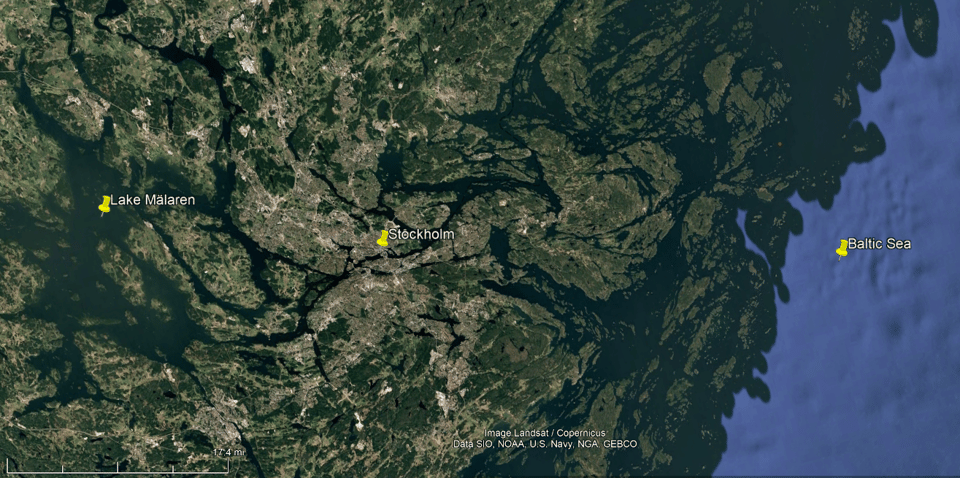
Color RGB aerial image of Stockholm and its surrounding area, with Lake Mälar (Mälaren) labeled to the west and the Baltic Sea labeled to the East.

Stockholm doesn't have much for surfing, which makes me terribly sad, but it is perhaps even more of an amphibious urban area than the Bay Area. As you can see from the satellite image above, Stockholm sits within a very watery landscape. To the east is the vast array of islands called the Stockholm Archipelago within the Baltic Sea. To the west is an interconnected landscape of lakes, river channels, and wetlands, dominated by the enormous area of the lake Mälaren, which supplies drinking water to Stockholm.

Map focusing on the blue-water extent of Lake Mälaren, with urbanized areas indicated within the landscape in red. Figure from Wikimedia.

Free post
#94
August 31, 2025
Read more

Gnamma #93 - Amphibious Possibility

My professional work right now mostly revolves around remote sensing of the dynamism of the wetlands in the Okavango Delta, a vast inland river delta in northwestern Botswana. It's a unique system, because most river deltas pour into oceans, seas, or lakes... but this one just ends. The water evaporates into the Kalahari desert air or percolates deep into its sands or gets sucked up by the trees of the area enduring the arid climate.

photo from wikimedia

The Delta also has a distinct hydrology. The rainy season here is approximately December-March, during which the entire landscape gets rain and the landscape gets green. Simultaneously, the Angolan Highlands, a plateau northwest of the Okavango Delta, collects a ton of water, which moves slowly through its forested landscape and spongy peatlands. This water then flows into the Okavango 3-5 months later, allowing the Delta and its wetlands another pulse of blue and green, in the peak of the hot summer. A recent paper called this service the "water tower" of the Okavango Delta, providing water when it is scarcest and turning the landscape into a vast oasis.

The magic of wetlands is their in-betweenness. They aren't totally wet—that's lakes and oceans. But they aren't very dry, either—that would make them a terrestrial ecosystem like shrubland or something. The Okavango is a huge area (~20,000 square kilometers) that's sometimes covered in a meter of water, sometimes completely dry, and everywhere in-between in both water depths and duration inundated. It's complex! Hence the need to study these dynamics!

Free post
#93
June 20, 2025
Read more

Gnamma #92 - NOAA's Ark

The National Oceanic and Atmospheric Administration (NOAA, pronounced like “noah”) is one of many agencies under enormous budget collapse from the Trump administration right now. While all of the scientific agencies in the USA essentially remain under a hiring freeze, they are also looking down the barrel of massive budget cuts that will addle research progress (if not virtually completely stop it, depending on the pace of necessary agency restructurings). This blockage in the research infrastructure of the United States is likely to halt a generation of scientists as they seek funding for graduate school, careers as federal scientists, and strategic guidance for the fundamental and applied research that keeps the whole shebang moving forward.

The United States has been the global hub of federal-level science essentially since World War II, a dominance supported by many state-level actions as well. That soft power has eroded somewhat in some recent decades particularly as China and India have produced STEM graduates at paces inconceivable by American standards, and many other [generally wealthy] countries have developed robust research arms (like CSIRO in Australia) and their own niches. But still, the income levels for scientific work and breadth of science funding in the US have supported robust workforces here, and the capacities of our federal-level scientific products have allowed the United States and its agencies’ data products to center themselves for global scientific development. It is very likely that we are now at a turning point for this pattern.

I am biased towards environmental science work of course, but let’s entertain an example. The National Weather Service is a federal agency under NOAA that produces weather forecasts (building upon NOAA’s various climate data pipelines and the computing resources to run the large-scale models). These forecasts and datasets inform all sorts of things: the temperatures and winds you see in your daily weather forecasts; farmers’ growing-season predictions; water resource management; and mountaineers’ avalanche awareness procedures. It’s unlikely that these services stop outright, but very likely that they are going to get a bunch worse as described in this solid article in Mother Jones (see also in NPR. This means potentially less drought predictability for farmers, tighter controls on water use, and more people dying in avalanches. Some of these data streams are only in the US, but data produced in the United States such as weather balloon sondes provide backbone data to climate models that are global in use. Still, closer to home, my cousin (who has a little rain-prediction gadget in his house) said he considered using the Norwegian global meteorological model due to forthcoming changes in the National Weather Service, before he ultimately found a more local data stream from here in the East Bay.

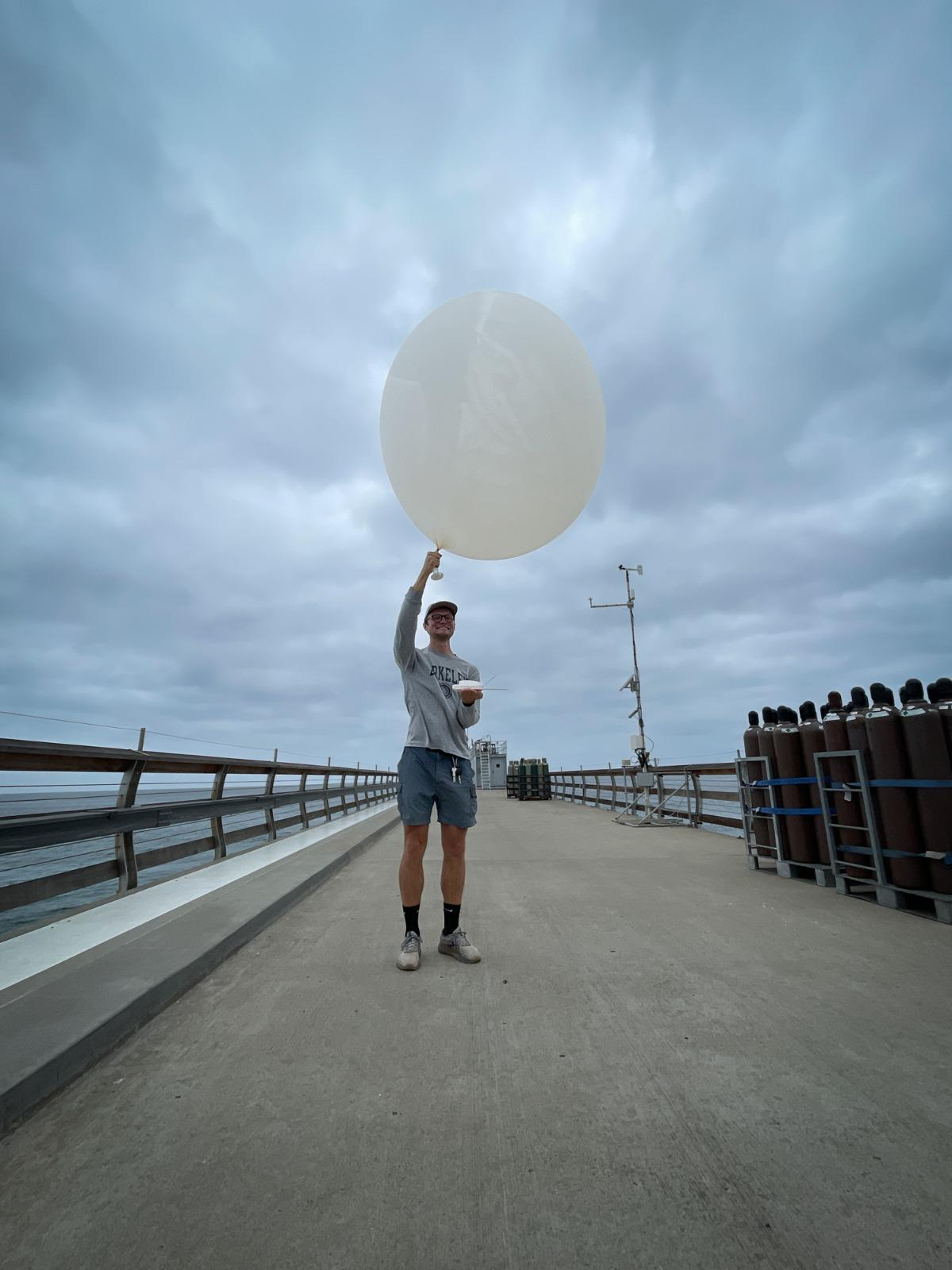
Me with a (granted, non-National Weather Service) Weather Balloon on Scripps Institute for Oceanography Pier, September 2023.
Free post
#92
May 21, 2025
Read more

Gnamma #91 - Los Angeles, Phoenix

It's been a whirlwind few months since my last post here on Gnamma. There is an anti-democratic, technocratically-fueled coup happening here in the USA. (The best aggregator on this topic, to me, has been kottke.org. Yet another country in the Americas falling to a coup supported by USA business interests, only this time... it's the United States itself?!). This shift in the American federal ruling has enormous consequences for... well, probably all of us... but definitely folks like me who were considering working for the federal government! Alas, this is not quite the topic of my newsletter today—I wanted to mention it in hopes that you're finding your strategies to keep alive and upright. Instead, I want to roll back the clocks a couple months and talk about the fires that roiled the Los Angeles metro area in January.

Hughes Fire Plume Over I-5 in Southern California Screenshot from the Hughes fire, north of LA close to I-5.
Let's remind ourselves that these fires were enormous. Hundreds of square kilometers of burned areas. Tens of thousands of burned structures. Not as many immediate deaths as you might think—the count seems to be somewhere between 20 and 50—but still, plenty of direct deaths. Plus, there are likely hundreds-to-thousands more human-years of life expectancies shortened by exposure to smoke and other toxins that will remain in the soil (or groundwater). Plenty of lives ruined by financial burdens of what was lost and what will be endured. And emotional burdens of many sizes that will be carried by people and communities for decades.

Free post
#91
March 17, 2025
Read more

Gnamma #90 - OBSF v2

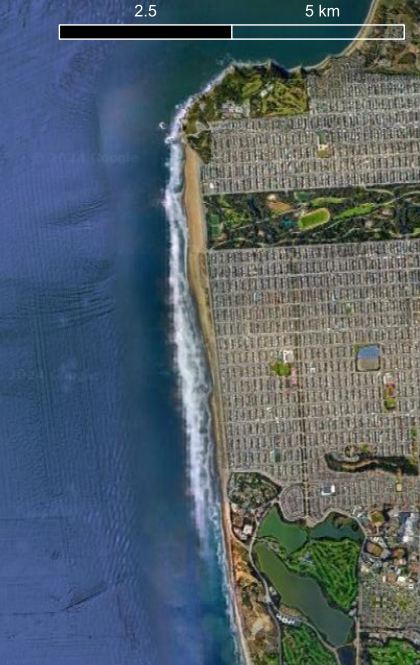
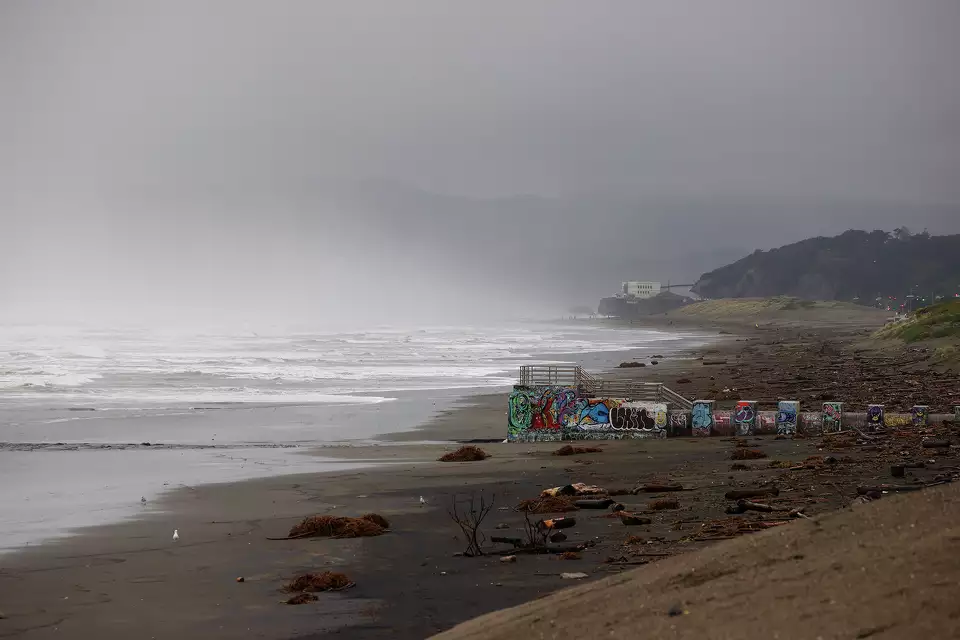
We're in peak surf season here in San Francisco, and thus far we've had a terrific run of surf. I've been paddling out as often as I can, and my favorite place to do so is Ocean Beach, San Francisco (OBSF). This enormous, windswept beach comprises almost the entirety of the western edge of San Francisco, running almost due north-south.

image.png

OBSF is really an amalgamation of a number of different waves and constantly-shifting sandbars. The surfers typically refer to them by cross-street, which are mostly alphabetical (Anza, Balboa, Cabrillo, ... Irving, Judah, Kirkham, etc). My favorite place to surf is the south end of the beach, typically around Ulloa, Vicente, Wawona, and (non-alphabetical) Sloat. Currents at the beach can be intense, so as a surfer you are constantly looking for landmarks that can notch how far you've been carried. At Vicente is a large storm drain, and by tracking this, I can take stock of how fast I'm drifting. (There is a second one at Lincoln, further north on the beach.)

Free post
#90
December 13, 2024
Read more

Gnamma #89 - Model Behavior

I just returned from the Physics of Estuaries and Coastal Seas conference, a small (~150 people), very science-focused event for the niche academic world I primarily live in. I thought it was a great conference, or at least, I liked the people and the science a whole lot.

(Note: since last writing, I accepted a postdoc in the Environmental Systems Dynamics Lab at the University of California, where I will continue to study wetlands but now mostly using satellite imagery! So I will take a step away from the fluid mechanics-heavy world, but I hope I will return some day too...)

This realm of science that seeks to understand coastal waters leans heavily on numerical models of environmental fluid mechanics. In other words, simulations of the physics that govern how water moves through estuaries and coastal seas. Virtually all of this means using the Navier-Stokes equations, a set of partial differential equations that describe the movement of fluids. These equations are then simplified somewhat for environmental flows: we can assume the water is essentially incompressible, and that horizontal scales are much longer than vertical scales. And we add a variety of processes like friction (as water flows over the ground), waves made by winds, and tides. All of our numerical models for solving partial differential equations require discretizing them—i.e., creating a grid of cells, and within each cell the physics are resolved and the equations solved.

from here

Free post
#89
October 4, 2024
Read more

Gnamma #88 - Fog Ontology

Gnamma #88 - Fog Ontology

For the past six years I’ve lived near San Francisco, a place with a particularly charismatic fog presence. (“Karl”). In the subtle seasonality of coastal California, fog is also one of the better markers of time: the chilly and damp conditions of “Fogust” (now) contrast with the starkly clear bluebird days coming soon in November. People who say the Bay Area doesn't have seasons are just bringing the expectation of dramatic continental climates to a place that's running a different system.

Fog can be difficult to define, even, at a quick pass. Is it different from a low-slung cloud? At what threshold do we go from damp condensing air to… fog proper? The slippery, airborne phenomenon, a flavor of "occult precipitation"--fog challenges us because the word denotes a “thing” that really sits across a few spectra of environmental effects.

(source)

Free post
#88
August 19, 2024
Read more

Gnamma #85 - Aquifer Warfare

Gnamma #85 - Aquifer Warfare

(NOTE, this newsletter was originally sent on February 10th 2024, via a brief stint using the Mailerlite software which I ended up hating. It is being reposted for completeness of the Gnamma archive.)

Newsletter title nomenclature credit goes to my friend N.Z.

Amidst the ongoing death and desecration in Gaza, it's a hydrologist's nightmare to learn that Israel is flooding subterannean tunnels with seawater, ostensibly in attempt to flush Hamas out of them. Introduction of salt into the subsurface soils and waters will lead to decades, if not centuries, of difficulty soil health and the use of subsurface water (aquifer water) for drinking or agriculture.

Free post
#89
August 12, 2024
Read more

Gnamma #87 - Riding The Wetland Rodeo

I was in Los Angeles last week (one of the upsides of working remotely in my postdoc thus far!), so Elena and I snuck in a visit to one of my all-time favorite little institutions, the Center for Land Use Interpretation. The Center was immediately on my radar when I moved to Los Angeles in Fall 2018, I think via a recommendation by a friend-of-a-friend who loved its quirky nature and its both real and performative institutionality. This manifests as an layer of bureaucratic aesthetics over what is really a passionate and artistic dive into critical geographic and (landscape) architectural theory.

Map of Tulare Basin in the Central Valley of California

The show on display at CLUI right now is Tulare, a series of photos, videos, maps, and words on Lake Tulare. To say whether Lake Tulare "exists" or not today depends on what exactly you're waiting for, but the lake loudly announced its re-arrival in the extremely-wet 2023 at the southern end of California's Central Valley, causing widespread flooding. The lake has since retreated, divvied up into evaporation, groundwater percolation, and surface water diversions (i.e. canals and streams). These diversions are part of how the region has now been lasso'd into agricultural use across in the former freshwater lake and wetlands. Intermittent lakes and rivers, with these large seasonal or multi-year swings in their hydrologies, are somewhat common in arid landscapes around the world. Tulare is just particularly huge (> 1000 square km) and intertwined with California water infrastructure and politics. The fertile and, most-of-the-time dried out lakebed is now the terranean jewel of the J.G. Boswell Company, the "biggest farmer in America" (thx Elena!), whose lobbying has had outsize impact on dam and levee and canal construction in the region. Ultimately, this same construction now mostly prevents Lake Tulare from swelling during wet seasons as it has done for millennia.

The dogged persistence of bodies of water is one of their attributes I most admire. Despite all the bulldozers in the world, it's just pretty tough to move enough dirt and rocks to meaningfully change how the earth's landscape is shaped, and water still flows and collects downhill. A lake drained out of existence by pumps and dikes exists as the potential to re-emerge, with enough melting snow pointed towards a shallow bowl-shaped geography, as happened last spring in Tulare. All of the earth's surface is always changing, but rivers, lakes, and wetlands (both freshwater and salty) are particularly dynamic; while water is inherently geographical, it is less fixed-in-place than many other physical landscape entities; plus its heft, cyclicality, and slipperiness make it difficult to engineer around. These dynamics challenge imposed management regimes or expectations for our environments to behave to our desires in many ways, some of which I've written about previously in this newsletter. Particularly, the ebbs-and-flows and murky edges of wetlands–including the tule reed landscapes of Tulare–contribute to their particular positioning as difficult landscapes, of sorts, to manage.

Free post
#88
May 20, 2024
Read more

Gnamma #86 - Surfing and Books and...

Gnamma #86 - Surfing and Books and...

On Wednesday I woke up at 6 am in San José del Cabo, Mexico; ate a breakfast of shrinkwrapped corn muffins, half a can of tuna, plus a gatorade; and proceeded to have perhaps the best surf session of my life.

I then napped, did groceries (the store was closed by the time I arrived the night before, hence the convenience-store diet), and plowed through Nat Young's book Church of the Open Sky, which is a memoir-of-vignettes about surfing. (Note, the author is the old Australian Nat Young, not the young American Nat Young--popular name for surfers?)

It's a fun, quick read, perfect morsels for light vacation reading between surf sessions. However, other than some touching spiritual notes at the beginning of the book, there is little depth in its pages. Young himself defers to William Finnegan's Barbarian Days as the titular example of exemplary surf writing. I told my girlfriend Elena that I found Young's book akin to an old guy's unprompted rambling stories of his youth, and she said that's somewhat how she found Finnegan's book, too. Maybe it's just how these words land differently to a surfer or not, but to me the main message is that damn, there's really very little good writing about surfing. But maybe I'm just overdue to subscribe to The Surfer's Journal.

Free post
#86
March 23, 2024
Read more

Gnamma #84 - Shifting Sands of Silicon

This edition of Gnamma is a reaction to the newsletter service I've been using, Tinyletter, announcing their shutdown. Tinyletter is owned by the larger email platform Mailchimp, and I've always appreciated that they've had a smaller and simpler tool for sending out little newsletters. No longer! Tinyletter closes at the end of February 2024; if you want to unsubscribe, do so now (no guilt/shame!): in early February I will transfer all subscribers over to some replacement service. As of now I am leaning towards mailerlite, as I am not quite ready to start paying for something like buttondown unless I start monetizing this newsletter somehow. 

Leaving Tinyletter adds just one more layer to the long list of internet services I have migrated to and from. While it still generally feels like what goes on the internet stays on the internet, I think this is mostly the result of the compostability of online content: photos and text and now video rapidly proliferate by web scrapers and compilations and reposts etc, gaining longevity via redundancy rather than by any particular platform providing stability. All of these services are mutable entities, subject to changing hardware and software and financing and personal or corporate priorities and cultural norms. I would love to see the day when Facebook (Meta) goes bankrupt and dissolved all their data, but I suspect they'll have my college-age selfies for a few more decades still, taking up a little bit of memory in enormous server complexes wherever the energy bills are cheap and privacy regulation loose. And after that, honestly, I bet all the data will be harvested by other layers in the corporate/state stack. 

Some of my first internet accounts were early LEGO forums: Classic Space, Classic Castle, Saber-Scorpion, and some services that supported them. I truly cannot believe Brickshelf (LEGO image hosting) still functions, and my accounts are still there. Even the web design is the same. It takes so much work to maintain a web-based platform: keeping up the domains, keeping up with browser development, the ballooning of web dev tooling, maintaining anti-spam and security measures, paying server fees and migrating between providers, user management: I am generally in awe whenever small sites with even medium-sized user bases make it more than a few years. I don't use Pinboard any more, but I still enjoy checking in on it because its creator is vocal about many of the details of keeping the whole machine running. 

While PHPbb forums were my first real "social media" accounts, they were pretty one-off. The genuine platforms started emerging circa 2006: the LEGO community moved to flickr, I became a tumblr boy in high school through the middle of college, I lugged around a facebook profile for a while, I spent my later college years and some thereafter in the twitter-sphere, I was in a bunch of Slack groups in the twenty-teens. I've essentially permanently logged off of each of these now, too. I do still use Instagram, although with an air of hatred. It feels like an absolute algorithmic brain-nuke every time I log on. I guess I keep going back because Instagram remains a way to learn about events happening that are of interest to me; interestingly, the long tail of event details was the same reason I stayed on facebook longer than I should have. There are also some unique folks playing with and posting on Instagram that keep me attached, like David Horvitz. When I finally log off, I will miss some things like that. 

Of course, the online service I still use the most is Are.na. I feel pretty indebted to the Are.na team for maintaining an incredible crucible of value against the maelstrom of cultural change online in the past decade; for seeking transparency in how the whole operation is maintained; and for simply keeping it working and interesting. I hope Are.na (and the values it represents) is around for a lot longer than all of these other tools. My friend Bryan recently wrote a piece called What Happened to the New Internet? which chronicles an online social scene from the late twenty-teens I was/am deeply intertwined with, broadly part of the Learning Gardens network. The article then chronicles crypto, which was a trajectory that I was not really involved with, although one that was inescapably present for anyone optimistic about the direction of the "new internet." The essay also ends on a note of optimism about tools like Are.na.

Communities inevitably come and go as their constituent people ebb and flow, or maybe their reasons-to-be cease to exist, or maybe, as in the case of many online spaces, the tools that host the communication degrade. Bryan touches just a bit on how the culture that was substrate to and grew intertwined with a specific group of people outlasts any specific "community" entity. It evolves into either a more loosely woven social network or persists as shockwaves of cultural production that reverberate out from a scene in a particular moment. To dive into ideas about cultural longevity more deeply, I think I'd need to read some anthropology...

At a personal level, I am increasingly thankful that I have quite low professional benefits to "be online" any longer. (I'm trying to be a coastal engineer or academic.) In this age of enormous normative platforms and dense advertising, it's a relief to not be forcibly attached to these social platforms for the sake of making money. 20 years of being super logged-on was more than enough to cause permanent brain damage. It's an extremely difficult extrication from my decades of online persona(s), which Kyle Chayka helps describe in his recent New Yorker piece. When I am not pushing stuff online or consuming I feel I have a bit of a phantom limb, despite now having good social networks that I primarily interact with in-person (is that why events are so "sticky" in their online feed value?), or via pretty lightweight tools like group chats. Emphasizing this feels correct to me at this moment in time, but perhaps in the future I will find my people online once more... we'll see where life goes! I am overdue for a major refactorization of my online consumption: brooding tools like CycleMarks or old tools like RSS may be useful in further de-centering of data-harvesting firehose content platforms like Instagram. 

I've never felt like my email newsletter is a "community": it is too one-directional, from one-to-many. But I have really valued friends and strangers alike reading my words and bouncing ideas around, and it helps me scratch the itch to publish something online, so I'll keep writing. Email is so strangely resilient as a tool, likely because of how decentralized and platform-agnostic it can be: I hope you'll stick with me as we migrate once more. 

Deplatforming,
Lukas

p.s. I finished my PhD in December and am now between jobs! Woohoo! I'll be surfing and reading and trying to un-fuck my brain for the next two months. 
 
Free post
#85
January 18, 2024
Read more

Gnamma #83 - Lukey's Mid-Semester Update

It's been a couple months since I last wrote: life is overwhelmingly full! I can think of two people who have told me that the end of their PhD was the most intense work period of their life, and it is shaping up similarly for me. 

I'm in my final semester of the PhD now, a long cry from when I first committed. Most of my time is spent trying to push research along, but I am also the TA for an undergraduate hydrology course, with Dr Cynthia Gerlein-Safdi as lead instructor, getting to revisit lots of basic hydrology concepts I'd forgotten about. Solar radiation fluxes. Soil infiltration. Snowpack measurements. Etc. 

Teaching is a joy for me, and despite all of the dysfunction of the modern-day university, I'm curious what's still possible. In this vein, I've accepted a short (1.5 year... or more?) postdoc position with a large teaching component at a teaching-focused university, Cal Poly San Luis Obispo ("SLO"). 

Thanks to an aunt who moved to San Luis Obispo decades ago, I have a long-standing relationship with California's Central Coast and I am excited to deepen it. Growing up and visiting her (and my cousins) gave me my first sense of what California "is..." The Central Coast is a little bit mystical to me, a place I feel both bewildered by and comfortable in; the surf can be both fantastic and fickle. My arrangement will allow me to keep dipping my toes into the Bay Area, Los Angeles, and elsewhere in this big weird state. I'll move to SLO sometime in the middle third of 2024; please come visit. I really want to get a cat. 

The postdoc is a bit of a stepping stone. The research project within it is extremely applied—I will essentially be working as an engineer. This appealed to me as I am trying to figure out how to scaffold the next moves in my career. Part of me wants to get a jobby job (likely as an engineer in the public sector), granting some financial stability to life and hopefully capacity to spend my extra time watering the garden of ideas I've neglected for years (environmental philosophy, degrowth organizing, and other new hobbies). Part of me wants to stay in academia, for the teaching opportunities and conflagration of work and intellectual pleasure (or at least more time on ocean-going research vessels?). We shall see what opportunities bubble up in the near future, I'm trying to embrace one step at a time. 

My first paper/chapter was published in late 2022; my second paper/chapter was just submitted to a journal. (It's about seasonality of marsh-edge erosion in San Francisco Bay!) In the next two months I need to squeeze out a third chapter: I'll have to submit it to a journal, too, but that will come later. I'm proud of my papers, but scientific publishing is such a small, weird form of a publication practice. If you are in the Bay Area and want to hear my PhD Exit Talk—where I'll actually talk about the ideas that motivate my research around restoration and environmental science and exploration of myself—please come to UC Berkeley campus on Friday, November 17th. (Text me for the exact details!) 

In the meantime, I've been swimming a lot, and in about a week and a half I'll be swimming from Alcatraz Island to San Francisco as a group swim, with friends, to raise money for gastric cancer research. It's a Bay Area bucket list item, I suppose. If you can, please consider donating to fuel me across the cold, shark-infested waters of SF Bay!!! 

Getting in the water has been a great respite during a punishingly busy period of work, as always. I have been missing more reading and writing time and am really excited for some months to refill my head after I wrap up in December. 

Off till then,
Lukas
 
Free post
#84
October 10, 2023
Read more

Gnamma #82 - Degrowth Environmental Science

I'm increasingly interested in degrowth-oriented politics as well as a career as an environmental scientist, so when I saw an article in Nature (a well-known science journal) titled "Degrowth can work—here's how science can help," I was excited to read it. It wasn't the first time a major science outlet has gone here: the IPCC Sixth Assessment explicitly discussed degrowth, too!

While the Nature article certainly introduces some concepts of degrowth well, I found that with regards to specific actions it fell into a realm that I generally think anyone can do, not just scientists or those who work in science. The core ideas of the article are the following: Remove Dependencies on Growth; Fund Public Services; Manage Working-Time Reductions; Reshape Provisioning Systems; and then, in my words, Make It Politically Feasible. These are all good goals and there can be science in support of these, but I wouldn't call "Manage Working-Time Reduction" and act of doing environmental science. "Doing Environmental Science" today is the work of getting to know particular places/systems, stitching together data-rich and data poor landscapes and processes, marrying correlation with mechanism to describe causation of physical processes, navigating peer review & publishing & outreach. But the the list from the article felt like a list that anyone could implement in the quotidian managerial, communicative, and political actions that we perform every day of our lives.

So I've been thinking about what environmental science work towards degrowth might look and feel like. I find degrowth mindsets relatively common amongst my peer scientists, who have often become interested in sciences out of a desire to live better with nature, more sustainably, and to study it more closely. I would love to hear your ideas, too, or responses to these thoughts. 

1. Publish and celebrate publishing negative or neutral results. Studying nature means we are always studying open systems, with many potential unknowns and messy intertwined influences. While I believe every individual scientist knows that some results lead nowhere or may not pass various checks of significance, it is often discouraged or impossible to publish these investigations in peer-reviewed ways. This limits the extent of knowledge sharing between scientists, teams, and institutions (what was tried? what didn't work?), leading to unnecessary repetition. Additionally, the bias of primarily publishing positive results creates a tone in science of a false sense of control and wisdom. This false confidence in the understanding and precise quantification of natural phenomena has fueled hubris in environmental engineering and management, twisting the knot of environmental systems tighter and straining our resources. The negotiations of the Colorado River Compact are a prime example. 

2. Develop science of the local. Much of the natural sciences rests on an epistemological stance that the laws of the universe are universal: that a behavior observed here is should be replicable there. (I'm not a great philosopher of science and could use to learn more about how to explain this!) While I agree with this in principle, when this expectation is applied to the environment (as opposed to, say, laboratory chemistry) it can get a bit awkward. I collaborate with environmental scientists who work hard to abstract their results beyond the particular place they are studying in order to get it published, or to get better employment; it is seen as less prestigious to share results that are unique to a place. Abstracted science does not need to die, but I believe that we need to work to celebrate equally the work that fights against the environmental damage that abstraction permits. Environmental impacts are not abstract: they are essential elements of the history of place, and we need to support people doing the work to understand the particular dynamics of particular places in order to build sustainability into the future. 

3. Write and refine life-cycle analyses. I have mentioned life-cycle analysis (LCA) in a few newsletters now: it's the act of determining the (typically environmental) impacts of all of the stages of an industrial process. For instance, the carbon LCA of some asparagus on your dinner plate could include the carbon the asparagus sequesters as it grows; the carbon emitted during production of the fertilizer used on the field; the emissions that resulted from the irrigation the plant required; the vehicles used to transport the asparagus to processing facilities, the grocery store, and then, ultimately, your plate. There are varying degrees of what gets included in LCA, and the broader the inclusion, the more difficult the analysis, generally. (Should we include the carbon emitted to pump the water used to flush your toilet after you've excreted the remains of the asparagus? I'm not sure, but you could.) LCA is a very messy but technical business, but there is hard work being done to standardize elements of it. It helps us grapple with the scale of impact of various decisions we make as consumers, and it is work that environmental scientists and engineers are well-equipped to handle. 

Those are my first three ideas to orient environmental science work more towards degrowth. Of course different choices will be relevant to other kinds of scientists, from nuclear physicists to psychologists. If you're an economist, incorporating a pro-degrowth orientation into your work should be more self-evident. 

Assessing the carbon footprint of this email,
Lukas

p.s. Thanks to everyone who helped me raise money for City Surf Project; International Surfing Day was really fun, and together we met our fundraising goals! 
Free post
#83
June 27, 2023
Read more

Gnamma #81 - Recycling Geology

Hi Everyone! Like last year, I am raising money for the SF-based nonprofit City Surf Project. With some friends, we're trying to raise $1500 for the June 17th deadline, which is the annual SURF-A-THON! 

City Surf Project is simply a wonderful nonprofit, doing the work to connect the next generation to the ocean. The mission is close to my heart, as getting into surfing was one of the major ways I became an environmental scientists, or environmentalist at all. I'm working with them now to develop some little science lessons to sprinkle in, especially on days when the ocean conditions make it tough to be in the water. 

If you can spare something—even $10 helps—please consider donating here! Now, on to the post. 

When I think of recycling, I first think of the paper, cardboard, glass, metal, and plastic that I put into a bin every week on the curb here in Oakland California. Over the years though, I've become increasingly aware and pessimistic of where this stuff ends up. I'm not actually sure where it goes, in my city (embarrassing!), but at the scale of the USA, the results are pretty dismal, especially for plastic. Most things put in recycling just end up in a landfill somewhere stateside, or have historically been sold to east Asia (mostly China, though no longer) to be "recycled" though ultimately just  getting dumped into the ocean. Yay! 

(n.b. steel & aluminum are some of the easiest materials to recycle, consider swapping those for plastics whenever possible, and glass thereafter!)

Without recycling, stuff accumulates. Some of the magic of sustainable ecosystems is how materials get broken down, moved around, and re-used—at the levels of compounds or elements! These cycling processes prevent buildup. There are many initiatives to figure out how to recycle anthropogenic mixtures on short-term timescales, which is essentially the basis of the "circular economy" concept. This is important, and valuable, but my focus here is on the cycles performed by nature already. You have probably heard of some of the big biogeochemical cycles—the water cycle, the carbon cycle, maybe the phosphorous cycle. While one can imagine a "cycle" for virtually any substance, some of them depend on very specific conditions or long amounts of time, making the cycle more difficult to conceptualize. For example, the rate of coal production now is quite low, because of fungal activity that now decomposes woody lignin. Before that, wood did not decompose and just got buried and transformed into coal. Because buried carboniferous wood isn't being replaced now, when we mine coal in contemporary times, it's pretty much a one-way process. I have not seen anyone do the life-cycle analysis to calculate if we're burying wood at a sufficient rate to make coal in the future. 

Lola wrote a great piece on lithium mining & its discontents in her newsletter, and the "lithium cycle" is another great case of "geologic recycling." The work of lithium mining is a complex process that depends on water and big trucks and jobs for the people doing it, but at a geologic level, lithium is largely found in pegmatite. Pegmatite is a not-uncommon kind of rock, but it remains a bit mysterious, as "no one universally accepted model of pegmatite genesis has yet emerged that satisfactorily explains all the diverse features of granitic pegmatites" (ref). As lithium mining continues to ramp up for the battery boom, I wonder if we know how quickly it's being placed "back"  into the environment, albeit kilometers under the surface we walk on, via tectonic processes. 


I wrote, over four (!) years ago now, about "Geologic Objects," the idea that the extractivism behind various materials fuels many of the things we touch daily—in architecture, infrastructure, and consumer products. You're likely reading this message on a device that contains lithium, cobalt, and tantalum, plus many many other somewhat more banal but perhaps more difficult-to-recycle materials. And it almost certainly used coal or oil somewhere in its supply chain, linking you to carbon cycle processes from millennia ago. As per the silly meme above, everything can be recycled, so long as you're patient enough for tectonics to pull your iPhone, plastic case and all, case into a subduction zone. In any substance you touch that's dependent on mining, try to remember the geologic timescales at play for their cycles. As seems to be a refrain for this entire newsletter series, we would benefit from figuring out how to live with a pace of extraction that can match the pace of geologic recycling*. 

I recently finished reading John McPhee's Assembling California and oh man, it makes me want to get another PhD, this time in geology! I particularly enjoyed a section where McPhee and the ostensible protagonist of the book, Eldridge Moores, go winetasting in California wine country. The passages weave together geologic details of far-off countries with those immediately evident in California—with Moores excited to see volcanic limestone used to build the roadhouse in which they were sitting. It then brings in details of the local wines, thusly described as "volcanic." I realized that the language of terroir, the connection of the grape's flavor to the place where it grew, the soil a byproduct of the country rock geology, makes wine a geologic object too. Hell of a lot more delicious than petroleum. 

Reduce, reuse, recycle,
Lukas

* This, to me, is the foundation of support for the degrowth movement. More on that some other time. 
Free post
#82
June 4, 2023
Read more
Older archives  
Powered by Buttondown, the easiest way to start and grow your newsletter.