
The Late Night Pour | Who Holds the Switch

|
Four Fingers News
The News, Neat.
|
| SUNDAY, OCTOBER 18, 2026 · DAY 233 |
| The Late Night Pour |
Who Holds the Switch
Who Holds the Switch, read aloud · 9 minutes.
Day 233. Around 1 a.m. on Oct 14, with Russian missiles and drones in the air over Ukraine, the satellite links Ukraine’s military uses to fly its drones started cutting out for anything moving faster than about 100 miles an hour. The system is Starshield, the military version of Starlink, and the cap landed hardest on the interceptor drones Ukraine sends up after Russia’s jet-powered Shaheds. Zelensky said those Shaheds come in at more than 400 km/h, about 250 miles an hour, while some of the drones chasing them had been slowed to as little as 70 km/h, about 43. Service came back in stages over the next few days, and Ukraine’s government says it still isn’t where it was.
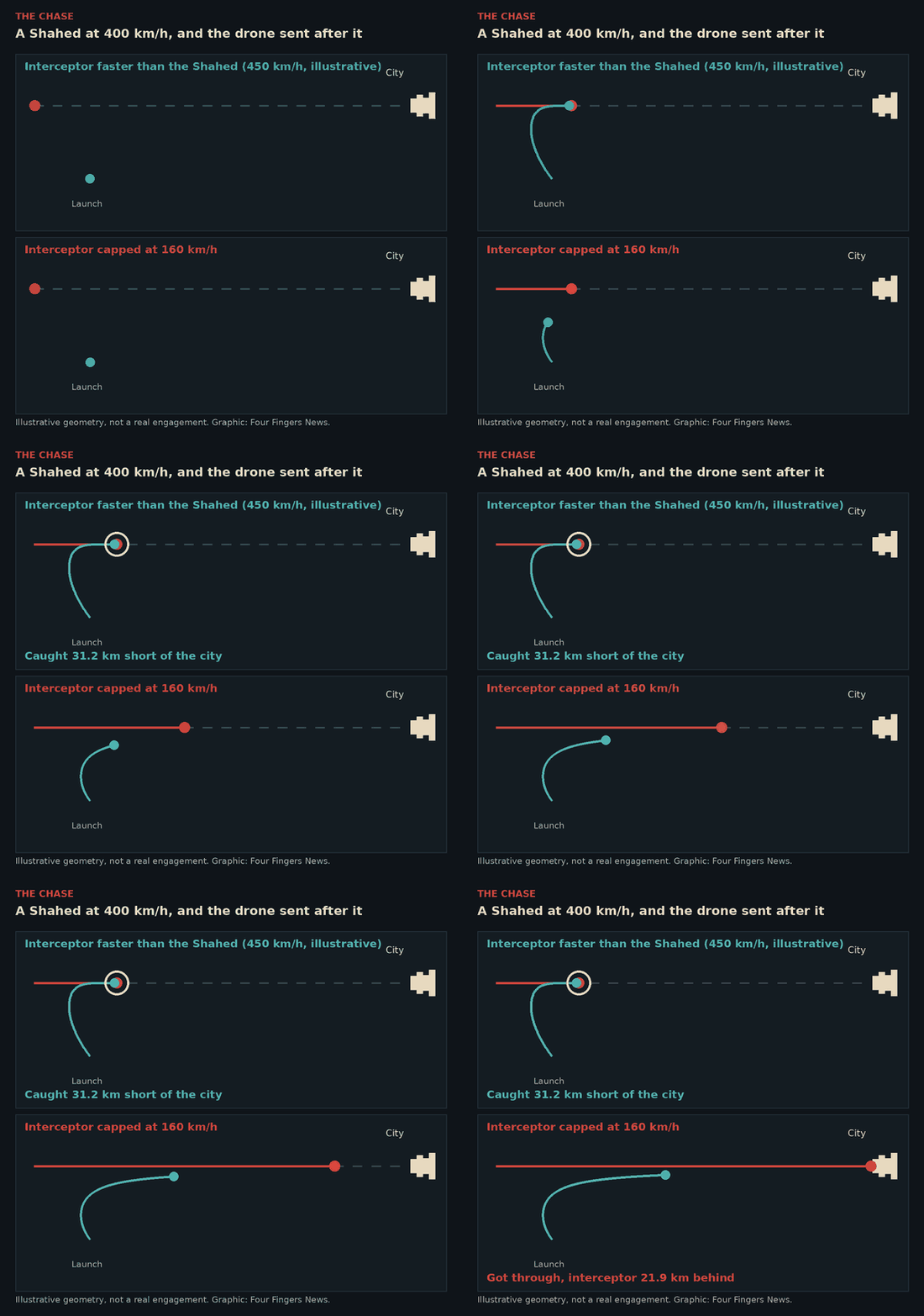
SpaceX builds and runs the network, but it belongs to the United States, and the company’s owner, Elon Musk, says Starshield is “owned and controlled by the US government” and that limits on its use are set by the US military. Reuters reported on Oct 15, citing two US officials and a Western official, that the instruction to slow the service for Ukraine came from inside the White House. The US government’s official position, as the Secretary of State put it on Saturday, is that nobody ordered it and that it “sort of happened.”
The switch sits there because of what happened in September 2022, when Ukraine asked for Starlink coverage near Crimea for an attack on Russia’s Black Sea Fleet and Musk, who was then providing the service for free, refused. The Pentagon’s answer was to put the service under contract, and in 2024 it paid to bring the number of Ukrainian terminals on Starshield to about 3,000, so that no private citizen could make that call again. It worked, in the sense that the decision no longer belongs to a businessman. It belongs to a state, and a state has interests of its own.
This week those interests and Ukraine’s pulled in different directions over one thing, Russian oil. The United States is fighting a war with Iran that’s cut shipping through the Strait of Hormuz to roughly a third of its prewar level, diesel set a record in September, and the country’s Strategic Petroleum Reserve is at its lowest since 1982. Every Russian refinery Ukraine sets on fire takes more fuel off a market that’s already short. So on Oct 11 the United States announced an energy ceasefire between Russia and Ukraine, though neither government had been told, and the next day US intelligence officials warned Ukraine’s embassy that all intelligence sharing would stop if Ukraine hit Russian energy sites again. On Friday the United States suspended the new sanctions and tariffs it had written into law in September, two days before they’d have taken effect, and Russia’s envoy for economic matters, Kirill Dmitriev, called it “an important and truly historic moment.”
Ukraine’s interests run the other way, and they’re just as plain. The refineries pay for the missiles hitting Ukraine’s power plants, and striking them is the one form of pressure on Russia that Ukraine can apply with its own hands, without asking anyone. Zelensky counted 76 Russian strikes on Ukraine’s energy system in the week of the ceasefire, and last night Ukrainian drones set St. Petersburg’s oil terminal on fire. Russia, which wasn’t asked to give anything up, ended the week with the new sanctions suspended and its enemy’s drones slowed.
Russia’s interests are the oldest of the three, and its government has stated them for nearly two decades. In February 2008 the US ambassador in Moscow, Bill Burns, wrote to the Secretary of State, Condoleezza Rice, that Ukraine in NATO was the brightest of all red lines for Russia’s elite, not just for Putin, and Russia has gone to war over Ukraine twice since. Its government treats a Western-aligned Ukraine on its border the way the United States treated Soviet missiles in Cuba in 1962, as a question of survival, and the four regions, the land bridge to Crimea and now a security zone along the border are how it intends to settle that question on the ground.
The thing none of them will settle is what the end of this war is supposed to look like. Ukraine’s official answer is its 1991 borders, Crimea included, which would mean taking back territory a nuclear power treats as its own soil, from a country with more than three times Ukraine’s population. Russia’s answer, set out in June 2024 and repeated by the Kremlin as recently as this June, is all four regions it annexed on paper in 2022, including the parts it doesn’t hold, along with a Ukraine that formally gives up on NATO. It hasn’t taken them in more than four years, and that says less about what its army could do than about the price it’s been willing to pay, because what’s left of them includes Zaporizhzhia, Kramatorsk and Sloviansk, and storming cities that size would mean mass death on both sides, so Russia has chosen to grind instead. This week Putin added to it, saying a 660 km “security zone” Russia is carving out of Sumy and Kharkiv, outside those four regions, won’t be up for negotiation, and the Kremlin says its troops already hold about 70% of that line. Russia has never been conquered, and when it’s lost wars before, in Crimea in 1856, against Japan in 1905, at Brest-Litovsk in 1918 and in Afghanistan in 1989, it lost by deciding at home that the war cost more than it was worth. That’s the logic behind Ukraine’s refinery campaign, which aims at exhaustion rather than conquest, and it’s the campaign the United States spent this week slowing down. The United States, which holds more of the levers than either side doing the fighting, hasn’t said what outcome it’s working toward, only which Ukrainian strikes it won’t support.
Realists have a name for this: alliances are instruments, and a patron backs a client’s war exactly as far as it serves the patron. The cleanest case on record is one the United States ran against its closest ally. In July 1956 Egypt’s president, Gamal Abdel Nasser, nationalized the Suez Canal, and that fall Britain, France and Israel secretly agreed to take it back by force. The United States didn’t want to be tied to European empire in the same week it was condemning the Soviet invasion of Hungary, and it worried the Soviets would step in on Egypt’s side, so it wouldn’t back them. As British paratroopers landed at Port Said, money ran from the pound, and the United States refused to support it and made clear Britain’s emergency loan from the International Monetary Fund would wait on a ceasefire. Britain’s reserves fell $279 million in the first few days of November. The Chancellor of the Exchequer, Harold Macmillan, who’d drawn up the plan for retaking the canal by force that August, was among the first in the cabinet to see that Britain couldn’t go on, and the ceasefire took effect at midnight on Nov 6. Britain had the army, the fleet and the will, and it stopped anyway, because the money it needed to keep fighting ran through someone else’s hands.
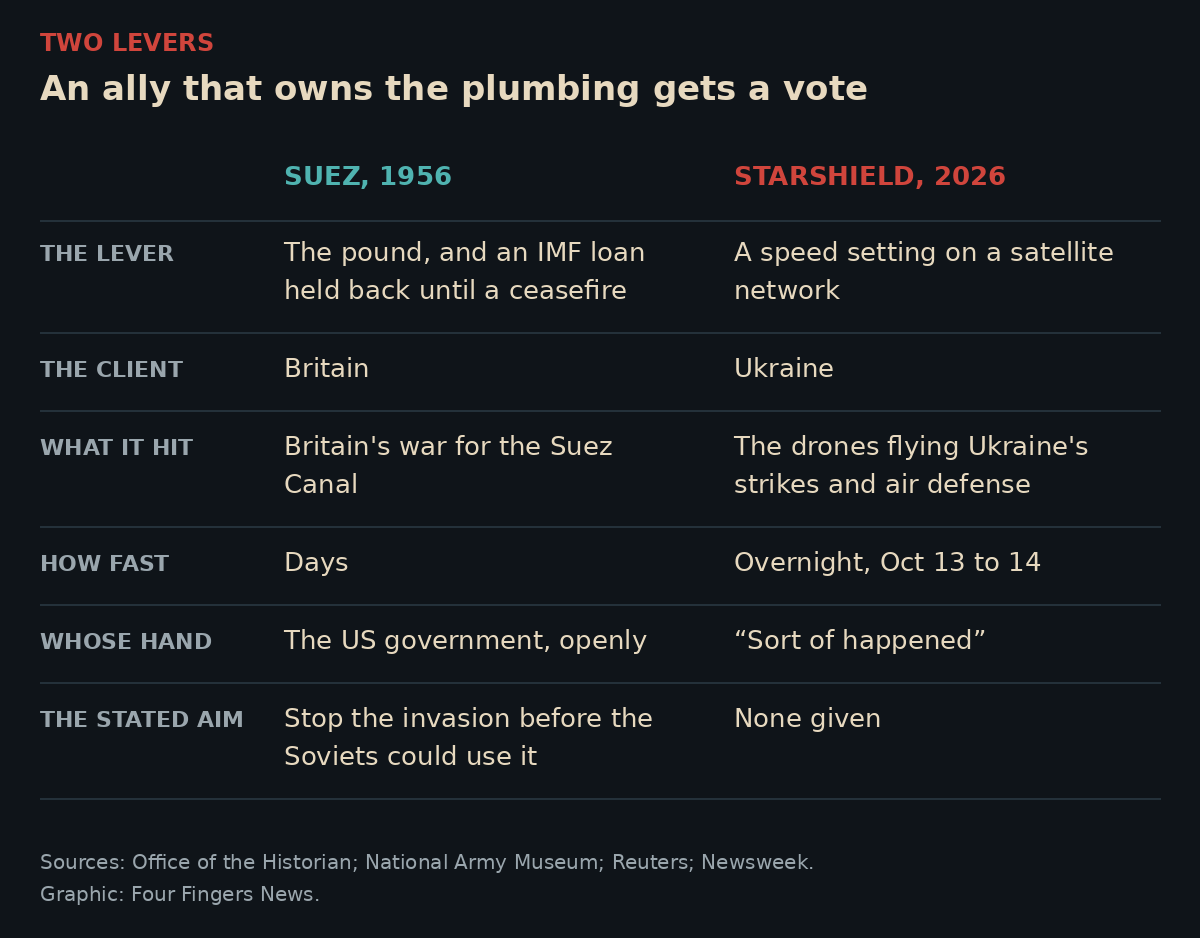
The difference between 1956 and this week isn’t the lever, which works the same way it always has, but the signature and the destination. In 1956 the pressure ran through the Treasury and the IMF’s board over several days, everybody in London knew whose hand was on it, and the United States said plainly what it wanted, which was the invasion stopped before the Soviets could make use of it. This week’s lever was a speed setting on a satellite network, changed in the middle of a Russian barrage, and the government that owns the network says no one changed it and hasn’t said where it’s steering. It can afford not to say, because it’s the only country at this table that can’t lose anything it can’t live without. Two oceans and the world’s reserve currency make every war the United States joins optional, which is how it left Saigon from a rooftop in 1975 and Kabul from an airport in 2021 and went home both times. Russia and Ukraine have no home to go back to if they lose this one. Two countries are fighting what each believes is a war for its survival, and the switch on that war sits with a third whose stake in it is the price of diesel.
Sources (24), on the site.
Iran Tells Trump to “Try Your Luck” as Lavrov Heads to Tehran
President Trump posted Sunday that the US could “soon finish the job” unless Iran changes course. Hours later Iran’s foreign minister, Abbas Araghchi, answered on X: “Want to try your luck again? Be our guest,” adding that Tehran has “unfinished jobs too.” The diplomatic track is still open. Araghchi says the seven-day Hormuz proposal sent through Qatar stands, with the strait open on the sixth day if the US accepts Iran’s conditions, and Russia’s foreign minister, Sergey Lavrov, is due in Tehran on Monday. On the water, UKMTO says a tug was hit by two projectiles off Khor Fakkan on Sunday, and CENTCOM says the large majority of Iran’s attempted attacks fail.
| The offer: strait open on day six · talks on day seven · first tabled in mid-September |
| Monday: Lavrov in Tehran for talks with Araghchi, Iran’s foreign ministry says |
| Sunday: tug hit off Khor Fakkan, UAE · one minor injury · still under way |
| Lost this week: GFS Pride, Singapore-flagged, sank while being towed |
| UKMTO’s tally: 135 incidents in the strait since the war began |
| CENTCOM’s count: about 400 transits in seven days |
| The war: Day 233 |
Egypt’s Parliament Stretches Its Saudi Debate into Monday
Egypt’s National Defence Council has pledged Saudi Arabia “all necessary and possible forms of support,” and at least two Egyptian C-130s landed at King Fahd Air Base in Taif on Sunday. Parliament, which must also approve a combat mission abroad, extended its session so every member could speak; MP Maha Abdel Nasser says debate resumes Monday, and Egyptian media say the vote could slip to Tuesday. Ansarallah’s parliament in Sanaa has warned Cairo off.
Fire Kills Four Soldiers in Training at CFB Wainwright
A fast-moving fire swept through an outdoor exercise at Canadian Forces Base Wainwright in Alberta on Saturday, killing Sgt. Morgan Wong and Privates Shaun Farrell, Aidan Goulding and Hayden Lykkemark of the Princess Patricia’s Canadian Light Infantry and injuring 39, 19 critically. “The fire was a kilometer away when the wind shifted,” Maj. Gen. Wade Rutland said. Prime Minister Mark Carney called it one of the military’s worst peacetime tragedies on Canadian soil.
Protesters Burn Limoges’s 1873 Town Hall
A movement that began with high school students striking over crumbling, understaffed schools, and grew into protest over the budget and fuel prices, turned violent on Saturday. Masked protesters torched a police car outside Limoges’s town hall, then broke in and set it alight; AFP says the building, which sheltered Belgium’s government in exile in 1940, is largely lost. Hundreds were arrested, and Macron vowed to punish “the sowers of chaos.”
Brazil’s Runoff Narrows to a Technical Tie
Datafolha’s Oct 13-14 poll has Flávio Bolsonaro at 47 percent to Lula’s 45, inside its two-point margin and half the gap of a week earlier. The two debate on Band on Sunday night and on Globo on Friday; Brazilians vote Oct 25.
Washington Driver Records Keep Reaching ICE, UW Finds
The UW Center for Human Rights ties 356 immigration arrests and detentions in the state this year to federal searches of state driver and vehicle records, through the Nlets network, data brokers and local agencies, despite the Keep Washington Working Act. The governor’s office says it’s blocked nearly 2,000 requests; director Angelina Godoy says agents just switch accounts: “you squeeze a balloon, and another bubbles out.”
Sounders Salvage a Draw with Montréal
Sebastian Gomez’s 66th-minute equalizer earned Seattle a 1-1 at Lumen Field on Saturday. At 11-10-9 and seventh in the West, the Sounders have four games left and a six-point playoff cushion, starting at San Diego on Saturday. The Kraken, 5-3-1, host Detroit on Tuesday; the Seahawks are off until Kansas City visits Oct 25.
| Read the full dispatch |
You’re receiving The Late Night Pour, an edition of Four Fingers News.