
The Late Night Pour | The Third Proviso

|
Four Fingers News
The News, Neat.
|
| FRIDAY, OCTOBER 23, 2026 · DAY 238 |
| The Late Night Pour |
The Third Proviso
The Third Proviso, read aloud · 5 minutes.
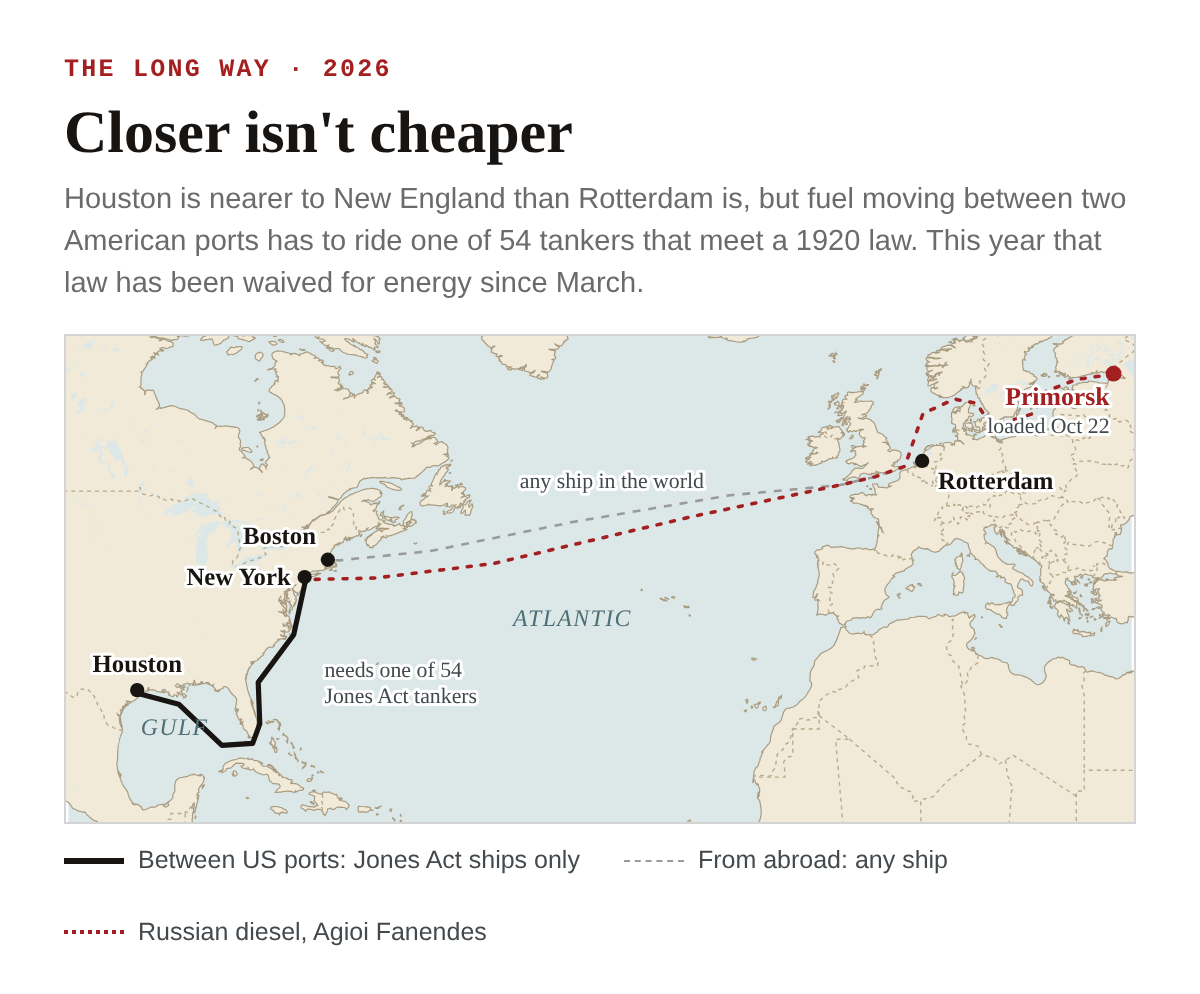
On Thursday a tanker called the Agioi Fanendes loaded 40,000 tons of Russian diesel at Primorsk, on the Baltic Sea, and set a course for New York. It’s due Nov 7, the first cargo under the deal that lifts American sanctions on Russian diesel in exchange for Moscow lifting its own export ban. Diesel was averaging $6.18 a gallon earlier this month, up from $3.48 in January, and the White House wants it down before the Nov 3 midterms. What’s strange is that the United States is the biggest oil producer in history and sells diesel abroad every day. A big part of the reason New York so often buys its fuel from overseas instead of from Texas is a law written 106 years ago by a senator from Yakima, and it was written mostly to help Seattle.
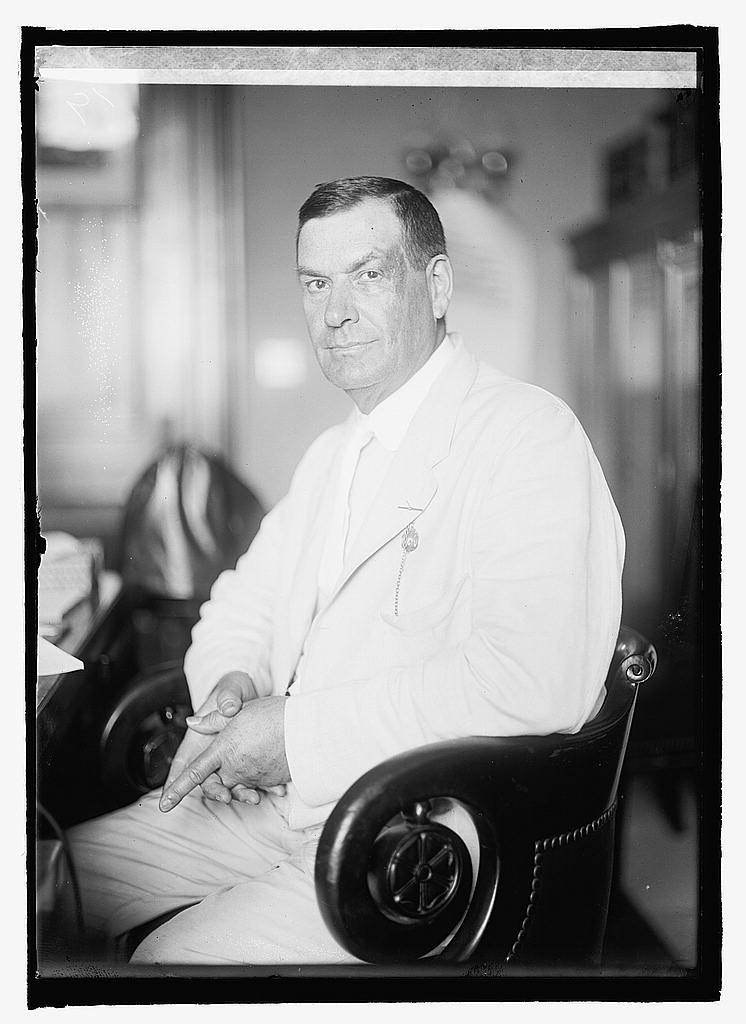
In 1920 Wesley Jones was Washington State’s senior senator and chairman of the Senate Commerce Committee, and he had a Canada problem. Seattle’s steamship lines ran the trade between the lower 48 and Alaska, which was a territory then, not a state, and had no vote in Congress. Those lines were losing business to a cheaper route: freight shipped by Canadian railroad to a Canadian port, then up the coast to Alaska on a foreign ship. Section 27 of Jones’s Merchant Marine Act of 1920, known ever since as the Jones Act, closed that door. From then on, anything carried by water between two American ports had to travel on a ship built in the United States, owned by Americans, flagged in the United States and crewed by Americans. Then came an exception, the third proviso in that section, which left the Canadian rail route open for the rest of the country but explicitly not for Alaska. Alaska’s one representative in Washington DC, George Grigsby, who wasn’t allowed to vote, said it plainly at the time: Seattle “does not want that Canadian competition, of course.”
Alaska sued. A Juneau hardware store had bought goods in Michigan and shipped them home through Canada, and federal customs tried to seize them. Alaska’s attorney general took the case to the Supreme Court, arguing the Constitution forbids Congress from favoring one state’s ports over another’s. In February 1922 the Court ruled against Alaska unanimously, on the grounds that a territory isn’t a state. The exclusion lasted until Alaska became one in 1958.
The law outlived its reason and grew into something much bigger. Building a tanker in an American shipyard costs about $220M; building the same ship in Korea or Japan costs about $50M. So almost nobody builds them here. Of roughly 7,500 oil tankers in the world, 54 can legally carry fuel between American ports, according to the Cato Institute, and not one has been built since 2017. Every one of them is booked. The result is a map that makes no sense until you know the rule. Gasoline from the Gulf Coast has been shipped on foreign tankers to the Bahamas and from there to California, because a foreign ship isn’t allowed to carry it straight there. Fuel can be cheaper to bring to Boston from Rotterdam than from Houston, even though Houston is closer. In January 2018, during a deep freeze, Boston took a tanker of liquefied natural gas that reportedly included Russian gas from the Arctic, while the United States was on its way to becoming the world’s biggest gas exporter, because none of the roughly 500 LNG tankers on earth qualifies under the Jones Act.
The law’s defenders aren’t wrong about everything. The 1920 preamble was about national defense, about the country being able to build and crew its own ships in a war instead of renting them from someone else, and the law protects shipyards and maritime jobs that would otherwise be gone. The argument against it is what that protection now costs: a fleet so small that the Pentagon’s own shipping command says it needs 86 tankers built to carry refined fuel like diesel that it could count on in a war, and the Jones Act fleet has only 43.
This year the country got to see what happens when the law is switched off. On March 17, 2026, with the war driving fuel prices up, the government waived the Jones Act for energy shipments, the longest and broadest waiver since at least 1950. Foreign tankers have since moved at least 67.7 million barrels of American crude, gasoline and other fuel between American ports that the Jones Act fleet couldn’t have carried. The waiver has been extended twice. It runs out on Nov 15.
So two dates sit next to each other on the calendar. On Nov 7 a tanker of Russian diesel arrives in New York, bought from a country Washington DC has spent four years sanctioning. Eight days later, unless it’s extended again, a 1920 law aimed at keeping Canadian railroads out of Alaska goes back to requiring that a Texas refinery’s diesel bound for New York ride on one of just 54 ships. A senator from Yakima was trying to protect Seattle’s grip on the Alaska trade. A century later, his law is still quietly helping decide where the whole country’s fuel comes from.
Sources (9), on the site.
Aramco Empties Its Dhahran Headquarters as the Yemen Front Reaches Oil
Saudi Aramco told its remaining essential staff Thursday to leave the Dhahran headquarters and work from home “until further notice,” the first such order since the Saudi-Houthi war resumed in September; most employees had been remote since the Oct 13 strike that set floors of the tower on fire. A day earlier the Houthis went after the Shaybah oilfield and King Fahd International Airport in Dammam, and the energy ministry says Shaybah’s output wasn’t touched. Traders priced the risk anyway: Brent settled up 4% Thursday, its highest close since May 4, as Riyadh’s second front starts to look like the oil market’s first worry.
| War: Day 238, counted from Feb 28 |
| Evacuation: Dhahran HQ, Oct 22 · no sign yet of lost production or exports |
| Wednesday’s targets: Shaybah oilfield and Dammam’s airport |
| Crude: Brent $113.17, WTI $99.47 at Thursday’s settle |
| Blockade: CENTCOM’s Adm. Brad Cooper puts Iranian crude kept off the market at $25B or more over 100 days |
| Calendar: Riyadh’s FII investor conference pushed to 2027 |
Barrack Says a Weekend Strike Is Possible
“Could there be a strike this weekend? Absolutely,” Tom Barrack, the US ambassador to Türkiye, said Friday; asked about it, President Trump said Barrack “is a powerful man, I guess” and that Iran would be “finished very soon, one way or the other.” Israel’s army chief told a closed meeting he sees no need to strike before the US election. The blockade of Iranian ports passed its 100th day Thursday, by CENTCOM’s count.
Four Regional Powers Sit Down with Europe’s Big Four
Turkey’s Hakan Fidan hosted ministers from Saudi Arabia, Pakistan and Egypt alongside Britain, France, Germany and Italy on Friday, the first meeting in that shape, with Hormuz, Bab el-Mandeb and Yemen on the table. Fidan’s line going in: “Lasting solutions cannot be imposed from outside.” No joint statement yet.
Nasdaq Sheds 2.7% as AI Spending Spooks Investors
The Nasdaq fell 713 points Thursday to 25,988, its worst day since early June, and the chip index lost 6.3%. Meta dropped 7.5% after reporting its first cash outflow in more than a decade, tied to AI spending; the Dow slipped just 0.2% as Lockheed and P&G rallied.
Putin Says He’s Ready to Talk Again, with Strings
A day after meeting US envoy Steve Witkoff, Putin told state TV Russia will rejoin US-mediated talks next month, but only toward a final settlement and a wider European security framework, not a short ceasefire. Zelensky, who met Witkoff in Norway Tuesday, says Kyiv’s ready too; the Donbas, which Moscow wants whole, is still the wall.
Lula and Flávio Bolsonaro Head into Sunday’s Runoff a Point Apart
Datafolha’s last big poll, taken Oct 20-22, has the senator at 47% and the sitting president at 46%, inside the two-point margin of error. Lula’s campaign has also asked the electoral court to bar Flávio for eight years over alleged abuse of economic power.
Seattle’s RV Parking Limits Wait on the Mayor’s Pen
The council’s six-bill package would cap unpermitted RVs at two hours of street parking, with enforcement from July 31, 2027, and $1.5M in one-time money plus eight outreach jobs. Mayor Katie Wilson hasn’t said she’ll sign, citing “some very serious concerns” about legal risk and cost.
Charbonnet Comes Off PUP in Time for the Unbeaten Chiefs
Seattle activated running back Zach Charbonnet this week ahead of Sunday night’s 5:20 PM PT kickoff against 5-0 Kansas City at Lumen Field, where former Seahawk Kenneth Walker III arrives leading the NFL with 665 rushing yards. The 3-3 Seahawks opened as 2.5-point favorites; Chiefs receiver Rashee Rice hasn’t practiced this week.
| Read the full dispatch |
You’re receiving The Late Night Pour, an edition of Four Fingers News.